DREO’s quiet 1,500W heater is the best pick for most medium rooms because it combines fast ceramic heat, very quiet operation, precise thermostat control, and ETL-listed safety features. If you want one heater that can handle a bedroom, office, or den without feeling fussy, that’s the one to start with.
The essentials
A 1,500W heater is the ceiling for most plug-in room heaters, and that’s the right starting point for medium rooms.
Pick a heater with tip-over shutoff, overheat protection, and a UL, ETL, or CSA listing.
If you want quiet heat for a bedroom or office, look for brushless fans or low noise claims around 34 dB.
If you want set-and-forget comfort, choose a model with a real thermostat and timer, not just a high/low dial.
Plan on direct wall outlet use only. Skip extension cords and power strips.
Say your bedroom is 12 by 15 feet, the walls are insulated, and the thermostat always seems to wait until your socks are already mad. A 1,500W heater can take the edge off a room like that, but the real trick is matching noise, controls, and safety to how you actually use the space.
Medium-room heaters live in a narrow lane: enough output to matter, not so much heater that you pay for heat you don’t need. That’s why the best choices are the ones with a real thermostat, tip-over and overheat protection, and a form factor that fits the room without hogging the outlet or the floor.
Best for Medium rooms needing quiet, precise heat and safety
DREO’s heater uses a Hyperamics 1500W PTC system for fast, efficient heat and a brushless DC motor with a winglet fan for whisper-quiet operation at 34dB. It offers a precise thermostat adjustable from 41 to 95℉ in 1-degree increments and 70-degree oscillation to spread warmth evenly. ETL-listed safety features include child lock, tip-over, and overheat protection, making it ideal for bedrooms, offices, or dens where quiet and control matter.
Power 1500WNoise level 34dBTemperature range 41-95℉Oscillation 70°
Why it made the cut
Very quiet operation with brushless motor
Precise thermostat with wide temperature range
Good oscillation for even heat distribution
Multiple ETL-certified safety features
Good to know
Remote requires batteries
Oscillation angle fixed at 70 degrees
Skip it if Skip if you want a heater with more power settings or a taller tower style.
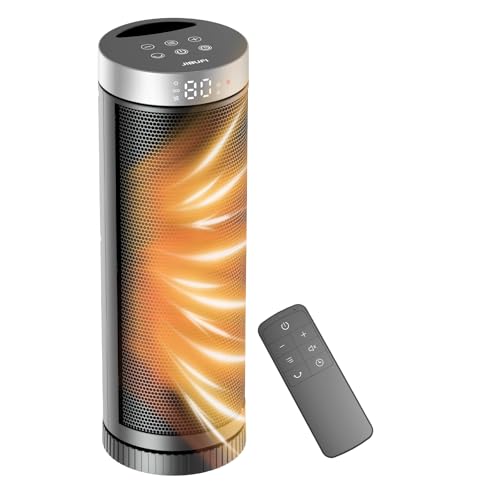
Best for Users needing multiple power levels and timer for varied rooms
JIBUFI’s heater offers three power settings (700W, 1000W, 1500W) and a smart thermostat that adjusts heat automatically to save energy. A 1-12 hour timer and remote control add convenience. It heats quickly with PTC ceramic elements and has ETL-certified safety including tip-over and overheat protection, suitable for homes with kids or pets.
Best for Rooms where wide oscillation and portability matter
Lasko’s 23-inch tower heater delivers 1500W of ceramic heat with wide oscillation to cover medium rooms evenly. It’s ETL-listed for safety with overheat protection and cool-touch housing. The remote controls heat, oscillation, and a 7-hour timer, making it easy to adjust from across the room. A built-in handle simplifies moving it between rooms.
WINHL Portable Electric Heater 1500W with Oscillation
Best for Users wanting remote operation and wide-angle heat spread
WINHL’s heater uses advanced PTC ceramic elements to heat up quickly and keep small spaces warm. It features wide-angle automatic oscillation for even heat spread and a remote control that adjusts temperature, fan speed, mode, and timer. Safety includes overheat and tip-over protection, all ETL-certified for reliable indoor use.
Best for Rooms needing heat that circulates far and precise temperature control
This DREO model combines a Hyperamics 1500W PTC system with a heat funnel design to push warm air up to 200% farther than traditional heaters. It has a precise thermostat from 41 to 95℉ with ±1℉ increments and multiple heat modes including ECO and fan-only. Safety features include an advanced tilt sensor, V0 flame retardant materials, and overheat protection, all ETL-listed. The brushless DC motor keeps noise low at 34dB, fitting well in bedrooms or offices.
Power 1500WNoise level 34dBTemperature range 41-95℉Heat modes Power heat, ECO, Fan Only
Why it made the cut
Heat reaches up to 200% farther
Precise thermostat with wide range
Quiet operation at 34dB
Advanced tip-over and overheat safety
Good to know
Multiple modes may require learning curve
Handle adds bulk compared to smaller models
Skip it if Skip if you want simpler controls or less heat spread.
The practical starting point for most medium rooms is a 1,500-watt plug-in heater, which hits the sweet spot for heat output without overloading a standard 15-amp circuit.
Not all 1,500W heaters are equal. The thermostat is a key divider: digital thermostats with narrow setpoint increments keep your room at a steady temperature. A vague dial can leave swings of several degrees, meaning you either freeze or overheat.
Timers matter too, especially if you want to avoid running the heater all night or forget to turn it off. Look for models with a programmable timer range of at least 1 to 8 hours. Some let you set it to turn off automatically, which helps save on your electric bill.
Oscillation helps spread warmth in rectangular or oddly shaped rooms. When the heater gently swivels side to side, it pushes heat farther, reducing cold spots. But oscillation won’t fix a heater that’s too small for your room.
Noise level varies widely. Ceramic heaters often run quieter than fan-forced models, but the quietest ones use ceramic elements with minimal fan noise. If you plan to run your heater in a bedroom or office, noise can quickly become a dealbreaker.
Remote control is handy if the heater sits across the room or near your bed or couch. Otherwise, it’s an extra feature you might not use much.
Smart and Wi-Fi space heaters are growing in number. They offer app control and voice commands, but their core heating power and thermostat quality still matter most for comfort.
Feature
Why It Matters
1,500W output
Ideal power for medium rooms, fits a standard outlet
Digital thermostat
Keeps temperature steady within 1°F increments
Timer
Program auto shut-off to save energy
Oscillation
Spreads heat evenly across the room
Noise level
Quiet models won’t disturb sleep or work
Remote control
Convenient for hard-to-reach units
Smart/Wi-Fi control
Remote operation and scheduling
Key features that set medium-room heaters apart.
Best Small and Electric Space Heaters
For smaller rooms under 150 square feet, smaller wattage heaters or oil-filled radiators may be better. For medium rooms, 1,500W electric heaters remain the top choice for balanced heat and efficiency.
In short
Pick a 1,500W heater with a digital thermostat, timer, and oscillation for medium rooms. If remote control or smart features fit your routine, get them—but focus first on steady, quiet heat.
From HeaterGuides · our own guidePage 6: heat only the rooms you use. Page 10 covers space-heater safety.Winter Heating Bill CutterSee what every heater in your home really costs, heat the rooms you use, and cut the waste in 30 days.Cost-per-hour tables for every heaterThermostat schedule and draft-proofing planRunning-cost and bill calculator (Excel)$14.99$9.99Get it for $9.99See what's inside and watch the 2-minute video →14-page printable PDF + Excel calculator · instant download · 30-day refund
How Big A Room A 1,500W Heater Covers
A single 1,500W plug-in heater suits most medium rooms, roughly 150 to 250 square feet, depending on insulation and ceiling height. Larger or draftier areas often need more than one heater or a central system.
Say you have a 12 by 15 foot room with 8-foot ceilings and average insulation. That’s 180 square feet. A 1,500W heater can raise the temperature comfortably by about 20°F on a chilly day.
Now consider a drafty 20 by 20 foot room with uninsulated walls and old windows. That’s 400 square feet, more than twice as large. The same 1,500W heater will struggle to keep up, and you’ll feel cold drafts despite the heater running full blast.
Ceiling height matters too. Higher ceilings mean more air to heat. A room with 10-foot ceilings behaves like a larger space than one with 8-foot ceilings of the same floor area.
Oscillation and fans help spread heat but don’t increase heat output. They can make the warmth feel more even, but they can’t compensate for insufficient wattage.
Oil-filled radiators add slow, steady background heat that lingers after they turn off. Ceramic fan heaters deliver quicker heat but cool down faster. Choose based on whether you want instant or lasting warmth.
Sizing example
Compare two rooms: one 12 × 15 ft with good insulation and one 20 × 20 ft with drafts and poor insulation. The 1,500W heater works well in the smaller, insulated room but falls short in the larger, draftier one.
Room 112 × 15 ft, insulated
Room 220 × 20 ft, drafty
Sizing tip
Measure your room’s square footage and consider insulation quality before choosing a heater. One 1,500W heater is rarely enough for open-plan or large, poorly insulated spaces.
Room Size
Heater Suitability
Notes
Up to 180 sq ft
1,500W plug-in heater
Ideal for average insulation and 8 ft ceilings
200–300 sq ft
Multiple heaters or higher output
Drafts or higher ceilings increase demand
Over 300 sq ft
Central heating or multiple units
Plug-in heaters can’t keep up alone
How room size and conditions affect heater choice.
In short
Use 1,500W heaters for well-insulated medium rooms. Bigger or draftier spaces need multiple heaters or a better system.
How Much A Medium-Room Heater Costs To Run
A typical medium-room space heater uses 1,500 watts when running at full power. Plugged into a standard US outlet at 120 volts, that means it draws about 12.5 amps of current—just under the 15-amp circuit rating common in most rooms.
12.5 A
What a 1,500 W heater draws
Knowing this helps you avoid tripping breakers or overloading your wiring.
Running one 1,500-watt heater for 8 hours at an electricity cost of 17 cents per kilowatt-hour uses 12 kWh (1.5 kW × 8 h). That adds up to about $2.04 for a night of heating.
Wattage
Hours per Day
Days
Price per kWh
1,500 W
8
30
0.17 per kWh
Example running cost assumptions for a medium-room heater.
Using two heaters of this size on the same 15-amp circuit is a bad idea. Two 12.5-amp draws add up to 25 amps, far beyond the circuit limit. That overload risks tripping your breaker or worse, overheating wiring.
Circuit overload risk
Never plug multiple high-wattage heaters into one circuit or power strip. Each 1,500 W heater needs its own dedicated outlet on a 15-amp circuit.
If you only need background warmth, running the heater at a lower setting like 700 or 1,000 watts can slash your electric bill by up to half. Those settings also reduce current draw and heat output proportionally.
Generators and battery setups change the calculation entirely. Portable power limits, run time, and fuel type matter here. This guide focuses on standard household electric use, so consider generator-specific advice separately.
Safe Use And Certification Matter Most
The safest space heaters carry a UL, ETL, or CSA listing and include tip-over and overheat protection. These certifications mean the heater meets strict electrical and fire-safety standards.
No extension cords or power strips
Plug your heater directly into a wall outlet. Extension cords and power strips can overheat and cause fires when running a high-wattage heater.
Keep a 3-foot clearance from anything flammable like bedding, curtains, furniture, or stored items. Blocked airflow or contact with combustibles is a top cause of heater fires.
Clearance and airflow
Never let a space heater touch or be too close to anything that can catch fire.
Don’t leave a space heater running unattended or while you sleep unless the manufacturer explicitly states the model is designed for that. Even with safety features, risks remain.
Space heaters get dangerous because their surfaces can reach high temperatures, airflow can get blocked, and circuits can overload. Those factors cause most electrical fires and burns.
Safe Space Heater Use Checklist
Look for UL, ETL, or CSA certification
Use tip-over and overheat protection features
Plug heaters directly into wall outlets only
Keep 3 feet of clearance around the heater
Never leave the heater unattended or while sleeping unless allowed
Avoid sharing circuits with other heavy loads
Myth
Any space heater is safe if you just watch it carefully
Fact
Certified models with built-in protections are much safer because they prevent overheating and accidental fires even if you get distracted.
Different heater types—ceramic, oil-filled, infrared—offer various safety profiles, but all require the same basic precautions. Always check the manual for specific safety instructions and never ignore clearance and power rules.
Which Pick Fits Your Room And Routine
Finding the best space heater at Walmart or any big-box store starts with matching the heater’s features to your room and daily habits. The DREO Quiet Space Heater stands out as the best space heater with remote for bedrooms and offices. It runs quietly at 34 dB thanks to its brushless DC motor, offers precise thermostat control, and has ETL-listed safety features. It’s the smart pick when silence and accuracy matter.
If your medium room edges toward the larger side or you want wider heat spread, the Lasko 23″ Ceramic Tower Space Heater with Remote Control is worth a look. Oscillation helps cover more ground, and the remote plus timer come in handy when the heater sits across the room instead of under your desk.
Budget-minded shoppers should consider the JIBUFI 17 Inches Space Heater. It covers the essentials with three heat settings and core safety features without extras. It’s straightforward and reliable, making it a solid choice if you want something simple and safe.
Quietness isn’t just a luxury in bedrooms and offices—it’s key to comfort. The DREO’s 34 dB noise level and brushless motor make it noticeably quieter than typical fan heaters. For spot heating under a desk or in small corners, a remote or timer may be less critical, so you might opt for simpler models there.
Heater
Best For
Key Features
DREO Quiet Space Heater
Bedrooms, offices
34 dB noise, precise thermostat, ETL-listed
Lasko 23″ Ceramic Tower
Larger medium rooms, wider coverage
Oscillation, remote, timer
JIBUFI 17 Inches Space Heater
Budget, basic heating
Three heat settings, core safety
How the top picks suit different room and routine needs
What To Do Before The First Cold Snap
1
Measure the room
Note the square footage and ceiling height, then check if the room is well insulated or drafty. This helps decide heater size and type.
2
Choose heater type
Pick a quick ceramic fan heater for immediate warmth or an oil-filled radiator for slow, steady background heat.
3
Check the outlet and safety
Avoid extension cords; ensure the outlet is rated for the heater’s power. Confirm the heater has a UL, ETL, or CSA listing for safe use.
4
Place with clearance
Keep at least 3 feet of clearance around the heater. Test the thermostat, oscillation, and timer to make sure everything works before cold weather sets in.
5
Don’t stack heaters
If 1,500 W doesn’t warm the room enough, look into air sealing or a larger heating solution instead of adding more small heaters.
Safe space heater use
Heating a small room safely means respecting clearance and power limits, not relying on extension cords, and choosing the right heater type for your space and habits. Avoid leaving any space heater unattended unless it’s specifically designed for that.
More Questions, Answered
What size room does a medium-room space heater cover?
Medium-room space heaters typically cover between 150 and 250 square feet. The exact coverage depends on factors like ceiling height, insulation quality, and outside temperature. For standard rooms, a 1,500-watt heater usually fits well.
How many watts does a space heater use?
Most plug-in space heaters use either 750 or 1,500 watts when running at full power. A 1,500-watt heater draws about 12.5 amps on a 120-volt circuit, which is the maximum for a standard household outlet. Lower wattage models run quieter but heat less.
Can I run a space heater on an extension cord?
It’s safest to plug space heaters directly into a wall outlet. Extension cords or power strips can overheat and cause fire hazards if they aren’t rated for the heater’s amperage. If you must use an extension cord, pick a heavy-duty one rated for at least 15 amps and keep it short.
What is the safest space heater for a bedroom?
Look for a heater with UL, ETL, or CSA safety listings and features like tip-over shutoff and overheat protection. Quiet operation matters in bedrooms, so ceramic heaters with a fan or oil-filled radiators are good choices. Never leave a space heater unattended while sleeping unless the model is designed for that use.
Why are space heaters dangerous?
Space heaters can cause fires if they tip over, overheat, or are placed too close to combustibles like curtains or furniture. They also risk electrical overload if used on inappropriate circuits or extension cords. Carbon monoxide isn’t an issue with electric models, but fuel-burning heaters need proper ventilation.
How many space heaters can you use on one circuit?
A 15-amp household circuit can safely handle one 1,500-watt heater drawing about 12.5 amps. Running two heaters can overload the circuit and trip the breaker or cause wiring damage. If you need multiple heaters, spread them across different circuits or use lower wattage models.
Is a Wi-Fi or smart space heater worth it?
Smart heaters offer convenience through remote control and scheduling, which can save energy by running only when needed. However, they usually cost more and add complexity. If you want precise temperature control and remote access, they’re worth considering, but basic models perform well for most rooms.
Before you go · a welcome giftGet the Winter Heating Bill Cutter for $4.99See what every heater in your home really costs, heat the rooms you use, and cut the waste in 30 days. Normally $14.99; your welcome price saves $10.00. We'll email your link right now.or buy it now for $9.99 without the gift →One email with your link now. We never share your address.



 Winter Heating Bill CutterSee what every heater in your home really costs, heat the rooms you use, and cut the waste in 30 days.Cost-per-hour tables for every heaterThermostat schedule and draft-proofing planRunning-cost and bill calculator (Excel)