The best energy-saving space heater for most readers is Product 2, because it pairs 1500W heat with a very precise thermostat, a 12-hour timer, and 34dB operation. Use it for one room, not the whole house; that’s where plug-in heaters earn their keep.
What to remember
A 1,500W heater is the practical ceiling for a standard 15A, 120V outlet.
Energy savings come from thermostat control and short runtimes, not from magical wattage dust.
Oil-filled radiators suit steady, long runs; ceramic fan heaters suit quick, directed heat.
Use a space heater in the room you are in, then lower the central thermostat a few degrees.
Never run a plug-in heater on an extension cord or power strip.
Say your bedroom is 12 by 14 feet and the thermostat downstairs keeps missing the mark. A 1,500W heater used for 8 hours is 12 kWh; at 17 cents per kWh, that is about $2.04 for the night.
For a larger or draftier room, the smarter move is usually to heat only the occupied zone and keep the central heat lower. A space heater can help with that, but only if its controls are precise enough to cycle off instead of running flat out like a stubborn hair dryer.
Best Energy-Saving Space Heaters
#1Best for most rooms
DREO Portable Electric Heater with Thermostat
Best for Bedrooms and home offices up to 200 sq ft where you want precise temperature control
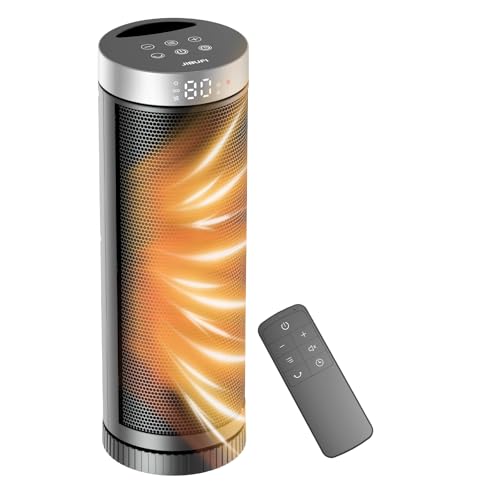
The NTC chipset gives you 1°F temperature control across a 41–95°F range, so the heater cycles exactly when you need it and stops before it wastes power. A 12-hour timer and ECO mode trim runtime further. At 34 dB it won’t interrupt calls or sleep, and the brushless DC motor with winglet fan cuts turbulence for quieter, steadier heat than fan designs that rattle.
Power 1500 W PTC ceramicCoverage Up to 200 sq ftThermostat range 41–95°F, ±1°F incrementsNoise 34 dBTimer 12 hours
Why it made the cut
Thermostat accurate to ±1°F across 41–95°F
34 dB operation with brushless DC motor
Tilt-detection sensor and V0 flame-retardant casing
12-hour timer and multiple heating modes
Good to know
No oscillation, so corner placement matters
Remote required for temperature adjustments
Skip it if If you need oscillation to spread heat across an L-shaped room, look at Product 3.
Best for Desks, small bedrooms and bathrooms where 35 dB matters more than wide coverage
Rated at 35 dB—quieter than turning a page—this one suits light sleepers and anyone on video calls. The 24-hour timer (not 12) lets you set an 8-hour shutoff for overnight use, and ECO mode claims 20% energy savings over non-cycling models. Thermostat precision is ±1°F. Lightweight with a carry handle, so moving it from bedroom to bathroom takes seconds.
Power 1500 W ceramic PTCCoverage Up to 200 sq ftThermostat ±1°F precisionNoise 35 dBTimer 24 hours
Why it made the cut
35 dB, quieter than most heaters
24-hour timer with ECO mode
Child lock and 45° tip-over shutoff
Compact with carry handle
Good to know
No oscillation
Touch buttons require close reach without the remote
Skip it if Coverage tops out at 200 sq ft, so skip it for garages or large open rooms.
Best for Rectangular or L-shaped rooms where 70° sweep spreads heat without repositioning
The 70° oscillation pushes warm air side to side, which helps in rooms where furniture blocks a straight shot. Three power steps—700 W, 1000 W, 1500 W—give you more granular control than high/low, and the thermostat cycles automatically to hold temperature. PTC ceramic heats in three seconds. A 12-hour timer and remote round out the package.
Power 700 W / 1000 W / 1500 WOscillation 70°Heating tech PTC ceramic, 3-second warmupTimer 1–12 hoursSafety ETL-certified, tip-over & overheat shutoff
Why it made the cut
70° oscillation for wider coverage
Three power settings: 700 W, 1000 W, 1500 W
Smart thermostat and 12-hour timer
ETL-certified with tip-over and overheat shutoff
Good to know
Oscillation motor adds slight noise
No noise spec listed
Skip it if If you need the absolute quietest heater for a bedroom, Product 1 or 2 will serve better.
Best for Offices and small rooms where you want one device for winter heat and summer air
Two heating modes—1500 W and 750 W—plus a cool-air fan mean you can leave it plugged in year-round. The thermostat cycles on and off to hold your preset temperature without manual fiddling. Six-foot cord and built-in handle make it easy to move. Flame-retardant ABS casing, tip-over and overheat shutoff come standard.
Power 1500 W / 750 W / fan onlyCoverage Up to 200 sq ftHeating tech PTC ceramicCord 6 feet, 2-prongSafety Tip-over & overheat shutoff, V0 flame retardant
Why it made the cut
Dual 1500 W / 750 W heat plus fan-only mode
Automatic thermostat control
Six-foot cord and carry handle
Flame-retardant ABS construction
Good to know
No timer
No remote control
Skip it if Without a timer or remote, you’ll need to walk over to adjust it—fine for a desk, less convenient across a bedroom.
Best for Home offices and bedrooms where you want plug-and-go heat with no remote or timer
Three settings—high (1500 W), low (900 W), or fan only—controlled by manual switches on the unit. Ceramic heating delivers warmth in minutes at 43 dB, which is louder than Products 1 and 2 but still quieter than a normal conversation. Weighs three pounds and measures 7.5 by 6.3 by 9.5 inches, so it tucks under a desk or beside a nightstand. Tip-over and overheat protection included.
Power 1500 W / 900 W / fan onlyHeating tech CeramicNoise 43 dBWeight 3 lbsDimensions 7.5 × 6.3 × 9.5 inches
Why it made the cut
Compact: 3 lbs, 7.5 × 6.3 × 9.5 inches
Three manual settings: 1500 W, 900 W, fan only
Tip-over and overheat shutoff
Good to know
No thermostat, timer or remote
43 dB—louder than Products 1 and 2
Not rated for bathrooms or humid spaces
Skip it if Without a thermostat it runs at full blast until you turn it off, which wastes power and overheats small rooms.
An energy-saving space heater doesn’t make heat for less electricity—it keeps you from heating rooms you’re not using. Every plug-in electric heater tops out at 1,500 W because that’s about 12.5 A on a 120 V circuit, close to the safe ceiling for a standard outlet. The savings come from running that wattage only where and when you need it, instead of firing up the furnace for the whole house.
Running 1,500 W for 8 hours is 12 kWh. At 17 cents per kWh—a common US rate—that’s about $2.04 a night. The heater labeled energy-saving cuts that bill by cycling off when the room hits your set temperature, or by shutting down entirely on a timer. A dial-controlled unit with no thermostat runs the full 1,500 W until you remember to turn it off. A model with precise degree-by-degree control and a programmable timer might run four hours instead of eight, halving the cost.
Heater
Watts
Per hour
Per day (8 h)
Per month (30 days)
1,500 W space heater, no thermostat
1,500 W
26¢
$2.04
$61.20
1,500 W space heater with thermostat
750 W
13¢
$1.02
$30.60
Calculated at 17¢ per kWh. Thermostat cycling cuts effective runtime in half, shown here as 750 W average draw.
Thermostat quality determines how tightly the heater holds temperature. A unit that cycles in 1°F steps wastes less electricity overshooting your target than one with a vague low-medium-high dial. Timer functions matter because the heater you forget to turn off costs more than the one that shuts itself down two hours after you fall asleep.
Zone heating and your central thermostat
Turn your central heat down three or four degrees and heat only the room you’re in. The space heater’s 1,500 W will cost less than raising the whole-house setpoint, but only if the furnace isn’t still trying to hit 72°F in empty bedrooms.
Space heater energy usage sits between a desktop computer and a clothes dryer. A laptop pulls 50 to 100 W; a space heater pulls fifteen times that. A dryer on high might pull 3,000 to 5,000 W, but it runs for an hour. The heater runs all evening. The appliance that runs longest drives the bill.
From HeaterGuides · our own guidePage 4 shows what every heater costs per hour; the Excel sheet works out your own bill.Winter Heating Bill CutterSee what every heater in your home really costs, heat the rooms you use, and cut the waste in 30 days.Cost-per-hour tables for every heaterThermostat schedule and draft-proofing planRunning-cost and bill calculator (Excel)$14.99$9.99Get it for $9.99See what's inside and watch the 2-minute video →14-page printable PDF + Excel calculator · instant download · 30-day refund
Best Pick For Most Rooms
The DREO Space Heater is the best energy-efficient space heater for most rooms because it pairs 1,500 W output with a thermostat that controls temperature in 1°F steps from 41 to 95°F, a 12-hour timer, and a claimed 34 dB noise floor. That degree-by-degree precision lets it cycle tightly around your target without the wasteful overshoot of a three-position dial, and the timer shuts it down after you’ve left or gone to sleep.
The 1,500 W ceiling means this heater—like every plug-in model—works for one room at a time: a bedroom, an office, or a den. It won’t heat an open-plan living area or a poorly insulated garage in January. The 70° oscillation spreads heat across a medium-sized room without pointing a jet of warm air at your desk chair. Three heat modes and three fan speeds give enough range to match light morning chill or a cold night without cycling the compressor on and off every two minutes.
Safety features include overheat shutoff and tip-over protection, standard for any heater worth plugging in. The product lists ETL-style testing, which covers construction and electrical safety. High-output fan noise is still fan noise, however well tuned, so the 34 dB claim applies to the lowest setting; expect audible airflow at 1,500 W.
Why it works
1°F thermostat steps cut wasted runtime
12-hour timer prevents all-night operation
70° oscillation for even bedroom or office coverage
Where it falls short
Fan noise rises with heat output
1,500 W limit means one room only
Energy Star and space heaters
Energy Star does not certify plug-in space heaters because every model hits the same 1,500 W ceiling and converts electricity to heat at nearly 100% efficiency. The label wouldn’t tell you anything useful. Savings come from controls, not the heating element.
Quiet Rooms And Desk Work
For a bedroom or home office, you’ll want a ceramic heater with a low fan speed and a timer you can set before sleep or before you sit down to work. Two models handle this well: the R.W.FLAME runs at a claimed 35 dB in Eco mode and brings a 24-hour timer, remote control, and child lock; the Amazon Basics unit is simpler, with high, low, and fan-only settings and no electronic controls. Both keep desk work and light sleeping comfortable without the wind-tunnel roar of a cheap fan heater.
A timer matters more than most buyers expect. Set it for six or eight hours and the heater shuts itself off whether you remember or not. Human memory is a weak thermostat, especially at 2 a.m. when the room is warm and you’ve been asleep for three hours. Eco mode on the R.W.FLAME cycles the element to hold a set temperature; the Amazon Basics runs until you switch it off or the timer (if your outlet has one) does it for you.
Desk and bedroom strengths
Quiet operation under 40 dB at lower settings
Timer prevents all-night runtime and waste
Compact footprint fits under a desk or beside a nightstand
Watch out for
Still draws the full 1,500 W when the element is on
Thermostat accuracy varies; expect ±3°F drift
Amazon Basics has no bathroom rating or splash protection
Bedroom and office clearance
Keep three feet of clearance around the heater, even under a desk. Plug straight into a wall outlet, never an extension cord or power strip. Don’t run a heater overnight unless the manual and listing explicitly allow unattended operation for that model.
Humidity and the Amazon Basics unit
The Amazon Basics heater carries no bathroom or splash rating. Use it in dry rooms only—not in a bathroom, laundry area, or basement with standing moisture.
Oil Radiator Vs Ceramic Fan Heat
Oil-filled radiators often feel more efficient because they store heat in the oil and keep radiating warmth for ten or fifteen minutes after the heating element cycles off. That stored heat spreads gently and holds a room’s temperature steady without the on-off gusts of a fan heater. Ceramic fan heaters warm faster—typically within five to ten minutes—and suit short bursts of heat when you need a cold room comfortable for an hour or two, then want to shut it off and move on.
Neither type saves electricity in the strict sense: both pull around 1,500 W when the element is on, and both turn the same watts into the same BTU. What changes is how the heat reaches you. Oil radiators work best for long, steady heating—a whole evening in one room, or overnight in a bedroom where the manual allows it. Ceramic fan units work best for targeted, short-duration heat: warming your feet under a desk, taking the chill off a bathroom before a shower, or heating a garage workspace for an hour while you finish a project.
Myth
Oil-filled radiators use less electricity than ceramic heaters.
Fact
Both draw the same wattage when heating. Oil radiators feel more efficient because the oil keeps radiating after the element shuts off, stretching each heating cycle and reducing the number of times the thermostat clicks back on. Over a long evening that can mean fewer total minutes at full draw, but the difference is modest—maybe 10 to 15 percent in a well-insulated room.
Which to choose
Pick an oil-filled radiator for rooms you’ll heat for four hours or more at a stretch, especially bedrooms and living rooms where quiet, steady warmth matters. Pick a ceramic fan heater for quick warm-ups, short sessions, and any time you want to feel heat within the first few minutes.
Readers comparing oil radiators in detail will find sizing rules, runtime costs, and safety notes in the seamlessly efficient oil-radiator guide. Both styles plug into the same 120 V outlet, need the same three-foot clearance, and cost roughly the same to run per hour when the element is on.
How To Size A Room Heater
Most 1,500 W plug-in heaters handle about 150 square feet in an average room with 8-foot ceilings and typical insulation. Drafty rooms, high ceilings, or concrete floors cut that figure down, sometimes by half. Measure your space before you buy: multiply length by width in feet, then compare that number to what the product listing claims it’ll heat. If the room is larger or the insulation is poor, you’ll run the heater longer and spend more.
Space heater energy usage sits between a refrigerator and an electric oven. Running 1,500 W for eight hours uses 12 kWh; at the current US average of about 17 cents per kWh, that’s roughly $2.04 a night. Over a month, figure $60 if you’re heating one room every evening. Compare that to leaving your furnace on for unused bedrooms or a basement office you occupy two hours a day.
Worked example
Say your bedroom is 14 by 14 feet—196 square feet—and you run a 1,500 W ceramic heater for eight hours each night in December.
Room size196 sq ft
Power draw1,500 W
Nightly runtime8 hours
Energy used12 kWh per night
Solar-panel add-ons don’t make a plug-in heater low-energy unless the heater draws power directly from those panels, and that’s a different product category sold for off-grid cabins or RVs. Claiming a 1,500 W wall-plug heater is solar-powered because your house has rooftop panels is wishful math; the heater still pulls the same watts from the grid or your battery bank.
Insulation before appliances
One heater keeps a small, well-sealed room comfortable. A drafty garage or a sunroom with single-pane windows needs weatherstripping and insulation before a better appliance will make a difference.
Before You Buy Or Plug It In
Electric heaters save energy only when paired with a thermostat you actually use and a room small enough for 1,500 W to matter. Before checkout, confirm the heater carries a UL, ETL, or CSA safety listing, has a tip-over switch and overheat protection, and fits the square footage you measured. Walmart and Amazon both stock most energy-efficient electric heaters with those certifications; sort by customer ratings and read the one-star reviews for recurring complaints.
Pre-purchase and first-use checklist
UL, ETL, or CSA safety listing on the box or product page
Tip-over switch and overheat shutoff
Thermostat with at least a few temperature settings
Cord long enough to reach a wall outlet without an extension
Timer if you plan to heat before bed or before you get home
Claimed coverage matches your room’s square footage
Plug and placement
Plug directly into a wall outlet, never a power strip or extension cord. Keep 3 feet of clearance on all sides. Don’t run one unattended or while sleeping unless the manual explicitly says the model is designed for it.
Read the manual before first use. Heaters differ in whether they remember the last temperature setting, how the timer counts down, and what triggers the safety shutoff. Guesswork rarely improves the outcome, and a five-minute skim tells you which buttons to press and which warnings actually matter for your model.
Questions People Ask
What makes a space heater energy-saving?
A thermostat that cycles the heater on and off to hold your target temperature, rather than running full blast until you unplug it. A timer helps too, so the heater shuts off when you leave or fall asleep. The heating element itself always converts watts to heat at the same rate; control features are what keep you from wasting it.
Do space heaters use a lot of energy?
A 1,500 W heater running eight hours costs about $2.04 at 17 cents per kWh—that’s 12 kWh a day. Whether that’s a lot depends on what you’re replacing: heating one bedroom with a space heater usually costs less than raising the thermostat for the whole house, but heating every room with plug-in units will push your bill higher than central heat.
Are oil-filled radiator heaters more energy efficient than ceramic heaters?
No. Both convert 1,500 W into the same amount of heat; the oil radiator just releases it more slowly because the oil stores warmth and keeps radiating after the element cycles off. That feels more even and can make the thermostat cycle less often in a drafty room, but the electricity used per hour of comfort ends up about the same.
Is a 1,500W space heater too much for a normal outlet?
It’s right at the safe limit. A 1,500 W heater draws about 12.5 amps on a standard 120 V circuit, and most household outlets are on 15-amp breakers. Plug the heater straight into the wall and keep that circuit free of other high-draw appliances while it runs.
What size room can a 1,500W space heater heat?
About 150 square feet with average insulation and 8-foot ceilings—a 12 by 12 bedroom or a small home office. Poorly insulated rooms, high ceilings, or a lot of exterior wall area will shrink that number. A garage or sunroom in January usually needs more heat than a plug-in unit can give.
Should I use an extension cord with a space heater?
No. The 12.5 amps a 1,500 W heater draws can overheat an extension cord or power strip, even a heavy-duty one, and that’s a fire risk. Plug straight into a wall outlet every time.
Does a timer really save electricity on a space heater?
Only if you would otherwise forget to turn it off. A timer that shuts the heater down after you fall asleep or leave for work prevents hours of heating an empty room. Pair it with a thermostat so the heater cycles during the hours it does run, and you’ll see the lowest bill a plug-in heater can give.
Before you go · a welcome giftGet the Winter Heating Bill Cutter for $4.99See what every heater in your home really costs, heat the rooms you use, and cut the waste in 30 days. Normally $14.99; your welcome price saves $10.00. We'll email your link right now.or buy it now for $9.99 without the gift →One email with your link now. We never share your address.




 Winter Heating Bill CutterSee what every heater in your home really costs, heat the rooms you use, and cut the waste in 30 days.Cost-per-hour tables for every heaterThermostat schedule and draft-proofing planRunning-cost and bill calculator (Excel)