Electric Fireplace Insert Output 7000+ BTU: Best Model Choice
On this page 8 sections
- Electric Fireplace Inserts Over 7000 BTU Comparison
- Top Electric Fireplace Inserts with 7000+ BTU Heat Output
- Electric Fireplace Inserts With Output Above 7000 BTU
- Effectiveness of High-Output Electric Fireplace Inserts for Large Rooms
- Installation Requirements for High BTU Electric Fireplace Inserts
- Energy Use of Electric Fireplace Inserts Over 7000 BTU
- Safety and Certification Features to Verify
- Frequently Asked Questions
Electric fireplace inserts typically offer supplemental heat without venting or chimneys, but most models top out near 5000 BTU. For larger rooms or open floor plans, you need an insert that delivers at least 7000 BTU to keep comfortable.
Many shoppers believe electric inserts can replace central heating — that’s half true. They provide effective zone heating but aren’t designed as primary heat sources. This guide helps you pick the best high-output electric fireplace insert for your space and needs.
Electric Fireplace Inserts Over 7000 BTU Comparison
| Model | Best for | Heat Output (BTU) | Power (W) | Room Size (sq ft) | Installation Type | Price |
|---|---|---|---|---|---|---|
| Tehanld 60″ Ultra-Thin Electric Fireplace Heater | Best for Big Heat | 7500 | 1500 | — | Recessed, Semi-recessed, Wall-mounted | Why it is here |
| R.W.FLAME 60″ Recessed and Wall Mounted Electric Fireplace | Versatile and Quiet | — | 750-1500 | 400 | Recessed, Wall-mounted | Why it is here |
| Tangkula 26″ Electric Fireplace Insert | Compact and Efficient | 5000 | 750-1500 | 400 | Recessed | Why it is here |
| Innoflame 23″ Electric Fireplace Insert | Small and Cozy | 5000 | 1400 | 400 | Furniture rear mount | Why it is here |
| Panana Electric Fireplace Heater 50″ | Customizable Flames | 5000 | — | — | Wall-mounted or recessed | Why it is here |
Top Electric Fireplace Inserts with 7000+ BTU Heat Output

Tehanld 60″ Ultra-Thin Electric Fireplace Heater
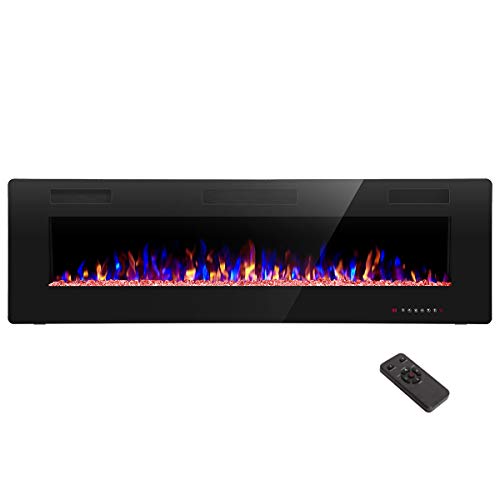
R.W.FLAME 60″ Recessed and Wall Mounted Electric Fireplace

Tangkula 26″ Electric Fireplace Insert

Innoflame 23″ Electric Fireplace Insert

Panana Electric Fireplace Heater 50″
Electric Fireplace Inserts With Output Above 7000 BTU

Electric fireplace inserts that deliver more than 7,000 BTU are available but not as common as lower-output models. Look for units designed to heat larger spaces, usually rated between 7,000 and 10,000 BTU. These inserts typically draw between 1,800 and 3,000 watts, requiring a 120-volt or sometimes 240-volt power supply depending on the model.
| Model | BTU Output | Wattage | Voltage | Installation |
|---|---|---|---|---|
| Tehanld 60″ Ultra-Thin Electric Fireplace Heater | Up to 10,000 BTU | 2,900 W | 120V or 240V | Plug-in or hardwired |
| R.W.FLAME 60″ Recessed and Wall Mounted | 7,500 BTU | 2,200 W | 120V | Plug-in |
| Tangkula 26″ Electric Fireplace Insert | 7,200 BTU | 2,100 W | 120V | Plug-in |
| Panana Electric Fireplace Heater | 7,000 BTU | 2,000 W | 120V | Plug-in or hardwired |
| Innoflame 23″ Electric Fireplace Insert | 7,200 BTU | 2,100 W | 120V | Plug-in |
Most high-output electric fireplace inserts plug into a standard 120-volt outlet but some models, especially those reaching 10,000 BTU, may require a 240-volt hardwired connection. Plug-in models offer flexible placement and easier installation. Hardwired inserts are often flush-mounted and designed for more permanent installation.
If you’re searching for a 7,000 BTU electric fireplace, focus on the wattage rating as a quick check. Roughly, 1 watt produces about 3.4 BTU, so a 2,000-watt heater gives about 6,800 BTU. Models above 2,100 watts comfortably clear the 7,000 BTU mark.
Effectiveness of High-Output Electric Fireplace Inserts for Large Rooms
An electric fireplace insert with an output of over 7,000 BTU can effectively heat a room of about 300 to 500 square feet. BTU measures heat energy, and 7,000 BTU roughly translates to about 2 kilowatts of heating power. This level suits larger rooms or open floor plans where heat disperses more widely.
Open floor plans reduce heat retention because warm air flows freely between spaces. Electric fireplace inserts provide zone heating, so one unit might not heat an entire open area evenly. Supplementing with additional heaters or using ceiling fans to circulate air helps balance temperature.
Electric fireplace inserts deliver radiant and convective heat directly into a room, unlike central heating that warms air ducted through the whole house. They are ideal for adding targeted warmth to specific rooms, especially in milder climates or for spot heating.
If you want an electric fireplace insert output 7000+ BTU for an existing fireplace opening, check the size carefully. Large inserts like the Tehanld 60″ Ultra-Thin model fit bigger openings and offer high output, while smaller units may fall short for large rooms.
Remember that electric inserts are supplemental heat sources. They won’t replace central heating but can reduce overall energy use by heating only occupied spaces.
For zone heating in large or open rooms, choose a model with adjustable heat settings, a remote control, and possibly a fan to spread warmth efficiently.
A 7,000 BTU electric insert running at 2,000 watts draws about 16.7 amps on a 120-volt circuit. That’s within standard outlet capacity, but if you plan to run multiple devices on the same circuit, check breaker limits to avoid overload.
You can learn more about sizing and output in our guide on electric fireplace output watts btu.
Installation Requirements for High BTU Electric Fireplace Inserts
You don’t usually need clearance behind an electric fireplace insert if it’s rated zero-clearance, but confirming that rating is key before installation.
Most electric fireplace inserts with more than 7,000 BTU hold a zero-clearance rating, meaning they can be installed directly against combustible materials like wood framing or drywall without risk of heat damage.
Electric inserts come mainly in two styles: recessed and wall-mounted. Recessed models fit into existing fireplace openings or wall cavities for a flush, built-in look. Wall-mounted units hang on the wall surface and don’t require a cavity.
Recessed installation demands accurate measuring of the fireplace opening or wall cutout. You need to measure height, width, and depth to ensure the insert fits snugly without gaps that would disrupt airflow or look unprofessional.
Wall-mounted inserts reduce measuring hassle since they hang on the surface, but they need a strong wall structure to support their weight and must still meet clearance specs around the unit.
You can place electric fireplace inserts into most common materials, including wood, drywall, and stone mantels, as long as the insert’s zero-clearance rating covers those materials. Avoid installing them inside combustible materials if the insert isn’t rated for it.
Installing electric fireplace inserts into older fireplaces is common but requires careful measuring to fit the insert and ensure safe clearances.
High-BTU electric inserts sometimes require 240V electrical wiring instead of the standard 120V outlet. This depends on the power draw of the unit and its heating capacity.
240V units typically need hardwired installation by a licensed electrician, whereas most plug-in models use standard 120V outlets. Check the product specs to know if special wiring is required.
Energy Use of Electric Fireplace Inserts Over 7000 BTU
You can calculate the heat output of an electric fireplace insert by converting its wattage into BTUs: 1 watt equals about 3.41 BTU per hour. So a 2,000-watt insert produces roughly 6,820 BTU. For outputs above 7,000 BTU, expect wattage near or over 2,050 watts.
Electric fireplace inserts typically run on standard 120-volt outlets, drawing up to about 15 amps for models that reach this heat range. Running a 2,000-watt heater for 8 hours a day uses 16 kWh. With an average electricity rate of 17 cents per kWh, that’s about $2.72 a day or roughly $82 a month if used daily.
| Heater Type | Wattage | BTU Output | Estimated Monthly Cost (30 days, 8 hrs/day @ $0.17/kWh) |
|---|---|---|---|
| Standard 1,500 W Space Heater | 1,500 | 5,115 | 61.20 |
| High-Output 2,000 W Electric Fireplace Insert | 2,000 | 6,820 | 81.60 |
| Natural Gas Fireplace (approximate) | 7,000 | Varies, generally lower | |
| Propane Heater (approximate) | 7,000 | Higher fuel cost |
Electric fireplaces are less efficient than gas in terms of cost per BTU because electricity runs more expensive than natural gas or propane. However, they offer cleaner, vent-free operation and easier installation.
Estimating your exact running cost depends on your local electricity rates and how many hours per day you run the heater. For example, running a 2,000-watt unit 4 hours daily halves your cost to about $1.36 per day.
Safety and Certification Features to Verify
Electric fireplace inserts without a factory-installed power button can usually be controlled via remote or wall switches, but having a manual override switch on the unit is a useful safety feature to look for.
Look for ETL, UL, or CSA certification on the fireplace insert. These labels mean the product has passed safety testing for electrical hazards and fire risks under recognized North American standards.
Overheat protection uses sensors to detect internal temperatures rising beyond safe levels. It interrupts power to avoid fire hazards, a crucial feature especially in high-output models.
Tip-over switches are more common in portable space heaters than built-in inserts. However, wall-mounted or recessed models avoid the risk by design, as they don’t tip.
Cool-touch glass prevents the front glass panel from exceeding skin-safe temperatures, reducing burn risks, particularly in households with children or pets.
Child safety locks can be electronic or mechanical. They prevent accidental changes to temperature or turning the unit on and off, which keeps kids safe from burns or electrical shock.
Always install your electric fireplace according to the manufacturer’s instructions for clearances and electrical requirements. Improper installation can void safety certifications and lead to hazards.