For most readers searching Electric Fireplace Output Watts & BTU, the best pick is Product 5 because its 1,000/1,500W heat settings and 5,100 BTU rating give you enough output for a typical room without paying for oversized flame effects. The usual mistake is buying by flame looks alone, then wondering why a pretty box only warms a small zone; that mistake can leave you short by one heat setting and a few hundred watts.
Electric fireplace output sounds tidy on a product page and messy in a real room. Watts tell you how much electric heat the unit can make; BTU is the same heat in another unit, and 1,500W is about 5,100 BTU.
The useful question is simpler: how much of that heat reaches the room you actually sit in, and how many settings do you need before the first cold snap?
Electric Fireplace Heat Output and Controls Comparison
Best for Rooms up to 150 sq ft needing adjustable heat output
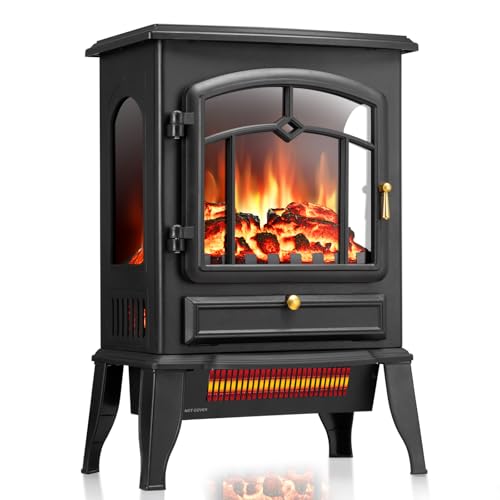
This ZAFRO stove delivers up to 5,100 BTU and two heat settings of 1,000 and 1,500 watts, which suit most average rooms without wasting energy on oversized flame effects. The 3D dancing flame and adjustable brightness add ambiance while the safety features give peace of mind. Its compact size fits tight spots and the heater warms quickly in 3 to 5 minutes.
Best for Those wanting infrared heat and smart control
The TURBRO Eternal Flame uses a 1,500-watt infrared quartz tube to heat more effectively without drying air or skin, unlike fan heaters. It offers five flame effects plus adjustable brightness and crackling sounds for a cozy feel. Smart WiFi control via remote or phone adds convenience. This unit fits well if you want a mix of ambiance and efficient zone heating.
Best for Heating larger rooms up to 1,000 sq ft with infrared heat
Duraflame’s stove heater covers up to 1,000 square feet, making it a solid choice for bigger rooms. Its infrared heat is more efficient than fan heaters, and the adjustable thermostat lets you dial in comfort. You get a classic stove look with real glass doors and glowing logs, plus independent flame and heat controls for year-round use.
Heat output —Heat settings Two heat settings: 1000W and 1500WControls ManualRoom size Up to 1,000 sq ft
Why it made the cut
Heats up to 1,000 sq ft
Adjustable thermostat and flame brightness
Portable with classic stove design
Separate flame and heat controls
Good to know
No remote control
Flame effect less customizable
Skip it if Skip if you want a wall-mounted insert or WiFi features.
Best for Small spaces needing quick heat and charm
This ZAFRO stove combines a vintage look with practical heat output of 5,100 BTU and two heat settings. Its compact footprint fits small rooms or apartments, and the 3D flame effect is adjustable for ambiance. Safety features include overheat shutoff and stable feet. It’s a good pick if you want a freestanding heater that’s easy to move and clean.
Best for Flexible installation and ambiance without high heat
Panana’s electric fireplace insert offers multiple sizes and installation options, including wall-mount or recessed. It has 5,000 BTU heat output with adjustable temperatures between 62°F and 86°F, plus 20 flame colors and brightness levels for ambiance. The unit runs with or without heat, making it ideal for year-round use focused on atmosphere rather than strong heating.
Heat output 5,000 BTUHeat settings —Controls Touch screen and remoteTemperature range 62°F–86°F
Why it made the cut
Multiple size options and install methods
Adjustable flame colors and brightness
Runs with or without heat
Timer and overheat protection
Good to know
Lower heat output than stove models
No high BTU setting for big rooms
Skip it if Skip if you want a freestanding stove or more heat power.
Electric fireplaces list heat output in watts or BTUs, but these are two ways of describing the same thing: the amount of heat the unit produces.
The standard conversion is that 1,500 watts equals about 5,100 BTUs per hour. So, when an electric fireplace says it runs at 1,000 or 1,500 watts, it’s delivering roughly 3,400 to 5,100 BTUs of heat. You can calculate the heat output by multiplying the wattage by 3.41; for example, 1,000 watts × 3.41 equals 3,410 BTUs.
Electric fireplaces use electricity measured in kilowatts (kW). Running a 1,500-watt (1.5 kW) fireplace for one hour uses 1.5 kilowatt-hours (kWh) of energy. You can estimate running costs by multiplying kWh by your local electricity rate.
Some smaller models run at 750 watts, providing about half the heat of a 1,500-watt unit. That can be enough for a small room or a focused spot like a desk area.
Wattage (W)
BTU Output (approx.)
750
2,550
1,000
3,410
1,500
5,100
Common Electric Fireplace Heat Outputs
If you’re wondering about a 7,000 BTU electric fireplace, that’s roughly equivalent to 2,050 watts. Few plug-in units reach this high; larger models or inserts usually get there.
Our best overall pick is the Electric Fireplace Heater Stove with 3D Flame (Product 5). Its 1,000 and 1,500 watt heat settings and 5,100 BTU output suit most rooms without paying for oversized flame effects.
For those wanting app control and more flame options, the TURBRO Eternal Flame 26 in. WiFi Infrared Quartz Electric Fireplace (Product 4) offers advanced features alongside solid heat output.
Pick by Watts First
When comparing plug-in electric fireplaces, choose by wattage first since it directly measures heat output. BTU ratings follow from watts, but watts are easier to check on labels and specs.
From HeaterGuides · our own guidePage 4 shows what every heater costs per hour; the Excel sheet works out your own bill.Winter Heating Bill CutterSee what every heater in your home really costs, heat the rooms you use, and cut the waste in 30 days.Cost-per-hour tables for every heaterThermostat schedule and draft-proofing planRunning-cost and bill calculator (Excel)$14.99$9.99Get it for $9.99See what's inside and watch the 2-minute video →14-page printable PDF + Excel calculator · instant download · 30-day refund
Which Pick Fits Your Room
The best electric fireplace with mantel among these picks is Product 5, balancing heat output and style for most living rooms.
Product 3 stands out as the roomy freestanding stove-style heater. It suits larger spaces where you want a traditional stove look and more heat coverage. Its downside is that it’s bulky and not suited for tight spots or wall mounting.
For smart controls, Product 4 leads with WiFi connectivity and app control, making it easy to adjust heat and flame from anywhere. It fits well in modern decor but has a fixed size and shape that limits placement options.
Product 1 is the clear choice for built-in or wall-mounted installations. It’s slim and designed to be recessed or hung on a wall, ideal for saving floor space. The tradeoff is less heat output and a smaller flame display compared to freestanding models.
Both Product 2 and Product 5 are compact and decorative electric fireplaces. They work well in smaller rooms or where you want a flame-only mode for year-round ambiance without heat. Product 5 offers higher heat settings, while Product 2 is quieter but less powerful.
Model
Style
Heat Output (Watts)
BTU
Flame-Only Mode
Smart Controls
Product 1
Wall-Mount/Recessed
750/1,500
2,560/5,100
Yes
No
Product 2
Compact Stove
750/1,500
2,560/5,100
Yes
No
Product 3
Freestanding Stove
1,500
5,100
No
No
Product 4
Mantel with WiFi
1,000/1,500
3,400/5,100
Yes
Yes
Product 5
Compact Stove with Mantel
1,000/1,500
3,400/5,100
Yes
No
Key specs to match fireplace style and room size.
Good for
Product 3 covers large rooms with its stove-style heat and bigger size.
Product 4 suits users who want smart home integration and remote control.
Product 1 fits built-in or wall-mount setups where floor space is tight.
Product 5 blends decorative mantel style with solid heat output for typical rooms.
Product 2 offers a quiet, compact option with flame-only mode for ambiance.
Not for
Product 3 is bulky and less flexible in placement.
Product 4’s shape limits where it can go and it’s pricier.
Product 1 has lower heat output and smaller flame effects.
Product 5 lacks smart controls.
Product 2’s heat coverage is smaller and flame less bright.
Size The Heat Before You Buy
How high your electric fireplace sits on the wall matters as much as its heat output. The viewing window should be at eye level, usually 42 to 48 inches from the floor, so you get the best flame effect without blocking the heat path.
The heat output you need starts with your room size, insulation quality, ceiling height, and whether doors stay open. A compact, well-insulated room with 8-foot ceilings needs less power than a drafty or tall space.
Wall-mounted or recessed units have to clear furniture and not blow heat straight into a mantel or shelf. Otherwise, you lose warmth and risk overheating surfaces.
Worked example
Say your den is 10 by 12 feet with 8-foot ceilings. A 750W heater produces roughly half the heat of a 1,500W model. The smaller unit draws about 6.25 amps at 120 volts, while the larger pulls about 12.5 amps—important if you share circuits with other devices.
Choosing the 750W heater means about half the running cost but also half the warmth. If you want consistent comfort without extra heaters, the 1,500W option is safer.
Heater
Watts
Per hour
Per day (8 h)
Per month (30 days)
1,500 W electric fireplace
1,500 W
26¢
$2.04
$61.20
750 W electric fireplace
750 W
13¢
$1.02
$30.60
Calculated at 17¢ per kWh. Estimated monthly cost at $0.17 per kWh for 8 hours daily use.
6.25 A
Amp draw at 120 V
750 W heater’s current draw, which matters on shared household circuits.
12.5 A
Amp draw at 120 V
1,500 W heater’s current draw, roughly double the 750 W model.
Vents, Chimneys, And Wall Mounting
Electric fireplaces do not need a chimney or vent because they generate heat electrically, not by burning fuel. That means there’s no combustion, no exhaust gases, and no venting requirements like with gas or wood fireplaces.
Wall-mounted and recessed electric fireplaces must follow the clearance and installation instructions in their manuals exactly. The cord should run freely without being pinched or crushed behind the unit. Avoid forcing the unit flush against the wall if it risks damaging the power cord.
Electric Fireplace Repair
Never paint, dismantle, or open internal panels unless the manual explicitly allows it and the unit is unplugged. Trying to chase or replace fuses inside without proper guidance can void the warranty and create a serious shock hazard.
If your electric fireplace trips breakers or stops heating, the problem might be a faulty heating element, fan, or internal fuse. Check the model’s manual for troubleshooting steps before calling for service.
Pre-Installation Checks
Confirm the outlet is easily accessible and on a dedicated 15A circuit
Verify the wall framing supports the fireplace’s weight if wall-mounted or recessed
Measure required clearances around the unit as specified in the manual
Plan cord routing to avoid pinch points or tight bends
What Buyers Usually Miss
The controls on electric fireplaces affect daily use more than the flame’s look in photos. Features like thermostat range, timer, remote control, touch screen, WiFi connectivity, and flame-only mode change how practical the unit is in your space.
Among these picks, control styles vary: some combine remote and touch screen, others use remote plus panel buttons, and a few offer WiFi control for smartphone operation. Choose the control style you find easiest and most convenient.
Flame-only mode lets you enjoy the ambiance without heating, perfect for mild days or rooms where you want the look without raising the temperature.
Myth
Brighter or more vivid flames mean more heat output
Fact
Electric fireplaces produce heat by electric elements, so flame brightness or color doesn’t affect how much heat they deliver.
Choose Controls You’ll Use
Pick the electric fireplace with controls you’ll actually use in the room it’s installed. Convenience and ease of operation matter more than fancy flame effects or extra watts you don’t need.
More Questions, Answered
How do you calculate the heat output from an electric fireplace?
Heat output in watts is usually listed on the unit’s label or manual. To convert watts to BTUs, multiply watts by 3.41. For example, a 1,500-watt fireplace produces about 5,115 BTUs, which helps you compare heat performance across models.
Does an electric fireplace need a chimney or vent?
Electric fireplaces don’t require chimneys or vents because they generate heat electrically without combustion. This means you can install them almost anywhere with an electrical outlet, unlike gas or wood-burning fireplaces that need proper venting.
How many kilowatts does an electric fireplace use?
Most electric fireplaces use between 1 and 1.5 kilowatts (kW) on their highest setting. That’s 1,000 to 1,500 watts, which translates to 1 to 1.5 kW. Knowing this helps you estimate energy use and running costs accurately.
How many amps does a 750 watt electric fireplace draw?
A 750-watt electric fireplace draws about 6.25 amps on a standard 120-volt circuit (750 ÷ 120 = 6.25). This matters for electrical safety and ensures you don’t overload the circuit or trip breakers when running the heater.
How high should an electric fireplace be mounted?
Mount an electric fireplace so the bottom edge is about 24 to 36 inches above the floor. This height lets the heat spread evenly and keeps the flame effect at eye level for the best visual experience without overheating walls or furniture.
Before you go · a welcome giftGet the Winter Heating Bill Cutter for $4.99See what every heater in your home really costs, heat the rooms you use, and cut the waste in 30 days. Normally $14.99; your welcome price saves $10.00. We'll email your link right now.or buy it now for $9.99 without the gift →One email with your link now. We never share your address.




 Winter Heating Bill CutterSee what every heater in your home really costs, heat the rooms you use, and cut the waste in 30 days.Cost-per-hour tables for every heaterThermostat schedule and draft-proofing planRunning-cost and bill calculator (Excel)