

Getting static wrong can mean more than a few zaps. In dry winter air, you risk frying sensitive electronics, damaging equipment, or even sparking a fire around flammable vapors.
If your heater leaves the air cold and dry, the real cost is not just discomfort—it’s the risk of damage and the hassle of controlling static that refuses to go away.
Does Temperature Affect Static Electricity? The Shocking Truth
Yes, temperature affects static electricity, but dry air usually decides how bad the shocks get. Cold conditions make surfaces and materials hold charge longer, while hot, humid weather usually lets charge leak away; hot weather can still cause static when the air is dry. The temperature-and-static relationship is therefore real, but indirect.
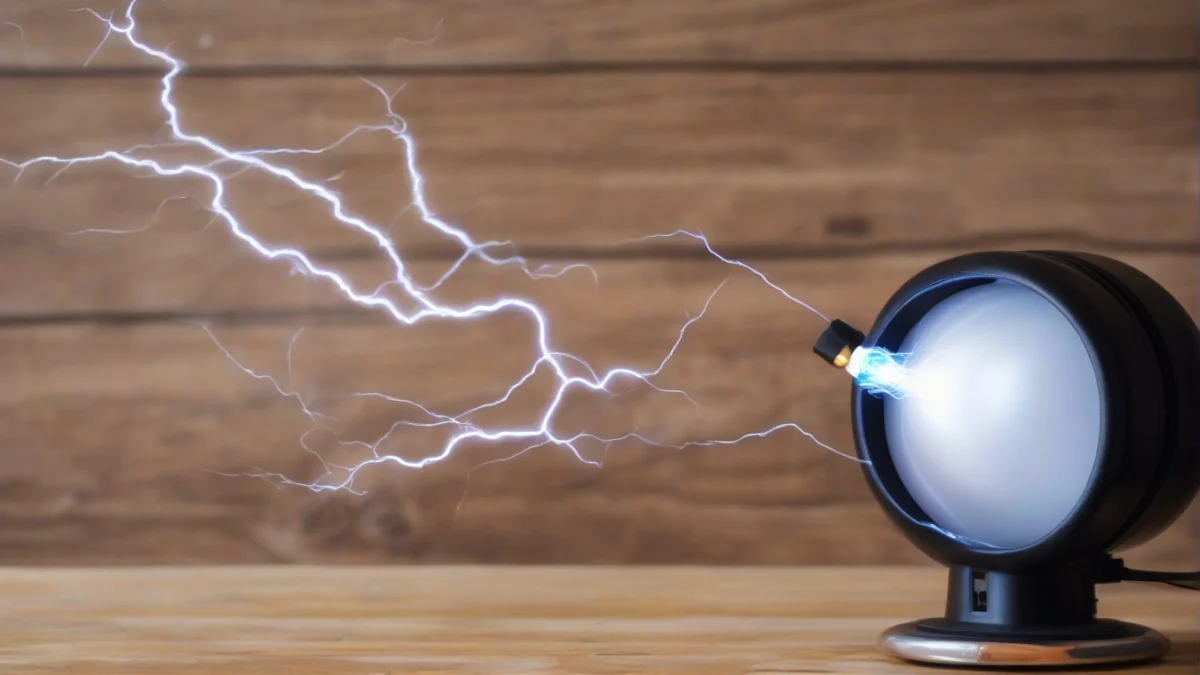
Static electricity is a buildup of electric charge on an object. When two materials touch and separate, electrons can move from one surface to the other through the triboelectric effect; rubbing your shoes on carpet gives that transfer more chances to happen. If the surface is a poor conductor, the extra electrons stay put until your hand provides a path to ground. The tiny spark is the charge crossing the air gap.
Cold surfaces tend to let charge move less freely, especially when their surface is dry. Heating a building can lower indoor relative humidity, so carpets, clothing and plastic surfaces lose the thin moisture film that normally helps charge bleed away. Material type still matters: temperature changes conductivity and contact chemistry, but it doesn’t create a fixed amount of static by itself. For the electrical side of that relationship, see why temperature changes electrical resistance.
| Condition | Typical static voltage | Charge on a 100 pF person |
|---|---|---|
| 5°C, 20% RH | 10,000–30,000 V | 1–3 µC |
| 20°C, 40% RH | 2,000–10,000 V | 0.2–1 µC |
| 30°C, 60% RH | 500–3,000 V | 0.05–0.3 µC |
Those charge figures come from Q = C × V. A 100 pF body at 10,000 volts holds about 1 microcoulomb, while the same body at 30,000 volts holds about 3 microcoulombs. A winter shock can feel sharp because the charge releases in a very short pulse, even though the total stored energy is small.
Where Humidity and Temperature Work Together (Or Against You)
Temperature changes how much moisture air can hold, while relative humidity tells you how close that air is to full. At 20°C, air at 50% RH contains about 8.7 grams of water vapor per cubic meter; at 0°C, 50% RH contains only about 2.4 grams per cubic meter. The same RH number can describe very different moisture conditions.
| Air temperature | Saturation moisture | Moisture at 50% RH |
|---|---|---|
| 0°C | About 4.8 g/m³ | About 2.4 g/m³ |
| 10°C | About 9.4 g/m³ | About 4.7 g/m³ |
| 20°C | About 17.3 g/m³ | About 8.7 g/m³ |
| 30°C | About 30.4 g/m³ | About 15.2 g/m³ |
Heating winter air usually lowers its RH because the warmed air can hold more vapor without gaining any moisture. Dry air at any temperature makes static worse: a thin moisture film normally helps charge leak across surfaces, but that pathway weakens as the air and materials dry.
Temperature also affects indoor air quality, though static isn’t an air-quality measurement. Cold, poorly ventilated rooms can hold more combustion pollutants and moisture-related condensation, while overheated rooms often become excessively dry. A humidifier can improve static conditions only if it adds enough vapor for the room temperature; in cold storage, vapor may condense on surfaces or freeze before it controls charge.
The antistatic property of a spray, floor finish, or fabric treatment can change with both temperature and humidity. Cold can slow drying and make a coating less uniform; very dry air can overwhelm a treatment that works well at moderate RH. Temperature can affect pH too, because the measured pH and chemical equilibrium shift with temperature; use the meter’s temperature compensation rather than comparing readings blindly. For a deeper look at water chemistry, see temperature changes and pH levels.
What Actually Changes When Surfaces Get Colder or Hotter
Cold surfaces usually hold static longer because plastics, rubber, and many fabrics become stiffer and more electrically insulating. Charge then has fewer easy paths to leak away. Many plastics show roughly a tenfold drop in surface resistivity for each 30°C rise in temperature, although the exact change depends on the material, moisture, additives, and contamination.

That helps explain the warehouse-versus-room difference: a charged plastic tote in a cold, dry warehouse may retain charge for minutes, while a similar tote in a warm room with moderate humidity may discharge in seconds. The numbers are examples, not a timer you can apply to every polymer. A dry warm room can still produce strong shocks because low humidity removes the moisture path.
Temperature affects post insulators by changing polymer stiffness, leakage resistance, and thermal expansion; porcelain and other rigid insulators also experience thermal stress. Cold doesn’t automatically make an insulator unsafe, but repeated heating and cooling, surface moisture, dirt, or cracking can change its performance. Metal behaves differently: its charge moves quickly across the surface, and resistance usually changes modestly with temperature, so a cold metal handle can deliver a sharp discharge without storing charge like plastic.
Glue viscosity falls as temperature rises and increases as adhesive cools, so cold glue may spread poorly and leave thicker contact spots. Pressure changes plastic by changing contact area, deformation, and friction; temperature changes its flexibility and electrical leakage. Which matters more depends on the plastic, the load, and how the contact is being made.
Weather responds to temperature through air density, pressure, moisture, and convection, so temperature affects weather without being the only cause. Those same changes can alter surface moisture and static risk outdoors.
Static Control Methods and How Temperature Limits Them
The most reliable static control matches the method to the temperature, humidity, surface and grounding path; adding moisture can also increase corrosion if a cold surface reaches its dew point. Humidification helps charge leak away through slightly more conductive air and materials, but humidifying a cold room too quickly can create condensation on metal, electrical parts and product-contact surfaces.
During dispensing, electrostatic charge can make API particles cling to equipment or one another and can contribute to agglomeration after dry-heat sterilization. It usually doesn’t explain hard, persistent agglomerates by itself; moisture, heat exposure, compaction and formulation behavior may also be involved. Check the process rather than blaming every lump on static.
| Method | Cold conditions | Moderate conditions | Hot conditions |
|---|---|---|---|
| Humidification | Often slow; cold materials stay resistive. Condensation is the main risk. | Usually effective when RH is controlled and surfaces stay above dew point. | Can work well, but excess moisture may cause corrosion or product problems. |
| Grounded flooring | Works only with conductive flooring, footwear and a verified ground path. | Reliable for grounded people and carts when the path is intact. | Usually reliable; sweat and contamination can change contact resistance. |
| Antistatic spray | May dry slowly or leave uneven coverage on cold surfaces. | Often effective when the product suits the material and is reapplied as directed. | May evaporate quickly; residue can still attract dust. |
| Ionizer | Often the most consistent across temperature changes, provided airflow and distance are suitable. | Effective for isolated or poorly grounded objects. | Still useful, but airflow, dirt and emitter condition limit performance. |
Measuring Static: Why Temperature and Humidity Must Be Logged
For the question “if electricity temp which number,” record the ambient air temperature in °F or °C, relative humidity in %, and the surface temperature when the object differs from the room. Static has no useful single temperature number of its own; the meter reading changes with the environment and the measurement setup.
Temperature can change both the charge on the object and the meter’s electronics, sensor response and stated accuracy. Sustained heat, cold and repeated cycling can dry, soften, embrittle or shrink materials, changing surface resistance and contact area. Freezing temperatures can freeze water in wood, followed by contraction and checking or splitting as moisture and temperature change.
Electrostatic force normally produces too little heat to warm an object, but a discharge can create a tiny hot spark or localized heating. Treat that spark as an ignition risk around flammable vapors, dust or solvents.
Other Ways Temperature Changes What Static Does
Temperature changes a spark’s final step: at the same pressure, warmer, thinner air generally needs less voltage to break down, so a spark can jump across a gap more easily. Cooler air is denser, meaning its molecules are packed closer together; charged particles collide more often, changing how corona and discharge spread. Gap length, pressure and humidity still matter.
Heating air makes it expand and lowers its density; cooling air compresses it and raises density. That same uneven heating drives weather: warm air rises, pressure changes, and moving air helps form clouds, wind and fronts. Seasonal temperature is one cue for animal migration, alongside daylight, food supply and breeding cycles. Temperature helps set the timetable, but it isn’t the whole calendar.
| Place | What temperature changes |
|---|---|
| Oven | Hot air can make air breakdown easier near a gap, but metal surfaces, insulation and the appliance’s grounding path control the actual shock risk. |
| Freezer | Cold, dry surfaces can hold charge, and frost or condensation during door opening can create unexpected leakage paths. |
| Manufacturing line | Temperature changes air density, material resistance and humidity, so film, powder and fabric lines need controls checked at operating temperature. |
Questions People Ask
Why do I get shocked more often in winter than summer?
Does running a humidifier really stop static shocks?
How does static risk change in a cold warehouse or freezer?
Can static electricity damage electronics more at low temperatures?
Why does static seem worse after using the heater?
Does temperature affect how well antistatic sprays work?

I am a mechanical engineer and love doing research on different home and outdoor heating options. When I am not working, I love spending time with my family and friends. I also enjoy blogging about my findings and helping others to find the best heating options for their needs.
Related guides

How Temperature Extremes Impact Kidney Health: A Clinical Guide for Patients and Caregivers
Summer heat waves are hitting harder every year. You feel the fatigue, the headache, the dizzy spell when…

How Temperature Changes Impact Enzyme Activity: A Practical Troubleshooting Guide
You set up a purification run on ice, just like the protocol says. The assay buffer sits in…

How Temperature Affects Insulation Performance
You might think of insulation as a static barrier. A fluffy blanket in your walls that just sits…
