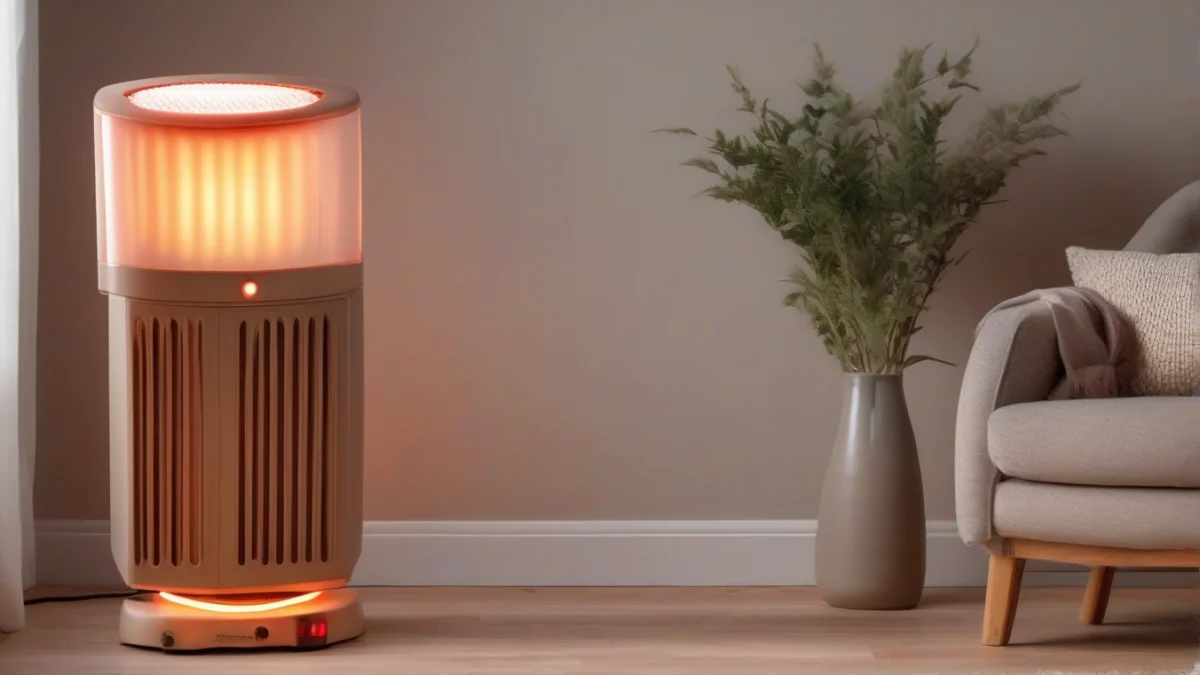
A Climawarm heater is an infrared heater that warms objects and people directly rather than the air. It delivers fast, efficient heat with low running costs and quiet operation, making it suitable for bedrooms and small to medium rooms.
Climawarm heaters use infrared technology to provide warmth by heating surfaces and bodies directly, not the air around them. This method differs from traditional convection heaters, which warm the air and rely on circulation.
Understanding how Climawarm heaters work helps you decide if they fit your heating needs, especially when considering running costs, comfort, and safety for indoor use.
What to remember
Climawarm heaters warm people and objects directly, not the air, providing quick comfort.
They use about 1,500 W, costing roughly 12 cents per hour at 8¢ per kWh, making them affordable to run.
These heaters are quiet and safe with tip-over and overheat protections, suitable for bedrooms and living rooms.
Infrared heating suits small to medium spaces better than large open areas due to direct radiant heat.
Keep at least 3 feet clearance from combustibles and plug directly into wall outlets for safety.
How a Climawarm Heater Works
A Climawarm heater is an electric infrared heater that sends heat directly toward people, furniture and nearby surfaces. Its heating element produces radiant heat, so you can feel warmth before the whole room’s air temperature catches up.
This infrared heater provides direct warmth to your space.
Infrared radiation travels outward in straight lines and is absorbed by solid objects. Those objects then give some heat back to the surrounding air, while your skin feels the direct warmth immediately. The effect is similar to standing in sunlight on a cool day, minus the sunburn.
Infrared Versus Convection Heating
A convection heater warms air first: the air rises over the element, cooler air moves in, and the room gradually mixes. Infrared heating skips that first air-heating step, which can feel faster when you’re sitting within the heater’s warming area.
The tradeoff is coverage. A radiant heater works best with a clear path between the panel or element and the person or objects receiving heat; a convection heater is better at spreading warmth around corners and through a closed room. For a deeper comparison, see this guide to convection heaters.
Specification
What to check
Power rating
Read the label or manual for the heater’s wattage and heat settings.
Electrical supply
Most plug-in US heaters use 120 V; a 1,500 W setting draws about 12.5 A.
Temperature control
A thermostat may cycle the element off after the room or target area reaches the set temperature.
Heat direction
Radiant warmth is strongest where the element has a direct line of sight.
The rating plate on your heater outranks a generic description.
Worked Example
Say the rating plate lists 1,500 W on high and 750 W on low. High uses 1.5 kWh for each hour the element stays on; low uses 0.75 kWh per hour. A thermostat can reduce the total over a full evening by switching the element off part of the time, although the heater still draws its listed wattage whenever that element is energized.
High setting1,500 W
Low setting750 W
High-setting energy1.5 kWh per hour
A Useful Distinction
Infrared describes how the heat reaches you, not a special kind of free electricity. Two electric heaters drawing 1,500 W use the same energy while both elements run continuously; comfort and thermostat cycling can change how long each one runs.
Running Costs of a Climawarm Heater
A Climawarm heater’s running cost depends on its wattage, your electricity rate and how long the heating element stays on. A 1,500 W heater uses 1.5 kWh in one hour at full output, while a 750 W setting uses 0.75 kWh in one hour.
Understanding running costs can help manage your energy bill.
For a US example, the cost blocks below assume electricity at $0.17 per kWh. Replace that rate with the energy charge on your bill; delivery fees and fixed charges may appear separately.
Heater
Watts
Per hour
Per day (1 h)
Per month (1 days)
Climawarm at 1,500 W
1,500 W
26¢
26¢
26¢
Climawarm at 750 W
750 W
13¢
13¢
13¢
Heated blanket at 100 W
100 W
1.7¢
1.7¢
1.7¢
Calculated at 17¢ per kWh. One hour at a $0.17 per kWh electricity rate.
A conventional plug-in space heater rated at 1,500 W costs the same to run as a 1,500 W Climawarm while both operate continuously. Infrared heating doesn’t lower the wattage by itself; the possible saving comes from heating the person or nearby area directly, using a lower mode, or letting the thermostat cycle instead of running flat out.
Heater or setting
Energy used while running
Climawarm, high at 1,500 W
1.5 kWh per hour
Climawarm, low at 750 W
0.75 kWh per hour
Typical 1,500 W electric space heater
1.5 kWh per hour
100 W heated blanket
0.1 kWh per hour
Compare the wattage on the label, not the heating method’s name.
Heater
Watts
Per hour
Per day (8 h)
Per month (30 days)
Climawarm at 1,500 W
1,500 W
26¢
$2.04
$61.20
Climawarm at 750 W
750 W
13¢
$1.02
$30.60
100 W heated blanket
100 W
1.7¢
14¢
$4.08
Calculated at 17¢ per kWh. Eight scheduled hours per day for 30 days at a $0.17 per kWh rate; the heater may cost less if its thermostat cycles off.
Thermostat setting, room temperature, insulation, outdoor weather and the selected heat mode all affect the final bill. For an exact estimate, use watts ÷ 1,000 × hours × your price per kWh, then account for the percentage of time the element actually runs. The Climawarm space heater buying guide is useful if you need to check a model’s listed wattage before doing that calculation.
Recommended Space Heaters for Efficient Indoor Heating
Portable electric heaters with thermostat and safety controls for rooms that need steady supplemental warmth.
Quiet Bedroom Heat
DREO Portable Indoor Space Heater
Choose this when you want fast supplemental heat without much fan noise. Its 1500W PTC system, 41-95°F thermostat range and 34dB operation suit a bedroom or office better than a heater that roars through every cycle.
This is the practical pick for a room with uneven temperatures: its 70° oscillation moves warm air across a wider area, while the thermostat and 12-hour timer help limit unnecessary run time. Child lock, tip-over protection and overheat shut-off add useful safeguards for shared living spaces.
Safety and Comfort When Using a Climawarm Heater Indoors
Climawarm heater safety is generally good indoors when the unit is listed for indoor use, stands on a stable surface and has clear space around it. Is a Climawarm heater safe for a bedroom? Yes, for a model whose instructions allow bedroom use, provided you keep it away from bedding and don’t run it while sleeping unless the manufacturer specifically permits that use.
Because infrared heat comes from electricity, a Climawarm heater doesn’t produce carbon monoxide or need venting for combustion gases. Still, keep the heater’s air intake and exhaust areas free of dust and obstructions. Maintain at least 3 feet of clearance around the heater to prevent nearby fabrics or papers from overheating. Always plug the heater directly into a properly grounded wall outlet without using extension cords, power strips, or multi-outlet adapters.
Before You Turn It On
Confirm the model is listed for indoor use.
Check for tip-over shutoff and overheat protection.
Set the heater on a level, hard surface where it can’t be knocked over.
Keep bedding, curtains, clothing, paper and furniture at least 3 feet away.
Use a direct wall outlet and inspect the plug and cord for damage.
Comfort is the quieter part of the deal: an infrared panel can warm people and nearby surfaces without the fan noise of a forced-air heater. A model with a fan may still be quiet, but check its stated noise level if you’ll use it beside a bed or sofa. Radiant warmth also feels more immediate when you’re in the heater’s coverage area; the far side of a room may feel cooler.
1
Place it in the open
Aim the heating face toward the occupied part of the room, with no furniture or fabric blocking it. Don’t cover the heater or dry clothes on top of it.
2
Use the controls carefully
Set the thermostat or timer instead of running maximum heat indefinitely. Turn the unit off before leaving home unless the manual says unattended operation is allowed.
3
Choose a quiet backup
If you want portable heat beside a bed or desk, compare the safety shutoffs, noise rating and thermostat range rather than relying on the word infrared alone.
Useful for bedroom heat
DREO Space Heater
Product 1 suits a bedroom or living room where quiet operation matters because its listed 34 dB noise level, tilt-detection sensor and overheat protection address the main comfort and safety concerns; skip it if you specifically want a fanless infrared panel.
A 1,500 W plug-in heater draws about 12.5 amps from a 120 V circuit. Plugging it into an extension cord or power strip can overheat the cord or overload the connection, so use a sound wall outlet and stop if the plug or outlet becomes hot.
From HeaterGuides · our own guidePage 4 shows what every heater costs per hour; the Excel sheet works out your own bill.Winter Heating Bill CutterSee what every heater in your home really costs, heat the rooms you use, and cut the waste in 30 days.Cost-per-hour tables for every heaterThermostat schedule and draft-proofing planRunning-cost and bill calculator (Excel)$14.99$9.99Get it for $9.99See what's inside and watch the 2-minute video →14-page printable PDF + Excel calculator · instant download · 30-day refund
Best Rooms and Spaces for a Climawarm Heater
The best room for a Climawarm heater is a small or medium room where you spend time within the heater’s radiant coverage, such as a bedroom, home office or seating area. You can use a Climawarm heater anywhere the model’s instructions allow, but a large open room, high ceiling or constantly open doorway gives infrared heat too much space to cover.
Infrared energy warms people, floors, furniture and other surfaces in its path instead of mixing evenly through all the air first. That makes a desk, reading chair or sofa a good target. A single panel has a harder job across a long room, behind a sofa or around several partitions, where some occupants may sit outside its strongest coverage.
Space
How Well It Fits
Placement Note
Bedroom
Good for one sleeping or dressing area
Aim at the occupied side, keeping bedding 3 feet away.
Home office
Good for a desk and chair
Place it where your legs and upper body have a clear path to the heating face.
Living room
Good for a seating zone
Point it toward the main chairs rather than an empty wall.
Large open area or garage
Limited as a single heater
Expect uneven comfort unless the model and sizing instructions support the space.
Radiant coverage works best when people and surfaces remain in front of the heater.
Placement Check
Keep the heater on a level, stable surface.
Point the heating face toward the occupied zone.
Don’t hide it behind furniture or curtains.
Keep doors and windows closed if you want the room to hold heat.
Maintain the manufacturer’s clearance, or at least 3 feet where the manual gives no smaller approved distance.
Worked Example
Say your home office is 10 × 12 feet and your chair sits across the room from the planned heater location. A clear path between the heater and chair lets radiant heat reach you directly. Moving the same heater behind a bookcase may leave the chair cool even though the heater is still running.
Room10 × 12 ft office
Best targetDesk and chair
Main checkClear radiant path
Next Steps for Choosing or Repairing a Climawarm Heater
Use a Climawarm heater on a clear, stable surface, plug it directly into a wall outlet and set the thermostat for the comfort you want; for climawarm heater troubleshooting, start with power, airflow and the controls before assuming the heating element has failed.
1
Check the basic setup
Confirm the plug is fully seated, the breaker hasn’t tripped and the power switch is on. Keep bedding, curtains, furniture and paper at least 3 feet away, and never use an extension cord, power strip or multi-outlet adapter.
2
Test the controls
Raise the thermostat several degrees above the room temperature and select heat rather than fan-only mode. If the unit runs briefly and stops, clear dust from the intake and outlet after switching it off and letting it cool; an overheat sensor may be doing its job.
3
Check for a tip-over issue
Place the heater upright on a firm, level floor. A tilted unit may refuse to run because its tip-over switch has opened the circuit. Don’t bypass that switch.
4
Choose the right replacement
Match the heater’s wattage and coverage to the room, then look for a recognized safety listing, overheat protection and tip-over protection. A 1,500 W plug-in heater draws about 12.5 A at 120 V, so a shared circuit may have little capacity left.
Useful alternative while choosing
DREO Space Heater
Product 1 suits a bedroom or office if you want a portable 1,500 W heater with a 41–95°F thermostat range, 34 dB operation and a handle; skip it if you specifically want infrared radiant heat rather than fan-assisted warmth.
Check the cord, plug, housing and controls for heat damage or cracks.
Confirm the outlet isn’t loose, scorched or shared with another high-wattage appliance.
Keep a working smoke alarm and carbon monoxide alarm in the home, as required for your other heating equipment.
Stop using the heater for a burning smell, sparking, repeated breaker trips or a cord that gets hot.
When to replace or call
Replace a heater with a damaged cord, failed tip-over switch, recurring overheating or electrical arcing. Don’t open the cabinet or repair internal wiring yourself; contact the manufacturer or a qualified electrician, especially when the outlet or breaker is the part getting hot.
Questions People Ask
What is the difference between a Climawarm heater and a convection heater?
A convection heater warms air, which then circulates through the room; a Climawarm heater sends infrared heat toward people and nearby surfaces. Radiant heat can feel immediate when you’re in its coverage, while convection is usually the better fit for raising the temperature throughout an enclosed room.
Can I leave a Climawarm heater on overnight safely?
Don’t leave it running overnight unless the manufacturer specifically says that model is designed for unattended or sleeping use. Turn it off before bed, keep the heater on a stable surface with three feet of clearance, and plug it directly into a wall outlet.
How far should a Climawarm heater be from furniture or curtains?
Keep at least three feet between the heater and furniture, curtains, bedding, clothing or other combustibles. Make sure the infrared output and air openings aren’t blocked, since a nearby curtain can become both an overheating problem and a fire risk.
Does a Climawarm heater work well in a large open room?
Large open rooms are usually a poor match unless you need heat only in the area directly facing the heater. Radiant warmth fades outside the unit’s coverage, and drafts or high ceilings make whole-room heating harder; a properly sized central or convection system may work better.
What maintenance does a Climawarm heater need to keep working efficiently?
Routine care is mostly cleaning dust from the grille and checking the cord, plug and housing for damage while the heater is unplugged and cool. Don’t open the cabinet or bypass a tip-over or overheat switch; a burning smell, damaged cord or repeated shutdown calls for service or replacement.
Before you go · a welcome giftGet the Winter Heating Bill Cutter for $4.99See what every heater in your home really costs, heat the rooms you use, and cut the waste in 30 days. Normally $14.99; your welcome price saves $10.00. We'll email your link right now.or skip the email and buy it now for $4.99 →One email with your link now. We never share your address.


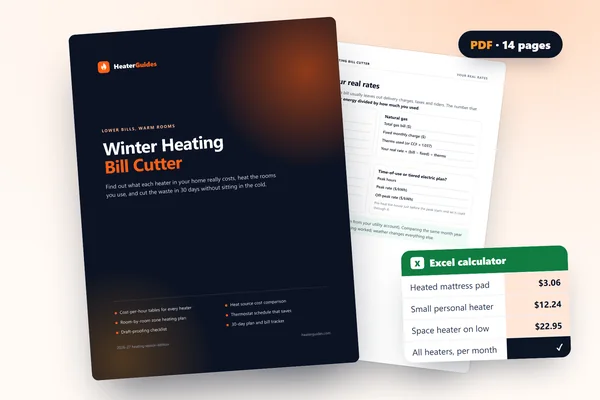 Winter Heating Bill CutterSee what every heater in your home really costs, heat the rooms you use, and cut the waste in 30 days.Cost-per-hour tables for every heaterThermostat schedule and draft-proofing planRunning-cost and bill calculator (Excel)