The best wall mounted hydronic heater for most readers is the KING H1208-AS-FS-BW because it delivers 6,000/7,600 BTU in a compact, in-wall, fan-driven design that suits zone heat in rooms already tied to hot water. If you need a simple wall-mounted radiator instead, the aluminum AB unit is the steadier fit.
What to remember
Choose the KING if you want the strongest hydronic output and fan-assisted room heat.
Choose the AB radiator if you want quiet, steady heat and a simpler wall-mounted panel style.
Do not buy a hydronic wall heater unless your plumbing and wall structure match the install requirements.
If you need plug-in heat instead, compare the electric wall heaters separately; they do a different job.
Check local code before any vented gas or hydronic work, and use a licensed pro for piping and electrical connections.
A wall-mounted hydronic heater is only a good buy if you already have the right hot-water source and the wall can take the unit and its piping. The half-true belief is that any wall heater with fins or a blower will act the same; the true part is that they all save floor space, while the part that matters is how they get heat into the room.
For most buyers, the decision comes down to output, install depth, and whether you want fan-driven heat or passive radiator heat. Get those three wrong and the room will still be cold, just with a nicer-looking box on the wall.
Best Wall Mounted Hydronic Heater Picks
#1Best Hydronic Pick
KING Hydronic Wall Heater
Best for Rooms already served by a hot-water heating system
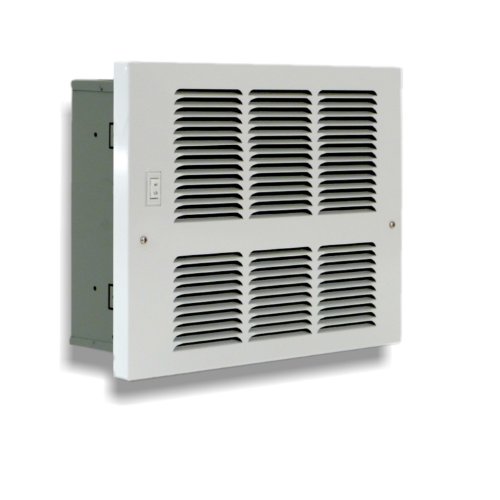
The KING H1208-AS-FS-BW is the closest fit for true zone-controlled hydronic heat, using existing hot water instead of a separate electric heating element. Its in-wall, fan-driven design offers 6,000/7,600 BTU, while tangential blowers keep operation quiet. Choose it when you can handle an in-wall installation and have a compatible hot-water source.
Best for Quiet, steady heat in kitchens, bedrooms, and greenhouses
The AB unit is the simpler hydronic choice: a wall-mounted aluminum radiator with 10 panels and side air vents for heat circulation. It produces up to 5,768 BTUs and runs quietly through a plumbing heating system. Pick it when steady radiator heat matters more than built-in fan-driven output.
Heat output Up to 5,768 BTUsPanel count 10 piecesDimensions 28.54 × 3.66 × 22.36 inWall types Load-bearing, solid brick, and concrete walls
Why it made the cut
Up to 5,768 BTUs
Quiet plumbing-system operation
Includes wall-mounting accessories and instructions
Good to know
Requires plumbing connections
Not suitable for hollow or light-partition walls
Skip it if Skip it if you need fast fan-assisted heat or don’t have a suitable solid mounting wall.
Best for Small 3–8㎡ rooms where silent operation matters
The FrauSonne panel uses 350W of infrared heat and can mount on a wall or ceiling, leaving the floor clear. Remote and app controls support 7-day and 24-hour scheduling, and the panel operates silently with overheat protection. It’s a practical alternative when you want electric panel heat rather than a water-based radiator.
Power 350WRoom range 3–8㎡Installation Wall or ceiling mountedCertification TÜV certifiedWarranty 10-year warranty
Why it made the cut
350W power use
Silent operation with low air circulation
Remote and app scheduling
Good to know
Designed for smaller 3–8㎡ rooms
Ceiling installation needs additional hardware
Skip it if Skip it if you need hydronic heat or more output for a larger room.
Best for Bedrooms and enclosed living rooms up to 250 square feet
The ROVSUN gives you a 1,500W electric heater that can mount to the wall or stand on its detachable feet. Its remote, touch panel, ECO mode, timer, child lock, and tip-over and overheat protection cover the controls most households actually use. Choose it when flexibility matters more than hydronic compatibility.
Power 1,500WRoom coverage Up to 250 square feetTemperature range 50–90°FNoise level Less than 45 dBCertification ETL-certified
Why it made the cut
Wall or floor placement
Three heat settings and 50–90°F control range
ETL-certified with tip-over and overheat protection
Good to know
Uses electric resistance heat rather than hot water
Room coverage depends on good insulation and an enclosed room
Skip it if Skip it if you specifically need a water-connected hydronic heater.
Best for Living rooms and apartments up to 400 square feet
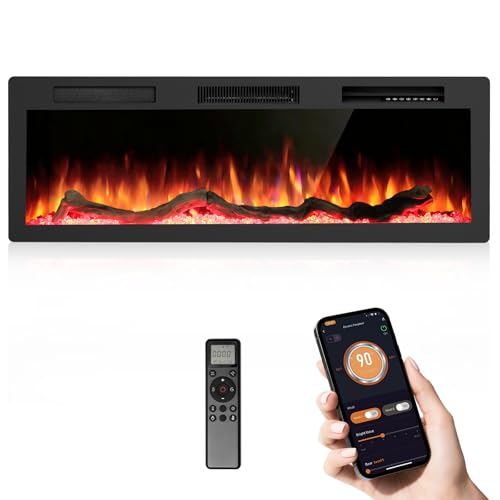
The R.W.FLAME combines supplemental heat with a recessed or wall-mounted fireplace design. Two heat modes, 750W and 1,500W, cover lighter and stronger warmth, while the remote, touch panel, smartphone controls, and Alexa support make adjustment easy. Pick it when appearance and flexible controls matter as much as wall-mounted heat.
Dimensions 50L × 17.32H × 5.71W inHeating modes 750W and 1,500WRoom coverage Up to 400 square feetTemperature range 59–95°FFlame settings 12 flame/flame bed colors
Why it made the cut
750W and 1,500W heating modes
Wall-mounted or recessed installation
Remote, touch, smartphone, and Alexa controls
Good to know
Supplemental zone heat only
Fireplace opening and wall preparation need careful measuring
Skip it if Skip it if you want a true hydronic radiator or a plain heating panel.
A wall mounted hydronic heater uses hot water moving through a heat exchanger, so there’s no fuel flame burning in the room. That separates it from a wall mounted gas heater or wall mounted natural gas heater, which needs the correct venting, combustion air and carbon monoxide protection; gas wall heaters for home heating are a different category.
For a wall mounted heater with blower, the fan pushes room air across the hot water coil and raises room temperature faster. A passive radiator gives up airflow for quieter, steadier heat. The KING H1208-AS-FS-BW is the fan-driven choice at 6,000/7,600 BTU, while the AB Wall-mounted Radiator Heater with 10 Panels is a passive aluminum radiator rated at 5,768 BTU.
Check
Fan-driven hydronic
Passive radiator
Heat delivery
Moves air across a hot water coil
Radiates and convects naturally
Room response
Faster response
Slower, steadier response
Sound
Fan noise when operating
Nearly silent
Installation form
Often compact and in-wall
Commonly surface mounted
Best fit
You want quicker recovery
You value quiet, even heat
Both need a compatible hot-water source; neither is a plug-in electric heater.
Wall structure and piping access decide more than the product photo does. An in-wall unit needs a suitable cavity, framing clearance and a path for supply and return pipes; a surface-mounted radiator needs a wall that can support its weight and exposed piping. Confirm the planned location before ordering, especially if the wall is masonry, heavily insulated or crowded with wiring.
Gas heater confusion
Natural gas heater pros and cons belong to a separate decision: gas can provide strong heat, but combustion, venting and carbon monoxide controls add installation work. Don’t substitute a gas wall heater for a hydronic unit just because both hang on a wall.
Confirm Before Ordering
A boiler or other hot-water source that can supply the heater
Wall type, framing and whether the unit will be in-wall or surface mounted
Supply and return piping access at the planned location
Room dimensions and insulation condition
Whether you prefer fan-assisted recovery or quiet passive heat
If the cabinet and piping plan are still unclear, compare the broader hydronic heater wall cabinet insights before buying; the useful distinction is the heating system behind the grille, not the word “heater” in the title.
From HeaterGuides · our own guidePage 4 sets boilers beside every other system, side by side.Heating System Upgrade PlannerChoose between a heat pump, a furnace, a boiler or a hybrid with your own numbers, and hire the right installer.Every system compared side by side25 questions for contractors, red flagsRunning-cost, payback and quote calculator (Excel)$14.99$9.99Get it for $9.99See what's inside and watch the 2-minute video →16-page printable PDF + Excel calculator · instant download · 30-day refund
Sizing And Running Cost For Real Rooms
To size a wall mounted hydronic heater for a room, compare the room’s heat loss with the unit’s output: the KING offers 6,000/7,600 BTU, while the AB radiator offers 5,768 BTU. How big of a wall mounted heater do you need? Start with the higher-output KING when the room needs faster recovery, but don’t treat its BTU number as a guarantee for a poorly insulated room.
A leaky room can feel cold beside a correctly sized heater because outdoor air keeps replacing warmed air. An uninsulated wall cavity can also pull heat away, so windows, exterior walls, ceiling height and insulation matter alongside floor area. The best wall mounted heater for a large room may be a larger system or a second heat zone rather than one small cabinet working overtime.
Worked example
Say your room is 12 × 14 feet, or 168 square feet, with average insulation and one exterior wall. The KING’s 6,000 BTU setting may suit a lower heat-loss room, while its 7,600 BTU setting gives more recovery capacity; a contractor or the boiler designer should confirm the heat-loss calculation before you order.
Room12 × 14 ft, 168 sq ft
KING output6,000/7,600 BTU
AB output5,768 BTU
A wall mounted heater’s cost to run depends on the boiler or water-heating system feeding it, so hydronic cost can’t be calculated from the cabinet’s BTU rating alone. Fuel type, boiler efficiency, circulation time and your local fuel rate all matter.
12.5 A
A 1,500 W electric wall heater draws
At 120 V, 1,500 W ÷ 120 V is about 12.5 A, so it has a very different circuit and cost profile from a hydronic cabinet.
Heater
Watts
Per hour
Per day (8 h)
Per month (30 days)
1,500 W electric wall heater
1,500 W
26¢
$2.04
$61.20
Calculated at 17¢ per kWh. Example only: 8 hours per day, 30 days, and an assumed electricity rate of $0.17 per kWh. Hydronic fuel cost requires your heating system’s fuel and efficiency data.
Safety And Certification Checks Before You Buy
The dangers of a wall mounted gas heater are carbon monoxide, fire, gas leaks and an installation that sends combustion products into the room. Safe wall mounted gas heaters are indoor-rated, installed exactly as listed, and protected by the required flue, ventilation and working CO alarm; a hydronic heater has hot water in its heat exchanger and doesn’t burn gas in the room.
A wall mounted propane heater is safe only when the model is approved for indoor use and its oxygen-depletion and ventilation requirements are met. Vent-free natural gas heaters and other vent-free gas appliances aren’t the same as hydronic wall heaters, and local states or cities restrict or prohibit them. Check local code before buying.
Gas installation
A store usually doesn’t hook up a wall mounted gas heater. A licensed gas fitter or plumber normally connects and tests the gas line, while the utility may need to inspect, unlock or approve service under local rules. Don’t connect the appliance yourself.
A flued wall mounted gas heater is installed by confirming the appliance listing, locating the approved wall penetration, fitting the flue through the wall with its required clearances, sealing and supporting it, then testing combustion and safety controls. The exact flue route belongs to the manual and local code, not a guess based on a similar-looking heater.
Hydronic wall heaters are a plumbing job in most places because the supply and return water lines, isolation valves and connections must be installed and tested. Any 240 V electrical work or fixed wiring belongs to a licensed electrician; even a 120 V fan connection should follow the installation instructions and local rules.
Before ordering
Confirm solid framing or masonry can carry the heater and piping; hollow or weak partitions usually need reinforcement.
Check the manual for clearances to curtains, furniture, insulation and service access.
Look for the exact model’s recognized safety certification or listing rather than assuming every unit in a product category has one.
Confirm local plumbing, gas, electrical and venting requirements before cutting the wall.
The wall matters
A heater can be correctly certified and still be a poor installation if the mounting screws land in weak material, insulation blocks required airflow, or piping cannot be serviced. Have the installer inspect the wall before the unit arrives.
Quiet Heat Or Faster Heat
A wall mounted heater with a blower warms a room faster, while a passive wall mounted radiator usually runs quieter and changes the room temperature more gradually. The KING’s tangential blowers move heat away from its hydronic heat exchanger quickly; the AB Wall-mounted Radiator Heater with 10 Panels relies more on radiant and natural convective transfer.
Expect a soft-breeze sound from a fan-driven unit, especially when the thermostat calls for heat. The AB radiator has fewer moving parts and a simpler sound profile, but quiet operation usually means slower room response. That tradeoff matters in a bedroom, nursery or office more than it does in a workshop.
A wall mounted ventless heater or wall mounted natural gas heater vent free is a fuel-burning appliance, not a hydronic radiator, so its combustion and ventilation rules are different. A wall mounted gas fired heater may respond quickly, but it needs the correct flue or approved indoor ventilation arrangement and a CO alarm.
Good for
KING for faster heat circulation and active zone control in a room already connected to hot water.
AB radiator for quiet operation, simpler hardware and steady background heat.
Product 4, the 350W Infrared Space Heater with Thermostat, for a small plug-in electric heating zone.
Product 5, the ROVSUN Wall-Mounted Heater with Remote Control, for buyers who want plug-in electric controls rather than hydronic plumbing.
Not for
Fan-driven heat adds sound and moving parts.
Passive radiator heat takes longer to change the room temperature.
Product 4 and Product 5 are electric alternatives, not replacements for a hydronic supply and return loop.
Choose by room use
Pick the KING when you want heat moved across the room soon after the thermostat calls. Pick the AB when low noise matters more than quick recovery; choose Product 4 or Product 5 only if running a plug-in electric heater fits the room and its electrical setup.
What To Do Before Ordering
For most existing hot-water systems, the best wall mounted hydronic heater is the KING H1208-AS-FS-BW; a wall mounted gas heater or wall mounted natural gas heater is a separate vented-combustion project, not a drop-in hydronic replacement. If your home has no usable hot-water loop, stop and choose a plug-in electric heater instead.
Check before clicking buy
Confirm the heat source, measure the wall opening and verify the wall construction. Those three checks prevent the expensive kind of weekend project.
1
1. Confirm the heat source
Find the boiler or hot-water supply and return lines, then check the heater’s required water connections and electrical supply. Call a licensed plumber for new piping, valves or loop connections. Call an electrician for a new circuit, hardwired controls or other 120V work.
2
2. Measure the actual wall
Record the opening width, height and depth from the manufacturer’s installation sheet, then locate studs and check for pipes, wiring and insulation behind the wall. An in-wall unit such as the KING needs a suitable cavity; a surface-mounted AB radiator may fit a wall that cannot accept a cabinet.
3
3. Pick the correct path
With an existing hot-water loop, have a plumber confirm the connection points before ordering. For a new hydronic install, schedule the plumber first and the electrician if the unit needs new 120V service. With no plumbing access, choose a listed plug-in wall heater instead—never improvise water lines or combustion venting.
Questions People Ask
What is the difference between a wall mounted hydronic heater and a wall mounted gas heater?
A hydronic heater uses hot water from a boiler or other heating system, while a gas heater burns fuel at the wall unit. Hydronic models avoid room combustion and usually need water piping; gas models need approved venting or must meet local rules for vent-free operation.
Can I install a wall mounted hydronic heater myself?
Most installations are professional jobs because the unit needs correctly sized water connections, shutoffs, and possibly electrical wiring for a blower. Have a licensed plumber or HVAC professional handle the hydronic loop, then follow the heater manual for mounting and clearances.
Which is quieter: a fan-driven hydronic wall heater or a radiator-style unit?
The radiator-style unit is quieter because it has no blower moving air. A fan-driven model usually spreads heat faster, but you may hear the fan start, stop, and change speed as the thermostat calls for heat.
How do I size a wall mounted hydronic heater for a bedroom or office?
Start with the room’s heat loss, including its size, insulation, windows, exterior walls, and local winter conditions. Compare that result with the heater’s output: the KING provides 6,000 or 7,600 BTU, while the AB radiator provides 5,768 BTU; oversizing can cause short cycling and uneven temperatures.
Do I need a plumber or a gas company to hook it up?
A plumber or HVAC professional normally connects a hydronic heater to the hot-water system; a gas company is only involved when gas piping or a gas appliance is part of the job. Any required 120- or 240-volt wiring should be handled by a licensed electrician where local rules require it.
Are ventless wall mounted gas heaters safe for home heating?
Ventless gas heaters can be restricted or banned by local code, and they still add combustion products and moisture to the room. Use only a listed indoor-rated model where permitted, follow its ventilation requirements, keep a working carbon monoxide alarm nearby, and don’t treat an oxygen-depletion sensor as a substitute for code-compliant installation.
Before you go · a welcome giftGet the Heating System Upgrade Planner for $4.99Choose between a heat pump, a furnace, a boiler or a hybrid with your own numbers, and hire the right installer. Normally $14.99; your welcome price saves $10.00. We'll email your link right now.or buy it now for $9.99 without the gift →One email with your link now. We never share your address.



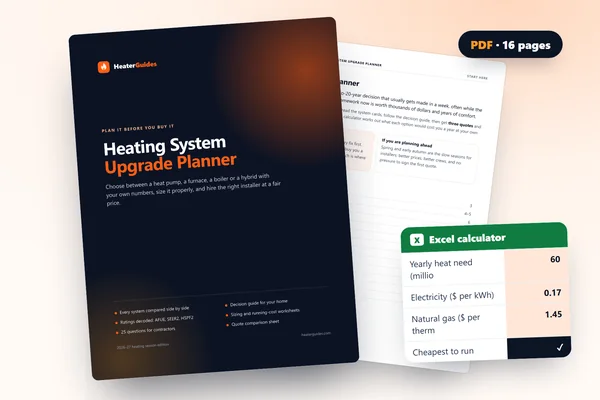 Heating System Upgrade PlannerChoose between a heat pump, a furnace, a boiler or a hybrid with your own numbers, and hire the right installer.Every system compared side by side25 questions for contractors, red flagsRunning-cost, payback and quote calculator (Excel)