Yes, you can use a portable electric heater with a generator if the generator can supply its wattage. For most people, the 1,500 W DREO heater with 70° oscillation is the most useful pick for spreading heat around a room. Check the generator’s running capacity, then add every other appliance before plugging in the heater.
Key takeaways
A 1,500 W heater draws about 12.5 A at 120 V; check the generator’s running-watt rating.
The DREO oscillating heater is the broad-room pick; the quieter 34 dB DREO is better for a bedroom or office.
Plug an electric heater directly into a suitable outlet, never an extension cord or power strip.
A 1,500 W heater running 8 hours uses 12 kWh; multiply by your electricity rate to estimate grid cost.
A fuel-burning heater needs indoor-use approval, required ventilation and a working carbon monoxide alarm.
The common mistake is treating a generator’s advertised peak watts as power you can use continuously. A heater can trip an overloaded generator when other loads are running, leaving you without heat and power.
Heaters Worth Considering for Generator Backup
#1Best for Shared Rooms
DREO 1500W Oscillating Space Heater
Best for Spreading heat through a bedroom, basement or living room
The 70° oscillation moves warm air across a wider area, while ECO mode switches between 1000W and 1500W to maintain your set temperature. It’s a practical first pick if your generator can handle the heater alongside your other loads.
Power 1000W or 1500WOscillation 70°Noise 34dBTimer 12 hours
Why it made the cut
70° oscillation for broader heat coverage
ECO mode offers 1000W and 1500W settings
ETL-certified with tip-over and overheat protection
Good to know
At 1500W, it draws a substantial share of a generator’s capacity
Skip it if Skip it if you need to reserve generator capacity for essential appliances and can’t spare the heater’s draw.
Best for A bedroom or office where low fan noise matters
This 1500W model runs at 34dB and has a thermostat adjustable from 41°F to 95°F in 1°F increments. Its remote and multiple heating modes make it easier to adjust from across the room, though the generator still needs room for its full electrical load.
Power 1500WNoise 34dBThermostat range 41°F to 95°FTimer 12 hours
Why it made the cut
34dB operating noise
Thermostat adjusts in 1°F increments
Remote control and multiple heating modes
Good to know
No oscillation angle is specified in the product data
Skip it if Skip it if you want wide-angle heat movement across a shared room.
Best for Personal heat in a small office or home space
At 6.22 × 6.22 × 8.78 inches and 3.53 pounds, this heater is easy to move where you need it. Low mode draws 950W, less than its 1500W high setting, and the ETL certification, tip-over protection and overheat protection add useful safeguards.
Power settings 950W and 1500WListed heating area 108–130 square feetDimensions 6.22 × 6.22 × 8.78 inchesWeight 3.53 pounds
Why it made the cut
950W low and 1500W high settings
Compact size and built-in handle
ETL certified with tip-over and overheat protection
Good to know
Listed heating area is 108–130 square feet
Skip it if Skip it if you need heat to cover a larger room.
Best for A living room or office where radiant warmth is useful
The DR-968 combines infrared quartz heat with PTC air circulation, so it provides radiant warmth while moving heated air around the room. Its thermostat, remote and 12-hour timer are convenient, but the 1500W draw needs to fit your generator’s available capacity.
Power 1500WHeat output Up to 5,200 BTUListed room size Up to 1000 square feetNoise 39 dB
Why it made the cut
Infrared quartz and PTC dual heating
UL certified with tip-over and overheat protection
Remote control and 12-hour timer
Good to know
Runs at 1500W
Skip it if Skip it if your generator can’t spare 1500W for a heater.
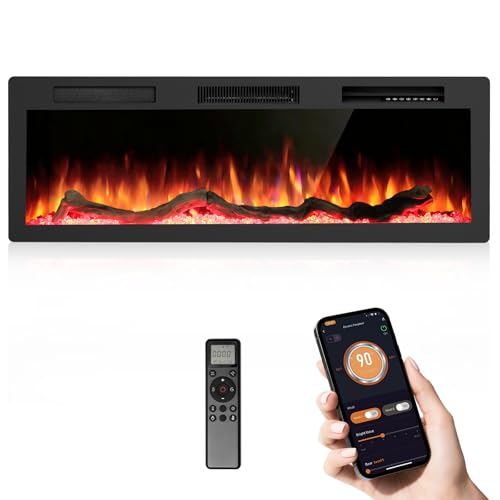
Best for Supplemental zone heat in a bedroom, living room or apartment
This wall-mounted or recessed fireplace offers 750W and 1500W heating modes, so you can choose its lower or higher setting based on available generator capacity. It also works as a flame display without making the heat setting its only feature.
Power settings 750W and 1500WListed room size Up to 400 square feetDimensions 50 × 17.32 × 5.71 inchesTemperature range 59°F to 95°F
Why it made the cut
750W and 1500W heating modes
Wall-mounted or recessed installation
Adjustable temperature from 59°F to 95°F
Good to know
Installation is less portable than a freestanding space heater
Skip it if Skip it if you need a heater you can quickly move between rooms.
Yes, you can use a plug-in heater with a generator if its running capacity covers the heater and every other load operating at the same time. Check running watts, not just the larger peak-watt number, before you plug it in.
1,500 W = about 12.5 A
At 120 V
That’s the draw for a typical 1,500 W heater, including the 1,500 W models in this guide. The heater label and generator manual are the final checks for your equipment.
1
Check the heater label
Find its wattage and voltage. Use the listed wattage for your load calculation; don’t assume a lower setting unless the heater identifies its wattage at that setting.
2
Check generator capacity
Find the generator’s running-watt rating in its manual. Peak watts are for brief starting demand, not a continuous heater load.
3
Add simultaneous loads
Total the heater’s watts and the wattage of appliances that will run at the same time. Leave capacity for the generator’s own operating needs as its manual directs; don’t use an invented percentage as a substitute.
Load
Watts to count
1,500 W heater
1,500 W
Other appliances running at the same time
Use each appliance’s label or manual
Total
Add the simultaneous loads
Compare the total with the generator’s running capacity.
Running Versus Peak Watts
A generator’s peak rating doesn’t mean it can supply that power continuously. Use the running rating for the heater and other steady loads.
For example, a 1,500 W heater plus a 700 W appliance means 2,200 W of simultaneous load. Compare that total with the generator’s running capacity and instructions before connecting anything. A product’s stated room coverage tells you about the heater’s intended use; it doesn’t establish generator compatibility or guarantee comfortable heat throughout your room.
Choose the Heater That Fits the Room
Choose by how the heater spreads heat and how you’ll use the room; these are plug-in electric heaters, not generator engine-block or battery-warming kits. For a broader spread, pick product 4 for its 70° oscillation; for quieter operation, product 3 is listed at 34 dB; product 2 is the compact personal-heating option.
Product
Useful distinction
Best fit
R.W.FLAME Smart Electric Fireplace 50 Inch
Wall-mounted or recessed supplemental fireplace; 750 W and 1,500 W heat settings
A fixed supplemental heat source, not a portable outage heater
R.W.FLAME Small Space Heater
1,500 W ceramic heater
Compact personal heating
DREO Space Heater, Portable Electric Heaters for Indoor Use
34 dB listed noise level
When quieter operation matters
DREO Space Heaters for Indoor Use with Thermostat
1,500 W; 70° oscillation
Spreading heat across a wider area
Dr Infrared Heater DR-968 Portable Space Heater
Portable electric heater
A portable option; check its label for wattage and controls
Compare the listed details, then confirm the exact model’s label and manual.
Product 4’s oscillation moves warm air across a wider area, which makes it the clearest pick here when one person isn’t the only one needing heat. Product 3 suits a room where fan noise is a concern, while product 2 makes more sense for heating the space around one desk or chair. Check the exact heater’s wattage against the generator’s running capacity before choosing.
Treat Coverage as a Guide
Manufacturer-listed coverage is guidance, not a promise that a drafty or poorly insulated room will feel warm throughout. Match the stated coverage to the space you’ll actually use, and expect room conditions to affect comfort.
Estimate Runtime and Cost Before an Outage
Without a generator, your practical options are blankets and warm clothing, closing off unused rooms, or a battery power station that can handle the heater’s continuous output and energy demand. A 1,500 W heater draws 1.5 kW, so it can drain many battery stations quickly; check both the station’s continuous-watt rating and usable energy before connecting it.
Generator runtime and heater electricity use are different calculations: runtime depends on the generator’s fuel use and load, while the heater’s energy use depends on its wattage and hours running. Without fuel-consumption data for your generator, there’s no sound way to estimate its gallons used or hours of runtime.
Heater
Watts
Per hour
Per day (8 h)
Per month (30 days)
1,500 W heater
1,500 W
26¢
$2.04
$61.20
Calculated at 17¢ per kWh. At an assumed $0.17 per kWh, this shows the grid-electricity cost for 8 hours a day over 30 days—not the cost of generator fuel.
Keep the costs separate
For one night, 1.5 kW × 8 hours = 12 kWh; at $0.17 per kWh, that’s $2.04 on grid power. A generator’s fuel cost depends on its fuel use at the actual load, which varies by model and operating conditions.
Don’t improvise combustion heat
Never use a car, grill or outdoor heater to heat a home. If you’re considering a fuel-burning heater, use an indoor-rated model only and follow its ventilation requirements; the next section covers the safety rules.
Use Electric Heaters Without Adding Risk
Connect the heater directly to a wall outlet supplied by the generator, and keep the generator itself outdoors. An extension cord or power strip can overheat under a high heater load, while generator exhaust can bring deadly carbon monoxide into the home.
Keep generator exhaust outside
Never run a generator in your home, garage or another enclosed space. Place it outdoors and follow its manual’s instructions for location and exhaust; carbon monoxide can enter living areas even when the generator is outside. Keep a working CO alarm in service.
Before running the heater
Plug it straight into a properly rated generator outlet—never an extension cord or power strip.
Keep at least 3 feet of clearance from furniture, bedding, curtains and other combustibles.
Choose a model with tip-over and overheat protection. Look for a UL, ETL or CSA listing when the product documentation states one; don’t assume every model has it.
Don’t leave a portable heater running while you sleep or leave the house unless the manufacturer says that model is designed for unattended use.
If you use a fuel-burning heater instead, choose an indoor-rated model, provide the ventilation its manual requires and keep a working CO alarm in service. Outdoor, patio and construction heaters aren’t substitutes for indoor-rated equipment.
Keep Heat in One Room During an Outage
Keep the heater in one occupied room and reduce the space it serves; that lowers the generator load only when the heater’s thermostat can cycle off as the room reaches its set temperature.
1
Choose one room
Close doors to unused rooms and keep the heated room’s door shut. Block obvious drafts around doors and windows without covering vents or creating a trip hazard. A smaller heated area gives the heater less space to serve, though the exact savings depend on the room, weather and insulation.
2
Set the heater sensibly
A resistance space heater turns electricity into heat. On high, a 1,500 W model uses its full rated power while the heating element is running. Once the room reaches the thermostat setting, the heater can cycle off and reduce its operating time.
3
Recheck the load
Watch the generator when the refrigerator, sump pump or another high-demand appliance starts. Starting demand can be higher than the appliance’s normal running demand. If the generator overloads, switch off nonessential loads before restoring anything else.
Worked Example
Say a generator is already supplying a refrigerator and lights when you add a 1,500 W heater. The heater adds its full 1,500 W while operating on high, so the generator must have that much running capacity left, plus enough margin for the refrigerator’s startup demand. If the generator overloads when the refrigerator starts, turn off nonessential lights or another load and let the heater cycle instead of adding more equipment.
Heater on high1,500 W while running
Thermostat responseHeating time can fall after the room rea
Load to watchRefrigerator or sump-pump startup
The Fireplace Exception
The R.W.FLAME Smart Electric Fireplace 50 Inch has a listed 400 sq ft supplemental-heating claim, but that doesn’t make it an outage-ready portable choice. It requires installation and an adequate electrical supply, so use a portable heater designed for the room and available outlet instead.
Frequently Asked Questions
Can I run a 1,500-watt space heater from a generator?
Yes, if the generator has enough running capacity after every other active load is counted. A 1,500-watt heater draws about 12.5 amps at 120 volts, and its resistive heating element usually doesn’t create a large startup surge.
What should I check before plugging a heater into a generator?
Check the generator’s running watts, the heater’s wattage, and the combined load of refrigerators, pumps, lights, and chargers. Use the generator’s proper outlet, inspect the heater cord, and plug the heater directly into the generator supply—never an extension cord or power strip.
What are other ways to heat a room without a generator?
A heated blanket or pad uses far less electricity than a space heater, provided you follow its auto-shutoff instructions and don’t fold or bunch it while on. Closing doors to unused rooms, layering clothing, and using a battery power station rated for the appliance are other options.
Can I use a propane heater indoors during a power outage?
Only an indoor-rated propane heater belongs indoors, and it needs the ventilation specified by its manual, a working carbon monoxide alarm, and an oxygen-depletion sensor where required. Never bring a patio, construction, or other outdoor-rated heater inside; check local rules before using a vent-free gas heater.
Can I leave a space heater running while I sleep?
Don’t leave a portable space heater running while you sleep unless the manufacturer specifically says the model is designed for that use. Shut it off before bed, keep three feet of clearance, and never cover it or place it where bedding can reach the grille.