5 Game-Changing TV Mounts for Above Your Fireplace You Need to See
On this page 8 sections
- TV Mounts for Above Fireplace Comparison
- Top TV Mounts for Fireplace Installations
- How Motion Range and Mechanism Affect Comfort
- Managing Fireplace Heat to Protect Your TV
- Sizing Your TV and Mount for Mantel and Room
- Planning Installation: Studs, Cable Management, and Safety
- Maintaining and Adjusting Your TV Mount Over Time
- Frequently Asked Questions
TV Mounts for Above Fireplace Comparison
| Rank | Model | Best for | TV Size Range | Weight Capacity | Motion Type | Price |
|---|---|---|---|---|---|---|
| 1 | MantelMount MM340 Pull Down TV MountBest Overall | Most users with 44″ to 80″ TVs needing versatile motion and heat safety | 44″-80″ | 20 to 90 lbs | Pull down, swivel | Check today’s price |
| 2 | MantelMount MM540 Pull Down TV MountBest for Heat Safety | Users needing a mount with advanced heat sensors and paintable covers | 44″-80″ | 20 to 90 lbs | Pull down, swivel, tilt | Check today’s price |
| 3 | MantelMount MM815 Motorized TV MountBest Motorized | Users wanting remote-controlled, automated swivel and drop for TVs up to 90″ | 45″-90″ | 20 to 115 lbs | Motorized drop and swivel | Check today’s price |
| 4 | MantelMount MM700 Premier Pull Down TV MountBest Heavy Duty | Heavier TVs 50″ to 90″ needing soundbar support and strong construction | 45″-90″ | 30 to 115 lbs | Pull down, swivel, tilt | Check today’s price |
Mounting a TV above a fireplace can save space and create a clean focal point, but it requires the right mount to manage heat and viewing angle challenges.
Choosing the wrong mount risks TV damage, awkward neck strain, or an unstable installation that wastes money and comfort.
Top TV Mounts for Fireplace Installations

MantelMount MM340 Pull Down TV Mount
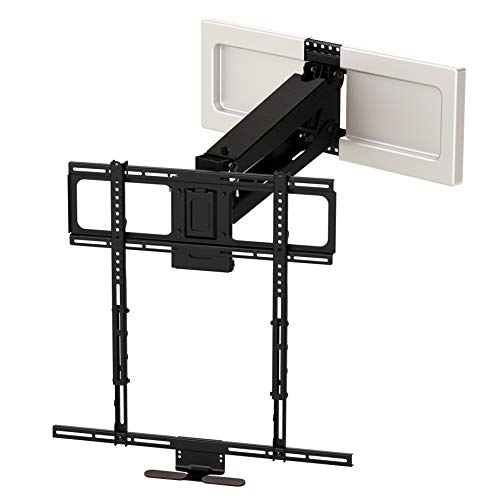
MantelMount MM540 Pull Down TV Mount

MantelMount MM815 Motorized TV Mount

MantelMount MM700 Premier Pull Down TV Mount
How Motion Range and Mechanism Affect Comfort
Pull-down mounts are the best motion type for TVs above fireplaces because they let you lower the screen to eye level for comfortable viewing. Unlike a full motion swivel mount, which pivots the TV side to side but usually doesn’t adjust height much, pull-down mounts provide vertical travel that eases neck strain.
Full motion mounts add swivel and tilt but can be harder to position precisely above a fireplace mantel. Pull-down mounts combine tilt and swivel with vertical movement, offering a better range for adjusting the TV height and angle.
Motorized mounts go a step further by letting you control the position with a remote, sometimes with preset memory positions. This means you can lower or raise your TV without climbing on a stool—handy if your mantel is tall or awkwardly placed.
Adjustable stops on mounts prevent the TV from pulling down too far or swinging into the mantel or wall, avoiding damage and making daily use smoother. They also help keep the TV stable in any position, critical in a frequently used living room.
The MantelMount MM340, for example, offers pull-down motion with smooth swivel and tilt, plus adjustable stops that protect both your TV and your mantel. It strikes a good balance between flexibility, safety, and ease of use for most homes.
Managing Fireplace Heat to Protect Your TV
Fireplace heat can damage your TV if they’re too close without protection. Heat rises, so the TV above the fireplace mantel gets the brunt of it. Pull-down mounts keep the TV a safer distance and angle, reducing heat risk and improving your view. Fixed mounts keep the TV flush but offer less heat clearance. The key is to measure mantel height and check the fireplace’s maximum surface temperature to pick a mount that keeps your TV safe.
A mantel alone won’t shield your TV from this rising heat. Heat tends to rise around the edges of the mantel, exposing the TV to damaging temperatures even if the mantel deflects some heat downward.
Heat sensors on some mounts monitor the temperature near your TV and can trigger warnings or lock the mount’s motion if it gets too hot. Adding a heat shield above or behind the TV helps redirect or absorb heat before it reaches sensitive components.
Gas fireplaces produce between 20,000 and 35,000 BTUs per hour, depending on venting type. Direct vent models direct most heat outside, while ventless units release more heat indoors, increasing risk to a TV mounted above.
Installing a heat shield involves mounting a non-combustible barrier with air gaps to dissipate heat effectively. It can be metal, stone, or specialized paneling designed for fireplaces. Proper installation is crucial to avoid trapping heat or violating fire codes.
Combining a mount like the MantelMount MM340 with built-in heat sensors and adding a heat shield provides a practical solution to protect your TV and ensure safe operation above your fireplace.
Sizing Your TV and Mount for Mantel and Room

The ideal TV size above a fireplace mantel is between two-thirds and seven-eighths of the mantel’s width. This range ensures the TV looks balanced and doesn’t overwhelm the space or leave awkward gaps. For example, if your mantel is 60 inches wide, aim for a TV between 40 and 52.5 inches wide.
Your TV’s size and weight must match the mount’s limits. Mounts rated for up to 80 inches TVs usually support weights up to 100 pounds, but check the specs. Also, measure your mantel width and room layout to avoid blocking airflow or crowding the wall. For instance, a 70-inch TV usually needs a mount rated for at least 70 pounds and a mantel wide enough to clear the screen edges by a few inches.
Pick a TV size that fits your mantel width, ideally between two-thirds and seven-eighths of that width. For example, a mantel 60 inches wide suits TVs from 40 to 52 inches diagonally, balancing scale and viewing comfort.
Calculating vertical travel needed for pull-down mounts depends on your mantel’s height and seating position. Say your mantel is 48 inches tall and your eye level seated is 42 inches. You’ll want a mount with at least 6 inches of downward travel to bring the screen to eye level comfortably. MantelMount models like the MM340 provide adjustable travel ranges to fit varied mantel heights.
Consider mantel height and seating distance together: a higher mantel means more vertical travel is needed. Also, the farther you sit, the higher the TV can be without discomfort. For typical living rooms with seating 8 to 12 feet away, keeping the TV center below 70 inches works well.
Planning Installation: Studs, Cable Management, and Safety
Locate studs behind the wall for secure mounting; drywall anchors won’t hold a heavy TV safely. Plan cable routes before drilling to avoid damage and keep cords hidden. Confirm your mount has integrated cable management or plan to add covers. Double-check local codes for fire clearance and electrical safety near fireplaces, especially with gas models. A licensed pro should handle any electrical or gas line work.
In-wall cable management for a fireplace TV is best done with UL-listed power extension kits and low-voltage wiring that complies with fire safety codes. Avoid running standard electrical cables inside walls without proper conduit or certification, as this poses fire risks, especially near heat sources.
UL certification for TV mounts guarantees the product meets minimum safety standards for strength and durability. Choose mounts with UL listing and a solid warranty to protect your investment. MantelMount mounts often carry these certifications, reassuring you that their mechanisms are tested for repeated use and heat exposure.
Installation difficulty is moderate to high for above-fireplace mounts because you must handle heavy TVs at height and work around heat shields or mantel structures. Two installers are recommended to safely hold, align, and secure the TV and mount. Attempting this solo increases the risk of damage or injury.
Plan cable runs before drilling. Use flexible conduits or cable raceways designed for in-wall use to prevent damage and maintain fire resistance. Keeping cables neat and protected extends their life and preserves your room’s aesthetics.
Maintaining and Adjusting Your TV Mount Over Time
Most guides stop at installation, but a mount above a fireplace needs attention over time. Heat cycles expand and contract metal parts, pull-down mechanisms accumulate dust in pivot joints, and settling walls shift alignment. Check tension adjustment screws every few months and retighten any that have loosened. If the mount drifts when you release it or won’t hold position, the tension bolts near the arms need a quarter turn clockwise.
Thermal sensors, when present, should be tested before heating season. Models with automatic heat lockouts trigger around 100 to 104°F. Light a fire, let the mantel warm for twenty minutes, then try to pull the mount down; if it moves freely when it shouldn’t, the sensor has failed and the TV risks heat exposure. Replace the sensor or the mount.
Cable strain is the second-most-common failure point. Every time you pull the TV down and push it back, HDMI and power cables flex. Inspect them twice a year for kinks, cracks in the insulation, or tight bends that could short. Leave a service loop—an extra foot of slack coiled behind the mount—so cables arc gently instead of pulling taut.
Fireplace soot and dust settle on the mount’s moving parts. Wipe pivot points and the pull-down track with a dry microfiber cloth every few months. If the manufacturer recommends it, apply a drop of silicone lubricant to each joint; never use WD-40 or oil-based products near electronics. Clean painted covers with a damp cloth only; harsh cleaners crack the finish and expose bare metal to moisture.
Realigning the mount takes five minutes and solves most comfort problems. Stand at your usual seat, pull the TV to eye level, and adjust tilt until you see no glare. Mark that position with a piece of tape on the arm so you can return to it quickly. If your seating changes or the mount sags over time, repeat the process. A mount that isn’t adjusted drifts into poor angles, and a TV too close to heat suffers panel damage you won’t notice until pixels fail.
For mounts with the smoothest long-term adjustment, see our guide to the best pull down TV mounts.