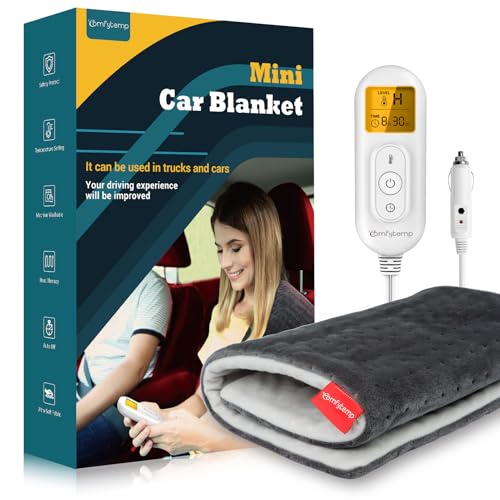
For most readers, Product 1 is the best travel comfort pick because it plugs into a 12V/24V vehicle, has 4 heat settings, and gives back-seat passengers 110 inches of cord to work with.
The essentials
Product 1 is the best overall if you want warmth in a car or SUV and need a long cord for passengers.
Product 2 is the quietest choice for discreet, disposable heat under clothes.
Product 3 and Product 4 make sense only if you want battery-powered clothing, not a pad or blanket.
Check the power source first: USB, 12V/24V, or a rechargeable battery changes where the product can work.
For any heated travel gear, auto shut-off and a secure fit matter more than headline warmth.
Say you’re driving 3 hours on a cold night and the cabin never quite warms up; a plug-in blanket in the car can make that trip bearable without cranking the heater the whole way. Product 1 fits that job better than a loose heating pad, because the power source, cord length and auto-off timing are built for vehicles.
Travel comfort is usually one of three things: warmth in a car, short-term relief on your lower back, or a heated layer you can wear outside. Pick the tool that matches the trip, not the one with the biggest marketing claim.
Best for Back-seat passengers who want adjustable heat from the vehicle
Product 1 is the easiest fit for road trips because it plugs into a 12V/24V vehicle cigarette lighter socket and has 4 heat settings. Its 110-inch cord can reach back-seat passengers, while 11 auto-off timers help you avoid leaving the blanket heating longer than planned. The 12″x24″ size suits targeted warmth rather than full-body coverage.
Vehicle fit 12V/24V cars, SUVs, and trucksHeat settings 4Auto-off timers 11Cord length 110 inchesSize 12″x24″
Why it made the cut
Works with 12V/24V cars, SUVs, and trucks
4 heat settings and 11 auto-off timers
110-inch cord reaches the back seat
Machine washable after removing the controller
Good to know
The 12″x24″ format covers only part of your body
Needs a vehicle cigarette lighter socket
Designed for vehicle use rather than cord-free wear
Skip it if Skip it if you need warmth while walking around away from the vehicle.
Best for Travelers who need discreet lower-back and hip warmth without a cord
Product 2 wraps around the lower back and hips, so it stays in place while you move through a trip. Its thin adhesive design needs no cord or bulky heating pad, and it provides up to 8 hours of heat while worn with extended comfort after removal. Choose it for targeted warmth, not for warming your whole torso or a passenger seat.
Pack size 5 countHeat while worn Up to 8 hoursExtended comfort Up to 16 hoursCoverage Lower back and hipsPower source No cord
Why it made the cut
Cord-free and discreet under clothing
Contoured fit stays around the lower back and hips
Up to 8 hours of heat while worn
Drug-free design
Good to know
Covers the lower back and hips only
Single-use wrap format limits reuse
No adjustable heat settings are listed
Skip it if Skip it if you want reusable gear or adjustable heat from a vehicle outlet.
Best for Travelers who need heated coverage across the torso, collar, and sleeves
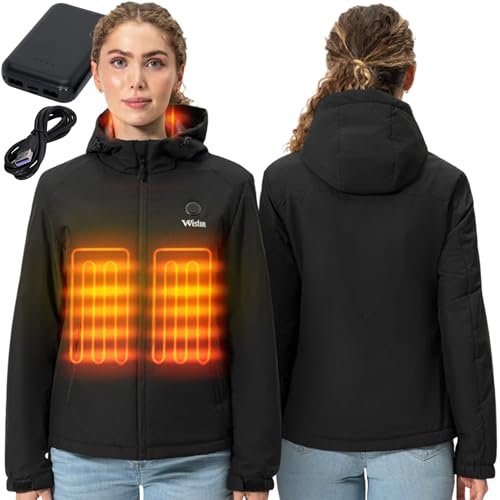
Product 3 spreads heat across 26 zones covering the collar, chest, back, abdomen, and sleeves. Four control systems let you adjust the collar, belly, back, and arm panels separately, while 3 temperature modes keep the jacket useful for commuting and outdoor stops. It runs from a standard 5V power bank, but the power bank isn’t included.
Heating zones 26Control systems 4Temperature modes 3Power source Standard 5V power banksHood Detachable
Why it made the cut
26 heating zones cover the upper body and sleeves
Four control systems separate heating areas
Detachable hood and tall collar block wind
Water-resistant shell and machine-washable heating elements
Good to know
Power bank is not included
A jacket is less convenient than a small wrap for seated travel
The many heating zones may be more coverage than you need
Skip it if Skip it if you don’t want to carry and recharge a separate 5V power bank.
Best for Women who want rechargeable heat in a tailored, water-resistant jacket
Product 4 uses 4 heating zones and a rechargeable 7.4V, 4800mAH battery for outdoor travel without a vehicle outlet. Three adjustable heat levels reach up to 130°F, and the wind- and water-resistant design suits winter errands and stops between destinations. Its tailored fit favors a closer silhouette over maximum coverage.
Heating zones 4Battery 7.4V, 4800mAH rechargeableHeat levels 3Maximum temperature Up to 130°FSize M
Why it made the cut
Rechargeable battery is included
4 heating zones and 3 adjustable heat levels
Wind- and water-resistant design
Machine washable after removing the battery
Good to know
Four heating zones cover less area than Product 3
The listed version is a women’s medium
Requires battery charging before travel
Skip it if Skip it if you need sleeve heating, broader zone coverage, or a different size.
Best for Men who want a rechargeable heated coat for cold outdoor travel
Product 5 provides 4 heating zones, 3 heat levels, and a rechargeable 7.4V, 4800mAH battery for outdoor travel away from a car outlet. The wind- and water-resistant coat is listed to withstand temperatures down to -25°C, giving it a stronger cold-weather focus than a light travel layer. A battery and charger are included, and the coat is machine washable after the battery is removed.
Home comfort solutions for Travel Comfort here means portable heat for cars, transit rides, and short outdoor stops—not a room heater you carry from the house. The guide compares three useful formats: a vehicle blanket, an adhesive heat wrap, and a heated jacket or coat.
The Comfytemp 12V/24V Car Electric Blanket for Back Neck Should… suits a passenger who wants broad warmth from the vehicle outlet. Drivers should skip a blanket if its fabric or cord could interfere with the wheel, pedals, shifter, or seat belt. An adhesive wrap such as ThermaCare Advanced Lower Back & Hip Heat Wraps is better for discreet, brief relief at a desk or during a stop, but skip it if you need hands-free heat across your torso and arms. Heated jackets and coats are for wearing while you move; desk-bound travelers who only want short lower-back or hip relief should skip the bulk and choose a wrap.
Format
Power source
Best match
Skip it if…
Vehicle blanket
12V/24V vehicle outlet
Passenger warmth in a car, van, or transit seat
You’re the driver and need completely clear controls
Adhesive heat wrap
Disposable heat
Brief, discreet lower-back or hip warmth
You need reusable, hands-free coverage while moving
Heated jacket or coat
7.4V battery
Hands-free warmth during outdoor stops or travel
You only need a short, focused desk-side heat session
The power source often decides the right product before the feature list does.
If you searched for comfort glow heater reviews or who makes Comfort Glow heaters, that is a separate product search from this guide. No Comfort Glow heater or verified manufacturer information is included in the supplied product data, so check the heater’s rating label and manual rather than assuming it is one of these travel garments.
In short
Choose the vehicle blanket for a seated passenger, a disposable wrap for brief discreet relief, and a heated jacket or coat when you need warmth while keeping both hands free. The power sources are different enough that a wall-outlet heater comparison won’t answer this travel question.
Match The Heat To The Stop
For a long ride, start with the vehicle blanket or a rechargeable garment. For a short stop outside the car, a heated jacket or coat avoids managing a blanket; for a quick lower-back pause, the adhesive wrap has less gear to carry.
Choose The Right Power Source First
Choose the outlet or battery before comparing heat settings, because the power source decides where your travel gear can actually work. Product 1, the Comfytemp 12V/24V Car Electric Blanket, is made for a vehicle socket; Product 3, the Heated Jacket with 26 Heating Zones, uses a 5V USB power bank; Products 4 and 5 use 7.4V rechargeable batteries; Product 2 uses air-activated disposable heat.
If you searched for portable water heater travel, travel tea water heater, travel water heater kettle, travel water element, or travel hot water heater, you’re looking for a different kind of product. A blanket or heated jacket won’t heat drinking water. Use a kettle made for travel, with a compatible wall outlet and vessel; the best travel water heater kettle is the relevant buying guide. A travel water element also needs the maker’s specific instructions for the container and power source, so don’t improvise with a vehicle socket, USB bank, or hotel-room outlet.
Power source
Product
Where it makes sense
12V/24V vehicle plug
Comfytemp car blanket
Back seat or front passenger seat
5V USB power bank
Heated Jacket with 26 Heating Zones
Walking, waiting, or short outdoor stops
7.4V rechargeable battery
Weston women’s or men’s heated jacket
Wearable heat away from a socket
Air-activated disposable heat
ThermaCare lower-back and hip wraps
Targeted warmth without charging
Match the power source to the place you’ll use the gear.
USB has a catch
A USB heating pad or jacket is handy only when a working power bank or USB source is available. Check the bank before leaving; a jacket with no charged battery is just a jacket with ambitious wiring. A car blanket belongs in the vehicle unless its manual specifically permits another power source, so don’t plug it into a hotel-room outlet with an adapter.
Worked example
Say a back-seat passenger needs heat during a road trip, while another traveler will walk from a parking lot to an outdoor stop. The passenger should choose Product 1 because the vehicle provides the 12V/24V socket and its cord reaches the rear seat. The walking traveler should choose Product 4 or Product 5 because the 7.4V rechargeable battery travels with the garment. Product 3 can serve the same walking job if a charged 5V power bank is already packed; without that bank, its USB power source disappears.
Pick by power source
Choose Product 1 for heat tied to a running vehicle.
Choose Product 3 for USB power you already carry.
Choose Products 4 or 5 for wearable heat away from the car.
Choose Product 2 when you need no charging or plug.
Skip it when
Vehicle-plug gear stays tied to the vehicle.
USB gear depends on a working power bank or USB port.
Rechargeable jackets need charging before the trip.
Disposable wraps can’t be recharged.
Check Coverage, Fit, And Control
Coverage and control matter more than a raw heat claim for travel comfort: the right product warms the body part you actually feel getting cold without making the rest of the trip awkward. A comfort zone space heater warms room air, while wearable gear puts heat against your body. For homes, a temperature comfort zone is a thermostat setting and insulation question, not a useful way to compare a blanket with a jacket.
Heat travels from warmer material toward cooler air and skin, but it doesn’t spread evenly through a vehicle or coat. That is why a targeted wrap can feel warmer at your lower back than a higher-powered garment that leaves that area uncovered. Searches for De’Longhi Comfort Temp or delonghi comfort temp usually point to room-heater temperature control; those features don’t describe coverage from travel gear.
Product
Coverage
Control
Best fit
Comfytemp 12V/24V Car Electric Blanket
Body-part coverage for the back, neck and shoulders
4 heat settings, 11 timers and memory
Repeat commuters and back-seat passengers
ThermaCare Advanced Lower Back & Hip Heat Wraps
Targeted lower-back and hip coverage
Fixed heat behavior
Discreet relief for one area
Heated Jacket for Men Women 26 Heating Zones Hooded Puffer
Full-garment coverage
3 heat settings
Broad warmth while moving outdoors
Weston Women’s Heated Jacket
Full-garment coverage
3 heat settings
Wearable coverage with a women’s cut
Weston Men’s Heated Coat
Full-garment coverage
3 heat settings
Coat-level coverage while outside
A smaller wrap is more discreet; a jacket gives you better mobility.
Use The Memory Setting
Product 1’s memory function suits a repeat commute because you can return to your preferred setting instead of starting the search through four heat levels each trip. The 11 timer choices also help limit how long the blanket runs.
Myth
More heating zones always mean better travel comfort.
Fact
More zones can spread warmth across a garment, but fit and the cold spot you need to cover matter more. Pick Product 2 for one stubborn area, Product 1 for seated vehicle use, and Products 3, 4 or 5 when you need warmth while walking or standing.
See What Travel Heat Will Cost You
Electric travel heat is cheap to run when the load is small, but you need the wattage and hours to calculate it instead of guessing from the product name. The formula is watts ÷ 1,000 × hours × your electricity rate; at 17 cents per kWh, 100 W for 4 hours uses 0.4 kWh and costs about 7 cents.
Heater
Watts
Per hour
Per day (4 h)
Per month (1 days)
100 W heated garment
100 W
1.7¢
6.8¢
6.8¢
1,500 W plug-in heater comparison
1,500 W
26¢
$1.02
$1.02
Calculated at 17¢ per kWh. Assumes four hours of use and electricity at $0.17 per kWh. The 1,500 W heater is a room-heating comparison, not a recommendation for a vehicle.
Worked Example
Say a 100 W heated garment runs for 4 hours. Divide 100 by 1,000 to get 0.1 kW, multiply by 4 hours for 0.4 kWh, then multiply by $0.17 for about $0.07. A 1,500 W heater running for the same four hours uses 6 kWh, so the room-heater comparison is 15 times the electrical load.
Heated garment100 W × 4 hours = 0.4 kWh
Electricity rate$0.17 per kWh
Estimated garment costRuns about 4 hours on a typical car batt
Battery runtime varies
Why the battery label matters
Runtime depends on the battery pack and heat level. Check the manufacturer’s runtime at each setting instead of dividing a guessed number by the garment’s heat output; a battery’s capacity and the setting both change the answer.
Product 2’s disposable heat wraps are bought per use rather than billed by electricity, so compare the per-use cost with how often you’ll need one. A low-watt travel pad can be calculated the same way once its wattage is listed; don’t borrow the 100 W garment assumption for a pad without that specification.
A travel water heater, travel water kettle or travel water element solves a different problem: heating water, not warming your body. For hotel coffee or tea, see the best travel water heater kettle; an improvised heating element is a poor substitute for a purpose-built appliance.
Buy The One That Is Safe To Wear Or Plug In
Choose travel heat with overheat protection, a clear auto-off timer, and a form that stays put; the strongest setting is rarely the safest fit for a moving car or crowded bus. If your Comfort Furnace infrared heater won’t come on, check its outlet, breaker, power switch, thermostat setting, and remote batteries before buying travel gear—don’t bypass a safety control, and use the manual or a qualified technician if it remains dead.
For the best compact travel heating pad, Product 2, ThermaCare Advanced Lower Back & Hip Heat Wraps, makes sense when you need small, temporary warmth without a vehicle outlet or battery. For the best travel-size heat protectant, use the product’s supplied cover or a manufacturer-approved pouch; never wrap a powered heater in clothing or bedding, where heat can build up.
Fit And Skin Safety
Heated clothing should fit close enough to keep the heating zones in place, but it must not bunch under a backpack strap or seat belt. Disposable wraps are for temporary use, and they should stay off irritated or damaged skin unless the package specifically says otherwise. Heated products provide comfort; they don’t treat a medical condition. Persistent pain belongs with a clinician.
Before You Plug In
Look for overheat protection, a clearly stated auto-off timer, and safety certification or listing information from the manufacturer.
For vehicle gear, use a stable 12V or 24V plug that fits firmly, keep the cord untangled, and route it away from the pedals, door hinge, and seat track.
Keep a heated jacket’s wiring and battery pocket flat under the seat belt; stop using it if the cord, connector, battery, or fabric is damaged.
Use disposable heat wraps only as directed on the package, and remove them if the skin becomes painful, unusually red, or numb.
In short
Pick the form that suits the trip: Product 1 fits a vehicle with its vehicle plug and long cord, a wrap suits short targeted warmth, and a heated jacket suits time spent outdoors. A lower setting that stays correctly positioned beats maximum heat trapped under a strap.
More Questions, Answered
Which travel comfort product is best for long car trips?
Product 1 is the strongest pick for long car trips because it works with 12V and 24V vehicle power, offers four heat settings, and gives back-seat passengers 110 inches of cord. Keep the cord routed away from the pedals, seat rails, and seat-belt latch, and unplug it when you leave the vehicle.
Is a USB heating pad or a 12V car blanket better for travel?
A 12V car blanket is usually better for warming your lap or a larger section of your body during a drive, while a USB pad suits a smaller area and works with a compatible power bank. Check the pad’s input requirements before connecting it: a power bank may not provide enough output for every heated product.
How long do disposable heat wraps last?
Most disposable heat wraps are designed to provide warmth for several hours, but the exact duration depends on the product and how you use it. Read the package before applying one, place it only where the instructions allow, and remove it if the skin becomes painful, unusually red, or numb.
Can I wear a heated jacket on a plane or use it with a power bank?
You can usually wear the jacket through a trip, but airline rules control whether its battery or power bank may fly and where it must be stored. Keep a removable battery in your carry-on unless the airline gives different instructions, protect its terminals, and disconnect the heating circuit during boarding if the crew asks.