Skip to content
HeaterGuides
Electric

Best Solar Pool Heaters for Inground Pools: What Works

On this page 8 sections
  1. Pool Heater Comparison
  2. Best Pool Heating Picks for Inground Pools
  3. Choosing a Solar Heater for an Inground Pool
  4. How to Choose a Pool Heater by Capacity and Climate
  5. Pool Heater Running Costs and Solar Savings
  6. Installation, Electrical Requirements and Pool Safety
  7. Before You Order a Pool Heater
  8. Frequently Asked Questions
Short answer
For most inground pools, the practical pick depends on what you mean by solar: Goplus is the true solar heater here, while products 3–5 are electric heat pumps that draw heat from outdoor air. A solar cover can reduce heat loss, but it does not replace a heater when you need active temperature control.
Key takeaways
Choose the Goplus only if you want a solar collector and can verify its pressure and pump requirements.
Products 3–5 are electric heat pumps, not solar-powered heaters; each requires 220–240 V power.
A solar cover reduces evaporation and heat loss but is not an active pool heater.
Match heat-pump capacity to pool volume, climate and desired swim season, not BTU output alone.
Get electrical and plumbing requirements checked before ordering a hardwired pool heat pump.

Pool Heater Comparison

RankModelBest forHeat outputPool capacityPowerPrice
1Pool owners who want a sunlight-powered heater5.4–7.2°F stated temperature increase—Solar-poweredCheck price
2Pools up to 30,000 gallons that need heating and cooling119,000 BTUUp to 30,000 gallons220–240 VCheck price
3Pool owners seeking an inverter heat pump with app control100,000 BTU—220 VCheck price
4Pools up to 21,000 gallons where low operating noise matters75,000 BTUUp to 21,000 gallons220 VCheck price
5Indoor supplemental room heat, not pool heating750 W or 1,500 W——Check price

The common mistake is buying a solar blanket or a small solar collector expecting it to heat a large pool quickly. A cover mainly slows heat loss; a collector needs sun, circulation and enough area to move the pool temperature meaningfully.

These are the closest listed options for pool heating, not five equivalent solar heaters. The distinctions matter: three picks require 220–240 V power, while the Goplus uses a solar collector and the product data does not specify a pool-size capacity.

Best Pool Heating Picks for Inground Pools

#1True Solar Pick
Goplus Solar Pool Heater

Goplus Solar Pool Heater

Best for Pool owners who want a sunlight-powered heater
Product 1 uses a black coil under a transparent dome to absorb sunlight, with a stated temperature increase of 5.4–7.2°F. Foldable legs let you angle it toward the sun, and rotatable hose connectors make plumbing the unit more flexible. You can connect up to three heaters in series, as the product recommends.
Heating source Solar-poweredStated temperature increase 5.4–7.2°FSeries connection Up to 3 heatersHose connectors 90° rotatable
Why it made the cut
Solar-powered water heating
Adjustable angle with foldable legs
Can connect up to three units in series
Good to know
Heating depends on available sunlight
Product data gives no pool-capacity figure
Skip it if Skip it if you need predictable heating through cloudy weather or want a heater sized by pool volume.
#2Large-Pool Heat Pump
DOEL 119,000 BTU Inverter Heat Pump

DOEL 119,000 BTU Inverter Heat Pump

Best for Pools up to 30,000 gallons that need heating and cooling
Product 3 is an electric heat pump, not a solar heater: it draws heat from outdoor air and lists a 119,000 BTU output and a maximum COP of 15.8. Wi-Fi control lets you set temperatures and schedules, while heating and cooling modes suit owners who want to manage water temperature in both directions.
Heat output 119,000 BTUPool capacity Up to 30,000 gallonsPower 220–240 VMaximum COP 15.8Ambient operating range 5°F to 109.4°F
Why it made the cut
Listed for pools up to 30,000 gallons
Heating and cooling modes
Wi-Fi app and onboard LCD controls
Good to know
Requires a 220–240 V supply
Uses electricity rather than solar power
Skip it if Skip it if you specifically want a solar-powered heater or don’t have a suitable 220–240 V supply.
#3Heating And Cooling
AQUASTRONG 100,000 BTU Heat Pump

AQUASTRONG 100,000 BTU Heat Pump

Best for Pool owners seeking an inverter heat pump with app control
Product 4 lists 100,000 BTU output and a COP of 15.8, with heating and cooling modes for adjusting water temperature. Its app and control panel support scheduling and energy-use tracking. The product also lists auto-defrost, useful in conditions that trigger frost buildup.
Heat output 100,000 BTUPower 220 VCOP 15.8Heating range 47–104°FCooling range 47–83°F
Why it made the cut
Heating and cooling modes
App control with scheduling and energy-use tracking
Auto-defrost system
Good to know
Requires 220 V power
Product data does not state a pool capacity in gallons
Skip it if Skip it if you need a solar heater or want a clearly stated gallon-capacity rating before choosing.
#4Quiet Operation
Vidapool 75,000 BTU Heat Pump

Vidapool 75,000 BTU Heat Pump
Best for Pools up to 21,000 gallons where low operating noise matters
Product 5 lists a 75,000 BTU output for pools up to 21,000 gallons and supports heating and cooling. Its inverter control is described as switching to low-power operation once the set temperature is reached, and the listed noise level is as low as 36 dB. The available product data is incomplete, so confirm the electrical and installation details before ordering.
Heat output 75,000 BTUPool capacity Up to 21,000 gallonsPower 220 VCOP 12Controls Smart Wi-Fi control
Why it made the cut
Listed for pools up to 21,000 gallons
Heating and cooling modes
App control and a stated noise level as low as 36 dB
Good to know
Requires 220 V power
Product data does not give an ambient operating range
Skip it if Skip it if you need a solar-powered heater or need a complete set of installation specifications before buying.
#5Not For Pool Heating
R.W.FLAME 50-Inch Electric Fireplace

R.W.FLAME 50-Inch Electric Fireplace

Best for Indoor supplemental room heat, not pool heating
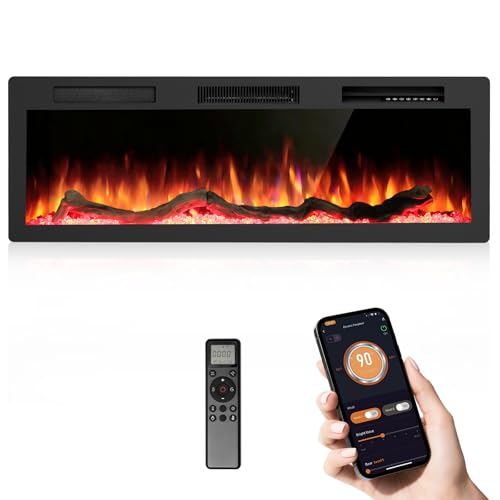
Product 2 is an indoor electric fireplace, so it doesn’t belong in a pool-heater shortlist. Its two heat settings are 750 W and 1,500 W, with remote, touch-panel, app, and voice controls. Consider it only for indoor room heating and flame effects.
Heat settings 750 W and 1,500 WInstallation Wall-mounted or recessedControls Remote, touch panel, smartphone, or AlexaSupplemental zone heating Up to 400 square feet
Why it made the cut
Two heat settings
Remote, touch-panel, app, and voice controls
Good to know
Not a pool heater
Designed for indoor installation
Skip it if Skip it for any pool-heating job.

Choosing a Solar Heater for an Inground Pool

best solar pool heaters for inground pools: Choosing a Solar Heater for an Inground Pool

The best solar pool heaters for inground pools use solar collectors connected to the pool’s circulation system; among the products here, the Goplus Solar Pool Heater Above Ground is the only solar-powered heater. Products 3–5 are electric air-source heat pumps that draw heat from outdoor air, so they aren’t solar heaters. The right pick depends on whether you want sunlight-driven heating or powered temperature control.

A solar collector uses sunlight to warm pool water as the pump circulates it through the collector and back to the pool. Results depend on sun exposure, collector area, water flow and weather. Goplus lists a 5.4–7.2°F temperature increase, but that claim isn’t a guaranteed result for every pool or set of conditions.

OptionWhat it doesWhat to expect
Solar collectorUses sunlight to warm circulating pool waterHeating varies with sun, collector area, flow and weather
Solar coverHelps capture sunlight and reduces evaporation and heat lossCan help retain warmth, but doesn’t actively heat the water
Electric air-source heat pumpUses electricity to move heat from outdoor air into pool waterPowered heating; not solar-powered
A solar cover can support a heater, but it isn’t a substitute for one.
Myth
A solar pool cover is a solar heater.
Fact
A cover can capture some sunlight and slow heat loss by reducing evaporation, but it doesn’t actively control water temperature or guarantee a target. For active heating, you need a collector or a powered heater.

Product 5 is a 75,000-BTU heat pump listed for pools up to 21,000 gallons, with a 12 COP, Wi-Fi and a claimed 36 dB operating level. Those specs describe an electric heat pump, not a solar unit. Product 2, the R.W.FLAME electric fireplace, is indoor room-heating equipment and has no place in a pool-heater comparison.

How to Choose a Pool Heater by Capacity and Climate

For a lower-cost true-solar option, choose the Goplus; for active heating with a rated output, compare the electric heat pumps by pool volume, local temperatures and electrical fit. The main limits are substantial: these heat pumps require 220 V or 220–240 V, and their listed capacity or maximum COP doesn’t guarantee the same performance in your weather.

ModelRated output and pool claimPower and temperature rangeOther listed specs
Product 3119,000 BTU; up to 30,000 gallons220–240 V; ambient operation 5°F–109.4°F; heating range 47–104°FMaximum COP 15.8
Product 4100,000 BTU; 20 × 43 × 48-inch pool dimensions220 V; heating range 47–104°F55 dB; COP 15.8
Product 575,000 BTU; up to 21,000 gallons220 VCOP 12; 36 dB claimed
Listed manufacturer specifications; pool dimensions are not a gallon rating.

For a larger pool, start with product 3: it lists the highest output and largest gallon capacity, provided your electrical service and climate are a fit. Product 5 has lower stated capacity and output, and may suit pools up to 21,000 gallons. Product 4 gives pool dimensions, not volume, so ask the installer to confirm compatibility instead of treating those measurements as a gallon limit.

A bigger BTU number alone doesn’t prove a heater will warm your pool faster in every climate. Heat pumps draw heat from outdoor air, so colder conditions can reduce performance; pool volume, starting temperature, desired temperature and heat loss also affect how long warming takes. Product 3 lists an ambient operating range down to 5°F, but that doesn’t promise the same heating rate across that range.

Check These Before Choosing

Pool and site fit
Confirm your pool’s volume in gallons; don’t infer it from Product 4’s dimensions.
Compare your local outdoor lows and swimming season with the unit’s stated operating range.
Decide how warm you want the water and how quickly you need it heated.
Confirm the required 220 V or 220–240 V supply and installation fit with a qualified installer.
Ask for confirmation when a listing gives dimensions but no gallon capacity.
COP and noise need context
COP is the ratio of heat delivered to electrical input under stated conditions. A maximum COP of 15.8 isn’t a cold-weather guarantee, and COP alone can’t establish your running cost without electrical input data and your local electricity rate. Product 4’s 55 dB and Product 5’s 36 dB are listed claims, not guaranteed readings after installation; location and operating conditions matter.

Pool Heater Running Costs and Solar Savings

Operating-cost comparisons are incomplete here because products 3–5 don’t provide electrical input watts; their BTU and COP claims alone can’t produce an exact hourly or monthly bill estimate. Use the heater’s rated input power or measured consumption, then calculate: electrical kW × running hours × your electricity price per kWh.

Say a hypothetical heater draws 3 kW, runs 6 hours, and your rate is $0.18 per kWh: 3 × 6 × $0.18 equals $3.24 for that day. That example isn’t a claim about the Swimming Pool Heater for Above Ground and Inground Pool up…, the Swimming Pool Heater for Above Ground and Inground Pool 20’…, or the Vidapool Swimming Pool Heater Electric Pool Heat Pump 21000…; check each unit’s input rating before doing the math.

The Goplus Solar Pool Heater Above Ground has no stated electrical consumption for its collector, so the collector itself doesn’t provide enough information for a power-cost estimate. It still depends on the pool circulation pump, and longer pump run times mean more electricity, even while sunlight supplies the heat.

Solar heating depends on sun, weather and available collector heat, while a heat pump uses electricity to move heat from outdoor air into pool water. A heat pump can provide active heating when conditions suit its operating range, but neither approach delivers the same result in every season or temperature.

Myth
Solar heating means zero operating cost.
Fact
The collector may use no stated electrical power, but the circulation pump still costs money to run. A cover can also reduce evaporation and heat loss, so the heater has less heat to replace; the available facts don’t support a specific percentage or dollar saving.
Cost inputWhat to use
Electric heat pumpRated input watts or measured consumption
Solar collectorCirculation-pump electricity and added run time
Your billPrice per kWh, including the rate you actually pay
Pool coverReduced heat loss, with savings that depend on use and weather
Don’t substitute a heat-output BTU figure for electrical input.

For a reliable estimate, record the unit’s input rating, expected hours per day and your bill’s kWh rate; a plug-in meter can help only if the equipment is designed for that connection. Solar saves fuel at the collector, not necessarily every dollar tied to circulation.

Installation, Electrical Requirements and Pool Safety

The main risks are an incorrect 220–240 V connection, mismatched pool plumbing, unstable solar mounting and pressure or flow outside the heater’s limits. Products 3–5 specify 220–240 V or 220 V, so they don’t belong on a standard household outlet.

Use a licensed electrician
Have a licensed electrician verify the circuit, disconnect and local-code requirements before ordering a 220–240 V or 220 V heater. Don’t improvise wiring, adapters or extension-cord arrangements around pool equipment.

Pool plumbing must follow the heater manual for connection size, flow, bypass arrangement and pressure. If the listing doesn’t clearly match your pump, filter and plumbing, have a pool professional confirm compatibility before you cut a hose or place the order.

Goplus pressure wording needs clarification
The Goplus Solar Pool Heater Above Ground listing states a maximum pressure of 0.8 kPa and separately uses 35 PSI wording. Those specifications conflict by a wide margin; ask the seller or manufacturer which limit applies before operating it.
Verify before buying
A licensed electrician has confirmed voltage, circuit capacity, disconnect and local-code requirements for products 3–5.
The heater manual matches your pump flow, plumbing connections, bypass plan and allowable pressure.
The Goplus pressure specification has been clarified in writing before operation.
Solar collectors will receive useful sun, have stable mounting and safe hose routing.
Electrical connections and equipment will be installed as the manufacturer and applicable pool electrical code require.

Solar collectors need a sound mounting surface and hose route that won’t kink, rub against sharp edges or create a trip hazard. Pump compatibility matters because insufficient flow can prevent useful heat transfer, while excessive pressure can damage equipment.

Keep every electrical connection installed according to the manufacturer and applicable pool electrical code, with the required separation and protection for the site. Water and improvised wiring are a poor pairing, even when the forecast looks friendly.

Before You Order a Pool Heater

These recommendations were selected by comparing the available product specifications with the needs behind a solar pool heater search; no measured performance data is available. The listed details identify Goplus as the solar option and products 3–5 as electric heat pumps. They don’t give Goplus capacity data or product 4’s gallon capacity.

That means the earlier picks cannot be validated from the information available. A listed feature or claimed rating doesn’t establish how a heater will perform in your pool, climate or desired swimming season. Check the current manual and listing before buying, including dimensions, electrical requirements and compatibility with your pool volume.

Recommendations are editorial selections based on fit, not guarantees of performance or statements about promotions. The information here does not establish whether advertising or affiliate arrangements apply, so don’t treat a product’s place in the guide as proof that it has been independently tested or verified.

Listings, product specifications and installation conditions can change. No update schedule can be confirmed from the available information, so recheck the model details and local installation requirements at purchase time. If your pool size, local climate or target swimming season has changed, reassess the fit rather than relying on an earlier pick.

Before You Buy
Confirm the exact model and read its current manual.
Match the heater’s stated capacity to your pool volume; if capacity is missing, ask the seller or manufacturer before ordering.
Check dimensions, electrical requirements and pool-system compatibility.
Confirm local installation requirements for your location.
Reconsider the choice if your pool size, climate or desired swimming season differs from what you planned for.
What The Specifications Can Tell You
Product data is the evidence available for these recommendations, and important details are missing. Treat the guide as a starting point for comparing options, not as confirmation that a heater will deliver a particular temperature or season length.

Frequently Asked Questions

Are solar pool heaters worth it for an inground pool?
They can be, if you have a sunny roof or ground area for collectors and can accept slower, weather-dependent heating. A solar cover helps keep the heat you gain, while an electric heat pump gives you more active control but uses electricity.
Can a solar pool heater warm an inground pool without a cover?
Yes, but an uncovered pool loses heat faster, especially overnight and in wind. A solar cover reduces that loss, so the heater has less work to do; it won’t create heat on its own.
What size pool is the 119,000-BTU heat pump designed for?
The 119,000-BTU rating alone doesn’t establish a reliable pool-size limit. Check the product’s stated pool capacity and compare it with your pool volume, desired temperature rise, local climate and swimming season.
Can I install a 220-volt pool heat pump myself?
Only if you’re qualified to do the electrical work and local rules allow it; otherwise, hire a licensed electrician. Confirm the unit’s voltage, breaker and wiring requirements before purchase, and follow its plumbing and clearance instructions.
Does a pool heat pump work in cold weather?
It can, but heating output and efficiency fall as outdoor air gets colder because the pump draws heat from that air. Check the manufacturer’s minimum operating temperature and capacity data for the conditions where you’ll use it.
How should I verify a pool heater’s energy use before buying?
Ask for electrical input watts or amps at the specified voltage, plus performance data at stated air and water temperatures. BTU output and COP alone don’t give you an exact bill; calculate kWh from input watts ÷ 1,000 × run hours, then multiply by your electricity rate.

Joye Editor

HeaterGuides covers home heating, water heating and HVAC: how the equipment works, what it costs to run, and how to use it safely.

More in Electric