For most road trips, Product 2 is the best pick because it works with 12V and 24V vehicle systems and heats drinks in a compact immersion format. Choose Product 3 for an RV tank, Product 4 for on-demand claims, and skip Product 1 because it is an indoor space heater, not a water heater.
What to remember
Pick Product 2 for a compact 12V or 24V drink heater.
Use Product 3 when you need a 10-liter RV tank and have suitable AC power.
Treat Product 4’s 10L/min and 5-second claims as specifications to verify before installation.
Never power an immersion element dry, and never leave it heating unattended.
Product 1 is an indoor space heater and should not be used to heat water in a car.
A car water heater has to match the vehicle’s voltage before it matches your coffee routine. A small mismatch can leave you with a dead fuse, a hot plug or an appliance that never gets useful heat.
The biggest number here is 1,500W: Product 3 can draw that much on 120V AC, while its 200W DC mode is far gentler on a 12V system. That difference matters more than a clever product name.
The 5 Best Car Water Heaters for Road Trips
#1Best Overall
QUBEIO 12V/24V Immersion Heater Rod
Best for Road-trip drinks in cars, trucks and RVs
Product 2 is a compact immersion heater for cups and mugs, suited to heating water, coffee, tea or soup on a road trip. Its small design is easy to store, but you must fully immerse the heating part before switching it on; dry operation is forbidden.
Voltage 1,500WFormat Immersion heating rodUses Water, coffee, tea and soupSafety notice Dry burning without liquid is forbidden
Why it made the cut
ETL certified with overheat and tip-over protection
Compact design for cups and mugs
Suitable for water, coffee, tea and soup
Good to know
Must be fully immersed before powering on
Designed for cups and mugs rather than a larger tank
Skip it if Skip it if you need a built-in RV water tank or a complete shower system.
Best for Caravans and RVs that need stored hot water
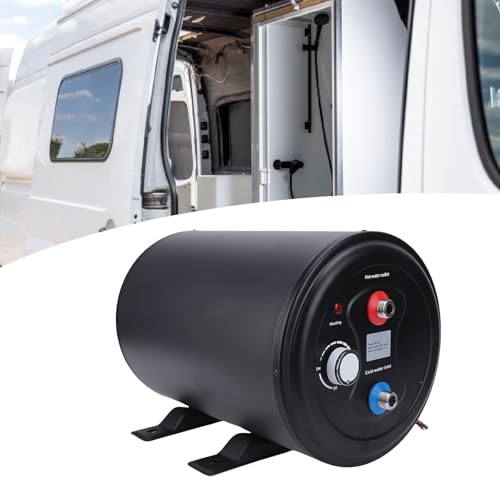
Product 3 suits an RV or caravan setup better than a mug heater because its 10-litre tank holds a larger supply of water. The double-power design offers a vehicle-power option and a household AC option, but the tank format is intended for an installed water system, not quick roadside drinks.
Voltage 12V DCPower Not specifiedCapacity 10 litresApproval CSA approved
Why it made the cut
Built-in 10-litre water tank
Offers DC and AC power options
Pressure-resistant shell structure
Good to know
Bulkier than an immersion rod
The 1500W AC mode needs a suitable AC supply
Skip it if Skip it if you only want to heat one drink from a vehicle socket.
Best for RV and camping setups seeking on-demand water
Product 4 is aimed at on-demand use, with a stated 10L/min flow rate and a 30°C to 75°C temperature range. Its 200W heating power and compact body make it easier to carry than a tank-style unit. Check the vehicle’s wiring and power source before relying on it for continuous hot water.
Voltage 12VPower 200WFormat 10L/min on-demandTemperature range 30°C to 75°CDimensions Compact design
Why it made the cut
10L/min on-demand flow claim
30°C to 75°C temperature range
Compact design for transport and storage
Good to know
Only 200W of heating power
Its installation and vehicle power requirements need checking
Skip it if Skip it if you want a simple plug-in mug heater with fewer installation questions.
Best for A compatible 12V system needing an immersion element
Product 5 is a 12V stainless steel immersion heating element with corrosion-resistant construction and several size options. It may suit a compatible tank or container, but treat it as a replacement element for an existing setup, not a ready-to-use car appliance.
Voltage 12VPower 200WMaterial Stainless steelFormat Immersion heating elementSafety detail Design takes safety factors into account
Why it made the cut
12V operation
Stainless steel construction
Several size options available
Good to know
Installation depends on the equipment it is fitted into
The product data does not describe a complete tank or control system
Skip it if Skip it if you need a finished heater that goes straight into a travel mug.
Best for Indoor air heating, not heating water in a vehicle
Product 1 is a ceramic space heater for indoor air, with a fan, thermostat and curved air outlet. Its ETL certification, overheat protection and tip-over protection don’t make it a water heater. Use it indoors with its intended power supply, never in a cup, tank or vehicle water system.
Power Low and high heat settingsFormat PTC ceramic space heaterHeating area 108-130Cord Power cord includedSafety Overheat and tip-over protection
Why it made the cut
Two heat settings
ETL certified
Overheat and tip-over protection
Good to know
Heats air rather than water
Indoor-use product
Draws far more power than the vehicle-focused options
Skip it if Skip it for any road-trip water-heating job; choose an immersion or tank water heater instead.
Top 5 Car Water Heaters That Will Change Your Road Trips Forever
Product 2 is the best fit for most road trips because its dual-voltage design works with 12V and 24V vehicle systems and heats cups, mugs and small amounts of liquid. That makes it a drink heater, not an RV water system—and your dashboard cup holder will appreciate the distinction.
Product
Best use
What to know
Upgraded Portable Car Immersion Water Heater Rod for Mug Co…
Cups, mugs and small quantities
Supports 12V and 24V vehicles; choose it for simple drink heating.
Dual Power Water Heater
RV or caravan water supply
10-liter tank with 200W DC and 1,500W AC modes; too large for a cup holder.
ACAGALA 12V Portable Tankless Water Heater
On-demand water heating
States 200W output, 10L/min flow and 30°C to 75°C range; verify plumbing, pump and power needs.
12V Water Heater 150w/200w/300w Stainless Steel Immersion H…
A bare immersion element
Available in 150W, 200W and 300W versions; it isn’t a complete kettle or protected tank.
R.W.FLAME Small Space Heater for office,1500W Ceramic Heate…
Indoor space heating
ETL-certified ceramic heater with low and high heat modes, but it isn’t made to heat water.
Match the heater to the water job before you match it to the vehicle.
Myth
Any small electric heater can warm water in a car.
Fact
A space heater such as the R.W.FLAME uses a ceramic heating system for indoor air, while an immersion heater transfers heat through a water-safe element. Never put a space heater in contact with water.
Product 3 belongs beside an RV tank or caravan plumbing because its 10-liter tank offers separate 200W DC and 1,500W AC operation. Product 4 makes a different promise: its stated 10L/min flow and 30°C to 75°C range suit an on-demand setup, but you still need to confirm the pump, plumbing connections and available power.
Product 5 is the simplest hardware and the easiest to misunderstand: the 150W, 200W and 300W choices are bare immersion elements, not a finished kettle with a tank, lid or built-in protection. For more purpose-built immersion options, compare immersion water heaters before dropping an exposed element into a travel mug.
In short
Pick Product 2 for heating a drink from a 12V or 24V vehicle. Pick Product 3 for an RV tank, investigate Product 4 before installing plumbing, and skip Product 1 for water.
From HeaterGuides · our own guideNo hot water? Page 9 is the electric flowchart: breaker, reset, thermostats, elements.Water Heater Owner's ToolkitFix the common faults yourself, keep it running for years, and know when a repair is money wasted.No-hot-water flowcharts, gas and electricFlush, anode, relief valve and descaling stepsRepair-or-replace calculator (Excel)$14.99$9.99Get it for $9.99See what's inside and watch the 2-minute video →18-page printable PDF + Excel calculator · instant download · 30-day refund
Power Use Depends on the Heater and Vehicle Supply
A 12V car water heater uses current equal to its wattage divided by voltage: a 200W model draws about 16.7A at 12V, while a 300W model draws 25A. Those loads can exceed a vehicle socket or accessory fuse, so the owner’s manual and heater instructions decide what your car can safely supply.
16.7A
200W at 12V
The calculation is 200 ÷ 12. A 300W 12V water heater rises to 25A, so the socket and fuse matter before the element ever touches water.
Product 2 is designed for both 12V and 24V systems, but the same wattage draws less current at 24V. Product 3 separates its inputs: 200W on DC for a vehicle or battery setup, and 1,500W on AC for a suitable 120V supply.
Worked example
Say you’re comparing a 200W 12V water heater with a 300W 24V car water heater. The 200W model draws about 16.7A at 12V; the 300W model draws 12.5A at 24V. Voltage changes the current, but the vehicle still needs wiring, a fuse and a socket rated for the load.
200W ÷ 12VAbout 16.7A
300W ÷ 24V12.5A
Product 3 AC mode1,500W ÷ 120V = 12.5A
At 120V AC, Product 3’s 1,500W mode draws 12.5A, which is a substantial load for an RV outlet. A USB port, cigarette-lighter socket or inverter may be unable to supply the listed wattage; check its rating instead of assuming the plug fits.
Heater
Watts
Per hour
Per day (1 h)
Per month (30 days)
Product 3 at 1,500W AC
1,500 W
26¢
26¢
$7.65
Calculated at 17¢ per kWh. Electricity estimate for 1 hour per day, 30 days, at $0.17 per kWh. Fuel and battery costs aren’t included in this electricity arithmetic.
Check the supply first
Don’t connect a 200W or 300W 12V element to a socket simply because it accepts a 12V plug. A blown fuse is the mild outcome; undersized wiring can overheat, so follow the vehicle manual and product instructions.
Immersion Heater Safety in a Car or RV
To safely use a car immersion water heater, put the element fully under the water before plugging it in, keep it supervised, and unplug it before you move it. That rule applies to the Upgraded Portable Car Immersion Water Heater and the 12V Water Heater 150w/200w/300w Stainless Steel Immersion Heater; dry operation can damage the element and create a burn or fire hazard.
1
Check the setup
Use a heat-resistant container on a stable surface, and inspect the heater and cord for damage. Keep the powered element away from plastic and hands; follow the product instructions for the required water level.
2
Heat with supervision
Keep the heater in view while it runs. Don’t leave it heating unattended, even if it has an automatic shutoff or protection feature.
3
Unplug before handling
Disconnect power before moving the container or heater. The liquid and metal element can stay hot after power is off.
For 12V immersion heater safety, a fuse and sound wiring matter as much as the heater’s built-in safeguards. Overheat, overvoltage, overload and dry-burn protection can reduce specific risks, but they don’t replace a suitable fuse, an intact cord or supervision.
Before switching on
The element is fully immersed and clear of the container’s sides.
The container is heat-resistant and stable.
The cord and plug are intact, with no exposed wire or loose connection.
You can stay beside the heater until it’s unplugged.
Myth
Built-in protection makes an immersion heater safe to leave alone.
Fact
Protection can help limit a fault, but it can’t guarantee safe operation in every setup. Keep the heater supervised and use the protections specified in its instructions.
Certification claims differ across these products: the R.W.FLAME Small Space Heater is identified as ETL certified, and the Dual Power Water Heater as CSA approved. The supplied product data doesn’t establish the same certification for Products 2, 4 or 5, so don’t assume they carry one.
Don’t guess at formula temperature
Don’t heat baby formula by guesswork with an immersion element. Follow the formula container’s preparation directions or medical guidance for preparation and temperature; uneven heating can leave hot spots.
The Vehicle Socket and Fuse Decide What Works
A car can run a 300W water heater only if the vehicle’s outlet, fuse and wiring are rated for the load; check the vehicle manual before connecting anything. A 300W setting draws about 25A at 12V, so Product 5 isn’t a casual accessory for an ordinary socket unless the manufacturer specifies a suitable connection.
There’s no universal fuse size for a 12V water heater: use the vehicle and heater manufacturers’ instructions for the outlet, circuit and required protection. Don’t replace a fuse with a higher-rated one to stop it blowing; that can leave the wiring unprotected.
1
Read the vehicle manual
Confirm the accessory outlet’s voltage, fuse rating and maximum load. Compare those limits with the heater’s voltage and wattage before plugging it in.
2
Use only an approved connection
If the heater’s load exceeds the outlet rating, don’t improvise with a different plug or bypass the fuse. Follow the heater manufacturer’s wiring instructions; have any dedicated wiring installed by a qualified professional.
3
Keep water systems separate
A portable drink heater isn’t a plumbed RV water system. Don’t improvise the Dual Power Water Heater or ACAGALA 12V Portable Tankless Water Heater into vehicle water lines; follow their instructions and applicable local requirements.
25A
Current at 12V for a 300W heater
That draw is why Product 5’s highest setting needs a verified, manufacturer-approved power connection rather than an assumed socket capacity.
An inverter still draws from the battery
You can use an inverter for an AC car water heater only if the inverter and vehicle-side wiring are suitable for the load. A 1,500W AC heater still demands substantial DC power from the vehicle and may require dedicated wiring installed by a qualified professional; an inverter doesn’t create free power.
Anode rods, gas orifice changes, gas-to-electric conversions and electric water-heater fuses concern fixed residential water heaters, not these portable car products. Don’t apply household heater repair steps to a vehicle drink heater.
Questions People Ask
How do you change an anode rod in a Rheem water heater?
First confirm your Rheem model’s manual identifies a replaceable anode rod and where it sits; some models use a combination hot-water outlet and anode. Shut off the water and the heater’s energy source, relieve tank pressure, then use the specified replacement part. If the rod is seized or the tank starts leaking, stop and call a plumber.
How do you change the fuse in an electric water heater?
Most residential electric water heaters are protected by a breaker, not a user-replaceable fuse in the heater. Turn off the breaker before inspecting anything, and don’t bypass a blown fuse or install one with a higher rating. Repeated trips or blown fuses point to a fault that needs diagnosis by a licensed electrician.
Can you change a gas hot water heater into an electric heater?
Yes, but it usually means replacing the water heater and adding or upgrading a suitable electrical circuit, not swapping a burner. A licensed plumber can handle the water connections, while a licensed electrician should assess the circuit and 240V work. Keep the gas appliance’s venting intact until it has been safely disconnected.
How do you change an orifice on a hot water heater?
A gas water-heater orifice must match the exact model and fuel type; the wrong part can cause unsafe combustion or carbon monoxide. Shut off the gas and leave the replacement and burner checks to a qualified technician. Don’t drill, enlarge or substitute an orifice.
When do you need to change a solar water heater tank?
Replace the tank if it leaks, is badly corroded, or can’t maintain hot water after the system’s other components have been checked. A failed collector, pump or controller may be repairable without replacing the tank. Have a solar-water-heating technician inspect the system before approving a tank replacement.
Before you go · a welcome giftGet the Water Heater Owner's Toolkit for $4.99Fix the common faults yourself, keep it running for years, and know when a repair is money wasted. Normally $14.99; your welcome price saves $10.00. We'll email your link right now.or buy it now for $9.99 without the gift →One email with your link now. We never share your address.




 Water Heater Owner's ToolkitFix the common faults yourself, keep it running for years, and know when a repair is money wasted.No-hot-water flowcharts, gas and electricFlush, anode, relief valve and descaling stepsRepair-or-replace calculator (Excel)