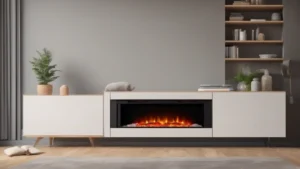
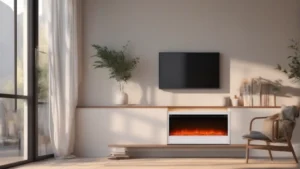
For most RV owners, the RecPro 26-inch recessed fireplace is the best fit: it’s designed for RV installation and lists 120 V, 1,500 W operation, eight heat levels and a remote. Choose it only if its cutout fits your cabinet and your RV can supply the electrical load; the two freestanding alternatives aren’t RV-specific.
Buying the wrong fireplace can leave you with a unit that won’t fit the cabinet or a heater you can’t run on your available power. A mismatched cutout costs time and money to fix. An overloaded circuit can trip a breaker or create a fire risk.
Three RV Electric Fireplace Picks
#1RV-Specific Pick
RecPro 26-Inch RV Recessed Fireplace
Best for RV owners whose cabinet cutout and electrical supply fit the unit
This is the only pick designed for RV installation, with 1,500-watt operation and eight heat levels. Its remote, LED touch controls and four flame colors give you options without taking up floor space. Check the cabinet cutout and available electrical capacity before buying.
Installation RecessedRated power 120V, 60Hz, 15 Amp, 1500 WattHeating levels 8Flame colors Orange, Blue, Orange + Blue, and Cycle
Why it made the cut
Designed for RV installation
Eight heating levels from 68°F to 82°F
Remote and LED touch controls
Good to know
Requires a suitable cabinet cutout
Rated at 15 amps and 1,500 watts
Skip it if Skip it if your cabinet opening or RV electrical supply can’t accommodate the unit.
Best for RV owners who want a freestanding stove-style fireplace
The 25-inch stove offers 500-watt and 1,500-watt heat settings, so you can choose between lower and higher output. Front and side flame views, plus 12 flame and log colors, make it a better fit when the visual effect matters and you have room for a freestanding unit.
Installation FreestandingHeat settings 500W and 1,500WFlame and log colors 12 adjustable colorsFlame controls Flame speed control
Why it made the cut
Two heat settings: 500W and 1,500W
12 flame and log colors
Flames visible from front and side panels
Good to know
Freestanding, not designed specifically for RV installation
The product data does not give its dimensions
Skip it if Skip it if you need a recessed RV fireplace or must confirm exact installation dimensions first.
Best for RV owners looking for a smaller freestanding stove-style fireplace
Its 17-inch format and freestanding design suit spaces where a built-in fireplace won’t fit. You can run the flame effect without heat, or choose 500W or 1,500W heating; four flame colors and four log colors let you adjust the look.
Installation FreestandingSize 17 inchesHeat settings 500W and 1,500WFlame colors 4
Why it made the cut
17-inch freestanding design
Flame effect can run without heat
Two heat settings: 500W and 1,500W
Good to know
Not designed specifically for RV installation
The product data does not list dimensions beyond its 17-inch size
Skip it if Skip it if you need an RV-specific recessed unit or a documented cabinet-fit measurement.
Best for A compatible motorhome fireplace needing a 12V AC transformer
This is a replacement transformer, not an electric fireplace. Its listed input is 120V and its output is 12V AC at a maximum rated power of 10VA, so confirm your fireplace’s specifications before ordering.
Part type AC/AC power transformerInput 120V 60ZOutput 12V 10VAMounting 2Hole
Why it made the cut
Listed for electric fireplace applications
12V AC output
Two-hole mounting
Good to know
Not a complete fireplace
Maximum power is 10VA
Skip it if Skip it if you’re shopping for a fireplace or can’t verify that your existing unit needs this transformer.
The best RV fireplace heater here is the RecPro 26″ RV Recessed Electric Fireplace, provided its listed dimensions and electrical requirements match your RV. It’s the only listed electric fireplace described specifically for RV installation.
The 17-inch and 25-inch R.W.FLAME models are freestanding indoor electric stoves, not RV-specific built-ins. They may work in an RV only where you have a stable, suitable spot and the manual permits that use. For more recessed options, see our recessed electric fireplace picks.
Check
What to verify
Installation
Recessed cabinet fit or a stable freestanding location
Electrical
120 V rating, amperage, plug and available RV power
Controls
Thermostat range, flame-only mode, remote and timer
Heating claim
Treat room-coverage numbers as rough marketing, not sizing data
Fit and electrical compatibility come before flame effects.
The RecPro listing specifies 120 V, 60 Hz and 15 A, along with eight heat levels and a remote. Compare those details with your RV before choosing a setting or installation method.
Before You Choose
Measure the cabinet opening, not the product name
Confirm the fireplace’s required cutout and mounting method
Check the RV circuit, plug and power source
Confirm which controls the model actually provides
Myth
A 25-inch fireplace that claims to heat 1,000 square feet in 10 minutes will size an RV easily.
Fact
That claim isn’t a reliable basis for RV sizing. The cabinet opening, electrical load and the actual space you need to heat matter more than a broad room-coverage statement.
Will a 26-Inch RV Fireplace Fit Your Cabinet?
If an RV electric fireplace was installed at the factory, its opening and wiring may be model-specific; check the RV manual, labels or manufacturer before replacing it. A 26-inch RV fireplace may not fit a 26-inch-wide cabinet.
Measure the existing opening at its narrowest points, then compare those measurements with the fireplace installation manual. Check width, height, depth, mounting method and required clearance before cutting anything.
Measure Before Ordering
Opening width at the narrowest point
Opening height at the narrowest point
Available depth behind the trim
Mounting points and required clearance
Circuit, plug and RV power-source limits
Worked Example
Say the RecPro runs at 1,500 W from a 120 V supply. The current is 1,500 ÷ 120 = 12.5 A, before other RV loads are counted. Its 500 W setting uses one-third as much power as the 1,500 W setting, so start lower in a small living area if that setting is available, then adjust for comfort and the manual’s instructions. That comparison doesn’t promise a particular temperature rise.
Full heat1,500 W ÷ 120 V = 12.5 A
Lower setting500 W = one-third of 1,500 W
Listed RecPro requirement15 A
Check The Whole Circuit
The fireplace may share its branch circuit with other appliances. Verify that the branch circuit, plug and RV power source can support the load before running full heat.
How Much Does an RV Electric Fireplace Cost to Run?
An RV electric fireplace running at 1,500 W uses 1.5 kWh per hour, so its cost depends on how long you run it and the electricity rate charged at your campsite or home. To estimate the bill, multiply watts ÷ 1,000 × hours × price per kWh.
Heater
Watts
Per hour
Per day (4 h)
Per month (30 days)
RV electric fireplace at full power
1,500 W
26¢
$1.02
$30.60
Calculated at 17¢ per kWh. Assumes continuous 1,500 W operation for 4 hours each day, 30 days a month, at $0.17 per kWh. Your actual rate and power source may differ.
At a 500 W setting, the fireplace uses 0.5 kWh per hour—one-third of the 1.5 kWh used at 1,500 W. A thermostat or cycling heater may use less than the full-power estimate because it switches the heating element off periodically; actual use depends on conditions and settings.
Flame-only operation can provide the visual effect without heater power, but only if the manual says the flame and heater can operate independently. The R.W.FLAME 17-inch model lists independent flame and heater operation; don’t assume another fireplace has that feature.
RV Electric Fireplace Safety and Certification
Safe RV electric fireplace installation starts with the manual and the RV’s electrical setup; plug the unit directly into a suitable wall outlet, never an extension cord or power strip. Keep at least 3 feet between the fireplace and combustibles unless its instructions require more.
Check Before Use
Plug directly into a suitable wall outlet; don’t use an extension cord or power strip.
Keep at least 3 feet of clearance from combustibles, or more if the manual specifies.
Look for an applicable UL, ETL or CSA listing on the actual model.
Read the fireplace manual and follow the RV manufacturer’s installation and electrical requirements.
The RecPro’s listed zero-clearance safety feature and thermal cut-off don’t replace its installation instructions, RV requirements or local electrical rules. Overheat protection also doesn’t make blocked air openings safe; keep vents clear.
Stop If You Notice a Fault
Stop using the fireplace if its plug becomes hot, the cord is damaged, the breaker trips repeatedly or you smell burning. Don’t bypass a breaker or safety switch, and don’t keep running a unit with blocked vents.
Product data here doesn’t establish a UL, ETL or CSA certification for any of the three fireplace picks, so check the label on the actual unit rather than relying on a listing elsewhere. Hire a qualified professional for hardwiring, a new circuit, damaged wiring or a replacement that doesn’t match the RV’s electrical setup.
More Questions, Answered
Can I use a regular electric fireplace in an RV?
Yes, if the fireplace matches the cabinet opening, uses the RV’s available voltage, and stays within its electrical capacity. An RV-specific model is easier to fit; a household unit may need different clearances, mounting, or wiring.
How do I find the cutout size for an RV fireplace replacement?
Measure the opening’s width, height, and depth, then compare those measurements with the replacement’s listed cutout dimensions. Check the RV manual, the old fireplace label, and the cabinet for wiring or trim that reduces usable space.
Can an RV electric fireplace run on a 30-amp hookup?
Usually, a 1,500-watt fireplace draws about 12.5 amps on a 120-volt circuit, so a 30-amp RV hookup can supply it. The hookup also powers the converter, air conditioner, microwave, water heater, and other loads, so a breaker can trip when several high-draw appliances run together.
Does an RV electric fireplace work on battery power?
Only through an inverter capable of supplying the fireplace’s electrical demand, and battery runtime will be limited. A 1,500-watt heater places a heavy load on the inverter and battery bank, so shore power or a properly sized generator is usually the practical choice.
Can I use an electric fireplace and an air conditioner at the same time in an RV?
You can if the RV’s hookup, wiring, and breakers support both loads at once. Because the air conditioner’s compressor can draw substantial power when it starts, turn off another high-draw appliance if the breaker trips.
Can I run an RV electric fireplace overnight?
Only if the manufacturer specifically allows unattended or overnight operation. Keep the unit clear of bedding and curtains, plug it directly into a suitable wall outlet, and don’t use an extension cord or power strip.
Can an electric fireplace heat an RV without its flame effect?
Yes, models with separate heat and flame controls can usually run the heater while the flame display is off. Check the control panel or manual for a heat-only setting; the flame effect itself doesn’t provide the heat.