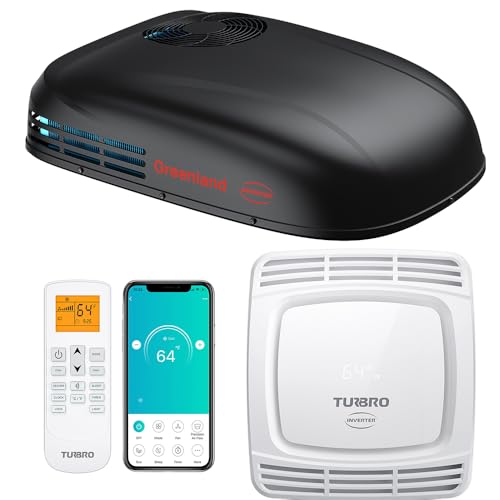
The best RV air conditioner with heat pump for most readers is the TURBRO Inverter 13.5K BTU rooftop unit because it pairs 13,500 BTU cooling and heating with an inverter compressor, app control, and a low 10-inch profile that fits common RV roof openings.
Key takeaways
Choose a rooftop unit that matches your 14.25″ x 14.25″ opening before you look at BTU ratings.
For shoulder-season camping, a heat pump is usually more useful than a straight electric strip heater because it moves heat instead of making it from scratch.
An inverter compressor matters if you want softer starts and less noise when the compressor cycles.
If you camp where the temperature regularly drops near freezing, check the unit’s heating range before you buy.
A smart app is nice; roof fit, ducting, and power access matter first.
RV heat pump units are a good buy when you need one roof unit to cool by day and take the chill off at night. The right pick comes down to roof fit, power source, noise, and how well the heat pump works once the weather drops near freezing.
For this search, the useful comparison is simple: match the unit to your roof cutout, then check how much cooling and heating it actually gives you before you care about the app or the light strip.
Comparison of Top RV Air Conditioners with Heat Pumps
Best for Most RVs needing efficient cooling and heating with smart control
This TURBRO unit pairs a 13,500 BTU heat pump that works efficiently from 19.4℉ to 109.4℉ with an energy-saving inverter compressor that cuts power use by up to 30%. Its slim 10-inch profile fits standard RV roof openings, reducing drag and noise. You control it via remote or app, and the modular ducting adapts to various ceiling thicknesses, making it versatile for campers and food trucks as well.
Cooling and heating output 13,500 BTURoof opening 14.25″ x 14.25″Unit thickness 10.0″Temperature range 19.4℉ to 109.4℉
Why it made the cut
Energy-saving inverter compressor reduces electricity use
Slim 10″ roof unit fits common RV openings, improving aerodynamics
Smart app and remote control with atmosphere lamp options
Heat pump delivers up to 4x output of traditional electric heaters
Good to know
Requires roof opening of 14.25″ x 14.25″, not universal for all RVs
Installation accessories may arrive in separate shipments
Skip it if Skip this if your RV roof opening is smaller or you want a non-inverter model.
Best for Buyers who want similar features with extra foam for thicker roofs
This version of the TURBRO 13.5K BTU inverter heat pump is almost identical but includes an additional air duct sponge for thicker RV roofs. It keeps the same slim profile and inverter efficiency, delivering both cooling and heating year-round with fan and dry modes. Its modular ducting and smart controls suit a wide range of RV types.
Cooling and heating output 13,500 BTURoof opening 14.25″ x 14.25″Unit thickness 10.0″Temperature range 19.4℉ to 109.4℉
Why it made the cut
Extra air duct sponge for flexible roof thickness
Inverter compressor saves energy and lowers noise
Smart app control and atmosphere lamp
Heat pump works efficiently down to 19.4℉
Good to know
Same roof opening size limits use in smaller rigs
Multiple shipments may complicate installation
Skip it if Choose this if your roof thickness needs extra sealing foam; otherwise pick the first.
Best for RVers needing a reliable, electricity-free heat source
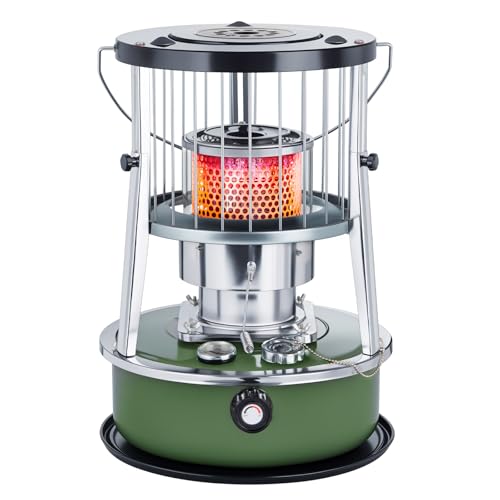
This portable kerosene heater puts out 9,000 to 10,000 BTU and runs up to 20 hours on a 1.4-gallon tank without electricity. It’s a solid backup for power outages or cold nights when the main heat pump can’t run. Safety features include an anti-tip base and protective net, making it suitable for indoor and outdoor use in garages or RVs.
Heating output 9,000–10,000 BTUFuel tank capacity 1.4 gallonsHeat duration Up to 20 hoursCoverage area 200–500 sq ft
Why it made the cut
Runs without electricity for up to 20 hours
Adjustable heat output with safety features
Includes accessories like funnel and siphon pump
Flat top doubles as a cooking surface
Good to know
Requires 1-K kerosene fuel, not gasoline
Produces combustion byproducts—ventilation needed
Skip it if Use this only if you want emergency heating without power, not as your main A/C heat source.
Best for Small RV spaces needing quick, quiet electric heat
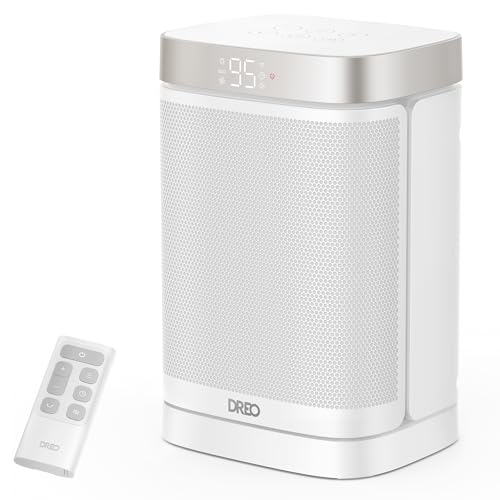
This 1,500 W ceramic heater warms up quickly with a digital thermostat adjustable from 41 to 95℉ in 1-degree steps. Its 70° oscillation spreads heat widely, while the brushless motor keeps operation quiet. Safety features include tip-over and overheat protection. It’s portable and suited for small RV rooms or offices needing supplemental heat.
Power 1500 WOscillation angle 70°Temperature range 41 to 95℉Timer 12 hours
Why it made the cut
Fast heat-up with precise digital thermostat
Quiet operation with oscillation
Multiple safety protections including tip-over
12-hour timer and ECO mode save power
Good to know
Limited to electric power, no cooling
Only 1,500 W max output—not for whole RV heating
Skip it if Skip if you want integrated cooling or a roof-mounted heat pump.
Best for Diesel RV owners needing powerful independent heating
This 8 kW diesel heater runs on 12 V with fuel consumption between 0.2 and 0.5 gallons per hour. It meets Euro IV emissions standards and uses ceramic ignition for fast, full combustion. The system includes automatic controls and a remote thermostat monitor. It fits commercial vehicles, buses, and motorhomes that run on diesel and want a reliable heat source separate from the engine.
Heating power 8 kWFuel type DieselVoltage 12 VFuel consumption 0.2-0.5 gal/hr
Why it made the cut
High heating power at 8 kW
Low emissions meeting Euro IV standards
Automatic control with remote thermostat
Works in extreme cold down to -40℃
Good to know
Requires diesel fuel and 12 V power
Installation complexity higher than electric units
Skip it if Not for RVers without diesel fuel systems or who want electric heat pumps.
Best Dual Duct Air Conditioner Heater Combo Reviewed
The best dual duct air conditioner heater combo for most RV owners is the TURBRO Inverter 13.5K BTU rooftop unit. It balances strong heating and cooling output with inverter efficiency, a low-profile design under 10 inches tall, and app control that makes adjusting your RV climate easy even from across camp.
When it comes to combined AC and heat, rooftop heat pump units clearly outperform portable plug-in heaters. Plug-ins often lack the power to condition an entire RV efficiently, especially in cold weather. Rooftop models attach to a standard roof opening, delivering both 13,500 BTU cooling and a robust heat pump cycle to extend your comfort season without the fuel worries of kerosene or diesel heaters.
Three factors decide which rooftop unit fits your rig: the roof opening size, the BTU output you need, and whether you want smart app control or simpler mechanical controls. Most RV roofs accept a standard 14 by 14 inch opening, which suits both TURBRO models here. Output-wise, 13,500 BTU is enough for many medium to large RVs, while smaller rigs might choose the 9,000 to 10,000 BTU options.
Both TURBRO units offer inverter compressors. That means the motor speed adjusts to maintain set temperatures efficiently, reducing power spikes and saving your RV’s limited electrical supply. The low-profile design also helps reduce wind resistance and fits most RV roof designs without extra modifications.
Model
Cooling BTU
Heating BTU
Profile Height
Control Type
TURBRO Inverter 13.5K BTU
13,500
13,500
10 inches
App and remote
TURBRO Inverter 9.5K BTU
9,500
9,500
10 inches
Remote with manual options
Key specs for top TURBRO rooftop units
Best overall pick
TURBRO Inverter 13.5K BTU RV Air Conditioner with Cooling and Heat Pu…
The TURBRO Inverter 13.5K BTU combines powerful cooling and heating, inverter efficiency, and smart controls in a sleek rooftop design, making it the best dual duct AC heater for most RV owners.
The size of the roof opening is the first spec to check before anything else when choosing an RV heat pump. Most RV rooftop air conditioners need a cutout around 14.25 by 14.25 inches. If the unit won’t fit through your RV’s roof opening, no amount of BTU output or features will help.
A low-profile housing, about 10 inches tall, makes a big difference for clearance and wind drag while driving. Taller units can scrape garage doors or add wind noise and fuel use. The TURBRO Inverter 13.5K BTU unit is a good example with its slim 10-inch profile.
BTU output matters, but only after you confirm fit. Most RV units range from about 10,000 to 15,000 BTU for cooling and heating. Too small, and the system won’t keep up. Too large wastes power and may short-cycle, which wears out the compressor.
An inverter compressor is a key feature for RV heat pumps. Unlike fixed-speed compressors that start and stop abruptly, inverter models ramp up and down smoothly. This reduces the start-up surge current that can trip breakers and cuts noise inside the RV.
Ducted versus non-ducted installation affects airflow and where you feel the heat or cool air inside. Most RV rooftop units are non-ducted, blowing air directly into the ceiling space. Ducted systems deliver air through vents but need more ceiling space and careful planning.
Ceiling thickness also matters because your unit must seal tightly to prevent leaks. RV ceilings vary widely; a unit designed to clamp onto a thinner ceiling might not fit thicker insulation or paneling.
Control methods have evolved beyond simple wall thermostats. Many modern RV heat pumps offer remote or app-based controls that let you adjust temperature and fan speed from across the rig or even remotely through your phone.
Spec
What to Check
Roof opening size
Must match or be slightly larger than your RV’s roof cutout, usually 14.25″ × 14.25″
Housing height
Low profile (~10″) fits better under roof vents and reduces wind drag
BTU output
Right size for your RV’s square footage, typically 10,000–15,000 BTU
Compressor type
Inverter reduces noise and start-up current surge
Installation type
Ducted or non-ducted based on your RV’s interior layout
Ceiling thickness
Ensure the unit clamps and seals properly on your RV’s ceiling panels
Control method
Remote, app, or wall thermostat depending on convenience needed
Key specs to compare when choosing an RV heat pump unit
1
Measure your roof opening
Use a tape to confirm the cutout size in your RV’s roof. Standard is about 14.25″ square, but some older or custom RVs differ.
2
Check ceiling thickness
Measure panel depth to ensure the unit’s mounting clamps will fit and seal properly.
3
Decide on ducted or non-ducted
Choose non-ducted for simple install; pick ducted if you have vent runs and want targeted airflow.
4
Match BTU to RV size
Estimate your RV’s volume or square footage to pick a unit with the right cooling and heating capacity.
5
Look for inverter compressor
Choose an inverter model to reduce noise and avoid breaker trips during start-up.
6
Consider control options
Pick a unit with remote or app control if you want more convenience than a wall thermostat.
What Size RV Heat Pump You Need
Choosing the right size heat pump depends on your RV’s square footage, insulation quality, and how much sun your roof gets.
A 13,500 BTU unit often fits the bill for campers and vans between 200 and 400 square feet. If your rig is larger or less insulated, a 15,000 BTU model provides better coverage without running constantly.
Avoid Under-Sizing
Poor insulation or a dark roof that absorbs heat can make a smaller heat pump struggle, even if its BTU rating seems adequate. That leads to longer run times and less comfort.
Heat pumps excel in mild cold, where they extract heat from outside air efficiently. In deep winter, their output drops, so consider backup heating for freezing conditions.
For a 30 amp RV, a 13,500 BTU heat pump usually matches the electrical limits best, avoiding overload while delivering solid cooling and heating. Larger units risk tripping breakers if your setup isn’t ready.
Worked Example
Say your RV is 24 by 24 feet, roughly 576 square feet. A 15,000 BTU heat pump suits this size, but if the walls have thin insulation and the roof faces strong sun, you might need the higher output to maintain comfort.
13,500 BTU
Common BTU rating
This is the middle ground for many RVs, balancing power and electrical draw.
Running Costs And Power Limits In The RV
Heat pumps save you money by using electricity more efficiently than resistance heaters in mild weather.
Heater
Watts
Per hour
Per day (8 h)
Per month (1 days)
1,500 W space heater
1,500 W
26¢
$2.04
$2.04
Heated blanket
100 W
1.7¢
14¢
14¢
Calculated at 17¢ per kWh. Daily running cost example at 17¢/kWh
Running a 1,500 watt heater for 8 hours uses 12 kWh. At 17 cents per kWh, that costs about $2.04 daily. Heat pumps can provide both heating and cooling from the same rooftop unit, avoiding extra appliances and power draws.
Your RV’s electrical setup—shore power, generator, or battery and inverter—dictates what size heat pump you can run without issues. Don’t guess: check your breaker ratings and generator output before buying.
Check Your Power Limits
A 30 amp RV circuit provides about 3,600 watts max. The TURBRO Inverter 13.5K BTU rooftop unit fits well here because its inverter technology keeps power draw manageable.
Among available dual duct air conditioner heater combos, inverter models offer smoother power use and quieter operation, making them the best choice for typical RV electrical systems.
Matching your heat pump to your RV’s power system avoids nuisance tripping and keeps running costs reasonable, especially on battery power where efficiency matters most.
Safety And Installation Checks Before You Buy
RV air conditioner heat pump installation requires exact matching of the roof opening size, ceiling thickness, and ducting style to the unit’s specifications. Even a slight mismatch can cause poor sealing, poor drainage, or excessive vibration, turning a top-rated unit into a leak or noise problem.
Installation Mistakes
Improper mounting or sealing around the rooftop unit often leads to water intrusion during rain or washing. Check that the installer uses the correct gasket and sealing compound, and that drainage channels are clear and sloping away from the roof.
Myth
A heat pump provides reliable winter heat in freezing temperatures
Fact
Most RV heat pumps lose efficiency below about 40°F and can’t replace a dedicated winter heater. They work best in mild cold and need backup heat when the mercury drops.
Heat pump RV in cold weather means knowing its limits. The heating element inside the unit supplements the heat pump but won’t keep your rig warm in subfreezing conditions. For true winter use, add a fuel-burning backup heater or electric resistance heater.
Carbon Monoxide Safety
Fuel-burning backup heaters require proper ventilation and a working carbon monoxide alarm inside the RV. Never use outdoor-only heaters indoors or without CO sensors.
Electric rooftop units need adequate electrical supply and safe wiring to handle the heat pump’s compressor and fan loads. Circuit breakers, wiring gauge, and outlets must meet the unit’s specifications to avoid tripped breakers or fire risk.
Best Smart Controls And Quiet Operation
The best RV air conditioner with heat pump quiet models rely primarily on inverter compressors and low-profile designs to reduce noise. Remote or app control adds convenience but isn’t worth choosing a noisy unit for.
Good for
Inverter compressor reduces sound and power consumption
Low 10-inch roof profile cuts wind drag on the road
App control offers phone-based temperature adjustments
Not for
App control requires Wi-Fi or Bluetooth, which may be spotty in remote areas
Ceiling assembly atmosphere lamp is a minor feature, not a selling point
The TURBRO Inverter 13.5K BTU unit stands out for smart controls: its app lets you monitor and change settings remotely, a genuine plus if you adjust your RV’s climate before arriving or while away.
Useful for this step
TURBRO Inverter 13.5K BTU RV Air Conditioner with Cooling and Heat Pu…
The TURBRO unit’s app control makes it easy to manage temperature without leaving your seat or getting up from outside the RV.
What size RV air conditioner with heat pump do I need for my camper?
You need to match the unit’s BTU capacity to your camper’s square footage and insulation. A rough rule is about 20 BTU per square foot for cooling, but heating needs vary with insulation and climate. Oversizing wastes power and space; undersizing won’t keep you comfortable.
Will an RV heat pump work in freezing weather?
RV heat pumps operate efficiently in mild to moderately cold weather but lose effectiveness below about 25°F. Below that, they struggle to extract heat and may require a supplemental heater. Plan for backup heating if you camp in freezing conditions often.
Is a ducted RV air conditioner better than a non-ducted one?
Ducted systems distribute air more evenly and quietly but need more ceiling space and precise installation. Non-ducted units are simpler and often easier to retrofit but can create hot or cold spots. Your choice depends on your RV’s layout and ceiling height.
Do I need a 14.25 x 14.25 roof opening for most rooftop RV AC units?
That size is standard for many rooftop units, but some models, like low-profile inverters, fit smaller 10-inch or custom openings. Always measure your existing opening and check the unit’s specs; a mismatch can cause leaks or installation issues.
Is inverter cooling worth it in an RV air conditioner with heat pump?
Inverter compressors adjust speed to match cooling demand, reducing energy use and noise. They’re worth it if you want quieter operation, longer compressor life, and lower power draw, especially when running on limited RV electrical service or solar.