Amazon portable heaters are usually 1,500 W plug-in units, and the best pick for most readers is Product 3 because it combines quiet operation, precise thermostat control and a 12-hour timer in a standard indoor heater. Get the wrong one and you pay twice: once at the checkout, and again in comfort or electricity.
What to remember
Choose a 1,500 W heater for most bedrooms, offices and small living rooms; it is the standard plug-in ceiling.
Pick the quietest model if the heater will sit near a TV, desk or crib; noise ratings around 34 to 35 dB are easier to live with.
Use the timer if you tend to forget heaters running; 7 to 12 hours is enough for overnight or workday use.
Look for tip-over shutoff, overheat protection and a UL, ETL or CSA listing before you plug in.
If you need warmth across a wider room, oscillation helps more than a higher label claim.
Most shoppers only need one room warmed well, not the whole house dragged into the conversation. The trick is matching the heater to the room, the noise level you can live with, and the safety features that let it run without fuss.
A 1,500 W heater draws about 12.5 amps on a 120 V circuit, so the outlet, the cord and the clearance around it matter as much as the heat output. Skip those details and the cheap fix gets expensive fast.
Best Portable Heaters for Fast, Controlled Warmth
#1Best Overall
DREO Ceramic Space Heater
Best for Bedrooms and home offices where quiet, precise control matters
The 34 dB noise rating, thermostat adjustable in 1°F increments and 12-hour timer make this the most controlled pick for a room where you work or sleep. Its 1,500 W PTC heater is designed for indoor use and has tip-over detection and overheat protection.
Heat output 1,500 W PTCNoise 34 dBTimer 12 hoursThermostat 41–95°F, 1°F incrementsSafety Tip-over detection and overheat protection
Why it made the cut
Quiet operation rated at 34 dB
Thermostat adjusts from 41–95°F in 1°F increments
12-hour timer and remote control
Good to know
Maximum heat output is 1,500 W, like the other plug-in picks here
The product data does not specify a certification
Skip it if Skip it if you want oscillation to spread heat across a wider area.
Best for A bedroom or office where oscillation helps spread warmth
The 23-inch tower combines 1,500 W ceramic heat with widespread oscillation, so it can move warm air beyond the spot directly in front of the heater. Its remote controls the heat settings, oscillation and 7-hour timer.
Best for Bedrooms and offices where remote control and oscillation are useful
This 24-inch heater pairs 70° oscillation with a remote and a 1–12 hour timer, giving you several controls without walking over to the unit. It also lists tip-over protection, overheat shutoff and ETL certification.
Heat output 1,500 W ceramicOscillation 70°Timer 1–12 hoursSafety ETL-certified, tip-over protection and overheat shutoffHeight 24 inches
Why it made the cut
70° oscillation
1–12 hour timer and remote control
ETL-certified with tip-over and overheat protection
Good to know
Remote requires 2 AAA batteries, which are not included
Noise level is not specified
Skip it if Skip it if you want a stated noise rating or don’t want to supply batteries for the remote.
Best for A small room where quiet operation and a longer timer are priorities
At a listed 35 dB, this heater is a quiet option for a bedroom or office, and its 24-hour timer gives you more scheduling range than most picks here. The thermostat is specified to ±1°F, and the unit includes a child lock, tip-over shutoff and overheat protection.
Heat output 1,500 WNoise 35 dBTimer 24 hoursCoverage claim Up to 200 sq ftSafety ETL-certified, tip-over shutoff, overheat protection and chi
Why it made the cut
24-hour timer and remote control
Thermostat precision listed as ±1°F
ETL-certified with tip-over and overheat protection
Good to know
The product data does not specify a room size beyond its claim of up to 200 sq ft
The 35 dB noise figure is slightly higher than Product 3’s stated 34 dB
Skip it if Skip it if you prefer a taller oscillating heater to move warmth around the room.
Best for A desk or small room where a fan setting is useful outside heating season
Two heat settings—1,500 W and 750 W—let you choose between full output and a lower setting, while the cool-air fan adds a non-heating mode. The automatic thermostat cycles the heater to maintain your preset temperature; tip-over and overheat protection are included.
Heat output 1,500 W / 750 WModes Two heat settings and cool-air fanSafety Tip-over and overheat protectionCoverage claim Up to 200 sq ft
Why it made the cut
1,500 W and 750 W heat settings
Cool-air fan mode
Automatic thermostat, tip-over and overheat protection
Good to know
Timer is not specified
Noise level is not specified
Skip it if Skip it if you need a timer or want a published noise rating before choosing a bedroom heater.
For most people comparing Amazon portable heaters, the DREO Space Heater, Portable Electric Heaters for Indoor Use… is the best portable heater in this group: it runs quietly, offers precise thermostat control and has a 12-hour timer. The right alternative depends on where you’ll use it and which feature matters most.
Pick
Best fit
Why it stands out
DREO Space Heater
Quiet bedroom use
Quiet operation, precise temperature control and a 12-hour timer make it the strongest all-around choice.
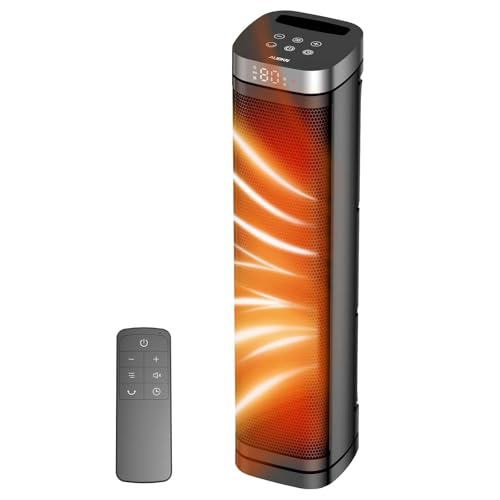
AUBKN X-Large 1500W Electric Space Heaters
Large-room coverage
A 1,500 W rating gives it the highest standard plug-in output; room layout and insulation still affect comfort.
GiveBest Space Heater
Budget buy
A straightforward option if you want a portable indoor heater without making extra controls the priority.
R.W.FLAME Small Space Heaters
Smart controls
Choose it if its available control features match how you want to adjust the heat.
Lasko 23″ Ceramic Tower Space Heater
Wide oscillation
Its tower format and oscillation suit a spot where you want heat to sweep across a wider area.
These picks serve different needs; a higher wattage does not make a heater more efficient.
A plug-in portable heater tops out at about 1,500 W because a standard 120 V, 15 A outlet circuit can supply about 1,800 W in total, and the heater alone draws roughly 12.5 A. That leaves limited room for other loads on the same circuit. A higher-output heater needs a suitable dedicated circuit or a different power source, not an adapter.
In short
Pick the DREO for quiet, controlled heat in a bedroom or other occupied room. Choose another model when its particular fit—budget, oscillation, controls or room coverage—matters more to you.
Best fit
DREO: quiet operation, precise thermostat control and a 12-hour timer.
AUBKN: 1,500 W output for buyers prioritizing plug-in heat output.
Lasko: tower design with oscillation for spreading heat across a wider area.
Look elsewhere if
A standard plug-in heater is limited to about 1,500 W; it can’t provide more heat just because the room is large.
The listed product names alone don’t establish exact room coverage or specific control features; check the model’s product details before buying.
Indoor Use Only
These portable electric heaters are meant for indoor use only. Always plug the heater directly into a wall outlet without using extension cords or power strips. Maintain at least 3 feet of clearance around the heater. Confirm the model has tip-over and overheat protection and a UL, ETL, or CSA listing. Avoid running the heater unattended or while sleeping unless the manufacturer explicitly states it is safe to do so.
How To Use a Portable Heater Safely
To use a portable heater safely, set it on a level, hard surface, plug it directly into a wall outlet, and keep at least 3 feet between the heater and anything that can burn. That setup matters during a game because blankets, jackets and folding chairs tend to migrate toward the heat.
1
Choose a clear spot
Place the heater upright on the floor where it can’t be knocked over, with its air intake and outlet unobstructed. Keep curtains, paper, bedding, furniture, clothing, pets and foot traffic away from it; never cover the grille or use it on a bed, sofa or rug that can bunch around the unit.
2
Use the wall outlet
Plug the heater straight into a properly working wall outlet. Don’t use an extension cord, power strip or adapter, and don’t share the outlet with another high-wattage appliance. Stop if the plug, cord or outlet becomes hot, loose, discolored or damaged.
3
Check the safety controls
Look for tip-over shutoff and overheat protection before buying or operating the heater. Tip-over protection cuts power if the unit falls, while overheat protection responds when internal parts get too hot; neither control makes a blocked or poorly placed heater safe.
4
Run it while you’re there
Keep the heater off when you’re sleeping or leaving the house unless the owner’s manual specifically says the model is designed for that use. Turn it off before moving it, cleaning it or packing it away, then let it cool before handling.
The outlet is part of the heater
A typical 1,500 W heater draws about 12.5 amps on a 120 V circuit, which leaves little spare capacity on a standard 15 A circuit. If the breaker trips, don’t keep resetting it or move the heater to a power strip; unplug other loads and have an electrician check a recurring problem.
Before kickoff
The heater is indoors only if its manual permits indoor use.
The tip-over and overheat protections are listed in the product information.
The unit stands level, with 3 feet of clearance on every side where practical.
The cord reaches the wall without an extension cord or power strip.
A responsible adult can see or check the heater while it’s running.
“No portable heaters” usually means the building, dorm, office or landlord forbids them, even if the product itself is listed for indoor use. Check the local policy, lease or event rules before buying; a safety feature won’t override a property rule.
How The Specs Separate These Five
The DREO Space Heater is the best portable heater for most buyers here because it combines quiet operation, precise thermostat control and a 12-hour timer. To compare it fairly with the R.W.FLAME, GiveBest, AUBKN and Lasko models, check the exact listing for the remaining details: the product data provided for this guide doesn’t verify their thermostat ranges, timer lengths, noise levels, oscillation or control types.
Spec
What to check
Why it matters
Thermostat
Temperature range and adjustment steps
A 1°F step lets you fine-tune the setpoint; vague high-low labels offer less control over the target temperature.
Timer
Maximum hours and shutoff behavior
A longer timer can suit a full game or evening without repeated resets.
Noise
Any stated noise level or quiet-operation feature
A quieter heater is less intrusive when you’re watching or listening to a game.
Oscillation
Whether the heater turns side to side
Oscillation spreads warmth across a wider area; a stationary tower can suit a fixed seat or a narrow space where you want heat aimed in one direction.
Controls
Buttons, remote, display or app, if listed
Controls are easier to judge when you know whether you can change settings from your seat.
Confirm each model’s exact features on its product listing; don’t assume a feature from the heater’s shape or name.
One listed advantage
The DREO model is described in this guide’s product information as quiet, with precise thermostat control and a 12-hour timer. The exact temperature range and control increments aren’t provided here, so check the listing before counting on 1°F adjustment.
Choose oscillation by where you sit
For one person staying in a fixed seat, a stationary heater may be simpler if its placement suits the area. If people are spread across a wider area, oscillation can help move warmth between positions; it doesn’t increase the heater’s rated output.
A thermostat with 1°F steps is more useful than high and low labels because you can set a specific target and make small adjustments instead of guessing between broad settings. Check that the listing gives both the adjustment increment and the range; “precise” alone doesn’t tell you either number.
For a heater you plan to use with a generator at a game, compare the available models in this portable space heater guide for generator use as well. Match the heater’s electrical demand to the generator’s capacity before plugging it in.
How Long Running Costs Stay Manageable
A portable heater costs $2.04 per day in this example when it runs at 1,500 W for eight hours and electricity costs 17 cents per kWh. That becomes about $61.20 over 30 days, so runtime matters more than the heater’s brand.
Worked example
A 1,500 W heater uses 1.5 kW. The math is 1.5 kW × 8 hours = 12 kWh per day; 12 × $0.17 = $2.04 per day; $2.04 × 30 days = about $61.20 per month.
Heater output1,500 W
Daily use8 hours
Electricity rate$0.17 per kWh
30-day estimateAbout 360 watts per hour
Heater
Watts
Per hour
Per day (8 h)
Per month (30 days)
1,500 W portable heater
1,500 W
26¢
$2.04
$61.20
Calculated at 17¢ per kWh. Estimate assumes the heater draws its full rated wattage for eight hours every day at 17 cents per kWh.
ECO mode and a thermostat can lower that bill by switching the heating element off after the room reaches the set temperature. Exact savings depend on insulation, outdoor temperature, room size and how often warm air escapes; a cold, drafty room keeps calling for heat.
1,500 W
About 12.5 A on a 120 V circuit
That is near the practical limit of a standard 15 A circuit, so don’t share the outlet with another high-wattage appliance.
A lower-watt setting uses less electricity while it’s heating. A 750 W mode, for example, uses half the power of a 1,500 W mode during the same runtime, though it also adds heat more slowly. Set the thermostat sensibly and heat the occupied area instead of trying to overpower a freezing garage.
The Checks Before You Buy
For Amazon portable heaters, start by checking the room, outlet and controls before comparing appearance or star ratings. A heater that fits the space but needs an extension cord is the wrong choice.
Knowing how to use a portable heater means placing it on a level, hard surface, plugging it directly into a wall outlet, and keeping at least 3 feet from curtains, bedding, furniture and other combustibles.
Pre-buy check
Room size: choose a heater suited to the area you need to warm, rather than expecting one small unit to heat an open floor plan.
Outlet location: confirm a wall outlet is close enough for the factory cord; don’t plan on an extension cord or power strip.
Noise tolerance: choose the DREO Space Heater for quiet control, especially near a desk, sofa or sleeping area.
Timer need: pick a timer that matches your routine, and remember that a timer doesn’t replace safe supervision.
Safety listing: look for a UL, ETL or CSA listing, plus tip-over and overheat protection.
Choose Product 3, the DREO Space Heater, for quiet operation, precise thermostat control and a 12-hour timer.
Choose Product 5, the Lasko 23″ Ceramic Tower Space Heater, when wider room coverage and tower-style airflow matter more.
Choose Product 2, the GiveBest Space Heater, for simple value and straightforward controls.
Choose Product 1, the R.W.FLAME Small Space Heaters, if remote control and a 24-hour timer are the deciding features.
Choose Product 4, the AUBKN X-Large 1500W Electric Space Heaters, if oscillation helps spread warmth across the occupied area.
Keep Fuel Heaters Outside
Vent-free gas heaters may be restricted by local code, and patio or construction heaters don’t belong indoors. They can create carbon monoxide or fire hazards; use an indoor-rated electric heater for this list and keep a working smoke alarm nearby.
The buying rule
If the heater needs an extension cord, it is the wrong heater for that spot.
Questions People Ask
How do I use a portable heater in a bedroom safely?
Place the heater on a hard, level floor with 3 feet of clearance, and plug it directly into the wall. Keep bedding, curtains and clothing away from the intake and outlet, and turn the heater off before sleeping unless the manufacturer specifically says overnight use is allowed.
What size portable heater do I need for a small room?
A 1,500 W portable heater is the usual maximum for a standard 120 V outlet and can suit a small, reasonably insulated room. Room height, insulation, drafts and outdoor temperature still matter, so a heater may run constantly in a cold or poorly insulated space.
Are portable heaters safe to leave on overnight?
Leaving one running while you sleep adds risk because you may not notice a hot plug, blocked intake or tip-over. Turn it off before bed unless the manual specifically permits overnight operation, and never cover the heater or place it near bedding.
Why does my portable heater keep shutting off?
The thermostat may be satisfied, or the tip-over and overheat protection may be responding to an unstable surface, blocked intake or excess dust. Put it on a hard, level floor, clear the vents and let it cool; repeated shutdowns mean you should stop using it and follow the manual’s service guidance.
Can I plug a portable heater into an extension cord?
No—plug a portable heater directly into a wall outlet, never an extension cord or power strip. A 1,500 W heater draws about 12.5 amps at 120 volts, leaving little margin on a standard 15-amp circuit.
What does no portable heaters mean in an apartment or office?
It usually means the building, landlord or fire policy prohibits all portable electric heaters in that space, not merely one brand. Ask management for the approved alternative before using one; a heater with tip-over protection can still violate the building rule.