For most patios, the EAST OAK 1,500W heater is the strongest fit here: it has three heat settings, an IP65 rating, and tip-over and overheat shutoffs. Its glass-ceramic element produces infrared heat, so it warms people and nearby surfaces more directly than a fan-style ceramic heater warms open air.
Key takeaways
Choose infrared for direct warmth on a covered or open patio; a fan heater mostly warms nearby air.
The EAST OAK has an IP65 rating; the Briza and DR. INFRARED HEATER list IP55 ratings.
A 1,500W heater uses 1.5 kWh per hour at full power; multiply by your electric rate for the hourly cost.
Use an outdoor-rated heater only as its manual allows, plug it directly into a wall outlet, and keep 3 feet of clearance.
Choosing the wrong heater can leave you paying to warm the open air while the people on your patio stay cold. A poor match for the location can also create an electrical or weather-exposure hazard.
The picks below include infrared patio heaters and compact ceramic fan heaters; those are different technologies, and only models rated for outdoor use belong outside.
The Best Outdoor Heaters for Different Patios
#1Best Overall
EAST OAK Glass-Ceramic Patio Heater
Best for Patios where you want direct heat and a weather-rated standing unit
The glass-ceramic infrared element warms nearby people and surfaces directly, which suits an open patio better than a fan heater aimed at outdoor air. Three heat settings, an IP65 rating, and tip-over and overheat shutoffs make it the most complete fit here.
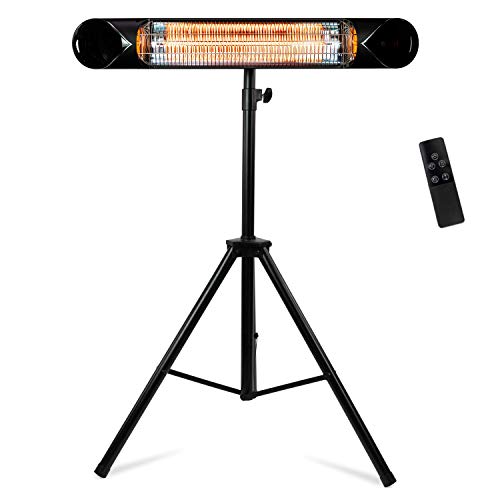
Best for Patios where you want a choice of wall, ceiling, or tripod setup
Choose this one if the heater needs to come off the floor: it includes wall and ceiling mounting hardware plus an adjustable tripod stand. Its infrared heat, remote, three power levels, and IP55 rating suit patios where flexible placement matters.
Wattage 900W, 1200W, 1500WHeat type Carbon infraredWeather rating IP55Setup Wall, ceiling, or adjustable tripod stand
Why it made the cut
Wall, ceiling, or tripod setup
Remote control and three heat levels
IP55 rating
Good to know
The product data doesn’t state a specific coverage area
Skip it if Skip it if you need a stated overheat shutoff; the product data lists tip-over protection but doesn’t mention overheat protection.
Best for Patios or decks where you can mount a heater on a wall or ceiling
This infrared model offers three power settings and remote control, with included brackets for wall or ceiling mounting. Its IP55 rating is specified for indoor and outdoor use, making it a reasonable option when you have a suitable mounting spot.
Wattage Low: 950W; high: 1500WHeat type InfraredWeather rating IP55Setup Wall or ceiling mounting
Why it made the cut
Three power settings
Remote controlled
Wall and ceiling mounting brackets included
Good to know
No thermostat
The product data doesn’t list a tip-over or overheat shutoff
Skip it if Skip it if you need a standing heater or want a thermostat to regulate room temperature.
Best for Covered or sheltered areas where you want a fan-only or lower-wattage mode
Its PTC ceramic element has fan-only, 750W, and 1500W modes, so you can use less power than a full 1500W setting when conditions allow. The portable handle and non-slip base make it easy to reposition, but the product data gives no weather rating.
Wattage 750W, 1500WHeat type PTC ceramicWeather rating —Setup Portable
Why it made the cut
Fan-only, 750W, and 1500W modes
Portable handle and non-slip base
Self-resetting heat breaker
Good to know
No weather rating is listed
The product data doesn’t specify a patio coverage area
Skip it if Skip it for an exposed patio unless the manual confirms it can handle your placement and weather exposure.
Best for A small indoor room, not an outdoor patio
This compact PTC ceramic heater uses a fan to move warm air and has low and high settings, a thermostat, and tip-over and overheat protection. The product data identifies it for indoor use only, so it isn’t a patio pick—even a covered one.
Wattage 900W, 1200W, 1500WHeat type PTC ceramic with fanWeather rating —Setup Portable
Why it made the cut
Low and high heat settings with a thermostat
Tip-over and overheat protection
Compact, portable design
Good to know
Indoor use only
No outdoor weather rating
Skip it if Skip it for any outdoor patio; choose a heater specifically rated for outdoor use instead.
A ceramic heater can be energy efficient at turning electricity into heat, but ceramic doesn’t make it cheaper to run. Resistance heaters convert electricity to heat where they’re used, so ceramic fan heaters and infrared electric heaters use roughly the same energy at the same wattage. Do ceramic heaters save electricity? Not by themselves; the wattage and run time set the bill.
The difference is where the warmth goes. A ceramic fan heater warms air and blows it around, which suits a small, sheltered area. An infrared heater warms people and surfaces in its path, so it can feel more effective outdoors, where moving air carries warmth away. “Ceramic infrared” describes a heater that uses a ceramic element to produce infrared heat; it isn’t the same as a fan heater with a ceramic element.
For a quick estimate, use watts ÷ 1,000 × hours × your electricity rate per kWh. At 1,500W for one hour and an example rate of $0.17/kWh, that’s 1.5 × 1 × $0.17, or about 26 cents. Your actual rate depends on your utility and plan.
Heater
Watts
Per hour
Per day (8 h)
Per month (30 days)
1,500W heater
1,500 W
26¢
$2.04
$61.20
900W heater
900 W
15¢
$1.22
$36.72
Calculated at 17¢ per kWh. Example only: assumes $0.17 per kWh. Your bill may use a different rate.
Lower settings use less power in direct proportion to wattage: 900W uses 0.9 kWh per hour, while 1,200W uses 1.2 kWh per hour. How efficient are ceramic heaters in practical terms? They’re useful for heating a person or a small area, not for warming an open patio evenly.
For an indoor, sheltered spot where you want fan-driven warmth, compare options in our ceramic space heater guide; an open patio calls for a different kind of heat.
From HeaterGuides · our own guidePage 8 is the room-by-room draft hunt; page 9 lists 25 cheap fixes.Winter Heating Bill CutterSee what every heater in your home really costs, heat the rooms you use, and cut the waste in 30 days.Cost-per-hour tables for every heaterThermostat schedule and draft-proofing planRunning-cost and bill calculator (Excel)$14.99$9.99Get it for $9.99See what's inside and watch the 2-minute video →14-page printable PDF + Excel calculator · instant download · 30-day refund
Match the Heater to the Patio
For direct warmth on a patio, choose an infrared heater; a fan-driven ceramic model fits a small, sheltered area better than an open one. Outdoor gas heaters are a separate fuel-burning category, and outdoor pellet heaters burn solid fuel; neither is a ceramic electric heater or a substitute for these plug-in picks.
For a screen porch, first consider how exposed it is to moving air: infrared can warm you directly, while a ceramic fan heater is better suited to a small, sheltered space. The R.W.FLAME product data specifies indoor use, so don’t treat it as an outdoor heater. The SISUPASSIE name says “outdoor,” but no IP rating or outdoor-use certification is supplied; that leaves its weather suitability unverified.
Model
Verified features
Useful distinction
EAST OAK Patio Heater Electric
1,000W, 1,200W and 1,500W settings; 24-hour timer; IP65
Three heat levels and a higher stated IP rating than the Briza or DR. INFRARED.
Briza Infrared Electric Patio Heater
900W, 1,200W and 1,500W settings; remote; mounting hardware and tripod; IP55
Offers mounting choices and remote control.
DR. INFRARED HEATER Portable Infrared Indoor and Outdoor Sp…
900W, 1,200W and 1,500W settings; remote; mounting brackets; IP55
No thermostat is listed in the supplied product name.
Use the supplied product details to compare controls and stated ratings; check the manual for installation and operating limits.
Check the patio before choosing
Is the spot open to moving air, or sheltered by screens and walls?
Can you place the heater so its warmth reaches the people using the area?
Is a suitable outlet within reach without an extension cord or power strip?
For a mounted model, do the included hardware and the manual suit your intended mounting surface?
Open or sheltered
On an open patio, favor infrared warmth directed toward the seating area. For a small, sheltered spot, a fan-driven ceramic heater may suit the air around you better; don’t assume an indoor-only model is safe outdoors.
If you’re shopping for an indoor ceramic fan heater rather than an outdoor infrared model, our Kuhaus ceramic heater picks are a more relevant place to compare options.
Check the Outlet and the Running Cost
A 1,500-watt ceramic heater uses 1,500 watts on high, whether the label calls it a patio heater or a space heater. At 120 volts, that’s about 12.5 amps—close to the capacity of a standard 15-amp circuit. Lower-wattage ceramic heaters use less electricity, but they also produce less heat; a heater isn’t cheap to run simply because it’s ceramic.
12.5 A
Current draw at 1,500 W and 120 V
That leaves limited room for other loads on a standard 15-amp circuit.
No dependable coverage area is supplied for these electric patio picks. Outdoors, wind, open sides, mounting height and distance matter more than a room-area figure: infrared heat works best when the heater can directly face the people and seating you want warm. Size for that occupied zone, not the whole patio.
Estimate One Hour on High
At 1,500 W, one hour uses 1,500 ÷ 1,000 × 1 = 1.5 kWh. Multiply 1.5 by your electricity rate; at 17 cents per kWh, that’s about 26 cents for the hour.
Power1,500 W
Energy in one hour1.5 kWh
Example rate$0.17 per kWh
Example costNot stated
Protect the Circuit
Plug the heater straight into a wall outlet, never an extension cord or power strip. If the breaker trips or the circuit is heavily loaded, don’t run another high-draw appliance on that circuit; reduce the load or use a suitable separate circuit.
Use Outdoor Heaters Safely
Ceramic heaters can be safe when their listing, location, clearance and use match the manufacturer’s instructions; a ceramic element alone doesn’t make a heater safe outdoors. The main dangers include fire from nearby combustibles, a tip-over and electrical exposure to water.
Before You Switch It On
Check for a UL, ETL or CSA listing and built-in tip-over and overheat protection.
Set the heater on a stable surface, keep at least 3 feet of clearance and move combustibles away.
Plug the heater directly into a wall outlet. Never use an extension cord or power strip, which can overheat under the load.
Follow the manual’s instructions for outdoor placement and weather exposure.
The EAST OAK Patio Heater Electric states ETL and UL certification, and the R.W.FLAME Small Space Heater states ETL certification. Don’t assume the other models carry a certification unless their own labels or manuals confirm it. Certification and weather resistance answer different questions: one doesn’t replace the other.
IP65 and IP55 are stated ingress-protection ratings, not permission to leave a heater outside or run it in any rain, standing water or fully exposed location. Check the model’s manual for where it may operate and whether it needs to be brought indoors after use.
Don’t Leave It Unattended
Don’t sleep with an electric heater running or leave home while it’s on unless the manufacturer explicitly says that model is designed for unattended operation. Keep the heater stable and clear of curtains, cushions and other combustibles.
Know What Ceramic Means on the Label
A ceramic heater element is an electrically heated part; “ceramic” alone doesn’t tell you how the warmth reaches you. A ceramic heating element for a heater commonly uses PTC material, which heats as electricity passes through it, while a fan pushes warmed air into the room. That’s what people usually mean by ceramic heater technology, and it explains how ceramic heaters work—including how ceramic tower heaters work when they use a fan.
Heater type
How heat reaches you
What to expect outdoors
Fan-driven ceramic
A fan moves warmed air from the element.
Works best in a sheltered spot; moving air can lose warmth quickly outdoors.
Infrared
Radiation warms people and objects in its path directly.
More direct warmth when you’re positioned within the emitter’s coverage.
Radiant heater vs ceramic heater is mainly a comparison of heat transfer, not element material.
The EAST OAK Patio Heater Electric describes a nanocrystal glass-ceramic element, but it uses infrared technology. Its ceramic label doesn’t make it a typical fan-driven ceramic space heater. Check the stated heat method, not just the material name.
Myth
Ceramic heaters are inherently more efficient, safer or healthier than other electric heaters.
Fact
Ceramic is one way to make heat electrically; it doesn’t establish lower running costs or greater safety. These listed electric heaters don’t burn fuel, so they produce no combustion exhaust or pilot flame. Their heat-transfer method and outdoor rating still matter.
Oil heater vs ceramic heater comes down to how each model delivers warmth: an oil-filled electric radiator heats oil internally, then warms nearby air and surfaces; a fan-driven ceramic heater moves warmed air sooner. For a patio, choose infrared or fan-driven heat based on where you’ll sit, then confirm the model is rated for that location. The word “ceramic” can’t do that checking for you.
Frequently Asked Questions
How much electricity does a 1,500-watt ceramic heater use?
At full power, it uses 1.5 kWh per hour, or 12 kWh over eight hours. A thermostat can reduce actual use by switching the heater off and on, but the high setting still draws 1,500 watts while it’s heating.
Can I use a ceramic fan heater on a patio?
Only if the manufacturer lists that specific model for outdoor use and the patio location meets its instructions. A standard indoor fan heater can be damaged by moisture, and a roof or enclosure doesn’t automatically make it suitable for outdoor use.
What does IP65 mean on an outdoor electric heater?
IP65 means the enclosure is rated dust-tight and protected against water jets from any direction. It doesn’t mean the heater can be submerged, and you should still follow the manual’s placement and weather limits.
Is infrared or ceramic heat better for an open patio?
For an open patio, infrared is usually the better fit because it sends warmth toward people and nearby surfaces instead of relying on heated air that wind can carry away. Ceramic describes the heating element; some infrared patio heaters use a glass-ceramic element.
Can an electric patio heater get wet?
Only to the extent allowed by its outdoor rating and manual; an outdoor rating does not make every part safe in every wet condition. Don’t handle a wet plug or heater, and disconnect power only if you can do so safely before checking the manufacturer’s instructions.
Does a ceramic heater have a spark or flame?
An electric ceramic heater has no fuel-burning flame. A brief glow from a heating element can be normal on some models, but visible arcing, repeated sparks, or a burning smell are reasons to switch it off and stop using it.
Can I run a 1,500-watt patio heater on a 15-amp circuit?
Usually, if the circuit is in good condition and isn’t already serving other heavy loads: 1,500 watts at 120 volts draws about 12.5 amps. That leaves little capacity on a 15-amp circuit, so avoid running other high-power appliances on it at the same time.
Before you go · a welcome giftGet the Winter Heating Bill Cutter for $4.99See what every heater in your home really costs, heat the rooms you use, and cut the waste in 30 days. Normally $14.99; your welcome price saves $10.00. We'll email your link right now.or buy it now for $9.99 without the gift →One email with your link now. We never share your address.



 Winter Heating Bill CutterSee what every heater in your home really costs, heat the rooms you use, and cut the waste in 30 days.Cost-per-hour tables for every heaterThermostat schedule and draft-proofing planRunning-cost and bill calculator (Excel)