For most readers, the best fit is a 1,500 W indoor electric heater with a thermostat and tip-over protection; it heats a room fast without the venting or fuel rules that come with gas. A 1,500 W heater pulls about 12.5 amps on a 120 V circuit, so the breaker in the hallway panel matters as much as the marketing copy.
Portable heaters are a short-term fix, a room-by-room fix, and sometimes the only fix until the furnace gets its act together.
For this search, the smart comparison is simple: wattage, room size, noise, controls, and safety listing. Fancy words are cheap; a cold bedroom is not.
Best Portable Heaters For A Quick, Warm Room
#1Best Overall
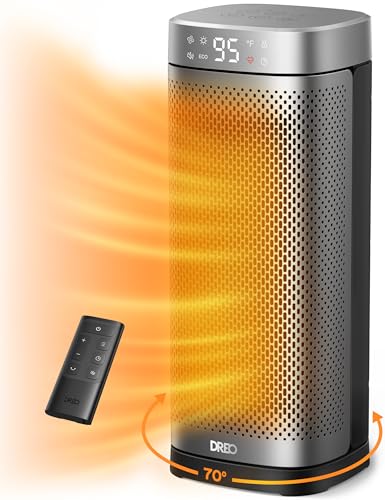
DREO 16-Inch Large-Room Ceramic Heater
Best for Bedrooms, living rooms and offices up to 250 sq. ft.
The 1,500 W ceramic element and 70° oscillation suit a room that needs quick, broadly spread heat. Its thermostat adjusts in 1°F increments, while tip-over and overheat protection cover two common heater hazards.
Power 1,500 WCoverage Up to 250 sq. ft.Noise As low as 34 dBThermostat 41–95°F, adjustable in 1°F incrementsSafety ETL-listed; tip-over and overheat protection
Why it made the cut
70° oscillation spreads warmth across the room
Thermostat adjusts from 41–95°F in 1°F increments
ETL-listed, with tip-over and overheat protection
Good to know
At 1,500 W, it draws substantial power on a household circuit
The product data gives a stated coverage area, not a room-heating guarantee
Skip it if Skip it if you need a lower-wattage heater for a desk or a very small room.
Best for Bedrooms and home offices where fan noise is a concern
A brushless DC motor and winglet fan design keep stated noise as low as 34 dB, making this a sensible pick for a room where you read or work. The thermostat adjusts from 41–95°F in 1°F increments, and the heater includes tip-over and overheat protection.
Power 1,500 WNoise As low as 34 dBThermostat 41–95°F, adjustable in 1°F incrementsTimer 12 hoursSafety Tip-over and overheat protection
Why it made the cut
Stated noise level as low as 34 dB
Thermostat adjusts in 1°F increments
Includes a remote and 12-hour timer
Good to know
The product data does not state a room coverage area
Its 1,500 W setting may be more heat than a small desk area needs
Skip it if Skip it if a specific room-size coverage figure is important to your choice.
Best for A cubicle or small personal space where a 1,500 W heater is more than you need
This compact ceramic heater runs at 750 W, using less power than many standard models. It offers an adjustable thermostat, two heat settings, and a tip-over shutoff for safe, straightforward personal heating.
Power 750 WDimensions 11 × 7.5 inchesWeight 5 lbs.Controls Adjustable thermostat and two-step switchSafety ETL-listed; tip-over switch
Why it made the cut
Uses 750 W output, which is less than many typical space heaters
Compact 11 × 7.5-inch design
ETL-listed with a tip-over switch
Good to know
Lower output is better suited to personal heating than warming a large room
The product data does not state a noise level
Skip it if Skip it if you need to spread heat across a larger room.
Best for A room where app control and scheduled heating matter more than portability
The programmable thermostat, app scheduling and remote let you set heat around your routine instead of adjusting it by hand each time. Its convection design is listed for rooms up to 250 sq. ft.; the manufacturer says it can warm an entire room within 1–2 hours.
Coverage Up to 250 sq. ft.Controls Programmable thermostat, remote and appMounting Wall-mountedHeating element Hedgehog Heating Element made from aerospace-grade aluminum
Why it made the cut
App supports schedules and mode changes
Remote displays set and room temperatures
Listed for rooms up to 250 sq. ft.
Good to know
The product data does not state wattage or noise level
Wall-mounted design is less suited to moving between rooms
Skip it if Skip it if you need a compact, portable heater or want a stated wattage before choosing.
Best for A small room where oscillation and remote control are useful
The 70° oscillation helps move warmth across more of the room, and the remote controls temperature, fan speed, modes and timer settings. It also lists both tip-over shutoff and overheat protection, plus ETL certification.
Power 1,500 WOscillation 70°Modes 5 modesTimer 12 hoursSafety ETL-certified; tip-over and overheat protection
Why it made the cut
70° automatic oscillation
Remote adjusts temperature, fan speed, modes and timer
ETL-certified with tip-over and overheat protection
Good to know
The product data does not state room coverage or noise level
The remote requires 2 AAA batteries
Skip it if Skip it if you need a published coverage area or noise figure before buying.
To choose portable electric heaters for home use, start with the room size and the heater’s stated coverage, then match the wattage and heater type to how you’ll use the space. A drafty room or poor insulation can make a heater feel weaker than its coverage claim suggests.
Wattage is a quick reality check: 750 W suits a small personal area, while 1,500 W is the usual ceiling for a plug-in room heater. A higher setting won’t fix heat escaping through a leaky window; it just uses more electricity while trying.
Type
How it heats
Often a good fit for
Ceramic PTC
A ceramic element warms air that a fan moves around the room.
Quick, directed heat where you’re sitting.
Oil-filled radiator
An electric element heats oil sealed inside the radiator; the warm metal releases heat gradually.
Steadier warmth over longer stretches, with less direct airflow.
Convection heater
The heater warms air, which circulates through the room as it rises and cooler air moves in.
More even background warmth, especially when you can leave it in one spot.
Different heating methods change how warmth feels and spreads; they don’t bypass the heater’s wattage limit.
The main types of portable heater suit different routines, not different laws of physics: ceramic models respond quickly, while oil-filled and convection models tend to feel gentler and more gradual. Oscillation, a timer and a remote can make control easier, but none makes a weak heater produce more heat.
Myth
A portable heater from Walmart is automatically a poor choice.
Fact
Walmart portable heaters can be suitable if the specific model has a UL, ETL or CSA listing, tip-over protection, overheat protection and a thermostat. Check the label and product manual rather than relying on the store name; the same checks apply to any portable heater at Walmart or elsewhere.
For a targeted shortlist, compare the coverage and controls on the DREO Space Heaters for Indoor Use, the Cozy Products ESH Eco-Save Compact Personal Space Heater and the Ballu Convection Heater for Large Room. If you’re comparing broader options, see our best electric heater for home guide.
Where The Running Cost Comes From
Energy efficient oil filled radiators don’t make more heat from each unit of electricity than other electric resistance heaters; their advantage is steadier heat delivery. That’s also the short answer for energy efficient oil radiators, how efficient are oil filled radiators, and are oil filled space heaters more efficient: the oil changes how heat is stored and released, not the basic electricity-to-heat calculation.
Same hours, different wattage
At 17 cents per kWh for 8 hours a day over 30 days, a 1,500 W heater uses 1.5 kW × 8 × 30 = 360 kWh, costing $61.20. A 750 W heater uses 0.75 kW × 8 × 30 = 180 kWh, costing $30.60. The smaller unit costs less in this example, but only if it can actually warm the space.
Electricity rate$0.17 per kWh
Daily use8 hours
Monthly use30 days
How efficient are oil filled electric heaters? Like other electric resistance heaters, they turn electricity into heat in the room. The oil stores heat after the element switches off, so the metal shell keeps warming the room during that pause; a thermostat can make the delivery feel steadier, but it doesn’t erase the energy used to heat the oil.
An electric heater efficiency chart based on wattage and hours gives a more useful cost comparison than a control-panel feature list. A smaller heater can cost less to run if it truly fits the room; an undersized one may run at full power and still leave you cold. The cheapest most efficient electric heater is the one with enough output for the space and controls that prevent unnecessary runtime.
1 kWh
1,000 W used for one hour
For any electric heater, calculate energy use as watts ÷ 1,000 × hours; multiply the resulting kWh by your electricity rate to estimate cost.
Safety And Certification That Matter
Portable heater safety starts with the outlet, clearance and safety switches, not the word “ceramic” on the box. Safe efficient electric space heaters should plug straight into a wall outlet—never an extension cord or power strip—and need at least 3 feet of clearance from bedding, curtains, furniture and clothing.
Use the wall outlet
A 1,500 W heater draws about 12.5 amps on a 120 V circuit. An extension cord or power strip can overheat under that load, while a crowded circuit can trip the breaker or heat the wiring. Keep the heater’s plug and cord visible, and don’t run it beneath a rug.
Look for tip-over protection, overheat protection and a UL, ETL or CSA listing. The tip-over switch cuts power if the heater falls; overheat protection shuts it down when internal temperatures rise too far. Neither feature gives you permission to cover the heater or place it against a wall.
Myth
Is a ceramic heater energy efficient because ceramic makes more heat?
Fact
A ceramic heater can be efficient in the practical sense if it warms the room you need quickly and avoids long runtime. Its electric heating element still turns nearly all of its electricity into heat, just like other resistance heaters, so ceramic doesn’t beat the wattage math.
Electric Versus Fuel
Electric heaters don’t burn fuel, so carbon monoxide is a separate concern from portable electric heater safety. Propane, kerosene and diesel heaters can produce carbon monoxide and need the correct indoor rating, required ventilation and a working CO alarm; an outdoor or construction heater never becomes safe indoors because a window is cracked.
Before You Run It
Confirm the heater is listed for indoor use and has a UL, ETL or CSA mark.
Keep 3 feet between the heater and anything that can burn.
Check that tip-over and overheat protection are listed in the manual.
Don’t sleep with a portable heater running or leave home with it on unless the manufacturer specifically says the model is designed for that use.
The Specs Buyers Skip Too Quickly
For high efficiency HVAC systems and the most efficient home heating systems, a properly sized heat pump or another central system usually beats portable resistance heat for an entire house. The most efficient home heating method and most cost efficient home heating choice still depend on the building and fuel rates, but portable heaters make sense for spot heating one occupied room instead of heating empty rooms.
Noise deserves a place beside wattage when a heater will run in a bedroom or office: around 34 dB is a useful benchmark for quiet models in the product data. Fan speed, clicking relays and oscillation can matter more at midnight than another decorative heat setting.
Spec
What to check
Noise rating
Around 34 dB is a useful quiet-model benchmark for bedrooms and offices.
Thermostat range
A wider usable range lets the heater hold comfort instead of running continuously.
Timer length
Choose a timer that covers your work period or bedtime routine without repeated resets.
Oscillation
Useful when one heater needs to spread warmth across more than one seating position.
Remote control
Changes temperature, mode or timer without making you cross a cold floor.
Controls only save energy when they help you stop heating an empty room.
Wall-mounted and app-controlled heaters can clear floor space, but permanent mounting and any new wiring must follow the manufacturer’s instructions and local code. A portable heater is simpler to move; a hardwired installation is a different electrical job.
Useful comparison
DREO Space Heaters for Indoor Use, 16 Inch Electric Heater for Large…
Use the DREO Space Heaters for Indoor Use, 16 Inch Electric Heater… as a shortlist candidate only after its listed noise level, thermostat and timer match the room where you’ll use it.
Choose a portable heater for one room and a heat pump or central system for whole-home heating. For quiet comfort, check the dB figure and the controls you will actually use before admiring the wattage.
Before You Buy Or Plug In
For the most efficient home heating system, a properly sized heat pump usually beats portable electric resistance heat; for a garage, choose a listed vented propane heater, and for wood, choose the highest tested-efficiency certified stove you can size correctly. The most efficient vented propane heater is usually a sealed direct-vent model, while a high efficiency propane garage heater must be approved for that space and installed as its manual requires.
Bedrooms, garages and workshops have different rules. A bedroom usually suits a 1,500 W indoor electric heater such as the DREO Space Heaters for Indoor Use, 16 Inch Electric Heater, provided the outlet and clearance work. A garage may need a vented propane unit; an outdoor-rated construction, patio or torpedo heater does not belong indoors.
Final Plug-In Check
Confirm the breaker and circuit can handle the heater; a 1,500 W model draws about 12.5 A at 120 V.
Plug an electric heater directly into the wall, never an extension cord or power strip, and keep the cord away from hot surfaces and walkways.
Match the stated room size to the room; a small personal heater won’t heat an uninsulated workshop well.
Look for a UL, ETL or CSA listing, tip-over protection and overheat protection.
Choose a thermostat if you want the heater to cycle instead of running flat-out; confirm the fuel heater’s venting and clearance instructions first.
Propane, kerosene and wood bring different hazards than electric heat. Indoor propane models need the manual’s ventilation and an operating CO alarm; kerosene heaters use 1-K kerosene only. Wood stoves need listed clearances, dry untreated wood, and an inspected, swept chimney. The highest efficiency wood burning stove still performs poorly if it is oversized or the flue is wrong.
Know When To Change Articles
If the problem affects the whole house, look at the furnace, heat pump or wood stove system instead. A gas connection, vent, chimney, 240 V circuit or water heater repair belongs on a licensed professional’s calendar in most places—not on a cold-night improvisation list.
More Questions, Answered
What is the best type of portable heater for a bedroom?
A thermostat-controlled electric heater with tip-over and overheat protection is a sensible bedroom choice. Pick one with a low setting so it can maintain the room temperature without running at full power; follow the manual’s clearance and overnight-use instructions.
Are oil filled radiators more efficient than ceramic heaters?
No—both convert electricity into heat at about the same rate. An oil-filled radiator releases heat more gradually after its element cycles off, while a ceramic heater usually warms the area in front of it sooner.
Can I use a portable heater from Walmart in a small apartment?
Yes, if the specific model is listed for indoor use and you follow its manual. Check that the heater has tip-over and overheat protection, plug it directly into a wall outlet, and leave at least 3 feet of clearance; avoid running it on the same circuit as other high-wattage appliances.
How much does a 1,500 watt portable heater cost to run?
At 17 cents per kWh, a 1,500 W heater costs about 25.5 cents per hour at full power: 1.5 kW × 1 hour × $0.17. A thermostat can reduce actual use by cycling the heater off, so your bill depends on how long it runs and your electricity rate.