Best Heater for Large Rooms to Transform Your Space with 300 sq ft Coverage
On this page 8 sections
- Comparison of Large Room Heaters
- Top Heaters for Large Rooms to Transform Your Space
- How To Choose the Best Heater to Transform Your Space
- Sizing and Running Costs for Large Room Heaters
- Safety and Certification for Indoor Electric Heaters
- Integrating Heating Upgrades During Space Transformation
- Quiet and Smart: Features That Make a Difference in Large Rooms
- More Questions, Answered
Comparison of Large Room Heaters
| Rank | Model | Best for | Heat Output (W) | Oscillation Range (°) | Coverage Area (sq ft) | Price |
|---|---|---|---|---|---|---|
| 1 | DREO 30-Inch Electric Space HeaterBest for Most Rooms | Large rooms up to 300 sq ft needing fast, quiet heating | 1500 | 30-60-90-120 | Up to 300 | Check price |
| 2 | DREO 25-Inch Electric Space HeaterQuiet and Safe | Medium to large rooms up to 270 sq ft needing silent operation | 1500 | 70 | 100-270 | Check price |
| 3 | DREO 1500W Electric Heater with TimerEnergy Efficient | Large rooms needing precise temperature and timed heating | 1500 | 70 | — | Check price |
| 4 | DREO 16-Inch Electric HeaterCompact and Quiet | Smaller large rooms up to 250 sq ft where quiet heat is key | 1500 | 70 | Up to 250 | Check price |
| 5 | DREO Smart Wall Heater 1500WSmart Wall Mount | Rooms where wall mounting and smart control are priorities | 1500 | 120 | — | Check price |
Many believe that any space heater will do the job for a large room, but most models either lack coverage or waste energy. The best heaters combine fast, even heat with quiet operation and safety features to truly transform your space.
Choosing the right heater means balancing room size, heating power, safety, and energy efficiency — all while keeping noise low and controls simple. This guide helps you find a heater that fits your large room and your needs.
Top Heaters for Large Rooms to Transform Your Space

DREO 30-Inch Electric Space Heater

DREO 25-Inch Electric Space Heater

DREO 1500W Electric Heater with Timer
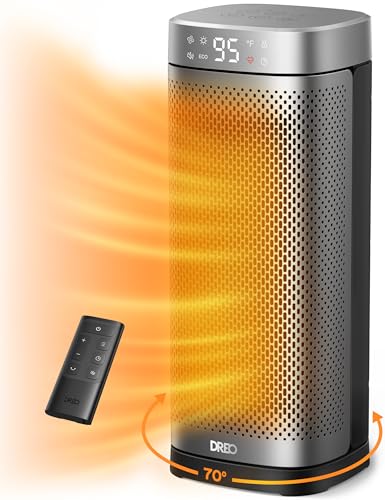
DREO 16-Inch Electric Heater

DREO Smart Wall Heater 1500W
How To Choose the Best Heater to Transform Your Space
To transform your space efficiently, pick an electric heater designed for large rooms that balances power, coverage, and quiet operation.

Wattage determines heating capacity. Most large rooms need about 10 watts per square foot if insulation is average. A 1,500-watt heater typically warms around 150 square feet, so look for models with 1,800 to 3,000 watts for bigger areas.
Oscillation spreads heat evenly. Wider angles—120 degrees or more—push warm air across the room, avoiding hotspots and cold corners.
Noise matters indoors. A heater running above 40 dB can disrupt conversations or sleep. Models emitting 25 dB or less are ideal for living rooms or bedrooms.
Safety features are a must. Tip-over switches cut power if the heater falls. Overheat sensors prevent fire risk. UL listings confirm these protections.
Thermostat precision lets you keep your temperature steady without wasting energy. ECO modes lower power once the room reaches set warmth, trimming your electric bill.
| Feature | Why It Matters |
|---|---|
| Wattage | Matches heater size to room area for effective warmth |
| Oscillation Angle | Distributes heat evenly for comfort |
| Noise Level | Keeps your space peaceful while heating |
| Safety Features | Prevents accidents and meets indoor use codes |
| Thermostat & ECO Modes | Maintains temperature efficiently |
Sizing and Running Costs for Large Room Heaters
Sizing your heater starts with your room’s square footage and insulation quality. Typical rooms need 10 watts per square foot; poorly insulated spaces may require up to 15 watts.
For example, a 300-square-foot room with average insulation needs about 3,000 watts of heating power (300 sq ft × 10 W/sq ft = 3,000 W). Choose a heater or combination that delivers this output.
Electric costs vary by your heater’s wattage, usage hours, and your local rate per kilowatt-hour (kWh). At 17 cents per kWh, a 1,500-watt heater running 8 hours uses 12 kWh, costing about $2.04 per night (1,500 ÷ 1,000 × 8 × 0.17).
| Heater Wattage | Hours Used | Monthly Cost @ $0.17/kWh |
|---|---|---|
| 1,500 W | 8 | Model prices vary widely based on features and sellers; check current listings for the latest cost. |
| 3,000 W | 8 | Prices depend on retailer and sales; consult current sources before purchasing. |
| 5,760 W | 8 | Costs fluctuate; compare prices from multiple vendors to find the best deal. |
Higher wattage heaters warm rooms faster but cost more to run. Balance upfront cost with your budget and how long you’ll run the heater.
If your heater is on a timer or thermostat, it won’t run continuously at full power, reducing costs. Investing in a smart heater with precise controls pays off in efficiency.
Safety and Certification for Indoor Electric Heaters
Space heaters are a common cause of home fires and carbon monoxide incidents, so safety comes first when picking one.
Look for models with a tip-over switch that shuts the heater off if it falls, and overheat protection that cuts power if internal parts get too hot. Both features reduce fire risk when you accidentally bump or block the heater.
The housing should be made of flame-retardant materials, and the plug and cord must be certified to handle the heater’s current without overheating. Certified plugs have markings from UL, ETL, or CSA, which also appear on the heater’s label—these are your quality markers.
Proper placement matters: keep heaters at least 3 feet from curtains, furniture, and any combustible items. Never place a heater on an unstable surface or near water sources.
Crawl spaces or poorly ventilated areas pose special challenges. The safest heater for a crawl space is one designed for that environment, often vented or hydronic models, because electric heaters alone might not provide adequate airflow or safety. Non-electric indoor heaters exist, but they generally require venting and professional installation.
If you’re shopping at stores like Walmart for indoor electric heaters, you’ll find many models meet these safety standards, but always check labels and features carefully before buying.
Integrating Heating Upgrades During Space Transformation
When redesigning a space, coordinate your heater placement and type with HVAC pros or professional organizers to optimize comfort and energy use.
Improving insulation and sealing gaps reduces heat loss and lowers running costs. Upgrading windows, door frames, and adding attic insulation makes a big difference alongside your heater.
Smart controls and timers help manage heater run time, preventing wasteful operation. Pair these with motion sensors or home automation to heat rooms only when occupied.
For large or challenging spaces like crawl spaces, combining electric heaters with hydronic or vented gas heaters can improve overall warmth. Heat pump water heaters in crawl spaces offer energy-efficient solutions, circulating warm water to radiators or floor loops.
Non-electric heating options such as solar thermal panels can supplement your system, especially in sunny climates. These reduce reliance on grid electricity and help cut heating bills.
By integrating heating upgrades with your space transformation, you improve comfort while keeping energy costs in check and avoiding surprises on your next bill.
Quiet and Smart: Features That Make a Difference in Large Rooms
The quietest heater for large rooms runs at about 25 decibels, roughly the sound level of a whisper or rustling leaves, which means it won’t compete with conversations or work sounds.
Noise levels around 25 to 35 dB are ideal in bedrooms, offices, or living rooms where peace matters. A 40 dB heater, by contrast, sounds like a quiet refrigerator humming and can become distracting over time.
Smart controls on electric heaters bring convenience and energy savings that pay off in large spaces. Remote controls let you adjust temperature and fan speed without leaving your seat. Many models also pair with smartphone apps, allowing scheduling, temperature monitoring, and even location-based activation.
Voice assistant integration, like Alexa or Google Assistant, adds hands-free control—just say “set heater to 70 degrees” while you’re busy with other tasks.
Timers and programmable thermostats help avoid wasted heat and high bills. You can set a heater to warm the room just before you arrive or turn off automatically after you fall asleep. This customization often slashes running time by 25% or more.
Oscillation modes extend heat coverage by gently sweeping warm air across the room. Some models offer adjustable angles and speeds, so you can focus warmth where you need it most or create a broad, even temperature.
Electric heaters for large rooms that balance power with whisper-quiet operation usually include ceramic or oil-filled elements with variable fan speeds and sound-dampening enclosures.
For indoor use Walmart offers a range of space heaters that combine these features, often with convenient size and safety certifications. Look for models with tip-over and overheat protection and at least ETL or UL listing.