Skip to content
HeaterGuides
Electric

Heat Pump Water Heaters Save About 60% on Energy Use

On this page 8 sections
  1. Best Heat Pump Water Heaters for Different Needs
  2. Best Heat Pump Water Heaters for Different Needs
  3. Match Capacity and Installation Location to Your Home
  4. Understand Efficiency Ratings and Running Costs
  5. Maintain Performance with Proper Descaling and Flushing
  6. Check Safety Certifications and Installation Requirements
  7. Avoid Common Misconceptions About Heat Pump Water Heaters
  8. Frequently Asked Questions
Bottom line
The ACiQ 50 Gallon Electric Residential Hybrid Heat Pump Water Heater is the best pick for most US homes, offering a 3.75 UEF rating, quiet operation, and ideal capacity for families of 3–5.
Our picks at a glance
1
Best Overall PickACiQ 50-Gallon Hybrid Water Heater
Families of 3–5 needing an efficient indoor tank
See current price
2
Best Compact Flush Kit6699 Tankless Heater Flush Kit
DIY maintenance on a tankless water heater
See current price
3
Best With DescalerChromex Tankless Flush Kit
Tankless owners who want a supplied citric-acid descaler
See current price
4
Best Heavy-Duty PumpSuperior Pump Descaler Kit
Frequent tankless descaling with higher pump flow
See current price
5
Best For Small BatchesQENIVO 1500W Immersion Heater
Heating water in a tub, bucket, or small inflatable pool
See current price

Heat pump water heaters save energy by moving heat instead of generating it, cutting your water heating costs significantly. Choosing the right model means matching capacity, efficiency, and installation conditions to your home’s needs.

This guide compares top models to help you decide quickly, with clear specs and practical advice on sizing, running costs, and placement.

Best Heat Pump Water Heaters for Different Needs

ModelBest forCapacity (gallons)Uniform Energy Factor (UEF)Installation LocationNoise Level (dB)Price
ACiQ 50-Gallon Hybrid Water HeaterBest Overall Pick50 gallons3.75 UEFIndoor; basement or garage, 37°F or warmer49.5 dB(A)Why it is here
6699 Tankless Heater Flush KitBest Compact Flush Kit————Why it is here
Chromex Tankless Flush KitBest With Descaler————Why it is here
Superior Pump Descaler KitBest Heavy-Duty Pump————Why it is here
QENIVO 1500W Immersion HeaterBest For Small Batches————Why it is here

Best Heat Pump Water Heaters for Different Needs

#1Best Overall Pick
ACiQ 50-Gallon Hybrid Water Heater

ACiQ 50-Gallon Hybrid Water Heater

Best for Families of 3–5 needing an efficient indoor tank
The 50-gallon tank suits 3–5 people, while its 3.75 UEF rating helps reduce energy use compared with traditional models. It delivers 69 gallons in the first hour and runs at 49.5 dB(A), making it a strong fit for a basement or garage with enough air volume and drainage.
Capacity 50 gallonsUniform Energy Factor 3.75 UEFFirst-hour delivery 69 gallonsAir circulation required 700–1,000 cubic feetNoise level 49.5 dB(A)
Why it made the cut
3.75 UEF rating
69-gallon first-hour delivery
Quiet 49.5 dB(A) operation
Good to know
Needs 700–1,000 cubic feet of air circulation
Should not be installed below 37°F
Skip it if Skip it if you need a water heater for an unheated space below 37°F or don’t have proper drainage.
See current pricePaid link · live price on Amazon
#2Best Compact Flush Kit
6699 Tankless Heater Flush Kit

6699 Tankless Heater Flush Kit

Best for DIY maintenance on a tankless water heater
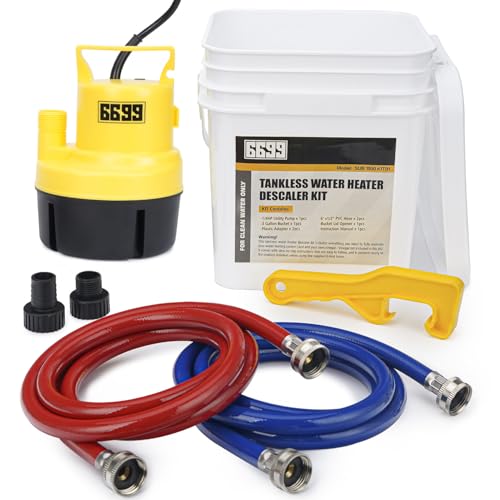
The 6699 kit includes a 1/4 HP pump, two 6-foot hoses, adapters, and a 3-gallon pail for circulating cleaning solution through a tankless unit. Its 1,500 GPH pump has thermal overload protection and a 23-foot maximum head, although this kit is for tankless maintenance rather than a heat pump tank.
Pump power 1/4 HPPump voltage 115V/60HzMaximum flow 1,500 GPHMaximum head 16.5 feetBucket capacity 3 gallons
Why it made the cut
Includes pump, hoses, adapters, and pail
1,500 GPH maximum flow
Thermal overload protection
Good to know
Designed for tankless heaters, not heat pump storage tanks
Maximum fluid temperature is 95°F
Skip it if Skip it if you’re buying a complete heat pump water heater rather than cleaning a compatible tankless system.
See current pricePaid link · live price on Amazon
#3Best With Descaler
Chromex Tankless Flush Kit

Chromex Tankless Flush Kit

Best for Tankless owners who want a supplied citric-acid descaler
Chromex combines a 1/6 HP pump, 5-gallon bucket, two PVC-coated hoses, and a citric-acid descaling solution in one kit. The solvent-free solution is listed as NSF certified and is intended for use with most metals, PVC, rubber, and ABS materials.
Pump power 1/6 HPBucket capacity 5 gallonsHose length 6 feetDescaler type Citric acid basedDescaler certification NSF certified
Why it made the cut
Includes descaling solution
5-gallon bucket with lid
6-foot hoses connect to heater valves
Good to know
Made for tankless water heaters
The supplied solution and pump are unnecessary for replacing a heat pump tank
Skip it if Skip it if your goal is a new heat pump water heater and you don’t need to descale a tankless unit.
See current pricePaid link · live price on Amazon
#4Best Heavy-Duty Pump
Superior Pump Descaler Kit

Superior Pump Descaler Kit

Best for Frequent tankless descaling with higher pump flow
The 91660 uses a 1/6 HP oil-free pump rated for up to 1,920 gallons per hour and 20 feet of vertical lift. Its 3.5-gallon pail, stainless steel hoses, non-toxic descaler powder, and debris-filtering bottom screen make it a practical maintenance kit for tankless systems.
Pump power 1/6 HPMaximum flow 1,920 GPHMaximum vertical lift 20 feetPail capacity 3.5 gallonsPower cord 8 feet
Why it made the cut
1,920 GPH maximum pump flow
Includes stainless steel hoses
Oil-free motor and debris screen
Good to know
For tankless heater descaling, not heat pump tank maintenance
The pail holds 3.5 gallons, less than the Chromex kit
Skip it if Skip it if you don’t own a tankless heater or won’t use its higher-flow pump and descaling parts.
See current pricePaid link · live price on Amazon
#5Best For Small Batches
QENIVO 1500W Immersion Heater

QENIVO 1500W Immersion Heater

Best for Heating water in a tub, bucket, or small inflatable pool
QENIVO is a portable 1,500W immersion heater with a separate thermometer for monitoring water temperature in small containers. It requires a dedicated 120V/15A-or-higher outlet and full submersion, so it isn’t a replacement for a household heat pump water heater.
Power 1,500WRequired outlet 120V/15A or higherMinimum water above heater 2 inches / 5 cmMaterial 316L stainless steelSafety testing Passed UL safety tests
Why it made the cut
Includes a separate thermometer
316L stainless steel construction
Open-slot guard supports water circulation
Good to know
Heats containers rather than household plumbing
Requires a dedicated outlet
Must stay fully submerged while powered
Skip it if Skip it if you need stored hot water for showers, sinks, or a whole home.
See current pricePaid link · live price on Amazon

Match Capacity and Installation Location to Your Home

heat pump water heater: Match Capacity and Installation Location to Your Home

Heat pump water heaters need to match your home’s hot water demand and the space where you’ll install them. The unit’s capacity, usually measured in gallons, should cover your household’s daily use without wasting energy or running out quickly.

Choose tank capacity by household demand, not by the number of bathrooms alone. A 50-gallon tank generally suits about 3–5 people, which is why the ACiQ 50 Gallon Electric Residential Hybrid Heat Pump Water Heater is a sensible match for many family homes. Smaller households may use less capacity, while several back-to-back showers, a large soaking tub or frequent laundry can push you toward a larger tank.

A heat pump water heater in a garage can work, but a cool garage reduces its advantage and may make recovery slower. The heat pump pulls warmth from surrounding air; colder air gives it less heat to collect, and the unit may use its electric resistance elements more often. Check the manufacturer’s minimum ambient temperature before choosing an unheated garage.

Basements usually make the easiest location because they’re indoors, protected from freezing weather and often have usable air volume. Garages and crawl spaces need closer checking for low temperatures, moisture, access and airflow. The unit also releases cooler air while operating, so don’t place it where that discharge will make a small finished room uncomfortable.

Measure Before Ordering
Tank height, width and service access around the unit
The manual’s minimum room temperature and required air volume
Clearance for air intake and cool-air discharge
A drain path for condensate and relief-valve discharge
A route wide enough to move the tank into place
Cold-Space Warning
Don’t install the tank in a location that can freeze. Water damage is only part of the problem; freezing conditions can also stop the heat pump from operating as designed.

If crawl-space placement is your only option, compare the manual’s space and temperature requirements with the actual conditions in winter, not a mild afternoon. heat pump water heater crawl space covers the placement tradeoffs in more detail.
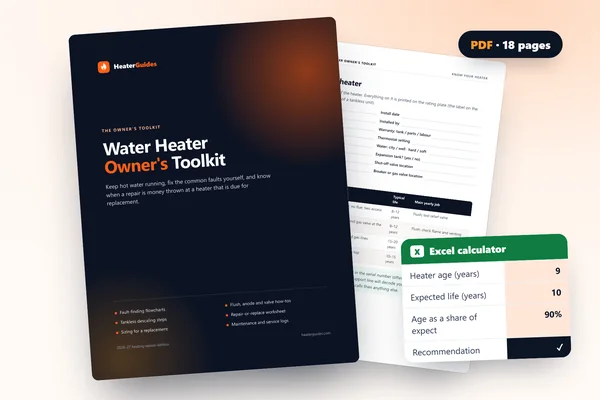
From HeaterGuides · our own guidePages 9 to 13 are the fault flowcharts: no hot water, noises, smells and leaks, in order.Water Heater Owner's Toolkit: the printable guide and its Excel calculatorWater Heater Owner's ToolkitFix the common faults yourself, keep it running for years, and know when a repair is money wasted.No-hot-water flowcharts, gas and electricFlush, anode, relief valve and descaling stepsRepair-or-replace calculator (Excel)$14.99 $9.99Get it for $9.99See what's inside and watch the 2-minute video →18-page printable PDF + Excel calculator · instant download · 30-day refund

Understand Efficiency Ratings and Running Costs

Efficiency ratings for these units, like the Uniform Energy Factor (UEF), help you compare operating costs. A higher UEF means less electricity used per gallon of hot water. Running costs depend on your local electricity price and how much hot water you use.

UEF, or Uniform Energy Factor, measures how much hot-water energy a unit delivers for the energy it uses under a standardized test. Higher is better. A 3.75 UEF rating, such as the ACiQ’s, means the test result delivered about 3.75 units of hot-water energy for each unit of electrical energy consumed; standard electric resistance heating operates much closer to a one-for-one exchange.

Worked Example
For a simple comparison, treat 1,500 W as the equivalent electrical consumption and assume the heater operates 8 hours per day. That is 1.5 kW × 8 hours = 12 kWh per day; at $0.17 per kWh, the energy cost is about $2.04 per day before any utility fees or demand charges.
Daily use12 kWh
Assumed electric rate$0.17/kWh
Daily energy costRunning a 1,500 W heater for 8 hours con
HeaterWattsPer hourPer day (8 h)Per month (30 days)
Heat pump water heater example1,500 W26¢$2.04$61.20
Calculated at 17¢ per kWh. Illustrative energy use only; actual consumption changes with hot-water demand, room temperature, setpoint and operating mode.

Hybrid mode lets the heat pump handle efficient everyday heating while resistance elements help recover the tank during heavier demand. That flexibility can prevent long waits after several showers, though frequent resistance operation reduces the savings. Quiet operation matters if the tank sits near a bedroom or living area; a quieter model such as the ACiQ is easier to live with there.

The main pros are lower potential operating cost, high efficiency and flexible hybrid recovery. The cons are the larger footprint, cool exhaust air, installation requirements and performance that changes with surrounding temperature. For a fuller cost-and-payback rule, see are heat pump water heaters worth it.

Maintain Performance with Proper Descaling and Flushing

A heat pump water heater stays dependable when you follow its maintenance schedule, flush sediment from the tank, and clean the air filter instead of treating every warning as a failed compressor. Hard water makes mineral buildup more likely, so a flushing kit is especially useful where scale collects quickly.

Searching for “hybrid water heater rheem service beeping”? Beeping usually means the control has detected an alert or fault, not that one universal part needs replacing. Read the display code, check the owner’s manual, confirm the air filter and condensate drain are clear, and call for service if the alert returns after the manual’s reset procedure.

Choose A Flushing Kit That Fits The Job

The 6699 Tankless Water Heater Flushing Kit is a general-purpose option for circulating descaler through a service connection, while the Chromex Tankless Water Heater Flush Kit with NSF Certified components is the better fit when certified wetted parts matter to you. The Superior Pump 91660 Tankless Water Heater Descaler Pump Kit is aimed at buyers who want a dedicated pump kit rather than assembling one from separate parts.

Check the pump’s flow and lift ratings against the heater manufacturer’s instructions, then confirm the kit includes the hoses, bucket or reservoir, isolation valves, and adapters your connection needs. A stronger pump isn’t automatically better; excessive flow can make a messy job out of a service port that calls for gentler circulation.

1
Shut Down Safely
Turn off the water heater according to its manual, disconnect power at the breaker when the procedure calls for it, and close the water isolation valves.
2
Flush The Lines
Connect the pump and hoses, use only the descaler approved for the heater, and circulate it for the time specified by the heater and chemical instructions.
3
Rinse Completely
Drain the solution, circulate clean water until no cleaner remains, reopen the valves, and restore power using the manufacturer’s startup sequence.
Don’t Guess At The Code
Neglected flushing can leave scale on heat-transfer surfaces, reducing efficiency and triggering warning or beeping errors. A service procedure for a tankless heater doesn’t automatically apply to a heat pump tank, so follow the exact manual before opening valves or adding chemicals.

Heat pump water heater reliability is generally strongest when the installation has the right air space, a clean filter, a working condensate drain, and scheduled inspections. Flushing removes sediment; it doesn’t repair a refrigerant, control-board, or compressor fault.

Check Safety Certifications and Installation Requirements

A safe heat pump water heater installation starts with an indoor-rated unit carrying the certifications and listing marks required for your model and local code, then gives it stable temperature, airflow, drainage, and correctly sized electrical service. Look for ENERGY STAR for the efficiency designation and a UL listing for electrical safety; follow the product label and local authority if another accepted listing is specified.

A heat pump water heater explained simply: the unit pulls heat from surrounding air with a refrigeration system and transfers that heat into the tank, with electric resistance elements available on many hybrid models for recovery or backup. Because the appliance extracts heat from its room, placement affects both performance and comfort.

Does a heat pump water heater work in cold climates? Yes, provided the installation space stays above the model’s minimum temperature—commonly above 37°F for the models that specify that limit—and the unit has the required air volume and circulation. A freezing garage, crawl space, or closet can fall outside the operating range, so check the installation manual before buying.

Confirm Before Installation
Indoor installation location remains above 37°F, or above the exact minimum in the manual.
Clearances and air-volume requirements leave the intake and discharge paths unobstructed.
Condensate tubing has a continuous route to an approved drain and cannot freeze.
The T&P relief valve has an unobstructed discharge line that ends where local code permits.
Electrical circuit, breaker, disconnect and wiring match the heater nameplate and instructions.

Ventilation for a heat pump water heater means open air circulation around the appliance, not a gas flue: don’t seal the unit in a tight closet unless the manufacturer provides a louvered or ducted design for that space. Condensate drainage also matters because the heat pump removes moisture from the air during operation.

Use A Licensed Installer
Have a licensed electrician handle new circuits or 240-volt work and a licensed plumber handle water connections, relief-valve piping, drainage, and code-required changes. Never cap or plug the T&P valve discharge line; it is the tank’s pressure and temperature safety outlet.

Avoid Common Misconceptions About Heat Pump Water Heaters

Some assume these water heaters work well everywhere, but they perform best in warm, ventilated spaces. Cold locations like unheated garages or crawl spaces can reduce efficiency and increase wear. Also, these units don’t heat water as quickly as conventional electric models, so sizing and installation location are key.

Myth
Heat pump water heaters don’t work in cold climates.
Fact
They can work in cold climates when the surrounding air stays above 37°F, the model allows that installation, and the space has enough air circulation. An unheated garage that drops below 37°F can reduce performance or push the unit toward backup electric heating. Check the installation manual before treating a garage, basement or utility room as suitable.
Myth
They always cost more to install.
Fact
The equipment and installation can cost more upfront than a standard electric tank, especially if the location needs electrical, condensate-drain or venting changes. Lower electricity use can offset that difference over time, but the payback depends on your hot-water demand, electric rate and installation work. A higher purchase price isn’t automatically a higher lifetime cost.
Good for
Homes with steady hot-water demand and room for the unit’s airflow requirements
Owners willing to maintain the air filter, tank and connections
Utility rooms where lower operating costs matter over several years
Not for
Very cold spaces that stay below 37°F
Tight rooms where fan or compressor noise would disturb a bedroom
Installations where the added electrical or condensate work erases the expected savings

Quiet operation matters in a small utility closet because the compressor and fan may run near bedrooms, living areas or a home office. A quieter model, such as the ACiQ 50 Gallon Electric Residential Hybrid Heat Pump Water Heater, is easier to live with when the equipment can’t be isolated behind a distant mechanical-room door. Check the manual’s sound and placement guidance rather than assuming every hybrid unit sounds the same.
Frequently Asked Questions

What is a heat pump water heater and how does it differ from a traditional electric model?
A heat pump water heater pulls heat from surrounding air and transfers it into the tank, while a traditional electric unit uses resistance elements to create heat directly. Most heat pump models also include resistance backup for periods of heavy demand or colder conditions. That design usually lowers electricity use, though the compressor and fan need room to operate.
Can heat pump water heaters be installed in crawl spaces or garages?
A crawl space or garage can work only when the model’s temperature range, air-volume requirement, clearance rules, and condensate drainage needs are met. The location also needs enough service access and protection from freezing conditions. Check the installation manual before choosing the spot; a cramped enclosure can starve the heat pump of usable air.
How long does a heat pump water heater typically last?
Most heat pump water heaters last about 10–15 years when installed correctly and maintained on schedule. Flushing sediment, cleaning the air filter, checking the anode rod, and keeping the condensate path clear can help prevent avoidable failures. Hard or corrosive water may shorten tank life, so local water conditions matter.
Are heat pump water heaters worth the higher upfront cost compared to electric water heaters?
They can be worth the extra purchase and installation cost when your household uses enough hot water for the lower electric consumption to repay that difference. The payback depends on your electricity rate, hot-water demand, climate, available incentives, and the installation work required. A simple comparison is to estimate each unit’s yearly energy cost, then divide the added upfront cost by the annual savings.

Joye Editor

HeaterGuides covers home heating, water heating and HVAC: how the equipment works, what it costs to run, and how to use it safely.

More in Electric