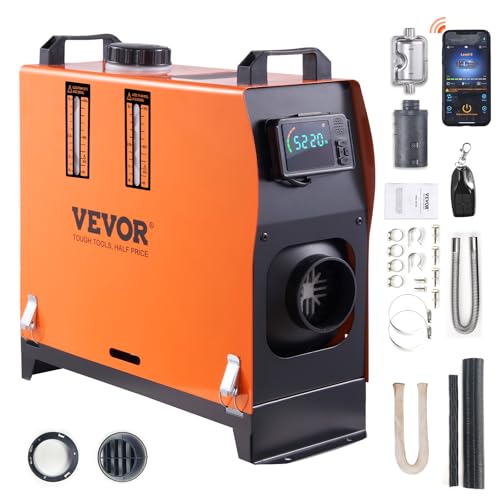
The best pick for most readers is product 5 because it adds a CO alarm, smart control, and low fuel use in one 8 kW unit. If you want an air parking heater gasoline shoppers usually mean for a vehicle or garage, start here and compare the tank size and safety features before you buy.
Key takeaways
Pick product 5 if you want the best safety package and the simplest control setup.
Choose product 2 or 4 for larger spaces, but check altitude and fuel tank size first.
Skip product 1 if you need heat; it’s a 7 L fuel tank, not a heater.
A parking heater needs outside exhaust and a working CO alarm indoors or in a cabin.
Noise matters more than the watt number once the heater is installed.
Say your van has about 250 square feet to warm and the inside is 25°F while you want 60°F for the night. An 8 kW heater can cover that kind of space faster than a small 5 kW unit, but fuel use, venting, and noise decide whether you’ll actually like living with it.
One thing the search phrase hides: most parking heaters in this group are diesel air heaters, not gasoline heaters. That matters because fuel type, exhaust routing, and CO safety are the real buying filters, and the wrong assumption can turn a cheap buy into a cold, noisy mistake.
VEVOR 8KW Diesel Heater with CO Alarm and Smart Control
Best for Vehicles and campers needing smart control and safety
This 8 kW diesel heater offers a built-in CO alarm that monitors carbon monoxide levels and can shut off the unit if needed, enhancing safety during indoor use. It consumes just 0.18-0.35 L/h of fuel and includes smart control options via Bluetooth app, remote, or display panel, making it easy to adjust temperature from a smartphone. Its leak-proof fuel tank cap and fuel level indicator reduce maintenance worries. Quiet operation at ≤75 dB means comfortable use in RVs or cabins.
Heat output 8 kWFuel use 0.18-0.35 L/hControls Bluetooth app, remote, display panelVoltage DC 12-24V
Why it made the cut
Built-in CO alarm for continuous safety monitoring
Multiple control options including Bluetooth app
Low fuel consumption with leak-proof tank cap
Quiet operation with premium muffler and fuel pump
Good to know
Only one tank size option (not specified)
Higher initial complexity for beginners
Skip it if Skip if you want a simpler heater without smart controls or CO alarms.
VEVOR 8KW Diesel Air Heater with Bluetooth and Remote
Best for Vehicles and garages needing altitude compensation
This 8 kW diesel heater features automatic altitude compensation up to 18,045 ft, so it adjusts fuel and air intake automatically for efficient heating in high elevations. It offers Bluetooth app control and a remote for convenience. The 10 L fuel tank supports longer operation, while the sandblasted aluminum heat exchanger ensures rapid heat transfer. It’s designed for cars, RVs, trailers, and boats.
Heat output 8 kWFuel use 0.16-0.62 L/hTank size 10 LControls Bluetooth app, remote
Why it made the cut
Automatic altitude compensation to 18,045 ft
Bluetooth app and remote control
Large 10 L fuel tank for extended use
Efficient heat exchanger for fast warming
Good to know
Fuel consumption range is wide (0.16-0.62 L/h)
No CO alarm included
Skip it if Skip if you want CO safety features or smaller tank options.
Best for Camping and outdoor use needing no installation
This all-in-one 8 kW diesel heater requires no installation, making it ideal for camping and temporary setups. It includes Bluetooth app and remote controls for easy operation from up to 98 ft away. The 5 L fuel tank balances portability with run time. Automatic altitude compensation up to 18,045 ft supports use in varied locations. It’s designed to be secure and reliable for cars, RVs, and boats.
Heat output 8 kWTank size 5 LControls Bluetooth app, remoteVoltage 12 V
Why it made the cut
No installation needed for quick setup
Bluetooth app and remote control
Automatic altitude compensation
Moderate 5 L fuel tank for portability
Good to know
Smaller tank means more frequent refueling
No built-in CO alarm
Skip it if Skip if you want a larger tank or CO alarm for safety.
Best for Garages and basements needing 110V plug-in
This 5 kW diesel heater stands out for supporting 12 V, 24 V, and 110 V power inputs, allowing use in vehicles or directly from household outlets without extra adapters. It has a fuel consumption range of 0.18-0.53 L/h and operates in temperatures as low as -40°F. The internal threaded fuel tank cap prevents leaks during movement. The included LCD and remote make controlling heat straightforward.
Heat output 5 kWFuel use 0.18-0.53 L/hControls LCD, remoteVoltage 12 V/24 V/110 V
Why it made the cut
Supports 12 V, 24 V, and 110 V power sources
Fuel tank cap prevents oil spills
Remote and LCD control included
Operates down to -40°F
Good to know
Lower heat output at 5 kW
No Bluetooth or altitude compensation
Skip it if Skip if you need more heat or smart controls.
This 7 L stainless steel external fuel tank is compatible with Webasto, Eberspacher diesel heaters, and other gasoline engines. It’s made of high-quality 304 stainless steel that resists rust and high temperatures. The upgraded filler neck improves fuel sealing and prevents leaks. It comes fully assembled with seals, screws, fuel tube, and cap, making it ready for installation.
How To Choose An Air Parking Heater Gasoline Buyers Mean
Most “parking heater gasoline” searches actually revolve around diesel air heaters, not gasoline models. The term sparks confusion because gasoline heaters are rare, while diesel air parking heaters dominate the market for vehicle and garage heating. Forums on parking heater gasoline experience often mix the two, but if you want reliable heat for winter travel, diesel air heaters are the practical choice.
Output size is a key spec: 5 kW heaters suit smaller, well-insulated spaces, like cozy cabins or tighter vehicle interiors. Larger or leakier areas demand 8 kW models to keep temperatures stable. But the headline number isn’t the whole story. Fuel consumption rates, tank capacity, and available controls influence how well a heater fits your needs—especially since these affect run time and convenience more than raw power.
Altitude support also matters. Some models adjust combustion automatically for high elevations, maintaining efficiency where air is thin. Remote controls and smartphone apps add usability, letting you start or adjust heat before stepping inside. Though handy, these features don’t change installation needs: all parking heaters require proper venting and exhaust systems to run safely indoors.
Product 1 is not a heater but a 7-liter stainless steel external fuel tank designed to supply fuel to a heater or engine. It’s useful if you need extended fuel capacity but doesn’t generate heat itself, so don’t include it in your heater count.
Gasoline vs Diesel Clarification
Despite the name, most air parking heaters labeled as gasoline heaters run on diesel. Make sure you check the fuel type before buying to avoid costly mistakes.
Feature
What to Check
Output (kW)
5 kW for small spaces, 8 kW for larger or drafty areas
Fuel Type
Diesel is standard; gasoline heaters are rare
Fuel Tank Size
Larger tanks mean longer run time without refueling
Altitude Support
Automatic adjustment needed above 7,000 ft
Controls
Remote or app controls improve convenience but not venting
Key Specs to Compare in Air Parking Heaters
Which Pick Fits Your Space
Choosing the right parking heater depends on your space and how you want to control heat. The VEVOR 8KW Diesel Heater (product 5) stands out as the best overall. It combines an 8 kW output with a built-in carbon monoxide alarm, Bluetooth app control, remote, and a display panel for easy monitoring and safer operation.
For large or high-altitude spaces, product 2—the VEVOR 8KW Diesel Heater variant with a 10-liter tank and automatic altitude compensation up to 18,045 feet—is the go-to. The bigger tank means longer running periods, and the altitude feature keeps performance steady where oxygen is scarce.
If quiet operation and versatility matter, product 3, the LF Bros 5KW Diesel Heater, fits well. It supports 12V, 24V, and 110V power, offering flexibility for different vehicle or garage power supplies while keeping output at a more modest 5 kW level.
Product 4, the VEVOR 8KW Diesel Heater with Bluetooth App Control, simplifies installation with a smaller 5-liter tank and an all-in-one setup. It’s a solid choice if you want an 8 kW heater but don’t need the larger tank or some advanced features of product 5.
Remember, product 1 is just an external 7-liter fuel tank accessory without heating capability. Choose it only if you want to extend fuel storage for an existing heater or engine.
Choosing a Heater for a 24 × 24 ft Garage
Say you have a 24 × 24 ft uninsulated garage wanting reliable overnight heat. The 8 kW heaters (products 2, 4, or 5) provide enough output. Product 5’s CO alarm and app control enhance safety and convenience, while product 2’s 10 L tank lets you run longer without refills. If you want quieter, smaller output, product 3’s 5 kW heater suits better for smaller, insulated spaces.
Garage Size24 × 24 ft
Best Heater8 kW models for size, 5 kW for insulatio
Tank Options5 L to 10 L, more fuel means longer heat
Best Overall
VEVOR 8KW Diesel Heater
Product 5 is the top pick because it combines 8 kW heat, a built-in CO alarm, remote and app control, plus a display panel for safer, smarter heating.
8 kW heaters suit larger or drafty spaces; 5 kW models fit smaller, insulated ones. Product 5 covers most needs with safety and control features, while others target specific fuel tank sizes or power options.
Running Cost And Fuel Range
Fuel consumption for gasoline parking heaters typically ranges between 0.18 and 0.35 liters per hour, which means an 8-hour night of heating uses roughly 1.4 to 2.8 liters of fuel.
Product 5 has the leanest published burn rate in this group, running from 0.18 to 0.35 L/h. In contrast, products 2 and 4 advertise a wider range of 0.16 to 0.62 L/h, with marketing claims close to 1 gallon per night—about 3.8 liters.
Tank size strongly influences how often you’ll need to refill. A 10-liter tank covers about three to seven nights of use, depending on the burn rate. A 5-liter tank lasts one and a half to three nights, while the 7-liter auxiliary tank on product 1 sits in between, roughly two to five nights per fill.
Tank Size
Approximate Nights of Heat (0.18-0.35 L/h)
5 L
1.5 to 3 nights
7 L
2 to 5 nights
10 L
3 to 7 nights
How tank capacity affects heating duration at typical burn rates
Expect actual fuel use to vary with outside temperature, altitude, and how often the heater cycles on and off. Colder or thinner air means the heater works harder, increasing consumption. Cycling frequency depends on insulation and thermostat settings.
To estimate running cost, multiply the burn rate by your local gasoline price and hours of use. For example, at 0.25 L/h for 8 hours, you use 2 liters. If gasoline costs $4 per gallon (about $1.06 per liter), that equals roughly $2.12 per night.
Forums dedicated to parking heater gasoline experience often emphasize these fuel consumption variations and tank size trade-offs when recommending models for winter travel.
Safety And Certification Come First
You can use a muffler on some diesel air heater setups to cut exhaust noise, but it does not make the heater safe to vent indoors or remove the need to route exhaust gases outside.
Gasoline parking heaters share similar safety requirements with diesel models: combustion gases must exhaust outside, intake and exhaust pipes must be correctly installed, and you must have a working carbon monoxide (CO) alarm nearby. Patio or construction heaters are never safe for indoor or vehicle use.
Product 5 includes a built-in CO alarm, which adds an extra layer of safety. However, this alarm is not a substitute for proper venting and installation following the manufacturer’s instructions and local codes.
Fuel-burner Venting
Fuel-burning heaters of any type require outside exhaust and proper intake routing. Never skip venting or rely solely on an alarm. A CO alarm warns, but it does not prevent CO buildup.
Local regulations can restrict or ban vent-free gas heaters because they release combustion gases directly into the room. Diesel heaters still need venting and clearances as specified by their manuals.
Planning to install a gasoline parking heater in a garage, cabin, RV, or boat? Follow the heater’s certification listing and local codes carefully. Proper ventilation, clearances to combustibles, and exhaust routing are critical for safe operation.
Muffler and Safety
Adding a muffler only reduces noise; it does not address the dangers of carbon monoxide or exhaust fumes. Venting exhaust safely outdoors is mandatory regardless of muffler use.
Follow manufacturer’s venting and clearance instructions
Never use patio or construction heaters indoors
What Competitors Leave Out
Forum discussions on gasoline parking heaters often focus on heat output but overlook practical issues like exhaust pipe length, available mounting space, and where to place the fuel tank.
Startup noise mainly comes from the fuel pump and fan. Choosing a model with a quiet pump and an effective muffler matters if the heater runs near sleeping areas.
Bluetooth or remote controls are convenient if the heater’s display panel remains easy to access for setup and error checks. A remote cannot replace physical controls completely.
The fuel tank accessory included with product 1 is designed for storing extra fuel, not for providing heat. It only fits systems where the heater and fuel lines are already properly arranged.
Myth
Bigger BTU numbers always mean a better heater
Fact
The best heater matches your space, fuel availability, and noise tolerance, not just the highest output rating.
In short
The right buy fits your space, fuel setup, and noise needs. Ignore the biggest number on the box and focus on installation ease and practical features.
Check Before You Click Buy
Air parking heater gasoline models require careful planning before purchase and installation to avoid costly mistakes and safety risks.
Pre-Buy and Pre-Install Checklist
Confirm fuel type matches your vehicle or setup (gasoline, not diesel).
Verify exhaust routing can be safely installed outside your space.
Measure available mounting location and ensure clearance for combustion air intake.
Match heater size to your space and expected heating load.
Check tank capacity fits your fuel range needs without frequent refills.
Consider altitude ratings; some heaters lose efficiency above 7,000 feet.
Evaluate noise level specs if you need quiet operation.
Ensure a carbon monoxide alarm is included or added separately.
A garage installation still demands the same exhaust and carbon monoxide precautions as an RV or cabin—you cannot skip venting exhaust outdoors or omit a CO alarm just because the heater is indoors.
1
Exhaust Path
Trace a clear path to route exhaust gases outdoors, avoiding windows, doors, and vents that lead inside.
2
Mounting Location
Pick a stable, vibration-free spot that doesn’t obstruct other vehicle functions and allows regular maintenance access.
3
Combustion Air Source
Confirm fresh air can enter from outside or a ventilated area; sealed spaces cause unsafe operation and poor performance.
Review this checklist at the store or before powering on. It’s the practical step that separates a working heater from a costly fail on the coldest night.
Frequently Asked Questions
What is a gasoline parking heater?
A gasoline parking heater is a compact device that uses gasoline as fuel to generate heat for vehicles or enclosed spaces without running the engine. It warms the air inside a parked vehicle or garage, making it more comfortable during cold weather and reducing engine wear from cold starts.
How does a gasoline parking heater work?
These heaters burn gasoline in a combustion chamber to produce hot air, which a fan then distributes inside the space. Exhaust gases are vented outside, while the heater draws in fresh air for combustion, ensuring safe and efficient operation.
What size parking heater do I need for a van or garage?
Sizing depends on the volume of the space and insulation quality. Typically, an 8 kW heater suits a standard van or small garage, providing enough heat output to maintain comfortable temperatures without excessive fuel use.
Can you use a muffler on a gasoline parking heater?
Some setups allow a muffler to reduce exhaust noise, but it does not make the exhaust safe to vent indoors. Proper routing of exhaust gases outside remains essential for safety regardless of muffler use.
Are diesel parking heaters safe indoors?
Diesel parking heaters are designed to vent exhaust gases outside and must never be vented indoors. Even with proper ventilation, a functioning CO alarm is necessary to detect any leaks and prevent carbon monoxide poisoning.
Do parking heaters need a CO alarm?
Yes, a carbon monoxide alarm is essential whenever using fuel-burning parking heaters indoors. It provides early warning of dangerous CO buildup from leaks or improper venting, protecting occupants from poisoning.
Can I install a parking heater myself?
Installation involves fuel lines, exhaust routing, and electrical connections that often require professional skills. Unless you have experience with vehicle heating systems and local code knowledge, hiring a licensed technician is the safer choice.