The best indoor heater that needs no electricity for most people is a portable propane heater rated for indoor use with an oxygen depletion sensor, sized at roughly 20 BTU per square foot of space. Below, five electric space heaters earn their place for readers whose real need is a plug-in backup when central heat fails — no hardwiring, no fuel lines, no generator required.
Key takeaways
Propane and kerosene models give the most heat for off‑grid rooms, but require ventilation and a CO alarm.
Alcohol‑gel cans (Sterno‑type) are safe for short‑term food warming, not whole‑room heating.
Battery‑powered ceramic units run 4–6 hours on a charge and suit small bedrooms.
Always keep 3 ft clearance and never sleep with a fuel‑burning heater running.
Check local codes; vent‑free gas heaters are banned in several states.
The most common mistake with this search is buying a heater labeled “portable” or “camping” that is rated for outdoor use only — then running it inside a closed room. An outdoor propane heater without an oxygen depletion sensor can fill a bedroom with carbon monoxide in under an hour. Always confirm the listing says indoor-rated, and keep a working CO alarm in the same room.
If what you actually need is backup heat you can carry from room to room during a power outage, a true no-electricity option means propane or kerosene — and the safety rules are strict. If your power stays on and you just want a space heater that plugs into any wall outlet without an electrician, the five picks below cover rooms from a desk to a large living room, with every safety certification and running-cost number you need to compare them.
Best Space Heaters for Indoor Use Without Central Heat
#1Quick Heat
R.W.FLAME Mini Portable Ceramic Heater
Best for Small spaces up to 200 sq.ft with quiet operation
This R.W.FLAME heater uses ceramic PTC technology to deliver heat in just 2 seconds and covers up to 200 sq.ft. It has a built-in thermostat with ±1℉ precision and runs quietly at 35 dB, making it great for bedrooms or offices. The 24H timer and child lock add safety and convenience for homes with kids or pets.
Best for Quiet heating with precise temperature control for bedrooms
DREO’s heater combines a 1500W advanced PTC system with a heat funnel design to extend warm air circulation up to 200% farther than usual. It offers a thermostat adjustable from 41 to 95℉ in 1-degree increments, plus a 12-hour timer and very quiet operation at 34 dB. Safety features include a tilt sensor and flame-retardant materials, ideal for quiet, safe bedrooms.
Best for Larger rooms needing oscillation and quiet operation
This DREO model adds 70° oscillation for 20% more room coverage, suitable for larger spaces. It features a 1500W PTC ceramic heater that warms quickly and quietly at 34 dB. Safety is solid with tip-over and overheat protection plus ETL certification. The ECO mode and thermostat optimize energy use while maintaining comfort.
Best for Large rooms needing strong heat and quiet blower
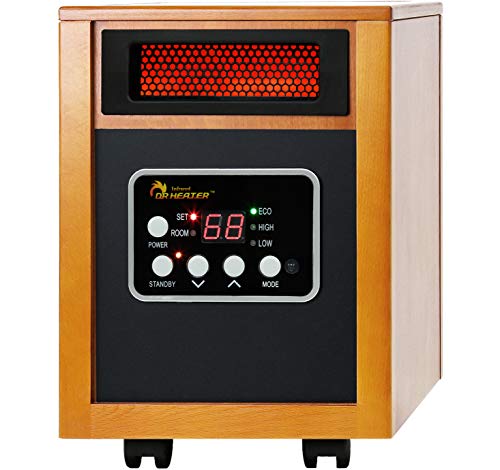
Dr Infrared Heater DR-968 combines infrared quartz and PTC heating for up to 5200 BTU, enough for large rooms. It runs quietly at 39 dB and includes a 12-hour auto shutoff timer. The heater has tip-over and overheat protection, plus a 72-inch cord and caster wheels for easy placement.
Wattage 1500 WNoise level 39 dBTimer 12HRoom coverage Large room
Why it made the cut
Dual infrared and PTC heating for more warmth
Quiet blower at 39 dB
12-hour automatic shutoff
Caster wheels for mobility
Good to know
Heavier at 19 lbs
Uses 12.5 amps, near a full 15A circuit load
Skip it if Skip if you have a small room or limited electrical capacity.
Best for Medium rooms needing widespread heat and remote control
Lasko’s tower heater offers 1500W of ceramic heat with wide oscillation to spread warmth evenly across medium rooms. It includes a 7-hour timer, remote control, and ETL certification for safety. The cool-touch housing and overheat protection suit homes with kids or pets. Its built-in handle makes it easy to move around.
Wattage 1500 WNoise level —Timer 7HRoom coverage Medium room
Why it made the cut
Wide oscillation covers medium rooms
Remote control for convenience
ETL-certified with overheat protection
Cool-touch housing for safety
Good to know
Timer limited to 7 hours
No thermostat for precise temperature control
Skip it if Skip if you want a thermostat or longer timer.
Indoor Heaters Without Electricity: What Actually Works
For indoor heaters no electricity needed, choose a fuel-burning model labeled for indoor use; an indoor-rated propane heater with an oxygen depletion sensor (ODS) is one option. Follow the manual’s ventilation requirements and keep a working carbon monoxide alarm nearby, preferably one with battery backup. The ODS can respond to low oxygen; it does not detect carbon monoxide or replace an alarm. Never bring an outdoor propane heater or patio heater indoors.
The label matters more than the fuel. A propane heater can still create carbon monoxide, and an ODS only responds to low oxygen; it does not detect carbon monoxide or make ventilation optional. For blackout heat, check whether ignition needs batteries, too. The Big Buddy can run without its optional four-D-battery fan, but some heater models need batteries to ignite.
Option
Works without grid power?
What to check
Indoor-rated propane
Usually; some models need batteries for ignition
Indoor-use label, ODS, cylinder or fuel supply, ventilation instructions
Kerosene heater
Yes, depending on the model
Indoor-use label, 1-K kerosene only, ventilation and fuel storage
Natural-gas heater
Only if its ignition and controls work without electricity
Permanent gas connection, installation requirements, local code
Plug-in electric heater
No
Needs a working outlet; useful only when power is available
A fuel-burning heater may still need batteries for ignition or a fan.
Use Only Indoor-Rated Models
Never bring an outdoor, patio, torpedo, or construction heater into a home, tent, or vehicle. For an indoor fuel-burning heater, follow the manufacturer’s ventilation instructions and keep a working carbon monoxide alarm nearby; a battery-backed alarm can keep operating during an outage. Don’t run a portable fuel heater while people are asleep or leave it unattended.
Portable propane is practical when you can store compatible cylinders safely; kerosene needs an approved supply of 1-K fuel, never gasoline. Natural-gas heaters generally depend on a gas line, and vent-free models may be restricted or banned by local code. Check the rules before buying or installing one. For a room-by-room comparison of models rated for indoor use, see our heaters for indoor use non electric guide.
How to Size a Space Heater for Your Room
Sizing a space heater depends mainly on your room’s square footage and insulation. The rule of thumb is about 10 watts per square foot for a normally insulated room. That means a 150-square-foot bedroom needs roughly 1,500 watts.
Ceiling height, insulation quality, and how many windows you have can shift that number. High ceilings or poor insulation may need more watts, while tight insulation and fewer windows reduce heat loss.
Worked Example
Say your bedroom measures 12 by 14 feet, that’s 168 square feet. At 10 watts per square foot, you need about 1,680 watts, close to a 1,500-watt heater’s capacity. A 20 by 20-foot living room is 400 square feet, so it would need around 4,000 watts, more than a typical plug-in heater can provide.
All five electric heaters we covered are rated at 1,500 watts. The choice between them comes down to how they spread heat—whether through oscillation, infrared and PTC dual elements, or tower versus compact designs.
When 1,500 Watts Isn’t Enough
If your room is larger than 200 square feet, or poorly insulated, you’ll need multiple heaters or a higher-BTU fuel-burning unit instead of a single 1,500-watt electric heater.
Running Cost for a 1,500 W Space Heater
Electric space heaters that need no electricity in the house are a myth — the models here all plug into a wall outlet. A 1,500 watt heater running at full power for eight hours a day uses 12 kWh (1,500 ÷ 1,000 × 8). At an average US rate of 17 cents per kWh, that’s about $2.04 a night. Over 30 days, expect roughly $61.20.
Heater
Watts
Per hour
Per day (8 h)
Per month (30 days)
1,500 W at full power
1,500 W
26¢
$2.04
$61.20
~1,000 W ECO mode average
1,000 W
17¢
$1.36
$40.80
Calculated at 17¢ per kWh. Cost comparison for running a 1,500 W electric heater versus ECO mode
The DREO and R.W.FLAME models use ECO mode to cycle power between 1,000 W and 1,500 W, which averages about 1,000 W over time. This cuts your monthly electric bill by roughly a third compared to running full power continuously.
When a space heater saves money
Using a space heater to heat just one room costs less than heating the whole house with central heat, which runs your furnace and ducts constantly. If you heat multiple rooms or the entire home, electric space heaters usually cost more than central heating fueled by gas or oil.
Safety Checklist Before You Plug In
Indoor heaters without electricity needed are mostly fuel-burning units, but plug-in electric heaters are common backups. Before you turn one on, make sure it’s safe to use in your room.
Pre-Use Safety Checks
Plug the heater directly into a wall outlet; never use an extension cord or power strip.
Maintain at least 3 feet of clearance around the heater from curtains, bedding, furniture, and anything flammable.
Confirm your heater has tip-over and overheat protection; all five models here include both.
Look for UL, ETL, or CSA certification on the box or label — the listing alone isn’t enough.
If your model has a child lock feature, like the R.W.FLAME, enable it when kids or pets are present.
Do not leave the heater running unattended or while sleeping unless the manufacturer explicitly allows it.
Extension Cord Danger
Using extension cords can cause overheating, fire, or damage to the heater’s internal wiring. Always plug directly into the wall outlet.
Oscillation, Infrared, and Noise: The Specs That Split These Five
Heaters that need no electricity are rare except for fuels, so the five picks here are really plug-in electric units. Their specs vary in ways that decide comfort and fit.
Three models (1, 2, and 5) use ceramic PTC heating elements only. They warm air by heating a ceramic plate that then raises room temperature. The Dr Infrared Heater DR-968 (4) combines infrared quartz tubes and ceramic PTC. Infrared heat warms objects and people directly, not just the air. This dual system means the DR-968 feels warmer faster in large or drafty rooms because your skin absorbs infrared radiation before the air heats up.
Product
Oscillation Angle
Timer Range (hours)
R.W.FLAME (1)
Fixed
24
DREO 1500W (3)
70°
12
Lasko Tower (5)
Wide
7
DREO Portable (2)
Fixed
12
Dr Infrared (4)
Fixed
Not specified
Oscillation and timer specs across the five heaters
Oscillation varies. The DREO 1500W model (3) oscillates 70 degrees, spreading heat more evenly in open-plan spaces. The Lasko Tower (5) has wide oscillation too, good for living rooms. Others (1, 2, 4) aim heat in one direction. This matters if your room layout needs the heater to cover a broader area.
Noise is subtle but real. The quietest run at 34–35 decibels (Products 1, 2, 3), softer than a whisper in a library. The Dr Infrared (4) runs at 39 decibels, still below normal conversation level but audible in very quiet spaces.
34–39 dB
Noise level range
Decibels tell how loud each heater runs. Lower means quieter comfort.
Timer range also splits the group. R.W.FLAME (1) offers a full 24-hour timer, perfect for overnight use without manual resets. DREO models (2 and 3) offer 12 hours, enough for most nights. Lasko Tower (5) runs timers up to 7 hours. Overnight sleepers want at least 8 hours to avoid waking up cold.
Weight and portability differ sharply. The Dr Infrared (4) weighs 19 pounds and has casters for moving around but is hefty. The R.W.FLAME (1) is lightweight with a carry handle, easy to move from room to room but intended as a smaller footprint heater.
What to Do Next
For heat without grid power, choose an indoor-rated fuel heater and match its listed capacity to one room; don’t treat a portable heater as whole-house heat. If you need a plug-in backup instead, use the electric picks above only while power is available.
1
Choose the fuel you can keep on hand
Propane is practical if you can store the cylinders your heater is approved for; kerosene means storing the correct fuel and using only 1-K kerosene. A vent-free natural-gas heater needs a gas supply, so it isn’t a portable answer to every outage. Compare kerosene space heaters if you’re weighing that fuel.
2
Verify the indoor-use label
Check the heater’s manual and label for indoor use before bringing it inside. Outdoor patio and construction heaters stay outdoors. An oxygen depletion sensor can shut off some propane heaters if oxygen falls, but it doesn’t detect carbon monoxide or replace a working CO alarm.
3
Size it for one room
Use the manufacturer’s stated room size, then account for insulation and drafts. As a rough starting point, 20 BTU per square foot puts a 200-square-foot room near 4,000 BTU; the Big Buddy’s listed settings are 4,000, 9,000 and 18,000 BTU, and its stated coverage is up to 450 square feet.
4
Check what still needs batteries
A Big Buddy can produce heat without its optional fan, which uses four D batteries. Other heaters may need batteries for ignition or controls, so check the manual if you need operation during a complete outage. Keep a battery-backed CO alarm working nearby.
5
Plan supervised use
Follow the manual’s ventilation and clearance rules, and use fuel-burning heat only as temporary, supervised backup. Don’t run it while you sleep or leave it unattended unless the manufacturer explicitly says the model is designed for that use. For more options, see our heaters for indoor use non electric guide.
Frequently Asked Questions
What indoor heaters work without any electricity?
Indoor heaters that operate without electricity rely on fuels like propane or kerosene, designed specifically for indoor use with safety features such as oxygen depletion sensors. These heaters burn fuel directly to produce heat and don’t need a power source, unlike electric space heaters that plug into wall outlets.
Is it safe to use a propane heater inside without electricity?
Using a propane heater indoors without electricity is safe only if the model is rated for indoor use and includes an oxygen depletion sensor to shut off the unit if oxygen levels drop. Proper ventilation and a working carbon monoxide alarm are essential to prevent buildup of dangerous gases.
How much does it cost to run a 1,500 W space heater all night?
Running a 1,500 W heater for 8 hours uses 12 kWh (1,500 ÷ 1,000 × 8). At 17 cents per kWh, that’s about $2.04 for one night. Multiply by your local rate and hours to estimate your actual cost.
Can you use a space heater as your only heat source?
A space heater can temporarily serve as your sole heat source in a small, well-insulated room. However, they are not designed to heat an entire home continuously and can be costly and less safe if used long-term without proper precautions.
Do ceramic heaters use less electricity than infrared heaters?
Ceramic and infrared heaters typically use similar amounts of electricity if rated at the same wattage. The difference lies in how they deliver heat: ceramic heaters warm the air, while infrared heaters warm objects directly, which can feel more efficient in certain settings.
How many square feet will a 1,500 W heater cover?
A 1,500 W heater produces about 5,000 BTU per hour, enough to heat roughly 150 square feet of average insulation at 20 BTU per square foot. Larger or poorly insulated spaces need more heating capacity.
Are space heaters safe to leave on while sleeping?
Most manufacturers advise against leaving space heaters on unattended or while sleeping unless the model explicitly includes safety features like tip-over and overheat protection. Even then, ensure proper clearance and never use extension cords with these heaters.