Best Flat Panel Radiant Heaters for Efficient Home Heating
Joye
Updated October 6, 2026 17 min read
Quick answer
Radiant heaters can be energy efficient for the room you actually use, and the best pick for most readers here is a 500 W or 600 W wall panel with fan-free operation and built-in overheat protection. That choice keeps running costs lower than a 1,500 W plug-in heater and trims the chance of buying more heat than you need. Get the size wrong and you pay for comfort you never feel.
What to remember
A 500 W to 600 W panel is usually the right lane for supplemental heat in small to medium rooms.
Fan-free panels are the quietest choice, but they still need clear wall space in front of them.
Look for a real listing mark, overheat protection, and a cord setup that matches the plug-in or hardwired install.
If you need whole-room heat in a leaky space, a flat panel may be the wrong tool.
Running cost depends on wattage and hours, not marketing language on the box.
Flat panel radiant heaters make sense when you want quiet heat, a slim wall-mounted shape, and lower wattage than the usual plug-in box heater. They are strongest in bedrooms, offices, bathrooms, and other spaces where you want targeted warmth without blasting the whole house.
Pick the wrong one and you waste money on output you do not need, or you end up underheating a drafty room and blaming the heater for doing exactly what physics told it to do.
Best for Targeted room heating where a low-watt, fan-free panel makes sense
Product 3 uses only 500 watts and has a wall-sense safety sensor that cuts power if the heater comes off the wall. Its fan-less Stack Convection design runs quietly, while the 90°F operating temperature suits homes with children, pets or older adults. The product is designed for 24/7 heating, according to its specifications.
Power draw 500 wattsVoltage / current 120 voltsSafety Wall-sense safety sensor; operates at 90°FDesign Patented fan-less Stack ConvectionInstallation Plug-in; installs in minutes with no drill or contractor
Why it made the cut
500-watt power draw
Wall-sense sensor cuts power when removed
Fan-less operation with Stack Convection
Auto-dimming power light
Good to know
Designed for targeted comfort rather than whole-home heating
No thermostat temperature range is listed in the product data
Skip it if Skip it if you need a listed room-size rating or adjustable thermostat range before buying.
Best for Bedrooms, offices and other rooms needing adjustable wall-panel heat
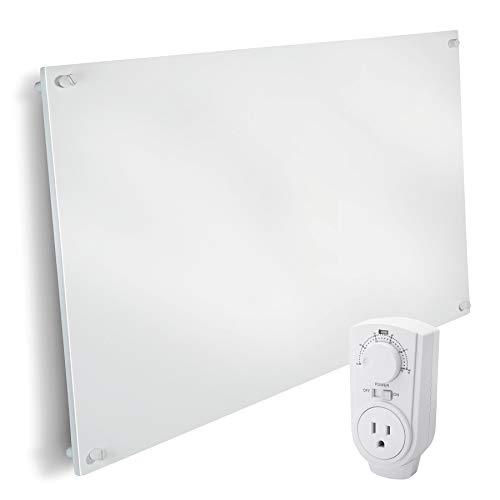
Product 1 combines a 600-watt panel with an adjustable plug-in thermostat ranging from 41-86°F, so you can set a target instead of leaving the heater at one constant output. The fan-free design avoids blowing dust around, and included mounting hardware and a heat reflector simplify installation. Its 24-by-36-by-0.40-inch panel is best suited to a wall with enough open space.
Power draw 600 wattsVoltage / current 120 volts / 5 ampsThermostat Plug-in adjustable thermostat, 41-86°FDimensions 24 x 36 x 0.40 inchesApproval / compliance cETL approved; UL-2021 and RoHS compliant
Why it made the cut
Adjustable thermostat from 41-86°F
No-fan operation
Wall-mounting hardware and heat reflector included
cETL approved and UL-2021 compliant
Good to know
The exterior casing feels warm and is specified as safe for adults only
The product data describes mostly convection heat rather than purely radiant heat
Skip it if Skip it if the heater will be within reach of children or you specifically want an infrared-only panel.
Best for Indoor yoga studios and spaces where direct infrared heat is the priority
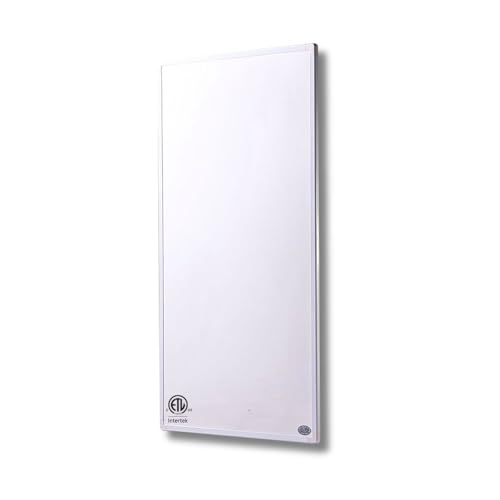
Product 2 is the clearest infrared-focused option here, using a 600-watt graphene electric heating panel with no air circulation from direct heat. Double overheating protection, flame-retardant materials and ETL, TÜV and GS certifications add useful checks for an indoor wall installation. It can also be floor-standing, but the stand feet aren’t included.
Power draw 600 wattsHeating type Heating type: Electric panel heaterControls On/off switchSafety Double overheating protection; flame-retardant materialsInstallation Wall installation materials included; stand feet not include
Why it made the cut
600-watt infrared panel
Double overheating protection
ETL, TÜV and GS certified
5-year manufacturer’s warranty
Good to know
Stand feet aren’t included for floor-standing use
The product data doesn’t list a thermostat or room-size rating
An on/off switch offers less temperature control than a thermostat
Skip it if Skip it if you need thermostat control or a clearly stated room-size recommendation.
Best for Rooms up to 120 sq ft where a simple wall-mounted panel fits
Product 4 offers the same basic 600-watt, fan-free wall-panel format as the other EconoHome option, with a plug-in thermostat and included heat reflector. The listed room guidance says it heats rooms up to 120 square feet, giving you a more conservative sizing target than a broad room claim. Its 24-by-36-by-0.40-inch panel needs suitable wall space.
Power draw 600 wattsVoltage / current 120 volts / 5 ampsRoom guidance Heats rooms up to 120 sq ftThermostat Plug-in adjustable thermostat, 41-86°FDimensions 24 x 36 x 0.40 inches
Why it made the cut
Listed for rooms up to 120 sq ft
Adjustable thermostat from 41-86°F
No-fan operation
Wall-mounting hardware included
Good to know
The exterior casing feels warm and is specified as safe for adults only
The product data describes mostly convection heat
The 600-watt draw is higher than Product 3’s 500 watts
Skip it if Skip it if your room is larger than the listed 120-square-foot target or you want mostly radiant rather than convection heat.
Yes—radiant heaters are energy efficient for spot heating because they warm people, furniture and nearby surfaces directly instead of spending all their power heating unused air. How efficient is radiant heat in practice? An electric panel turns its electricity into heat at the heater, but your real savings come from heating only the room or area you’re using.
In short
A radiant panel can be an efficient choice for a bedroom, office or chilly seating area. It won’t fix a drafty house or make whole-house heating efficient by itself; room efficiency and whole-house efficiency are different jobs.
500 W
A practical supplemental-heating size
A 500 W or 600 W fan-free panel with a thermostat suits many readers who want steady extra warmth without running a 1,500 W plug-in heater at full power.
The useful distinction is control, not a magical heating advantage. If you close the bedroom door and heat that room while the rest of the house stays cooler, the panel avoids paying to warm empty rooms. Leave doors open in a poorly insulated house and cold drafts can erase that advantage; the panel is still converting electricity to heat, but comfort leaks away through gaps, windows and exterior walls.
Here are the running-cost numbers. A 500 W panel for 8 hours uses 0.5 kW × 8 hours, or 4 kWh; at 17 cents per kWh, that’s about 68 cents a day. A 1,500 W heater for the same 8 hours uses 1.5 kW × 8, or 12 kWh, which costs about $2.04 a day at the same rate. The thermostat may reduce actual use by cycling off, while a cold, leaky room may keep either heater running longer.
Heater
Watts
Per hour
Per day (8 h)
Per month (30 days)
500 W radiant panel
500 W
8.5¢
68¢
$20.40
1,500 W plug-in heater
1,500 W
26¢
$2.04
$61.20
Calculated at 17¢ per kWh. Monthly comparison at 8 hours per day and 17 cents per kWh; the thermostat can lower actual consumption when it cycles the panel off.
Myth
Radiant heat is automatically cheaper than every other electric heater.
Fact
Electric resistance heaters use roughly the same electricity for the same heat output. A radiant panel can cost less to run when its lower wattage and room-by-room control mean you heat less space, not because the electricity itself becomes more efficient.
For most supplemental-heating needs, start with a 500 W or 600 W fan-free panel with a thermostat, then match its output to the room instead of buying the largest unit on the shelf. Readers comparing panel styles can also see how to choose the most efficient radiant heater for your needs before moving on to sizing.
How To Choose The Right Flat Panel Heater
Choose a flat panel by wattage, placement and controls first; a higher-output claim won’t rescue a heater mounted on the wrong wall or fighting a draft. For a small bedroom, office or task area, 500 W and 600 W panels are sensible starting points because they add focused heat without automatically pulling the roughly 1,500 W of a plug-in space heater.
Yes, oil-filled radiant heaters are efficient at turning electricity into heat, but their advantage is steadier heat after the element cycles off, not lower electricity use for the same wattage. Flat panels use less wall and floor space and operate silently; an oil-filled model is usually the better shape for long, even heat in one occupied room.
Model
Output and electrical
Controls or protection
What to check
EconoHome Wall Mount Space Heater Panel
500 W; 120 V; 4.2 amps
Thermostat range
ETL, UL, cETL, TÜV or GS mark shown for the exact model
Infrared Heater Panel 600W for indoor yoga studio with on/o…
600 W; 120 V; 5 amps
IP54; thermostat range if listed
Confirm the certification mark and indoor installation instructions
Envi Plug-in Electric Panel Wall Heaters for Indoor Use
500 W; 120 V; 4.2 amps
Thermostat range
Confirm the exact UL or other listed certification on the heater
EconoHome Convection Wall Heater with Thermostat
600 W; 120 V; 5 amps
Built-in thermostat
Check the exact ETL, UL, cETL, TÜV or GS listing before buying
Match the label on the heater and its manual; product names alone don’t establish a certification.
Wall-mounted models save floor space and keep the heat source in a fixed position, while portable panels let you move heat between rooms but make placement easier to get wrong. Fan-free operation is effectively silent, so noise usually points to a blower rather than the heating element itself. Thermostat range matters because a control that only cycles near the top of your preferred room temperature wastes the point of fine adjustment.
SBEM Rating
An SBEM-style efficiency rating belongs to building-design calculations, including systems such as ceiling radiant panels; it isn’t a consumer efficiency label for a plug-in heater. For this purchase, compare wattage, thermostat controls, installation rules and the product’s actual listing instead.
Use Placement As A Spec
Put the panel where people sit or work, with the clearances in its manual. Insulation and a sensible wall location often matter more than chasing a larger wattage number.
Estimating Heat Output And Running Costs
Size a flat panel for the room you occupy and the heat you want at that spot, then check the cost from its wattage; a low-wattage panel is usually supplemental heat, not a cure for an open-plan room or a badly drafty bedroom.
For a 120 sq ft bedroom, a 600 W panel running six hours per day uses 0.6 kWh per hour. The monthly calculation is 600 ÷ 1,000 × 6 hours × 30 days × $0.17 per kWh; the cost block below does the final arithmetic without making you hunt for a calculator.
Worked Example
Say the 120 sq ft room has a closed door, ordinary insulation and a desk near the panel. Six hours of scheduled heat can suit that occupied zone, but an open doorway, leaky window or cold exterior wall may leave the rest of the room below your target temperature. A second zone or a different heater may be more sensible than simply buying the biggest panel.
Room120 sq ft bedroom
Panel600 W
Use6 hours per day
Electricity rate$0.17 per kWh
Heater
Watts
Per hour
Per day (6 h)
Per month (30 days)
600 W flat panel
600 W
10¢
61¢
$18.36
Calculated at 17¢ per kWh. Assumes one 600 W panel runs six hours daily for 30 days at 17 cents per kWh.
Radiant heat feels quicker where you sit because the panel warms nearby people and surfaces directly; forced air mixes the room faster because a blower moves heated air through it. The more efficient choice depends on the job: heating people in one occupied zone favors radiant heat, while heating a larger volume of air may call for a properly sized forced-air system.
600 W
A focused supplemental load
A 600 W panel uses 0.6 kWh for each hour it runs. Drafts, insulation, ceiling height and open doors can matter more than the panel’s advertised coverage.
For gas heat, a forced-air heater isn’t automatically more efficient than a gas radiant heater, and radiant isn’t automatically the winner either. Compare the appliance efficiency, venting and duct losses: forced air distributes heat faster, while gas radiant heat can warm occupants without first mixing all the room air. A wood radiant heater can also be less efficient than a well-designed convection model, but the result depends on the appliance, combustion and venting rather than the word radiant alone.
Oil-filled radiators tend to feel steadier for all-night heat because their heated oil and metal casing release warmth after the element cycles off. Flat panels win when slim wall space and silent operation matter more than thermal carryover.
Safety And Certification Matter More Than Sleek Lines
Radiant heaters can be safe in bathrooms only when the specific model is rated for that location and installed by its rules; the best flat panel radiant heater for a bathroom is one with the right moisture rating, overheat protection and a clear bathroom-use approval. A smooth white panel isn’t a bathroom rating. It’s just smooth and white.
Use The Outlet, Not A Power Strip
Plug-in panels belong directly in a wall outlet, never an extension cord or power strip. Keep at least 3 feet between the heater and towels, curtains, bedding, paper or furniture unless the manual gives a different clearance. A wall-mounted unit still needs the clearance its listing requires.
Before Installation
Look for a UL, ETL or CSA listing on the heater or its documentation.
Confirm overheat protection; check for tip-over protection when the model can be knocked over or used on legs.
For bathroom use, confirm the model’s moisture or damp-location rating and follow the manufacturer’s mounting and clearance rules.
Check local code before installing a hardwired panel or adding bathroom wiring.
Use a licensed electrician for hardwired work and bathroom wiring when required by local code.
Hardwired models should have the correct circuit, disconnecting means and mounting method for the installation, rather than a improvised connection behind the wall. Bathroom wiring brings extra shock and clearance concerns, so the electrician should verify the location and the heater’s listing before the drywall closes over anything.
Warm Is Different From Wrong
Some panels and their casings run warm during normal operation. Stop using the heater and investigate before another hour passes if you smell hot plastic or scorching, the breaker trips, or the wall, plug or outlet shows browning or discoloration. Repeated breaker trips are a fault to diagnose, not a cue to reset the breaker again.
What Flat Panel Heaters Do Better Than People Expect
Radiant heaters are energy efficient for the area you actually occupy, but radiant heat is a line-of-sight tool: the side of the room facing the panel, along with nearby people and surfaces, warms first. Placement can matter more than the brand name, so aim the panel at the chair, desk or bed area instead of hiding it behind furniture.
Myth
A radiant panel heats every part of the room evenly because its surface gets hot.
Fact
The panel transfers heat most directly to nearby surfaces and people in front of it. A closed door, a large sofa or a cold outside wall can leave other parts of the room cooler, even while the panel is working normally.
How efficient is radiant heat? An electric panel converts its incoming electricity into heat at the point of use, but that doesn’t make every installation economical. A 600 W panel running for 8 hours uses 4.8 kWh; at 17 cents per kWh, that is about 82 cents for that period. Comfort depends on where those watts go.
Fix The Draft First
No quiet panel can make a poorly insulated room behave like a new one. Weather-strip a loose door, seal obvious window drafts and check the room’s insulation before paying extra for a fancier heater; stopping heat loss often buys more comfort per dollar.
Skip It When
Choose another approach for a leaky garage, an open-concept space that needs broad circulation, or a whole-house heating job. A flat panel fits bedrooms and home offices especially well, works in a bathroom only with the right rating, and makes sense as supplemental heat near a desk or chair.
Before You Buy, Check These Four Things
Yes, radiant heaters are energy efficient for the room and people they actually heat, but the wrong room, wiring or placement can turn an efficient panel into an expensive wall decoration. Run this four-point screen before you order.
Pre-buy screen
Room size: Does the manufacturer list the panel for your room, or is the space too large for its wattage? If the room exceeds the guidance, stop.
Outlet or wiring: Plug-in models go straight into a wall outlet, never an extension cord or power strip. Hardwired models need the correct circuit and a licensed electrician.
Certification mark: Look for a UL, ETL or CSA listing on the heater or its documentation. A sleek panel without the right listing isn’t a bargain.
Placement: Can the panel face the area you occupy without a sofa, cabinet or curtain blocking it? Radiant heat works best with a clear line of sight.
Check the product manual for clearance, mounting height and thermostat location before measuring the wall. Furniture can block the panel’s warmth, while a thermostat tucked behind a bookcase may read the wrong temperature and cycle poorly.
Know when to call
A bathroom installation needs a model specifically rated for that location and must follow its instructions and local code. Hardwired work, new circuits and bathroom wiring belong with a licensed electrician; a plug and a hopeful look at the breaker panel aren’t electrical planning.
Questions People Ask
Are radiant heaters energy efficient for daily use?
Yes, a radiant heater can be efficient for daily use when you heat one occupied room instead of the whole home. Electric resistance panels turn nearly all incoming electricity into heat at the room, but your bill still depends on wattage and run time. A thermostat or timer can prevent the panel from heating an empty room.
Are oil-filled radiant heaters efficient compared with flat panels?
Both use electric resistance heating, so their electricity cost is similar at the same wattage and run time. An oil-filled radiator warms air by convection and keeps releasing heat after its element cycles off, while a flat panel sends more direct radiant heat toward nearby people and surfaces. Choose the panel for quiet, targeted wall heat; choose the oil-filled radiator when you want slower, steadier room warming.
How efficient is radiant heat in a small room?
A small room can make radiant heat feel efficient because less output is needed to warm the area you occupy. Placement matters: a panel aimed across the seating or desk area will feel more effective than one hidden behind furniture or mounted where a draft strips heat away. Close the door and control the room separately if you want the panel’s limited output to count.
What’s more efficient, a gas forced-air heater or a gas radiant heater?
The more efficient choice depends on the equipment’s rated efficiency, duct losses and how much of the home you need to heat. Gas radiant heat can feel effective at a lower room temperature because it warms people and surfaces directly, while forced air distributes heat to more of the building but can lose heat through ducts. Compare the listed efficiency and fuel use, then account for ventilation and installation requirements.
Are radiant wood heaters less efficient than convection heaters?
Radiant and convection describe how a wood heater delivers heat, not how completely it burns the fuel. A listed, properly operated wood stove can be efficient in either style; combustion design, moisture content, chimney draft and loading practices matter more. Burn only dry firewood, never trash or treated wood, and follow the required clearances and chimney inspection schedule.
What size flat panel radiant heater do I need for a bedroom or office?
Start with the panel’s wattage and the room’s insulation, window area, ceiling height and outdoor climate, then use the manufacturer’s room-size guidance as a check. A 500 W or 600 W panel may suit supplemental heat in a small, reasonably insulated bedroom or office, while a drafty room may need more than one heat source. Don’t use a low-wattage panel as a substitute for fixing major drafts or an undersized central system.
Share
Written byJoye
HeaterGuides covers home heating, water heating and HVAC: how the equipment works, what it costs to run, and how to use it safely.
Free newsletter
Heater deals and guides, worth opening
Price drops, new guides and safety recalls. One email, only when it matters.