Product 2 is the best electric heater for most travel trailers because it delivers 1,500 watts, a precise 41–95°F thermostat, 70-degree oscillation, remote control and ETL-listed safety features. Product 1 suits a permanent remodel, while Products 3–5 are small 12V or solar options rather than whole-trailer heaters.
Key takeaways
Pick Product 2 for the strongest all-around mix of heat, thermostat control, quiet operation and listed safety features.
A 1,500-watt heater draws about 12.5 amps at 120 volts, so use one wall outlet and check the trailer’s electrical load.
Products 4 and 5 are 12V spot or defrosting heaters, not replacements for a furnace or 120V space heater.
Product 1 can heat up to 400 square feet, but its 50-inch recessed or wall-mounted format needs a permanent installation.
Product 3’s 30-watt solar output is suited to tiny enclosures and cannot provide meaningful cabin heat.
Choosing the wrong heater can leave you cold, trip the trailer’s breaker, or overload a 12V socket. A heater that fits the outlet but cannot move enough heat is money spent on a fan with good intentions.
The five picks below cover a full-size plug-in heater, a built-in fireplace, and low-power vehicle options. Match the heater to your hookup, room size and intended use before you pack it.
Top 5 Electric Heater Picks for Travel Trailers
#1Best for Most RVs
DREO 1500W Ceramic Space Heater
Best for Supplemental heat in a travel trailer with shore power
A 1,500W PTC heater, 70-degree oscillation and a thermostat adjustable from 41–95°F make this the most practical pick for warming an occupied area. Remote control and ETL-listed safety features add useful convenience, though it still needs a suitable outlet and clear space around it.
Power 1,500WThermostat range 41–95°F, 1°F incrementsOscillation 70 degreesTimer 12 hoursSafety ETL-listed; tip-over and overheat protection
Why it made the cut
1,500W PTC heating system
70-degree oscillation spreads airflow
41–95°F thermostat with 1°F increments
ETL-listed; includes tip-over and overheat protection
Good to know
Needs shore power for full output
Portable indoor heater, not an RV-specific built-in unit
Skip it if Skip it if you need a permanently installed heater or heat while disconnected from shore power.
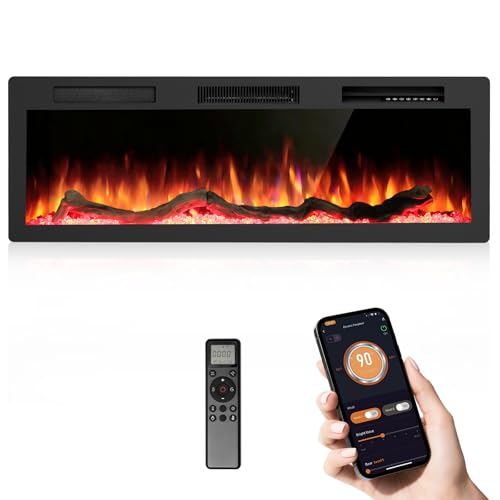
Best for A travel trailer remodel with a suitable built-in opening
This 50-inch fireplace offers 750W and 1,500W heating modes, plus a 59–95°F temperature setting. Its recessed or wall-mounted installation suits a planned renovation better than a quick plug-in heat boost; remote, touch, app and Alexa controls handle the extras.
Dimensions 50 × 17.32 × 5.71 inchesHeating modes 750W and 1,500WTemperature range 59–95°FListed opening fit 48 × 16.9 × 6.1 inches
Why it made the cut
Two heating modes: 750W and 1,500W
Recessed or wall-mounted installation
Remote, touch, smartphone and Alexa controls
Good to know
Requires a 48 × 16.9 × 6.1-inch opening for the listed fit
50-inch format is a substantial permanent installation
Skip it if Skip it if you want a portable heater or don’t have room for a built-in or wall-mounted unit.
Best for A compatible 12V vehicle socket and short-range windshield airflow
This 150W unit plugs into a 12V cigarette-lighter socket and can direct airflow with its 180-degree rotary base. It’s described for vehicle use and windshield defrosting, so treat it as a small-area accessory rather than a travel-trailer heater.
Power 150WVoltage 12VModes Heating and fanBase adjustment 180 degrees
Why it made the cut
150W draw
Heat and fan modes
180-degree adjustable base
Good to know
For 12V vehicle sockets only
Not sized or described for heating a travel trailer
Skip it if Skip it if you need meaningful heat for the trailer’s living space or have a 24V system.
Best for A small space under 0.5 cubic meters with a suitable 12V supply
The 100W PTC fan heater is intended for spaces smaller than 0.5 cubic meters, with mounting holes for installation and automatic regulation of heating power. That makes it a niche option for a very small enclosure, not a cabin heater.
Power 100WVoltage 12VIntended space Less than 0.5 cubic metersHeating element PTC
Why it made the cut
100W power draw
Mounting holes for installation
Automatic regulation of heating power
Good to know
Intended for spaces under 0.5 cubic meters
No thermostat range or safety certification is stated
Skip it if Skip it if you want to warm a person-sized area or the travel trailer itself.
Best for Small pet houses, greenhouses or other small outdoor areas
Its 30W solar panel and USB and DC ports suit small specialty spaces where low power matters more than strong heat. The product is described for pet houses, greenhouses and similar areas; that output is not a practical way to heat a travel trailer.
Power 30WPower source Solar panelPorts USB and DCSafety feature Automatic shut-off system
Why it made the cut
30W solar-powered output
USB and DC ports
Automatic shut-off system
Good to know
Designed for small areas, not a travel trailer cabin
Output depends on sunlight
Skip it if Skip it if you need dependable cabin heat, especially when sunlight is limited.
For most travel trailers, the best electric heater is the DREO Quiet Space Heater, 1500W Portable Heaters for Indoor… because its 1,500-watt PTC heat and adjustable thermostat suit a trailer’s main living area. These best electric heaters 2026 picks also include permanent-install, 12V, solar and windshield-defrosting options—but those solve different problems.
Rank
Product
Badge
Best fit
1
DREO Quiet Space Heater
Best overall
Main living area
2
R.W.FLAME Smart Electric Fireplace
Best smart controls
Permanent remodel
3
Hyuduo 30W Solar Panel Heater
Best for large rooms*
Tiny outdoor-area use
4
Portable Space Heater
Best budget for tiny spaces
Under 0.5 m³
5
Portable Car Heater
Best vehicle defroster
Windshield and spot heat
*The Product 3 badge refers to its listed outdoor-area applications, not trailer heating capacity.
1. DREO Quiet Space Heater
The DREO is the strongest all-around pick for a travel trailer because it combines 1,500-watt PTC heat with a 41–95°F thermostat adjustable in 1°F increments. Its claimed 34 dB noise level, 70-degree oscillation and remote control suit a small living area, while the child lock, tip-over protection, overheat protection and ETL listing address the tighter margins inside an RV.
Good for
Whole-trailer supplemental heat from a 120V outlet
Precise thermostat and remote control
Safety features suited to unattended moments when the manual permits it
Not for
Uses far more power than the 12V and solar picks
Needs a suitable wall outlet and clear space
2. R.W.FLAME Smart Electric Fireplace
The R.W.FLAME Smart Electric Fireplace is the best electric heater here for a permanent remodel, with 750W and 1,500W modes, Alexa and Wi-Fi control, plus remote and touch controls. Its 50-inch recessed or wall-mounted design can look finished in a fixed installation, but that makes it a poor fit for a short-term trailer, a narrow wall or a renter.
Good for
Permanent RV remodels
Smart-home control through Alexa and Wi-Fi
Choice of 750W or 1,500W heat
Not for
Requires wall or recessed installation
The 50-inch format consumes valuable trailer wall space
3. Hyuduo 30W Solar Panel Heater
The Hyuduo is best for large rooms only in the limited sense of its listed small outdoor-area applications, such as a chicken coop, pet house or greenhouse. Its 30-watt solar output is far below a whole-trailer heater’s demand, so treat it as a tiny-space specialty device rather than a way to heat the cabin.
Good for
Small solar-powered enclosures
Places where a 120V hookup isn’t available
Low-power spot applications
Not for
30W won’t heat a travel trailer
Its output depends on solar conditions
4. Portable Space Heater
The Portable Space Heater is the best budget-power option for a space under 0.5 cubic meters, where its 100W, 12V output and automatic power regulation can provide small-area heat. That specification describes a very small enclosure, not a trailer living room.
Good for
Tiny enclosed spaces
12V systems
Automatic power regulation
Not for
100W is unsuitable for whole-trailer heating
Its stated application is under 0.5 cubic meters
5. Portable Car Heater
The Portable Car Heater is the best vehicle defroster, with 150W output, 12V operation, heat and fan modes, and a 180-degree base for aiming at a windshield. Its cigarette-lighter plug makes it a spot heater for defrosting or a small directed area, not a replacement for the trailer’s main heater.
Good for
Windshield defrosting
Directed heat from a 180-degree base
12V vehicle use
Not for
Limited to 150W
Cigarette-lighter connection restricts it to spot use
Low wattage has a limit
Products 3–5 draw less power because they produce much less heat. A 30W solar heater, 100W 12V heater or 150W car heater may help a tiny enclosure or windshield, but none should be treated as a whole-trailer heating source.
Electric Heaters Use Different Amounts of Power
Electric heaters use power according to their wattage and how long the heating element runs; the trailer’s hookup and circuit determine what you can run at once. Check the actual hookup rating, and don’t run another high-wattage appliance on the same circuit as a 1,500W heater.
Estimate energy cost with watts ÷ 1,000 × hours × your electricity rate. At $0.17 per kWh, a 1,500W heater running for 8 hours uses 1.5 × 8 = 12 kWh, costing about $2.04 per night. A 750W setting uses half as much electricity over the same time, but produces half the rated heat while on.
What a 15A Circuit Leaves
A 1,500W heater on a standard 120V supply draws about 12.5A: 1,500 ÷ 120 = 12.5. That leaves little margin on a 15A circuit for the refrigerator, microwave, converter or other loads. Follow the trailer’s actual hookup rating and circuit layout.
Heater drawAbout 12.5A at 120V
Circuit15A
Practical checkAvoid another high-wattage load on the s
Products 4 and 5 draw less—100W and 150W, respectively—but they also deliver far less heat than Product 2’s 1,500W. Electric resistance heaters turn nearly all the electricity they consume into heat where they’re used, so wattage and run time matter more than labels such as ceramic or PTC. A thermostat cycles the element off after the set temperature is reached; while the element is on, a 1,500W heater still draws up to 1,500W.
Heater
Watts
Per hour
Per day (8 h)
Per month (30 days)
Product 2, full power
1,500 W
26¢
$2.04
$61.20
Product 2, 750W setting
750 W
13¢
$1.02
$30.60
Product 5
150 W
2.6¢
20¢
$6.12
Product 4
100 W
1.7¢
14¢
$4.08
Calculated at 17¢ per kWh. Estimated energy cost at 8 hours daily for 30 days and $0.17 per kWh; actual use depends on thermostat cycling.
Check the Breaker
Confirm which outlets share a breaker before using the heater. For a closer look at other models for enclosed trailers, see electric heaters.
Electric Heater Safety in a Travel Trailer
An electric heater in a travel trailer needs a clear space, a sound outlet and steady placement; the tight interior leaves less room for a small mistake. Plug a portable heater directly into a wall outlet—never an extension cord, power strip or loose adapter.
Keep Combustibles Away
Leave at least 3 feet between the heater and curtains, bedding, clothing, cushions or paper. Don’t sleep with a portable heater running or leave it on while you’re away unless the manufacturer specifically designs and permits that use.
A trailer’s close bedding and curtains, restricted airflow and compact wiring call for extra care. An overloaded circuit can trip the breaker, while a poor connection can heat at the plug or receptacle. Stop using the heater if either becomes hot, discolored or loose.
1
Inspect the connection
Before each use, check the plug, cord and outlet for damage, looseness or discoloration. Don’t use a damaged heater or receptacle.
2
Choose a stable spot
Set the heater on a level, stable surface where it can’t be kicked or tipped. Keep the 3-foot clearance around it.
3
Check the safety features
Look for tip-over shutoff, overheat protection and a UL, ETL or CSA listing. Product 2 is ETL-listed and specifies a child lock, V0 flame-retardant material, tip-over protection and overheat protection; don’t assume other products share those features.
Product 1 is a recessed or wall-mounted fireplace, so installation needs more than a convenient open patch of wall. Follow its listed opening dimensions and mounting instructions; don’t improvise a recessed installation in a trailer wall, where wiring and wall construction may differ from the product’s requirements.
12V Heating Has Limited Use in Travel Trailers
Electric heaters turn electrical power into heat, but a 12V heater can warm a tiny spot or defrost glass—not heat a travel-trailer cabin like a 1,500W 120V heater. The difference is output: Product 2 delivers 15 times the power of Product 4’s 100W and 10 times the power of Product 5’s 150W.
Spot Heat vs. Cabin Heat
Spot heat warms a small nearby area or a window; cabin heat has to replace heat lost across the trailer’s walls, windows and floor. A low-wattage 12V unit may help with the first job, but it isn’t a substitute for a full-size heater.
Compare the Heat Output
These ratings show why the small 12V products have a limited job. Product 3’s 30W solar output is smaller still.
Product 4100W
Product 5150W
Product 21,500W
Product 4, the Portable Space Heater, is specified for a space under 0.5 cubic meters. Its mounting holes, automatic power regulation and aluminum fins suit that narrow use case; don’t treat it as a trailer-cabin heater. Product 5, the Portable Car Heater, plugs into a 12V vehicle socket, not a 24V system. Its 180-degree rotary base and fan mode make it primarily a windshield defroster.
Product 3, the Hyuduo 30W Solar Panel Heater, needs sunlight and produces only 30W. Automatic shutoff and USB/DC ports don’t change that output or make it a cabin heater.
Shore power supplies the trailer from an external electrical hookup; battery power draws from stored energy, which even a low-voltage heater can use quickly. A 12V socket alone doesn’t mean a heater is suitable for overnight cabin heating.
Check Before You Plug In
Confirm the socket voltage is 12V and the heater is rated for it.
Check the product’s intended space or task: small-area warming or window defrosting, not cabin heating.
Never use a 12V product on a 24V system or modify plugs and wiring to force compatibility.
Frequently Asked Questions
What are electric heaters?
Electric heaters convert electricity into heat, usually with a resistance element or PTC ceramic element. They produce no carbon monoxide, but they still need a clear area, a sound outlet and the correct circuit. A thermostat cycles the element on and off to maintain the set temperature.
What is the best electric heater for a travel trailer?
Product 2 is the best choice for most travel trailers because its 1,500-watt output, 41–95°F thermostat, oscillation and remote control suit a small living space. Check the trailer’s breaker and avoid running another high-wattage appliance on the same circuit.
How many watts does an RV electric heater use?
A common plug-in RV heater uses 750 or 1,500 watts; at 120 volts, a 1,500-watt model draws about 12.5 amps. Check the label, then add the heater’s load to appliances already running before choosing the high setting.
Can you use a 12V car heater in a travel trailer?
A 12V car heater can warm a small nearby area or help clear glass, but it won’t heat the trailer cabin like a 120V, 1,500-watt heater. For scale, 1,500 watts at 12 volts would require about 125 amps, so battery-powered options are better treated as spot heaters.