Garage-Ready Ceramic Heaters with Strong Heat Output
Joye
Updated October 6, 2026 20 min read
Straight answer
The best pick for most garages is a 1,500 W ceramic heater with oscillation, tip-over protection, overheat shutoff, and ETL listing, because it gives fast spot heat without demanding a special circuit. A 1,500 W unit draws about 12.5 A on a 120 V outlet, so it’s near the limit for a standard 15 A circuit and should be the only major load on that outlet.
Garage heat sounds simple until the door opens, the slab steals warmth, and a heater that looked strong in a bedroom feels puny in a drafty bay. For most people, the right ceramic heater is the one that fits the room, the outlet, and the way you actually work.
The number to keep in mind is 1,500 W. At 120 V, that’s about 12.5 A, which is why a garage heater that runs on a normal plug can do the job in a single bay or a small workshop, but won’t magically heat an uninsulated two-car garage by itself.
Best for Workbenches, workshops, greenhouses, and damp covered areas
Product 4 is the strongest garage fit because its 1,500 W / 5,120 BTU fan-forced output, alloy steel housing, ETL certification, and IP24 rating are aimed at work areas and damp covered spaces. The 0-25° tilt lets you aim heat at a bench instead of warming the rafters. Choose it when durability and directional heat matter more than oscillation.
Heat output 1,500 W / 5,120 BTUSafety ETL certification and built-in overheat protectionRating IP24Airflow Adjustable 0-25°Modes Heat and fan-only
Why it made the cut
1,500 W / 5,120 BTU output
IP24 rating and alloy steel housing
Adjustable 0-25° airflow direction
Fan-only mode for year-round use
Good to know
No coverage figure is provided
No tip-over protection is listed
Not designed for an open, exposed outdoor area
Skip it if Skip it if you specifically want wide oscillation, a thermostat, or a stated room-coverage figure.
Best for Dry garages needing wide, controlled heat for up to 250 sq ft
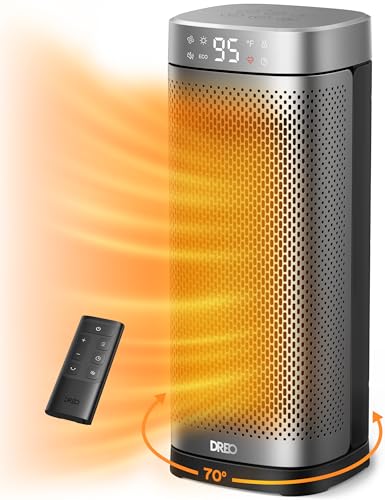
Product 1 is the better choice for a dry garage where fast spot heat and precise control matter. Its 1,500 W PTC ceramic element, 70° wide-angle heating, and coverage up to 250 sq ft spread warmth across a larger work area, while tip-over protection, overheat protection, a safety plug, and ETL listing cover the basic safety checks. The digital thermostat adjusts from 41-95°F in 1°F increments.
Heat output 1,500 W PTC ceramicCoverage Up to 250 sq ftHeating angle 70°Thermostat 41-95°F in 1°F incrementsSafety Tip-over and overheat protection; ETL-listed
Why it made the cut
Coverage up to 250 sq ft
70° wide-angle heating
Tip-over and overheat protection
ETL-listed with a safety plug
Good to know
Listed for indoor use rather than specifically for garages
No fan-only mode is listed
No noise figure is provided
Skip it if Skip it for damp or dusty garage conditions where a heater with an IP24 rating and metal housing is a better fit.
Best for Garages up to 200 sq ft where you want heat, low heat, or fan-only
Product 3 keeps control simple with fan-only, 750 W, and 1,500 W modes, so you can avoid full output when the garage only needs a little help. Its PTC ceramic element is listed for spaces up to 200 sq ft, and the non-slip base, carry handle, overheat protection, and 7.8 ft cord suit portable bench work. The product is also listed for patio use, so follow its instructions and keep it away from combustible materials.
Heat output 750 W or 1,500 W; fan-only modeCoverage Up to 200 sq ftHeating type PTC ceramicCord length 7.8 ftNoise Less than 40 dB
Why it made the cut
Three operating modes
Coverage up to 200 sq ft
7.8 ft cord and carry handle
Non-slip base and overheat protection
Good to know
No tip-over protection is listed
No certification is provided in the product data
No thermostat temperature range is provided
Skip it if Skip it if an ETL listing or tip-over protection is a deciding requirement.
Best for Garages and workspaces up to 160 sq ft with simple knob control
Product 5 suits a smaller garage or a single work area where you want three heat choices without a digital control panel. Its PTC ceramic heater offers 20 W, 750 W, and 1,500 W settings, while the thermostat, carry handle, non-slip base, and under-40 dB operation keep daily use straightforward. Coverage is listed up to 160 sq ft.
Heat settings 20 W, 750 W, or 1,500 WCoverage Up to 160 sq ftHeating type PTC ceramicNoise Under 40 dBSafety Overheat protection and self-resetting thermal cutoff
Why it made the cut
Three heat settings
Coverage up to 160 sq ft
Under 40 dB operation
Non-slip base and carry handle
Good to know
No tip-over protection is listed
No certification is provided in the product data
The 20 W setting provides very little heat
Skip it if Skip it for a larger garage or if you need the stronger damp-area protection listed for Product 4.
Best for Dry garages where remote control and wide oscillation matter most
Product 2 is the most convenient tower-style option, with widespread oscillation, a remote control, an adjustable thermostat, and a 1-8 hour auto-off timer. Its 1,500 W output and two quiet heat settings work well for a dry garage used for short periods. ETL listing, overheat protection, and a cool-touch exterior add useful safeguards, but the product is described for home use.
Heat output 1,500 WHeat settings Two quiet settingsControls Adjustable thermostat and remote controlTimer 1-8 hoursSafety Overheat protection; ETL-listed
Why it made the cut
Widespread oscillation
Remote control and adjustable thermostat
1-8 hour auto-off timer
ETL-listed with overheat protection
Good to know
Listed for home use rather than specifically for garages
No coverage figure is provided
No tip-over protection is listed
Skip it if Skip it for damp garage conditions or when you need a rugged metal housing and stated garage coverage.
Garage-Ready Ceramic Heaters with Strong Heat Output
For most plug-in garage use, choose a 1,500 W PTC ceramic heater; move to a hard-wired 240 V unit or another heater type when the garage is large, very drafty, or difficult to heat. A portable model such as the DREO Space Heaters for Indoor Use or Lasko Oscillating Digital Ceramic Tower Heater for Home wit… can give fast spot heat, but wattage alone doesn’t decide how warm your work area feels.
12.5 A
What a 1,500 W ceramic heater draws
At 120 V, 1,500 W ÷ 120 V equals about 12.5 A. That can fit a standard 15 A circuit only when the heater is the main load on that line; the outlet, breaker and wiring still need to be in good condition.
Ceramic heaters use a fan-forced design: electricity heats a PTC ceramic element, and the fan pushes air across it into the garage. The result is quick, directional warmth near the heater. Ceramic doesn’t store much heat after the thermostat switches off, unlike an oil-filled radiator, so the fan and heating element need to run again as the room cools.
In short
A ceramic heater is energy efficient in the narrow sense that nearly all of the electricity it uses becomes heat, but it doesn’t create more heat per watt than another electric resistance heater. A 1,500 W model uses 1.5 kWh for every hour it runs at full output; thermostat cycling can reduce its actual use.
Myth
A higher-wattage ceramic heater will always heat a garage better.
Fact
A higher wattage adds heat only when the garage can keep it. Insulation, air leaks around the garage door, ceiling height, heater placement and airflow often matter more than a small difference in wattage. Oscillation or a 90° adjustable angle can spread warmth across a work zone, while a fixed heater may feel hotter in one chair and useless six feet away.
Heater type
What you feel first
Best fit
PTC ceramic
Fast warm air aimed at a nearby zone
Short work sessions and spot heating
Infrared
Hotter skin and objects in its beam while the surrounding air stays cooler
A person or workbench that stays in one place
Oil-filled radiator
Slower air warming with gentle residual heat after shutoff
Longer, quieter heating in an enclosed room
Ceramic and infrared can use the same electrical power while delivering warmth in different ways.
That difference answers both “how many watts does a ceramic heater use” and “how efficient are ceramic heaters”: common plug-in models offer 1,500 W on high, and some offer 750 W on low, but the thermostat determines how long that power stays on. Say a heater runs at 1,500 W for four hours; 1.5 kW × 4 hours equals 6 kWh. At an assumed 17 cents per kWh, that is about $1.02 for those four hours before thermostat cycling.
For a bigger garage, a 240 V hard-wired heater avoids asking a 120 V receptacle to carry nearly its full circuit capacity and can provide far more output, but installation belongs on the electrical side of the project. See 240V electric shop heaters with strong heat output when a portable 1,500 W unit can’t keep up. Use a ceramic model only where its instructions allow garage use; a damp or dusty space calls for closer attention to the heater’s listing and operating limits.
Check The Outlet Before You Buy
Natural gas heaters for garages follow a different safety path from plug-in ceramic heaters: a garage wall heater using natural gas needs an indoor-rated appliance, proper venting, local-code approval, and professional gas and vent work. For electric models, the garage heater electrical requirements are simpler: plug a 120 V ceramic heater straight into a wall outlet, never an extension cord or power strip, and keep it as the only heavy load on that circuit.
A 1,500 W portable heater draws about 12.5 A at 120 V, so it runs close to the practical limit of a standard 15 A circuit. Check the hallway panel or garage subpanel for the circuit feeding that receptacle, then switch off other large loads such as a compressor, freezer, shop vacuum, battery charger, or garage-door equipment before running the heater. A tripped breaker is the circuit telling you it has had enough.
Garage situation
Better electrical choice
Why
One workbench or occasional use
120 V portable ceramic heater
It can move with you and uses an existing wall outlet when that circuit has enough capacity.
Daily shop-bay heating
Hard-wired ceiling or wall heater
A fixed unit keeps cords and floor space out of the work area.
Large, drafty, or poorly insulated garage
240 V hard-wired heater
A dedicated higher-voltage circuit can support more output than one 1,500 W plug-in heater.
Natural gas or diesel heat
Separate fuel-heater plan
Combustion adds carbon-monoxide, venting, fuel, and code requirements.
Choose the circuit and installation method before choosing the heater.
Portable Vs Hard-Wired Garage Heater
A 120 V portable heater makes sense for intermittent work at one bench, a small heated zone, or a renter who can’t alter the building. A 240V garage heater makes more sense when one portable unit leaves too much of the shop cold, especially in a large or poorly insulated garage. Hard-wired installation needs the correct circuit, disconnecting means where required, and wiring sized to the heater’s instructions; have a licensed electrician handle that work.
1
Count the heaters
If one 1,500 W unit is not enough, write down the total wattage before shopping. Two units would draw 3,000 W, or about 25 A at 120 V, so they cannot share one standard 15 A circuit.
2
Trace the load
Identify what else shares the receptacle and breaker. A heater that works alone may trip the circuit when a compressor or other motor starts.
3
Choose the installation
Use portable 120 V heat for occasional spot heating. Choose a dedicated 240 V ceiling or wall unit for daily shop-bay heating or a garage that needs more output, and let an electrician confirm the panel can supply it.
Don’t Use A Cord As A Circuit
Never run a ceramic heater through an extension cord, power strip, or multi-outlet adapter. If the outlet is too far away, install a correctly wired receptacle or choose a different heater plan; a warm plug, buzzing outlet, discoloration, or repeated breaker trips means stop using the circuit and call an electrician.
Worked Example
Say your garage needs two 1,500 W heaters to stay comfortable. The total is 3,000 W, and 3,000 ÷ 120 V equals about 25 A. Buying another portable heater without checking the panel only moves the problem to the breaker; a dedicated hard-wired design may be the cleaner answer.
One heater1,500 W ÷ 120 V = 12.5 A
Two heaters3,000 W ÷ 120 V = 25 A
Likely decisionReview the panel and wiring before buyin
The Practical Split
For a single bench and occasional winter work, pick a portable ceramic unit. For a shop bay used every day, compare 240V electric shop heaters with strong heat output and plan the circuit before the heater arrives.
Choose Safety Features That Matter In A Garage
Yes, ceramic heaters are safe for garage use when the model is ETL, UL, or CSA listed and includes a tip-over safety switch and overheat protection; without those basics, choose a different heater. The ceramic element itself isn’t the dangerous part—the dust, clutter, moisture, damaged cords, and blocked airflow around a portable forced-air heater are.
Feature
What it protects you from
What to check
ETL, UL, or CSA listing
Unverified electrical construction
A certification mark on the heater or its documentation
Tip-over safety switch
Continued heating after the unit falls
The heater shuts off when tilted or knocked over
Overheat protection
Excess temperature from blocked airflow or a fault
Automatic shutoff listed in the specifications
Cool-to-touch exterior
Accidental contact burns
A housing that stays cooler during normal operation
Stable base
The heater tipping near clutter
A broad, level footprint that doesn’t wobble
A thermostat and remote control improve convenience; they don’t replace these safety protections.
Garage hazards are more varied than living-room hazards: cardboard, paint fumes, oily rags, sawdust, and loose insulation can collect around the heater. Keep the intake and outlet open, set the heater on a solid level surface, and leave the clearance stated in the manual; a cool-to-touch exterior helps with contact burns but doesn’t make the heater safe beside flammable vapors or a pile of rags.
Keep Vapors Away
Don’t run a ceramic heater while you’re using paint, thinner, gasoline, or another flammable product nearby. Let vapors clear and store those containers away from the heater; an electric heater has no business warming a solvent cloud.
Moisture needs its own check. A model may claim a dust or moisture-resistance rating, but look for the exact rating and what the manufacturer says it covers; that claim doesn’t make the heater safe in a puddle, under a dripping roof, or in direct spray. Damp garage-adjacent spaces deserve extra caution, and a heater with no stated moisture rating should stay in a dry location.
A Rating Isn’t A Force Field
Keep the heater off wet concrete, away from hoses and snowmelt, and never handle the plug with wet hands. If water reaches the heater, unplug it only when you can do so safely and let the unit dry completely before anyone inspects it.
Fan-forced ceramic heaters are usually audible because a small blower moves warm air across the element. A quieter motor matters if you work late, record audio, or use the garage as a hobby room; oscillation spreads heat across more of the space, but it also adds moving parts and won’t silence the fan.
Ceramic heater cleaning is simple: unplug the unit, vacuum the intake, and wipe the grille with a dry or slightly damp cloth before putting it back into service. Sawdust and lint on the intake restrict airflow, make the heater run hotter, and can trigger overheat protection; never spray cleaner into the grille or take the housing apart unless the manual specifically directs it.
1
Unplug and cool it
Turn the heater off, disconnect the plug, and wait until the housing is cool before cleaning.
2
Clear the intake
Use a vacuum brush to remove dust, lint, and sawdust from the intake without pushing debris farther inside.
3
Wipe the grille
Clean the outlet grille and exterior, keeping water and cleaning liquid away from electrical openings.
4
Inspect before restarting
Check the cord, plug, base, grille, and tip-over switch for damage; skip operation if anything is cracked, loose, or scorched.
Make Dust Part Of The Routine
Clean the intake before a dusty project and again after it, especially when sanding or cutting wood. A clear grille helps the fan move air instead of cooking the heater’s internal safety switch.
Garage Safety Check
ETL, UL, or CSA listing is visible or documented
Tip-over and overheat protection are listed
The base sits firmly on a dry, level surface
The intake and outlet have clear airflow
Paint, fuel, cardboard, rags, and sawdust are kept away
Any moisture or dust rating matches the actual garage conditions
The fan noise is acceptable for your planned work
The intake and grille can be cleaned without opening the housing
Match The Heater To Your Garage Size
The best way to heat a garage is to match the heater to the space you actually use: a 1,500 W ceramic heater suits a small, closed garage or spot heating beside a workbench, while a large or leaky garage needs air sealing, better insulation, or a different heater class. A ceramic heater doesn’t cool, so the best way to heat and cool a garage is to use separate seasonal equipment—heat in winter, then ventilate or use a properly sized cooling unit in summer.
Worked Example
Say your garage is 12 by 14 feet and reasonably closed up. A 1,500 W fan-forced ceramic heater can warm the area near your bench and take the chill off the room, but it may struggle to hold the whole space warm when the door opens. Running 1,500 W for 8 hours uses 12 kWh; at 17 cents per kWh, that’s about $2.04 per day.
Heater load1,500 W
Run time8 hours
Energy used12 kWh
Assumed rate$0.17 per kWh
That arithmetic also explains why the most efficient way to heat a garage is usually to reduce heat loss before increasing wattage. Seal the bottom and sides of the garage door, close gaps around windows and service doors, and insulate the ceiling or walls where practical. A heater can replace heat that escapes; it can’t win a fair fight against a six-inch gap under the door.
Ceramic, Oil-Filled, And Radiant Heat
Heater type
What it does well
Where it falls short
PTC ceramic
Fast forced-air heat; easy to aim or spread with oscillation
Fan noise; heat fades quickly after shutoff
Oil-filled radiator
Quiet, steady warmth; keeps radiating after the thermostat cycles off
Takes longer to warm up; awkward for fast spot heat
Radiant or infrared
Warms hands, tools, and people directly in a defined area
Limited whole-room performance in a drafty garage
Choose by the area you need warm, not wattage alone.
Oil-filled radiators feel slower because the heating element must warm the oil and metal корпус before the room gets much benefit. Once hot, that mass keeps releasing heat after the thermostat switches off, so the temperature changes more gradually. A ceramic fan heater sends warm air out almost immediately, but the airflow and residual heat disappear sooner when the element shuts down.
Radiant heater versus ceramic heater comes down to coverage: radiant heat is useful for your hands at a bench, while ceramic heat is better for moving warmth through a small enclosed room. Infrared versus ceramic follows the same rule. Infrared can feel efficient for one person or one tool area, but it isn’t a full-room answer for a drafty bay.
Choose This Approach If
A 1,500 W ceramic heater gives quick spot heat near a bench
Oscillation spreads warmth across a small enclosed garage
An oil-filled radiator suits quiet, longer-lasting background heat
Choose Something Else If
Poor insulation can overwhelm any plug-in heater
Radiant and infrared units leave unheated areas outside their beam
A larger garage may need a 240 V hard-wired heater or another heater class
Readers comparing the best way to heat a garage should treat insulation as part of the heating system, not a side project. For a large workshop, compare the efficient way to heat garage options before buying another portable unit; a 240 V ceiling heater or properly installed fuel-burning system may fit the load better, but each requires its own electrical, venting, and code checks.
Run A Final Check Before You Buy
The right garage heater must fit your heat demand, electrical circuit, work pattern, and air conditions; ceramic is energy efficient at the point of use, but every 1,500 W electric heater still uses 1,500 W while running. A ceramic unit heats with a fan, while radiant heaters warm people and surfaces; cooling requires separate ventilation or air-conditioning equipment because a heater cannot provide garage air and cooling.
Garage Heater Checklist
Outlet: Confirm the heater’s voltage and plug match the outlet. Plug a portable 1,500 W heater directly into a wall outlet, never an extension cord or power strip.
Circuit load: A 1,500 W heater draws about 12.5 A at 120 V. Check what else shares that circuit, and don’t run it beside another major load.
Clearance: Leave at least 3 feet around the heater, with no cardboard, sawdust, clothing, gasoline, or other combustibles in the hot-air path.
Safety listing: Look for ETL, UL, or CSA listing, plus a tip-over safety switch and overheat protection.
Noise: A fan-forced ceramic heater makes operating noise. Stand near the workbench and decide if that sound will interfere with calls, music, or detail work.
Moisture and dust: Keep the heater away from rain, condensation, wash areas, and wet floors. If the garage is damp, buy only a model whose instructions permit that environment.
Heat plan: Measure the area you actually occupy, close drafts where practical, and decide if you need spot heat or whole-garage coverage.
Choose a portable heater for temporary work, seasonal use, or moving heat between a bench and a vehicle. A permanent shop setup is a better match for a hard-wired unit on a known circuit, with the circuit, mounting, and wiring handled by a qualified electrician; a 240 V ceiling heater is a different installation from a plug-in ceramic tower.
Combustion Heat Is A Different Purchase
If electricity cannot cover the space and you’re considering propane, kerosene, diesel, or natural gas, put venting and carbon monoxide protection first. Use only an indoor-rated heater where permitted, follow its ventilation instructions, and install a working CO alarm; an outdoor patio or construction heater doesn’t become garage-safe because the door is cracked open.
If the heater cannot fit the room, the circuit, and the way you work, skip it and choose a different class of heater.
Frequently Asked Questions
Are ceramic heaters safe for a garage?
They can be, provided the heater is listed by ETL, UL, or CSA and has tip-over and overheat protection. Keep it on a solid surface with 3 feet of clearance, plug it directly into the wall, and don’t run it near gasoline, solvents, sawdust piles, or other easily ignited materials.
How many watts does a ceramic heater use?
Most plug-in ceramic garage heaters use 1,500 W on high, while a 750 W low setting uses half as much power. At 120 V, 1,500 W draws about 12.5 A and 750 W draws about 6.25 A; a thermostat may reduce the average by cycling the element off.
Do ceramic heaters heat up your body like infrared?
No. A ceramic heater is a fan-forced heater that warms moving air, while infrared heat warms nearby surfaces and people more directly. Ceramic heat reaches you quickly across a work area, but infrared can feel more immediate when you’re sitting in one fixed spot.
What electrical circuit do I need for a 1,500 W garage heater?
A 1,500 W heater normally uses a 120 V circuit and draws about 12.5 A, so it leaves little capacity on a standard 15 A circuit. Plug it straight into the wall and avoid running another major load on that circuit; a 240 V heater needs a properly sized hard-wired circuit installed by a qualified electrician.
How do oil-filled radiators compare to ceramic heaters in heat retention?
Oil-filled radiators retain heat longer because the heated oil and metal continue releasing warmth after the thermostat shuts off. Ceramic heaters respond faster and push heat toward your work area, so they usually suit short garage sessions better; an oil-filled radiator fits quieter, steady heating in a closed space.
Can I use a ceramic heater in a damp garage?
Only if the manual allows that environment and the heater is kept away from splashes, condensation, and wet floors. A standard indoor ceramic heater isn’t waterproof simply because it sits in a garage, and a GFCI outlet doesn’t change that; choose a different listed heater if moisture exposure is routine.
Share
Written byJoye
HeaterGuides covers home heating, water heating and HVAC: how the equipment works, what it costs to run, and how to use it safely.
Top Pick
Buyplus Outdoor Heaters for Patio, 1500W Portable…