The Dyson Purifier Hot+Cool HP07 is the best Dyson heater for most large rooms because it adds 350° oscillation and sealed HEPA filtration to Dyson’s Air Multiplier airflow. If you want focused personal heat instead of whole-room coverage, the AM09 is the smaller, simpler choice.
The common mistake is buying a Dyson for the badge and ignoring the room shape. That gets expensive in a hurry: a heater that only handles a corner leaves you cold, so you keep running it longer or buy a second unit.
Large rooms need coverage, not optimism. A tall open living room, a basement den and a wide bedroom all ask for different airflow, oscillation and control features, so the right Dyson model depends on how the room is laid out and how you plan to use it.
Dyson Picks For Large-Room Heating
#1Best Dyson Pick
Dyson AM09 Fan Heater
Best for Focused heat and year-round fan use
The AM09 uses Air Multiplier airflow to project heat around a room, and its thermostat works to reach and maintain your chosen temperature. It suits you if you want a Dyson heater for flexible, directed heat; the product data doesn’t specify a square-foot coverage limit.
Technology Air MultiplierTemperature settings 33 degree to 99 degree precisionSafety Tip-over automatic shutoffOther features Sleep timer; Quiet Mark accreditation
Why it made the cut
Air Multiplier technology for heating and cooling
Thermostat maintains the selected temperature
Tip-over shutoff and no visible heating elements
Good to know
No room-size coverage figure is provided
No smart-home control is listed
Skip it if Skip it if you need a documented large-room coverage rating or built-in air purification.
Best for Supplemental heat in rooms up to 400 square feet
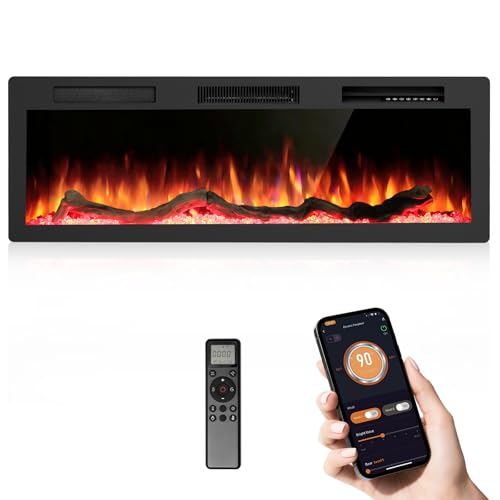
For a larger room, this fireplace is the clearest fit in the listed products: its data states supplemental zone heating for up to 400 square feet. It offers 750W and 1500W heating modes, plus Alexa and Wi-Fi control, if you want heat with an installed fireplace look.
Heating modes 750W and 1500WStated coverage Up to 400 square feetTemperature range 59-95 ℉Controls Remote, touch screen, smartphone, AlexaDimensions 50″L x 17.32″H x 5.71″W
Why it made the cut
Stated supplemental coverage up to 400 square feet
Two heating modes: 750W and 1500W
Alexa, Wi-Fi, remote and touch controls
Good to know
Designed for recessed or wall-mounted installation
It is an electric fireplace, not a Dyson heater
Skip it if Skip it if you want a portable fan heater or specifically want Dyson airflow.
Best for Portable supplemental heat in spaces up to 200 square feet
This compact ceramic heater has a stated coverage of up to 200 square feet, a thermostat and a remote, making it a practical pick for moving between smaller rooms. Its 1500W high setting and 24-hour timer provide straightforward supplemental heat without the footprint of a fireplace.
Power 1500WStated coverage Up to 200 sq.ftNoise 35dBTimer 24H timerSafety ETL-certified; overheat protection; 45° tip-over shutoff
Why it made the cut
Stated coverage up to 200 square feet
Thermostat, remote and 24-hour timer
ETL-certified with tip-over and overheat protection
Good to know
No smart-home control is listed
Does not provide the stated 400-square-foot coverage of the fireplace
Skip it if Skip it if you need a Dyson heater or are heating a large open-plan room.
Best for Year-round fan heating with basic controls
The AM09 uses Dyson Air Multiplier technology and has a tip-over cut-out, with no visible heating elements. Choose this version if you want the listed core fan-heater features; its product data gives fewer details than the other AM09 listing.
Technology Patented Air Multiplier technologyHeating Precise, energy efficient heatingSafety Tip-over automatic cut-out; no visible heating elements
Why it made the cut
Air Multiplier technology
Tip-over automatic cut-out
No visible heating elements
Good to know
No room-size coverage figure is provided
No smart control, timer or noise specification is listed in this product data
Skip it if Skip it if you need a stated large-room coverage figure or more detailed control features.
The Dyson Purifier Hot+Cool HP07 is the strongest Dyson choice for a large room, but Dyson doesn’t provide a verified maximum room size for it here. The same limit applies to the Dyson Hot+Cool Jet and Dyson bladeless heaters generally: there’s no defensible square-foot figure to promise. They work best in small to medium rooms; a large or open room may need better insulation, a favorable layout or a second heater.
The HP07 earns the top spot because it pairs heat with 350° oscillation and H13 sealed HEPA filtration. That wide sweep sends airflow across more of the room than a fixed direction does, while the filter adds air cleaning. It can improve coverage, but oscillation doesn’t increase the heater’s output or guarantee an even temperature from wall to wall.
If by “how good is Dyson’s new heater” you mean the HP07, it’s a capable multi-purpose choice when you’ll use its heating and purification features. It’s a weaker fit if your only goal is heating a very large space: the available facts don’t establish a maximum area or a heating-power figure that would justify that promise.
Best fit
Large rooms where wide airflow coverage helps
Homes that will also use the H13 sealed HEPA filtration
Less suited to
Very large or open-plan spaces that need dependable, even heat from one unit
Buyers who want a stated maximum room size or heating-power figure
How The Dyson Models Compare
For large-room use, choose the HP07 first, then consider the AM09 only if your priority is heat aimed at one spot. The AM09 is the right call at a desk, sofa or bedside when you don’t need air purification. Its focused airflow suits personal comfort better than trying to heat a whole large room.
Dyson’s Air Multiplier technology circulates warm air into the room, and the AM09 can provide quick, directed heat. But moving warm air around isn’t the same as supplying enough heat for every corner of a large space. An open doorway, high ceiling or poor insulation can make a single unit feel much less effective.
In short
Pick the HP07 for the best Dyson combination of large-room airflow and air purification. Choose the AM09 for focused personal heat, and don’t treat either model as a guaranteed whole-room solution for a very large space.
Room-size claims need a number behind them
A Dyson bladeless heater’s useful coverage depends on the room, not just its model name. Without a verified maximum area or heating-power rating, claims that a unit heats a specific number of square feet would be guesswork. The next step is to measure your room and account for its shape and insulation.
If neither Dyson fits the area you need to heat, compare purpose-built options in this guide to a powerful heater that warms large rooms quickly. That’s a better route than assuming a wider sweep alone will cover more space.
Measure The Room Before You Buy
Dyson doesn’t give a verified ideal room size in square metres or a fixed Air Multiplier heating distance, so use the room’s shape and heat loss—not a claimed maximum—as your guide. A 300 sq ft room is about 28 m²; a 500 sq ft open-plan space is about 46 m². Long rooms, high ceilings, connected kitchens and drafts make the larger space harder to heat than its floor area alone suggests.
Air Multiplier technology pushes a strong stream of air into the room, helping warm air travel farther than heat coming from one spot. But Dyson doesn’t publish a reliable distance in feet, and airflow can’t overcome a drafty layout or make every corner reach the same temperature. If an air conditioner is running, its cooling works against the heater; there’s no dependable warm-up time to give without knowing the room, starting temperature and heat loss.
Compare Two Room Layouts
A 300 sq ft enclosed living room is a more realistic single-heater job than a 500 sq ft open-plan area. The larger space may need oscillation to spread the airflow and a second heat source; neither room size guarantees an even temperature.
Enclosed room300 sq ft ≈ 28 m²
Open-plan space500 sq ft ≈ 46 m²
Dyson heaters don’t maintain an even temperature throughout every large space on their own. The thermostat responds to conditions near the unit, while a far corner, adjoining kitchen or cold exterior wall can stay cooler. In a long room, place the heater where its airflow can travel down the open part of the space rather than directly into a wall or furniture.
Oscillation changes how widely the heater sweeps warm air; it doesn’t add heating power. The Gen1 HP10’s 350° sweep is the widest in the lineup, while Dyson models vary from 70° to 350°. A wider sweep can help distribute airflow across an open area, but it won’t make a large, leaky room heat like a smaller enclosed one.
Measure The Hardest Part To Heat
Check the full connected floor area, ceiling height and the distance from the heater to the far end of the room. A kitchen opening or long hallway counts if you expect the heater to warm it, even when the room looks manageable on a floor plan.
Myth
A strong Air Multiplier stream means one Dyson can heat any large room evenly.
Fact
The stream helps carry warm air farther, but room layout and heat loss still set the limit. For a large open-plan space, plan for uneven temperatures or additional heat rather than relying on airflow alone.
Check Running Costs And Noise
Dyson heater running costs depend on its watt draw, how long it runs and your electricity rate—not the Dyson nameplate. Dyson heaters use electricity for heat, so check the model’s rating label for power consumption; a 1,500 W heater running at full power for 8 hours a day uses 12 kWh. At 17 cents per kWh, that’s 12 × $0.17 = $2.04 a day, or about $61.20 over 30 days.
So, are Dyson heaters hard on electricity? They can add up if you run one for many hours, just like any electric resistance heater. Are Dyson heaters energy efficient? The AM09 is described as precise and energy efficient because its thermostat cycles the heater to hold your set temperature instead of blasting continuously. That can reduce running time; it doesn’t change the cost of each kilowatt-hour.
Heater
Watts
Per hour
Per day (8 h)
Per month (30 days)
Heater at 1,500 W
1,500 W
26¢
$2.04
$61.20
Calculated at 17¢ per kWh. Example assumes the heater draws 1,500 W continuously and electricity costs 17 cents per kWh. Actual use varies as the thermostat cycles.
Myth
A Dyson heater costs less to run than an oil-filled heater because it’s more energy efficient.
Fact
At the same wattage and runtime, both electric heaters use the same amount of electricity and cost the same to operate. An oil-filled radiator may cycle differently as it stores and releases heat, but that stored heat isn’t free; compare actual watt draw and runtime.
For a basic 1,500 W ceramic heater, the full-power example is 12 kWh over eight hours. A Dyson costs less over that period only if its average draw is lower, or its thermostat lets it run for fewer equivalent full-power hours. For instance, if it draws 1,500 W for half the time, it uses 6 kWh; at 17 cents, that’s $1.02. Your room’s heat loss and thermostat setting affect that runtime.
12.5 A
Current drawn by a 1,500 W heater at 120 V
That’s close to the usual limit for a plug-in heater on a standard 15 A circuit. Avoid running another high-wattage appliance on the same circuit.
Dyson heaters aren’t automatically loud: the AM09 has Quiet Mark accreditation and is described as having low-noise operation. Product information reports 26 dB in sleep mode and 34 dB in quiet mode for specific models; treat those as model-specific claims, not a noise rating for every Dyson heater. Fan speed and heating mode can change what you hear.
Compare like with like
Read the wattage on each heater’s label, then compare expected runtime at the same room temperature. A lower setting or cycling thermostat can cut use, but a heater that runs longer to warm a poorly insulated room may erase that difference.
Choose The Features That Actually Help
A Dyson heater can be energy-efficient in how it controls room temperature, but its electric resistance heat doesn’t use less electricity per unit of heat than a basic electric heater. A solar setup can run one if its inverter and available power can handle the heater’s draw; check the heater’s wattage and your system’s limits first. Dyson doesn’t publish a verified maximum room size here, so features can improve comfort, not guarantee even heat in a large or open space.
When a Dyson heater stops, it may have reached the thermostat setting or triggered a safety shutoff. If it won’t turn on, switch it off, unplug it, let it cool, and check the outlet and intake for an obstruction. If the fan isn’t spinning, stop using it and check for visible blockage; don’t open the unit. For a heater that won’t rotate, select oscillation with the remote or controls and make sure the base has room to move. Control labels and options vary by model, so check its manual if those steps don’t work.
Match Oscillation To The Room
A wider oscillation angle sweeps warm airflow across more of a large room, which can make coverage feel less patchy; a narrow sweep keeps more airflow on one seat. Dyson models vary from 70° to 350°, and the Gen1 HP10 reaches up to 350°. To rotate a compatible model, use its oscillation control; don’t try to turn the base by hand.
The magnetized remote is handy when the unit sits across the room or beside your couch. App control is useful if you’ll actually change settings from your phone; otherwise, it’s another control you can ignore. The HP07 and HP10 add a sealed HEPA filter for people who want heating and air cleaning in one unit. Check the manual for that model’s filter replacement interval.
Keep The Clearance
Tip-over shutoff is a backup, not permission to place a heater beside curtains or a child’s play area. Keep at least 3 feet of clearance, plug the heater directly into a wall outlet, and look for a UL, ETL or CSA listing. Don’t leave it running while you sleep or leave home unless the manufacturer says that model is designed for it.
Good for
Wider oscillation can spread airflow across more of the room.
The HP07 and HP10 combine heat with sealed HEPA filtration.
The remote attaches magnetically to the unit.
Not for
No verified maximum room size is available here.
Large, open spaces may need additional heat.
App features add little if you won’t use them.
For focused heat
Dyson AM09 Fan Heater
Choose the Dyson AM09 for heat aimed at one seat; its strength is personal warmth, not broad room coverage.
Check whether your model’s oscillation angle suits the room or the seat you want to warm.
Leave 3 feet of clearance and keep the heater away from children’s play areas.
Use the manual to confirm controls and the filter replacement interval for your model.
What To Buy Next
For large rooms, an oil-filled radiator is the better route if you want steady heat over time; compare models by their rated wattage and the room’s heat loss, since no specific radiator size fits every large room. Reviews of Dyson heaters point to a different strength: the HP07 combines heating, 350° oscillation and sealed HEPA filtration, while the AM09 is better for direct heat at a seat or desk. Dyson’s newer purifier-heater design is useful if you’ll use the air-cleaning and app features, but it doesn’t make resistance heat cheaper to run.
In short
Choose the HP07 for a Dyson all-in-one setup in a room that’s already within your heating system’s capacity. Choose the AM09 for focused personal heat; choose a basic 1,500 W ceramic heater if price matters more than the Dyson features.
Choose the HP07 if
You want heating, circulation and air purification in one unit.
You’ll use its app controls and wide oscillation.
Skip Dyson if
You need a verified maximum room size; Dyson doesn’t provide one here.
You want the lowest-cost way to add electric heat.
The HP07 is the cleanest all-in-one Dyson choice when the room is already under control and you want circulation plus purification. Its Air Multiplier airflow can move warmth around, but don’t treat it as a guaranteed whole-room solution for a very large or open space. Add another heat source if the room stays cold at the far end.
Pick the AM09 when you mainly need warmth at one chair or desk and want a simpler heater. It’s the better fit for focused personal heat than for heating a large room evenly. If you’re comparing non-Dyson options, oil filled radiator heaters are worth considering for sustained room heat; a basic ceramic model is the budget choice for quick supplemental warmth.
1
Measure the room
Note its floor area, ceiling height and whether it opens into other rooms; those affect how hard any portable heater has to work.
2
Choose the heat pattern
Pick focused heat for one seat, or whole-room circulation and purification if you’ll use those features.
3
Buy controls you’ll use
Choose the HP07 for app control and purification, the AM09 for direct heat, or a basic 1,500 W ceramic heater when budget comes first.
Questions People Ask
Which Dyson heater is best for a large room?
The Dyson Purifier Hot+Cool HP07 is the best overall Dyson pick for a large room because it combines Air Multiplier airflow, 350° oscillation, and sealed HEPA filtration. It still may need help in a very large or open-plan space.
How big a room can the Dyson Hot+Cool AM09 heat?
Dyson doesn’t provide a verified maximum room size for the AM09 in the available specifications. Treat it as a focused personal heater rather than a dependable whole-room heater for spaces over 300 square feet.
How much electricity does a Dyson heater use?
Use the heater’s watt rating, hours run, and your electric rate: watts ÷ 1,000 × hours × price per kWh. A thermostat can reduce runtime after the room reaches its target, but every hour the heating element runs uses electricity.
Are Dyson heaters energy efficient?
Dyson heaters can control room temperature efficiently and spread warm air well, but their electric resistance element produces heat at roughly the same basic rate as other electric resistance heaters. Air Multiplier improves distribution; it doesn’t create extra heat from each kilowatt-hour.
Do Dyson heaters work well in rooms over 300 square feet?
They can improve comfort in a room over 300 square feet, especially with oscillation aimed across the occupied area, but Dyson gives no verified maximum size here. Large, drafty, or open-plan rooms usually need another heat source or multiple heaters.
Why does my Dyson heater stop or turn off?
A Dyson heater may stop when its thermostat reaches the set temperature, and it automatically shuts off if tipped over. If it keeps stopping while upright and the room is still cold, unplug it and follow the model’s manual rather than bypassing its safety protection.
Can I control a Dyson heater with my phone?
Phone control depends on the specific Dyson model and its smart-home features, so check the model listing before buying. Many models include a remote control that attaches magnetically to the heater, which is useful when app control isn’t available.