For most skoolie builds, the VEVOR 8KW with automatic altitude adjustment is the strongest pick because its listed operating range reaches 18,045 feet and it offers app, remote and LCD controls. Its claimed 8 kW output may be excessive for a small, well-insulated bus, so size the heater to the space before buying.
Key takeaways
Choose the 10 L VEVOR model if its listed automatic altitude adjustment and app controls fit your travel; its stated maximum is 18,045 feet.
A 5 L tank holds less fuel than a 10 L tank, but actual runtime depends on the heater’s burn rate and operating level.
Treat advertised coverage and 8 kW output as manufacturer claims, not a substitute for sizing your insulated bus.
Keep combustion exhaust outdoors, install a working CO alarm, and follow the heater manual for clearances and venting.
A skoolie is a long, leaky metal box until you insulate it well; the heater’s advertised coverage alone can’t predict comfort. These picks are diesel air heaters, not complete bus heating systems, and safe installation depends on routing combustion exhaust outside.
The product data lists three VEVOR 8 kW models. Their useful differences are altitude claims, fuel-tank capacity, controls and whether the unit is described as portable or all-in-one—not independent evidence that any model is certified for a particular installation.
Three VEVOR Heaters for Skoolie Builds
#1Best for high routes
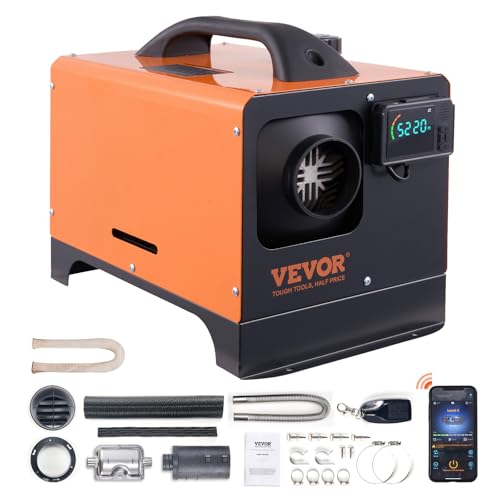
VEVOR 8KW Diesel Heater, Auto Altitude
Best for Skoolies that travel through high-altitude areas
Automatic altitude compensation is listed up to 18,045 feet, the highest stated range among these picks. App, remote and LCD controls give you several ways to preheat or adjust it, and its 10 L tank holds more fuel than the other listed VEVOR options.
Power 8 kWVoltage 12 VAltitude adjustment Automatic, up to 18,045 feetFuel tank 10 L / 2.6 galListed coverage 215–269 sq ft
Why it made the cut
Automatic altitude compensation up to 18,045 feet
App, remote and LCD controls
10 L fuel tank
Good to know
The claimed 8 kW output may be too much for a small, well-insulated bus
Listed coverage is 215–269 sq ft, not a sizing guarantee
Skip it if Skip it if your bus is small and well insulated; size the heater to the space before choosing an 8 kW unit.
Best for Skoolies needing automatic altitude adjustment in an all-in-one unit
This 12 V all-in-one heater has automatic altitude compensation up to 18,045 feet, plus app, remote and LCD controls. Its 5 L tank is smaller than product 4’s, so it suits a build where portability matters more than carrying the larger listed fuel capacity.
Power 8 kWVoltage 12 VAltitude adjustment Automatic, up to 18,045 feetFuel tank 5 L / 1.3 galListed coverage 215–269 sq ft
Why it made the cut
Automatic altitude compensation up to 18,045 feet
App, remote and LCD controls
All-in-one design listed as requiring no installation
Good to know
The 5 L tank is smaller than product 4’s 10 L tank
The claimed 8 kW output may be excessive for a small, well-insulated bus
Skip it if Skip it if you want the larger listed tank; product 4 has a 10 L capacity.
The 12–24 V input and 5 L tank make this an option for a bus that stays within its stated altitude range. It has remote and LCD controls, but its listed operating range stops below the automatic-adjustment models, so it’s a weaker fit for high mountain routes.
Power 8 kWVoltage 12–24 VAltitude range Under 9,843 feetFuel tank 5 L / 1.3 galListed coverage 161–215 sq ft
Why it made the cut
12–24 V input
Remote and LCD controls
5 L / 1.3 gal tank
Good to know
Listed for altitudes under 9,843 feet
No automatic altitude adjustment is stated
Skip it if Skip it if your route may take the bus above 9,843 feet; choose a model with automatic altitude compensation instead.
Best for A plug-in heater for a small indoor space, not a skoolie diesel system
This is a 1,500 W ceramic electric heater, not a diesel air heater, so it won’t meet a search for a diesel skoolie heating system. Its ETL listing, tip-over protection and overheat protection are relevant if you need supplemental heat in an indoor room with a suitable wall outlet.
Power 950 W / 1,500 WHeating area 108–130 sq ftSafety features Overheat and tip-over protectionListing ETL certified
Why it made the cut
ETL certified
Tip-over and overheat protection
Low and high heat settings
Good to know
Runs on electricity, not diesel
No bus-specific installation or coverage claim
Skip it if Skip it if you need a diesel heater for your skoolie.
Best for Indoor supplemental heat and flame effects, not a diesel bus heater
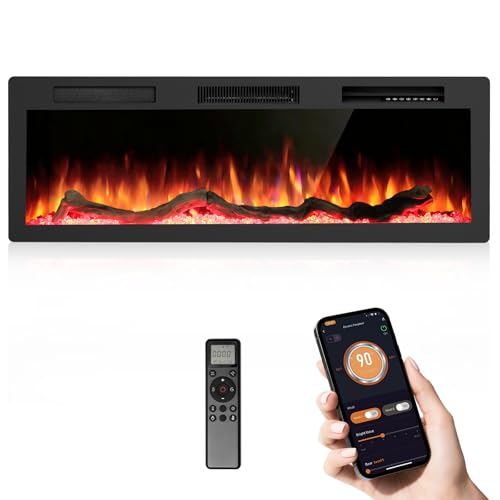
This is a recessed or wall-mounted electric fireplace rather than a diesel heater. Its 750 W and 1,500 W heat modes and listed coverage up to 400 square feet may suit an indoor room, but they don’t make it a skoolie diesel heating option.
Heat settings 750 W / 1,500 WListed coverage Up to 400 sq ftDimensions 50 in L × 17.32 in H × 5.71 in WControls Remote, touch panel, smartphone and Alexa
Why it made the cut
750 W and 1,500 W heat modes
Wall-mounted or recessed installation
Remote, touch, smartphone and Alexa controls
Good to know
Electric fireplace, not a diesel heater
Designed for indoor supplemental zone heating
Skip it if Skip it if you’re choosing a diesel heater for a bus build.
For a diesel heater for garage use, overlanding or a diesel heater caravan, choose a model only after checking its instructions for that exact setting; product data alone doesn’t establish indoor-use certification or prove a particular bus installation is safe. For a skoolie that travels through changing elevations, the VEVOR 8KW Diesel Heater is the clearest fit of these picks: it claims automatic altitude adjustment up to 18,045 feet, a claim rather than a performance guarantee.
Pick
What the listing says
Best fit
VEVOR 8KW Diesel Heater
10 L tank; 12 V supply; automatic altitude adjustment claimed up to 18,045 feet
A bus build that travels at changing elevations
VEVOR 8KW Diesel Heater All in One DC12-24V Fast Heating Di…
5 L tank; 12–24 V supply; listed coverage of 161–215 sq ft
A build that wants a broader voltage range and doesn’t need the highest listed altitude range
Portable, described as installation-free; 5 L tank
Outdoor use or preheating only as its manual allows
These are product-listing details, not proof of safe indoor operation or suitability for every bus.
The 5 L tank and 12–24 V input on product 3 give you a smaller listed fuel capacity and more voltage flexibility than product 4’s 10 L tank and 12 V supply. Product 3 also lists coverage of 161–215 sq ft; that figure doesn’t account for insulation, windows or heat loss. Product 5’s portable, installation-free description doesn’t mean you can run it inside a bus as supplied.
For a boat, the best diesel heater for boat depends on the exact model’s intended use and installation requirements; the same check applies to a garage, caravan or overlanding setup. Verify the manual’s installation and ventilation instructions, plus local rules, before use. A diesel heater marketed for vehicles and related spaces isn’t automatically approved for an occupied indoor space.
Before Choosing a Setting
Check the exact model’s intended use, installation instructions and ventilation requirements. Don’t treat a portable label or a claimed coverage area as permission to operate a heater inside a bus, boat or garage.
Myth
A heater marketed for vehicles is automatically safe to run inside a bus.
Fact
Vehicle marketing doesn’t establish certification or confirm that a particular installation meets the manual’s requirements and local rules. Verify both before operating it in an occupied space.
If your bus route crosses high passes, product 4’s stated altitude adjustment makes it the more relevant listing; the claim doesn’t guarantee output at every elevation. For a build where that highest listed range isn’t needed, product 3 offers a 12–24 V input and a stated coverage range. Match the choice to your actual installation, not the 8 kW label alone.
How to Size a Diesel Heater for a Skoolie
Size a diesel heater for the bus’s heat loss, not its length or the 8 kW label. Insulation, air leaks, window area, ceiling height, winter temperatures and the floor plan all change how much heat you need. A short bus with lots of glass can lose heat faster than a longer, well-insulated conversion.
The listed coverage gives a rough comparison, not a sizing guarantee. The VEVOR 8KW All in One DC12-24V lists 161–215 sq ft; the VEVOR 8KW and VEVOR Diesel Heater 12V 5L Fuel Tank list 215–269 sq ft. None of those ranges specifies the insulation, outdoor temperature or other conditions used to set them.
1
Measure the heated floor area
Measure the space you plan to heat, not the bus’s exterior length. Include only areas that share the heated interior; a partition or closed-off section can change how heat reaches it.
2
Assess heat loss
Check insulation, drafts around doors and windows, window area, ceiling height and the coldest conditions you expect. A drafty bus with large windows needs more heat than a tightly sealed conversion of the same floor area.
3
Check the manufacturer’s sizing guidance
Compare your space and conditions with the heater maker’s guidance. The product’s coverage range and 8 kW label alone don’t prove it’s correctly sized for your bus.
4
Plan air distribution
Work out how warm air will reach the far end of the bus. Duct length, bends and outlet placement affect delivered heat; follow the manual’s ducting limits instead of improvising a route.
Two Buses, Different Heat Needs
Say one conversion is compact, well insulated and tightly sealed. The other is a full-size bus with more window area, higher ceilings and noticeable drafts. The second may need more heat even if the first has a similar floor area; there isn’t enough information in a coverage claim alone to calculate either bus’s heat load precisely.
Compact conversionLower heat loss if insulation and air se
Full-size busPotentially higher heat loss from drafts
Why Oversizing Can Backfire
An oversized heater may spend much of its time at low output or cycle frequently instead of matching the bus’s steady heat demand. Neither the 8 kW rating nor the listed square footage tells you how it will perform in your specific build.
Diesel Heater Fuel Use and Tank Runtime
Diesel heater fuel use and tank runtime depend on the model’s burn rate and tank size; the listing figures give rough estimates, not guaranteed hours. Dividing tank capacity by the stated low and high consumption rates shows the possible range on paper.
Heater
Listed fuel use
Integrated tank
Estimated runtime
VEVOR 8KW All in One DC12-24V
0.18–0.36 L/h
5 L
About 13.9–27.8 hours
VEVOR 8KW Diesel Heater
0.16–0.62 L/h
10 L
About 16.1–62.5 hours
VEVOR Diesel Heater 12V, 5L tank
0.16–0.62 L/h
5 L
About 8.1–31.3 hours
Runtime estimates are tank capacity ÷ listed consumption rate, rounded to one decimal place.
The low-consumption estimate uses the listing’s lowest burn rate; the high-consumption estimate uses its highest. For example, 5 L ÷ 0.36 L/h is about 13.9 hours, while 5 L ÷ 0.18 L/h is about 27.8 hours. Actual runtime can fall outside that range if conditions or operation differ from the listing assumptions.
Worked Example
Say you run the 5 L VEVOR model listed at 0.16–0.62 L/h for 8 hours. At those rates, it would use about 1.28–4.96 L, so the tank could be nearly full or nearly empty afterward. That spread is why a single runtime promise is hard to rely on.
Calculation0.16–0.62 L/h × 8 hours
Estimated fuel used1.28–4.96 L
Your selected output, outdoor temperature, bus insulation and thermostat cycling all affect fuel use. A heater may burn less fuel while cycling at a lower setting than while running steadily at higher output. A listing’s “one gallon per night” shorthand doesn’t specify how many hours, what output or what weather conditions it assumes, so it isn’t a useful runtime guarantee.
Estimate Your Fuel Cost
No fuel price was supplied for these heaters. Use your local diesel price and the heater’s actual burn rate: liters per hour × hours used × price per liter. For instance, multiply your measured L/h by the hours you run it, then by what you pay per liter; don’t substitute the listing’s maximum rate unless the heater actually runs there.
The capacities above are integrated tanks. Don’t assume a connection to your bus’s main fuel tank is approved or included; check the exact heater manual and installation instructions before planning around one.
Diesel Heater Exhaust, Carbon Monoxide and Installation
Route a diesel heater’s combustion exhaust outside the bus, and keep that exhaust path separate from the heated-air duct. A diesel heater burns fuel; a leak or poor exhaust installation can put carbon monoxide into the living space.
The hot-air duct carries warmed cabin air, while the exhaust pipe carries combustion gases from the heater’s combustion chamber. They’re separate paths. Don’t join them, and don’t allow exhaust leaks to reach the cabin through the floor, openings or ductwork.
2 separate air paths
Heated air and combustion exhaust
The cabin-air duct distributes heat; the exhaust must discharge outside. A working CO alarm is still essential because correct-looking fittings don’t prove there’s no leak.
Before You Run the Heater
Install a working carbon monoxide alarm in the living area and check its operation as its instructions specify.
Follow the exact heater manual for ventilation, combustion-air intake, exhaust routing, clearances and shutdown.
Inspect exhaust joints and the exterior termination as the manual directs; check nearby combustible materials against its stated requirements.
Keep the hot-air duct and exhaust pipe separate, and check for signs of exhaust leaking toward the cabin.
Verify that electrical connections match the manual and your bus system.
Never Use an Outdoor Heater Inside
Use only a diesel heater rated for indoor installation in a bus; never use an outdoor or patio heater inside a bus, tent or vehicle cabin. Route combustion exhaust outside, follow the manual’s ventilation requirements and keep a working CO alarm in the living area. A CO alarm doesn’t make an indoor-unsafe heater suitable for enclosed space, and generic overheat protection doesn’t make unattended operation safe. Follow the model’s stated operating limits.
Don’t guess at a sealant, exhaust clearance or routing detail: those depend on the heater and its instructions. If you can’t verify the exhaust path or electrical connections, stop and get qualified help; also check local requirements before installation.
After installation, follow the manual’s shutdown procedure and inspect the exhaust system at the intervals it specifies. If the CO alarm sounds, leave the bus and get outside; don’t re-enter until it’s safe and the cause has been checked.
Diesel Heater Altitude, Controls and Bus Power
Choose a diesel heater whose listed altitude range and voltage match your route and bus electrical system; those specs aren’t interchangeable. The VEVOR 8KW Diesel Heater and VEVOR Diesel Heater 12V 5L Fuel Tank, 8KW, Upgrade list automatic altitude adjustment up to 18,045 feet, while the VEVOR 8KW Diesel Heater All in One DC12-24V Fast Heating Diesel Air Heater lists suitability under 9,843 feet. Treat both as product claims, then confirm the exact unit’s manual before buying.
Model
Listed voltage
Listed altitude claim
Listed controls
VEVOR 8KW Diesel Heater All in One DC12-24V Fast Heating Diesel Air Heater
Claims and controls are from the product listings; check the manual and model label for your exact heater.
An altitude claim doesn’t guarantee the heater will run correctly at every elevation, and an app listing doesn’t promise a particular connection range. Compare the controls you’ll actually use: all three listings include app, remote and LCD controls, but the product data doesn’t establish how far the remote or app will work in your bus.
Voltage is a firm compatibility check: product 3 lists DC 12–24 V, while products 4 and 5 list 12 V. Match the heater’s label and manual to the bus system before wiring; have a qualified installer handle wiring if you’re unsure. The heater also needs electrical power for its controls and operation, and the listings give no electrical draw, so there’s no sound way to calculate battery runtime from these specs.
1
Measure and insulate
Work out the heated space and improve insulation before choosing output; the 8 kW label alone doesn’t tell you what your bus needs.
2
Confirm altitude and voltage
Compare your route’s elevations with the exact unit’s manual, then check its voltage against the bus electrical system.
3
Compare tank and controls
Choose the tank arrangement and controls that suit your use. Don’t assume app or remote range from the listing.
4
Read the installation manual
Check the required wiring, clearances and installation details for the exact model before you start.
5
Plan exhaust routing
Plan a route that sends combustion exhaust outside the bus, separate from the heated-air duct.
6
Buy and install when the plan is clear
If the voltage, altitude capability or safe exhaust route is uncertain, resolve that before buying or installing.
In short
Match the heater’s listed altitude and voltage to your route and bus, then verify both in the manual. Plan the electrical work and exhaust route before installation.
Frequently Asked Questions
Are diesel heaters noisy?
Some noise is normal: the combustion fan makes a steady sound, and the metering pump can tick as it feeds fuel. Mounting the pump on a soft isolator and securing the fuel line can reduce vibration, but follow the heater’s installation instructions.
What is the quietest diesel heater for a skoolie?
There isn’t enough comparable noise data here to name a measured quietest model. If noise is your main concern, compare models with published sound ratings and look at a silent diesel heater showdown; pump mounting and exhaust routing also affect what you hear inside the bus.
Can I add a timer or use a diesel heater controller?
Use a timer or controller only if the heater manufacturer lists it as compatible with your model. An incompatible controller can disrupt the heater’s start-up or shutdown cycle, which may leave soot in the combustion chamber.
What ducting should I use for a diesel heater?
Use heat-rated ducting in the diameter and configuration specified in the heater manual. Keep the heated-air intake and outlet clear, support the duct so it can’t sag or crush, and keep combustion exhaust in its separate route outside the bus.
Can I use a diesel heater for overlanding at high altitude?
Yes, if the specific heater’s altitude rating covers your route and its instructions explain how to operate it there. The VEVOR 8KW listing gives an operating range up to 18,045 feet with automatic altitude adjustment; confirm the range and adjustment method for any model you consider.
Can a portable diesel heater run inside a bus?
Only a model designed and installed for that use should run while you’re inside the bus. Combustion exhaust must discharge outside, separate from the heated-air duct, and you need the ventilation required by the manual and a working carbon monoxide alarm; never run an outdoor-only heater in the cabin.