Top 5 Combo Fan & Heater Units for Year-Round Comfort
Joye
Updated October 14, 2026 16 min read
Quick answer
The best combo fan and heater for most readers is a 42-inch tower model with 1500 W heat, oscillation, remote control, and overheat protection, because it handles both winter heating and summer air movement in one floor-standing unit. If you pick the wrong size or skip the safety features, you pay in comfort first and in wasted power second.
Key takeaways
Choose a 1500 W tower if you want a real room heater that also works as a fan.
Pick a smaller desk unit only for personal comfort at a desk or in a tight office.
Check for tip-over protection, overheat shutoff, and ETL, UL, or CSA listing before you buy.
Quiet mode matters if the unit will run in a bedroom or home office.
Use the running-cost math to compare models before you pay for extra features.
A fan-heater combo sounds simple until you try to use one in a real room. A desk-sized unit can leave your couch cold, and a tower with no tip-over or overheat protection is a bad trade for a few extra bells and whistles.
The job here is to separate the units that can actually heat a room from the ones that mainly circulate air and dress it up. The details that matter are wattage, oscillation, noise, controls, and safety listing.
Best Combo Fan & Heater Units for Year-Round Comfort
#1Best for most rooms
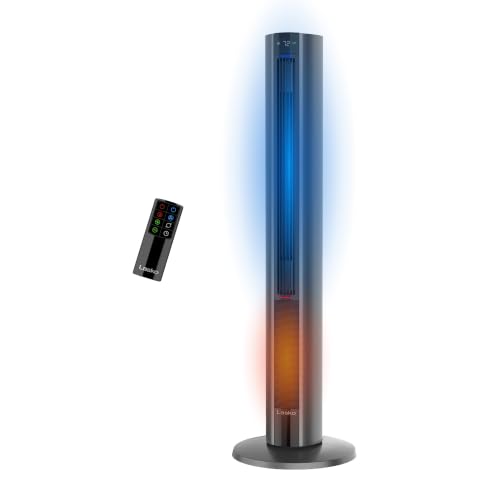
Lasko 42″ DUO Comfort Tower Fan & Heater
Best for Bedrooms and living rooms where you want quiet operation and full remote control
The 42-inch tower oscillates across large rooms and delivers 1,500 W of heat or eight fan speeds depending on the season. Three heat settings and an 8-hour timer let you dial in comfort without getting up, and the tip-over switch, overheat protection, and child lock cover the basics for families. ETL certification and a cool-touch exterior mean you can run it near kids and pets.
No precise temperature display or thermostat control
Oscillation width not specified in the data
Skip it if If you need to set an exact target temperature or want oscillation wider than the standard tower range, look at models with digital thermostats.
Best for Offices and bedrooms where noise matters more than anything else
The DC motor and TurboSilent aerodynamic design drop the noise floor to 25 dB in heating mode, making this the pick when you need warmth without the hum. A digital thermostat lets you set target temperature from 41 to 95°F in ECO mode, and the 1,500 W PTC element heats the room in two seconds. Twelve fan speeds and 120-degree oscillation move air up to 40 feet in summer.
Heat output 1,500 WFan speeds 12Noise level 25 dB (heating)Oscillation 120°Thermostat range 41–95°F
Why it made the cut
25 dB heating mode for near-silent warmth
ECO mode with ±1.5°F precision thermostat
1,585 CFM airflow reaches 40 feet
Eight-layer safety including FortPlug and V-0 flame retardant
Good to know
Higher upfront cost for the quieter motor
Remote functionality not detailed in the data
Skip it if If you don’t care about noise and just want a basic remote-controlled unit, the Lasko costs less and covers the same rooms.
Best for Rooms with tall ceilings or furniture that blocks horizontal airflow
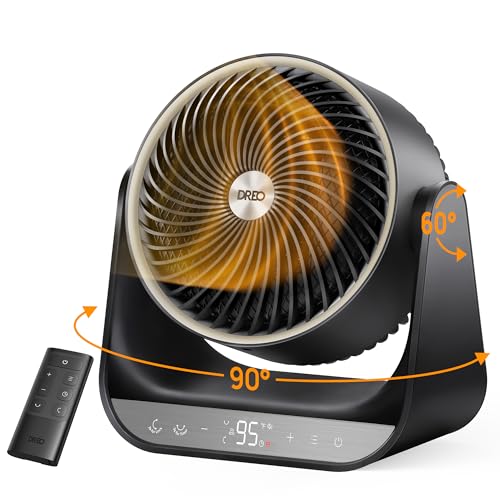
Sixty degrees of vertical oscillation and 90 degrees horizontal mean this heater can sweep heat up toward a vaulted ceiling or down to floor level, not just side to side. The 1,500 W ceramic element delivers heat in two seconds, and the brushless DC motor keeps the noise at 34 dB. ECO mode holds your target temperature from 41 to 95°F in 1-degree steps, and a 12-hour timer shuts it off overnight.
Best for Homes with toddlers where exposed blades are a safety worry
The bladeless design eliminates the pinch points of a traditional fan grille, and the seven-color LED base light doubles as a nightlight you can set to red, blue, green, yellow, purple, cyan, or white. A digital thermostat adjusts from 59 to 95°F, and 70-degree oscillation spreads 1,500 W of ceramic heat or high-velocity airflow across the room. The 24-hour timer and remote let you program shutoff from bed.
LED light can’t be disabled, only cycled through colors
Oscillation narrower than 42-inch models
Skip it if If the LED light will bother light-sensitive sleepers or you need the reach of a taller tower, pick the Lasko or DREO 42-inch units instead.
Best for Home offices and dorm rooms where floor space is tight
The compact rectangular shape and built-in handle make this easy to move from desk to nightstand, and the 45-degree tilt lets you aim airflow whether you’re sitting or standing. Two fan speeds and a heating mode cover the basics, and tip-over and overheat protection are built in. It won’t heat or cool a large room, but it works as a personal unit within arm’s reach.
Type Desk fan and heaterTilt range 0–45°Fan speeds 2Safety Tip-over, overheat protection
Why it made the cut
Small footprint for desks and shelves
0–45° tilt angle
Carrying handle for portability
Good to know
Only two fan speeds—no fine control
No remote, timer, or thermostat
Heat output and airflow distance not specified
Skip it if If you’re heating or cooling anything larger than a cubicle or a single-occupant dorm room, the taller tower models will do the job better.
Comfort Glow is a legacy brand name you’ll see on some propane and kerosene models, but it doesn’t appear on the combo fan-heater units people are comparing right now. The search brings you here because you’re trying to sort brand names from spec sheets, and that instinct is right—just aim it at the features that actually keep you safe and comfortable.
Brand recognition matters less than three things you can verify in thirty seconds: a real safety listing (UL, ETL or CSA), tip-over and overheat shutoff, and a control layout that lets you adjust heat and fan speed without crouching next to the unit. A tower from a name you’ve never heard of will outperform a desk model from a household brand if the tower has 1,500 W, oscillation, and the safety switches that cut power when something goes wrong.
Where review snippets mislead
Customer reviews routinely overstate how quiet a fan runs and how many square feet a 1,500 W heater can warm, especially in open layouts or rooms with poor insulation. Start with the wattage, the oscillation range, and the decibel rating if the manufacturer lists one; those numbers won’t shift with the weather.
Here’s the rule: if the product page shows a certification mark, names the wattage, and includes a photo of the control panel or remote, you have enough to decide. If it skips two of those three, keep scrolling. Lesser-known brands earn trust with transparent specs and real safety hardware, not with five-star averages that lump together summer fan use and winter heating in the same score.
In short
Look past the brand and check for a safety listing, tip-over shutoff, and clear wattage before you compare models. The spec sheet tells you more than the name on the grill.
Which Combo Fits Your Room
Tower units spread warm air across a room; desk and personal models aim it at you. That split matters more than styling, because a 42-inch tower with oscillation can cover a bedroom or home office, while a stationary desk fan warms the person in front of it and little else. Both top out at 1,500 W—the ceiling for any plug-in electric heater on a standard 120 V circuit—but the tower’s height and swing give it more reach.
Wattage is the first number to check. A combo fan and heater rated below 1,000 W will take the edge off a cold morning but won’t hold a room at 70°F when it’s freezing outside. At 1,500 W you’re pulling about 12.5 A, which is safe on a dedicated 15 A circuit as long as you’re plugged straight into the wall outlet and nothing else is drawing power on that same circuit. Oscillation range runs from 60 to 90 degrees on most towers; the wider the swing, the more even the heat feels six feet away.
Style
Typical height
Best for
Oscillation
Tower
40 to 42 in
Bedrooms, home offices, living rooms up to 200 sq ft
60–90°
Desk / personal
12 to 18 in
Desks, nightstands, personal warming within 3 ft
Fixed or 60°
Bladeless tower
32 to 42 in
Households with kids or pets, easier to clean
70–90°
Height and oscillation determine how far warm air travels before it mixes with room air.
Matching size to space
Say your bedroom is 12 by 14 feet with decent insulation and one window. That’s 168 square feet, and a 1,500 W tower with oscillation will keep it comfortable as a supplemental heat source. Your home office is 10 by 10, drafty, with a desk against the back wall—a small desk unit aimed at your chair does the job without heating the empty half of the room. The living room is 15 by 18 and open to the hallway; even a full-size tower will struggle unless you close the doorway or accept that it’s zoned heat, warm near the unit and cooler at the edges.
Bedroom12 × 14 ft, 1,500 W tower
Home office10 × 10 ft, small desk unit
Living room15 × 18 ft, tower as zoned heat
Read the room size claim conservatively
Manufacturers assume closed doors, average insulation, and a starting temperature in the low 60s. Subtract 20 to 30 percent from the claimed square footage if you have high ceilings, single-pane windows, or an open floor plan.
Fan speed settings matter in summer but also in winter, because lower speeds let the heating element’s warmth linger in the airstream instead of blowing across you in a rush. Three speeds is the practical minimum; anything less and you’re either too warm or fighting a draft.
What The Running Cost Really Looks Like
A 1,500 W combo unit running on heat for 8 hours costs about $2.04 at the national average rate of 17 cents per kWh, because 1,500 W ÷ 1,000 × 8 hours × $0.17 equals 12 kWh times that rate. That’s the formula: watts divided by 1,000, times hours, times your local price per kilowatt-hour.
Fan-only mode drops the draw to somewhere between 30 and 70 W depending on speed, so running just the fan for those same 8 hours costs roughly 8 to 14 cents. The motor uses power, but it’s a fraction of what the heating element pulls.
Heater
Watts
Per hour
Per day (8 h)
Per month (30 days)
1,500 W combo unit (heat mode)
1,500 W
26¢
$2.04
$61.20
Same unit (fan-only, high)
60 W
1.0¢
8.2¢
$2.45
Calculated at 17¢ per kWh. Monthly cost assuming 8 hours every night at 17 cents per kWh.
ECO or thermostat modes cycle the heater on and off to hold a target temperature, which cuts total runtime and trims the bill. They don’t reduce the 1,500 W draw when the element is on; they just shorten how long it stays on.
A tower unit left on all night in a bedroom adds up faster than a desk model you run for two hours at your feet while you work. Say the tower runs 8 hours and the desk unit runs 2: at 1,500 W, that’s 12 kWh versus 3 kWh, or $2.04 versus 51 cents per night at 17 cents per kWh. Over a month the tower costs around $61, the desk unit about $15.
12 kWh
What 1,500 W for 8 hours consumes
Multiply that by your actual rate to see what a full night costs in your state.
Your rate matters more than the model. Check a recent bill for your cents per kWh; rates range from under 12 cents in some states to over 30 cents in others. Plug your number into the formula and you’ll know what to expect before the first bill arrives.
In short
Heat mode at 1,500 W costs about $2 per 8-hour night at 17 cents per kWh. Fan mode costs pennies, and shorter runtime cuts the monthly total fast.
Safety And Certifications To Check
Plug a combo fan and heater straight into a wall outlet, never into an extension cord or power strip. A 1,500 W unit draws 12.5 amps, close to the 15-amp limit of a standard household circuit, and the extra resistance in a cord or strip can overheat the connection.
Keep 3 feet of clearance around the unit—no curtains, furniture, or laundry within that circle. Tower and desk models get moved often, sometimes knocked over, which is why tip-over protection and an overheat shutoff aren’t optional. Tip-over switches cut power the moment the unit tilts past a safe angle. Overheat sensors do the same when internal temperature climbs too high, whether from a blocked vent or a failing component.
Space heater safety checklist
UL, ETL or CSA listing on the label or in the manual
Tip-over shutoff that works in any direction
Overheat protection independent of the thermostat
Three feet of clearance on all sides
Plugged directly into a wall outlet, not a cord or strip
Look for a UL, ETL or CSA mark. Those certifications mean the design passed third-party testing for electrical and fire safety under realistic fault conditions. The mark usually appears on a label near the cord or on the back panel; if you don’t see it, check the manual or the manufacturer’s specs online before you buy.
No sleeping or leaving home
Do not leave a combo heater running while you sleep or when nobody’s home unless the manufacturer explicitly states the model is designed for unattended use. Most are not.
Child lock and cool-touch housing add useful layers. A child lock disables the control panel so settings can’t be changed by accident or curious hands. Cool-touch plastic on the front grille reduces burn risk if someone touches the unit while it’s running. Neither replaces tip-over or overheat protection—they’re extras, not substitutes.
Indoor electric only
These are indoor electric appliances. They have no exhaust, no fuel tank, and no outdoor rating. Don’t use one in a garage workshop without heat, a tent, or a vehicle cabin.
Which Pick Fits Which Buyer
Large-room towers work best in bedrooms and living rooms where you’ll use both the oscillation and the remote to adjust settings from across the room. Pick the Lasko 42″ DUO Comfort Tower if you need strong heat spread and don’t mind a bit of motor noise, or choose the DREO 42″ Space Heater if bedroom quiet matters more than saving a few dollars. Both deliver 1,500 W and cover roughly 200 square feet, but the DREO runs noticeably quieter at night.
Compact desk units like the TRUSTECH 2 in 1 make sense for a home office or cubicle where you’re sitting within three feet of the unit and room coverage doesn’t come into play. You’ll feel the warmth without heating the whole space, which cuts your running cost when the rest of the room can stay cooler. Skip the smaller MOMOKOVA 32″ model if you’re trying to heat anything larger than a tight workspace; it lacks the throw and oscillation range of the full-height towers, and you’ll end up cranking it to high and still feeling cold at your desk across the room.
Smart controls and app features suit buyers who actually change settings from another room or schedule the unit to warm up before they wake. If you set it once and leave it, manual controls cost less and work just as well. Most of these units include a basic timer and remote, which handles the real daily adjustments without installing an app or pairing to Wi-Fi.
Tower units deliver
Oscillation that spreads warmth across 150 to 200 sq ft
Remote control from bed or couch
Tall profile that pushes air higher into the room
Desk units limit you to
Fixed airflow aimed at your immediate workspace
Manual controls you adjust by hand
Lower maximum coverage, typically under 100 sq ft
In short
Match the unit’s height and oscillation to your room size, not to the product photo. Quiet motors matter in bedrooms; raw wattage matters when you’re heating more than a desk.
What To Check Before You Buy
Run through room size, wattage, oscillation, safety listing, timer and remote control before you add anything to the cart. Measure the space you’re heating: 1,500 W handles about 150 to 200 square feet in a moderately insulated room, but you’ll need a second unit or a different heat source for anything bigger. Check that the unit carries a UL, ETL or CSA mark, which tells you it passed third-party testing for tip-over and overheat protection.
Look at the wall outlet where you plan to run the heater and confirm it’s on a dedicated circuit with no other high-draw appliances. Never plug a combo fan and heater into an extension cord or power strip; the 12.5 A draw at 1,500 W will overheat cheap cords and trip breakers on shared circuits. Bedrooms need a noise floor under about 50 dB on the heat setting, which rules out some of the louder tower fans; garages and basements tolerate higher motor noise without anyone noticing.
Before you buy
Room size in square feet, matched to the unit’s rated coverage
UL, ETL or CSA safety listing printed on the box or in the manual
Oscillation if you’re heating more than a desk or tight corner
Timer and remote control for bedside or across-the-room adjustments
Quiet motor spec if the unit will run in a bedroom at night
Dedicated wall outlet with no extension cord in the plan
Fan-only units won’t heat
Some tower fans look identical to combo units but deliver airflow only, with no heating element. Check the wattage and the product title: if it says “fan” without “heater” and the power draw is under 100 W, it won’t warm anything.
Frequently Asked Questions
Who makes Comfort Glow heaters?
Comfort Glow was a brand owned by World Marketing of America, which produced propane, kerosene and electric heaters through the 1990s and 2000s. The name still appears on older stock and liquidation models, but it’s not associated with the tower and personal combo units people search for today. If you see it, double-check the listing date and warranty before you buy.
Are combo fan and heater units good for bedrooms?
A 1,500 W tower combo with tip-over shutoff and overheat protection works well in a bedroom between 150 and 200 square feet, as long as you plug it into a wall outlet and keep three feet of clearance around the grille. Most models cycle the heating element on and off, so they’re quiet enough for light sleepers. Never leave one running while you sleep unless the manual explicitly states the model is designed for unattended operation.
How much does a 1500 W combo heater cost to run?
Running a 1,500 W combo on heat for 8 hours uses 12 kWh, which costs about $2.04 at the national average of 17 cents per kWh. Fan-only mode draws between 30 and 60 W—closer to five cents for 8 hours—so your bill climbs only when the heating element is on.
Can I use a fan heater combo with an extension cord?
No. A 1,500 W heater draws 12.5 amps, which exceeds what most household extension cords and power strips are rated to carry without overheating. Plug the unit straight into a wall outlet on a dedicated 15-amp circuit to avoid tripping the breaker or creating a fire risk.
Share
Written byJoye
HeaterGuides covers home heating, water heating and HVAC: how the equipment works, what it costs to run, and how to use it safely.