The best bathroom heater light fan for most readers is Product 4 because it combines 1800W heat, 160 CFM exhaust, and a smart memory feature in one ceiling unit. That matters in a bathroom: a 1800W heater draws about 15 amps, so it usually needs a dedicated 120V circuit and a proper install.
Bathroom heater-light-fan combos solve three jobs at once: clear steam, warm the room, and give you usable light before the mirror fogs up again.
The tradeoff is simple. More heat, stronger airflow, and brighter lighting usually mean a larger housing, a louder fan, or a more demanding electrical install.
Best Bathroom Heater Light Fan Picks
#1Best Overall
VIVOHOME 1800W Bathroom Fan
Best for Bathrooms needing fast heat and adjustable exhaust
The 1800W PTC heater and oscillating louvers spread warmth, while the fan offers 80, 110, or 160 CFM. A humidity sensor can start ventilation automatically, and memory restores your settings after a power loss. Its 1800W load draws about 15 amps at 120V, so check the circuit and have the ceiling unit installed correctly.
Heat 1800W PTC; 2 heating modesAirflow / noise 80/110/160 CFM; 0.1–1.5 sonesOpening / depth 10.8 × 10.8 in opening; 7.1 in depthDuct 4 in connectorLight 2700K, 4000K, or 5700K
Why it made the cut
Three exhaust speeds, from 80 to 160 CFM
Humidity sensor and 20/30/60-minute timer
Three LED color temperatures and setting memory
Good to know
Requires a 10.8 × 10.8-inch opening with 7.1 inches of depth
Electrical load may require a dedicated circuit
Skip it if Skip it if your ceiling opening or wiring can’t support the unit; confirm both before ordering.
Best for Bathrooms up to 110 sq ft where quiet exhaust matters
This ceiling unit pairs a 1300W heater with 110 CFM ventilation rated at 1.5 sones. The fan, heater, and LED light can run independently or together, which suits a bathroom where you want to clear mirror fog without always turning on the heat.
Heat 1300WAirflow / noise 110 CFM; 1.5 sonesBathroom coverage Up to 110 ft²Housing depth 5-1/2 inDuct 4 in connector
Why it made the cut
110 CFM airflow for bathrooms up to 110 sq ft
1.5-sone fan rating
Includes a 4-inch duct connector and adjustable hanger bar
Good to know
Heating output is lower than the 1800W options
The product data doesn’t state light color or control options
Skip it if Skip it if you want higher heat output or need a specific light temperature and control setup.
Best for Bathrooms needing 1800W heat, light, and 140 CFM exhaust
Its 1800W heater, 140 CFM exhaust, and 18W LED combine the main bathroom functions in one ceiling unit. The remote handles temperature, lighting, and fan speed; the stated 11.7 × 11.7-inch frame gives you a concrete opening size to check before buying.
Best for Portable supplemental heat in a dry room, not a bathroom ceiling
The 1500W ceramic heater is portable and includes a thermostat, remote, timer, and Eco mode. Its ETL certification and tip-over shutoff are useful features for room heating, but the product data doesn’t establish it as suitable for bathroom use.
Heat 1500WCoverage Up to 200 sq ftNoise 35 dBTimer 24-hour timerSafety ETL-certified; tip-over shutoff
Why it made the cut
1500W high setting and thermostat
Tip-over shutoff and overheat protection
Remote, timer, and Eco mode
Good to know
Portable floor unit, not a bathroom exhaust fan or ceiling fixture
Bathroom suitability isn’t established in the product data
Skip it if Skip it for bathroom use unless the manufacturer explicitly approves that location and its moisture conditions.
Best for Supplemental heat and flame effects in a living area
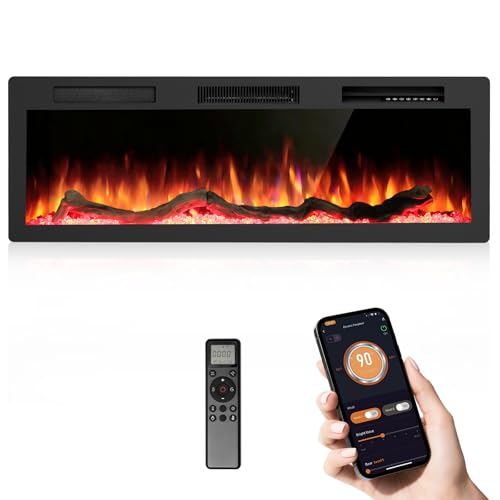
This recessed or wall-mounted fireplace offers 750W and 1500W heating modes, adjustable flame effects, and remote, touch, smartphone, or voice control. It doesn’t provide bathroom exhaust or a ceiling-mounted heater-light-fan combination, so it isn’t a match for this search.
Heat 750W / 1500WCoverage Up to 400 sq ftDimensions 50 × 17.32 × 5.71 inOpening 48 × 16.9 × 6.1 inTemperature range 59–95°F
Why it made the cut
750W and 1500W heating modes
Recessed or wall-mounted installation
Remote, touch, smartphone, and Alexa control
Good to know
No bathroom ventilation or ceiling fan
50-inch format is meant for a wall or recessed opening
Skip it if Skip it if you need bathroom exhaust, a ceiling fixture, or a heater-light-fan combo.
The best bathroom heater light fan is the one that warms the room, clears steam, fits your ceiling opening and has controls you’ll actually use. For most buyers comparing bathroom exhaust fans with heat and light, the VIVOHOME 1800W PTC Bathroom Exhaust Fan with Light and Heat stands out for combining 1800W heat, 160 CFM exhaust and a smart memory feature; check your wiring and ceiling fit before choosing it.
For the best bathroom exhaust fan with light and heat, compare five things before you focus on grille style: heater watts, airflow in CFM, fan noise in sones, the ceiling opening and duct size, and whether the light is dimmable or offers multiple color temperatures (multi-CCT). A bathroom light fan with heater is a small appliance package, so a mismatch in any one of those can make the unit a poor fit.
Spec
What it tells you
Heater watts
The set ranges from 1300W to 1800W. More heat helps only if the circuit and wiring can support the load.
CFM
Airflow for removing steam. As a basic starting point, allow about 1 CFM per square foot for bathrooms up to 100 square feet; follow the unit instructions and local requirements.
Sones
How loud the fan feels in use. Lower numbers generally mean quieter operation.
Opening and duct
Whether the housing fits the ceiling cutout and connects to your existing duct. Measure both; grille shape won’t fix a mismatch.
Light controls
Dimming or multi-CCT options let you adjust brightness or light color if the product includes them.
Compare the actual unit specifications, not just the appearance of the grille.
Check the ceiling opening first
A replacement can look right from below and still fail to fit above the drywall. Confirm the housing dimensions and duct diameter against the existing opening and duct before ordering; changing those can mean ceiling or duct work.
A 1800W heater draws about 15 amps at 120V, so it usually needs a dedicated circuit; don’t assume an existing bathroom light circuit can carry it. Independent controls are better than one switch for everything because you can run the fan to clear steam without heating the room, or use the light without turning on either.
In short
Choose by heat, airflow, noise, fit and light controls, in that order of practical consequence. If you want a closer comparison of bathroom exhaust fans with heat and light, see our bathroom exhaust fan with heater buying guide.
Size The Fan To The Bathroom And Wiring
Match the heater and airflow to the room, then have an electrician check the circuit before you buy. A bathroom fan and light with an 11.6 × 11.6-inch opening must also fit your ceiling cutout; measure the existing opening and ceiling depth, not just the grille. If you mean a heater mounted in the wall while you’re in the bathroom, that’s a different appliance and installation—don’t assume a ceiling combo can replace it.
A Small Room Versus A Larger Room
For a small bathroom, a 1,300 W heater with 80 to 110 CFM may be enough. A larger room can benefit from 1,800 W and stronger airflow, provided the circuit is suitable. For example, Product 3 has 110 CFM, while Product 4 has 1,800 W and 160 CFM; choose based on room size and verified wiring, not the biggest numbers alone.
Small bathroom example1,300 W; 80–110 CFM
Larger room example1,800 W; stronger airflow
A ceramic PTC element can regulate heat as it warms, but it doesn’t make electric resistance heat magically cheaper: 1,500 W of electricity produces about 1,500 W of heat, minus minor losses. The most efficient mini heater is the one sized so you can warm the room without overheating it or running the fan longer than needed.
12.5 A
Current drawn by a 1,500 W heater at 120 V
A standard 15 A, 120 V bathroom circuit is already near its limit with a 1,500 W heater, and an 1,800 W heater alone draws about 15 A before the fan and light are counted.
Have The Circuit Verified
Ask an electrician to verify the branch circuit and the unit’s installation requirements before purchase. A compact housing doesn’t mean a small electrical load; the heater’s wattage is what matters.
Pick Quiet Heat For Early Mornings
For a calmer bathroom, compare fan noise in sones and favor the lower listed number when the fan sits close to your head. A 1.5-sone fan can still be noticeable in a small room, even while its heater is doing its job.
If you’re searching for the best-rated bathroom exhaust fan with LED light and heater or Bluetooth, decide first whether you want smart controls or simply a bathroom exhaust fan with heater and light. Product 4 is the stronger fit for smart controls; Product 3 is the simpler quiet option. Check each model’s listed sone rating before choosing—don’t infer quietness from the feature list.
A humidity sensor can start the fan automatically after a shower, which helps in a shared bathroom or when someone forgets the switch. Bluetooth and smart controls can make operation more convenient, but they don’t improve the heater’s output or the fan’s airflow. A bathroom ceiling heater fan with smart features is useful if you’ll use them; they’re extras, not a reason to skip checking the core specs.
Smart Controls
Product 4 suits shoppers who want smart controls in a bathroom ceiling exhaust fan with light and heater.
Product 3 is a simpler choice for people prioritizing a quieter, more straightforward unit.
Simple Operation
Smart features add convenience, not heating performance.
Fan noise still depends on the sone rating and how close the fan is to you.
Check The Noise Rating
Compare the models’ sones on their specifications, especially for a compact bathroom where the fan is near your head. If the rating isn’t listed, don’t treat a quiet-sounding product name as proof.
Check Safety, Code, And Replacement Parts
A bathroom heater-fan-light combo must be installed on a properly sized, listed circuit and only in a location the manufacturer allows. The red light on a wall panel can mean the heater is powered, actively heating, or reporting a fault; the control’s manual tells you which, so don’t diagnose it by color alone.
For a Broan bathroom ceiling fan heater element replacement, identify the exact model and find its specified element or compatible assembly before ordering. Established brands are generally easier to match to replacement parts than obscure clones; if the model number or part fit can’t be verified, don’t assume a similar-looking element will work.
A Fisher heater red light flash can’t be interpreted reliably without the model and its manual. Flash patterns may have model-specific meanings, so check the unit’s troubleshooting instructions rather than treating every red flash as the same fault.
Keep Wiring Work Safe
Turn power off at the breaker before any work involving 120V wiring, moisture, or a ceiling box, and verify the circuit is de-energized. Bathroom electrical work and ceiling-unit installation may require a licensed electrician; follow local code and the manufacturer’s instructions.
Why Public-Bathroom Heaters Look Different
Golf course bathroom wall heaters and units in clubs or other public bathrooms are often designed for hard use and service access, so their exposed housings and controls can look unlike residential ceiling combos. That appearance doesn’t make them suitable for a home installation; use equipment listed for the intended location.
What To Do Before You Order
The best bathroom heater light fan is the one that fits your ceiling opening, duct and circuit—not simply the one with the longest feature list. For the best bathroom exhaust fan with light and heater, check those three constraints before choosing among the models.
1
Measure the ceiling opening
Record the existing cutout dimensions and compare them with the replacement unit’s installation requirements; a different housing may mean ceiling work.
2
Check the duct size
Confirm the duct diameter and route match the unit’s stated requirements. Don’t assume the old duct will fit a new housing.
3
Confirm the circuit
Have an electrician verify the available circuit and installation requirements before buying a heater-fan-light unit. The 1800W models need particular attention to circuit capacity.
4
Choose by your priority
Pick the VIVOHOME 1800W model for the most complete feature set, the Keoslpy for quieter, simpler heat, or the xugossio if you’re budget-minded and want 1800W with a 140 CFM fan. Product 2, the R.W.FLAME portable space heater, suits a bathroom only if its manual permits that location and you can meet its safety clearances; otherwise, skip it there.
If your bathroom already has a good exhaust fan and heat is the main problem, a separate wall heater may be a better fit than opening the ceiling. A portable heater is another option only when it’s approved for the location; plug it directly into a wall outlet, keep 3 feet of clearance, and don’t leave it running unattended.
Next step
Measure the opening, match the duct, check the circuit, then choose the model that fits the room and the noise level.
More Questions, Answered
What size bathroom does a 1300W heater fan cover?
There isn’t a dependable square-foot figure from wattage alone: insulation, ceiling height, outside walls and the room’s starting temperature all affect warm-up. A 1,300W element produces about 4,440 BTU per hour, but check the manufacturer’s room guidance and treat it as supplemental heat rather than a guaranteed whole-room heater.
Is a ceramic bathroom heater energy efficient?
A ceramic electric heater turns nearly all the electricity it uses into heat, much like other electric resistance heaters; ceramic doesn’t make it cheaper to run by itself. A thermostat can reduce consumption by cycling the element off after the room warms, while fan use and the set temperature also affect the bill.
Do I need a dedicated circuit for a bathroom heater light fan?
For an 1,800W unit on 120V, the heater alone draws about 15 amps, leaving no practical spare capacity on a standard 15-amp circuit. Many models require a dedicated circuit, but follow the installation manual and have an electrician verify the circuit, wiring and required protection before installation.
What does a red light on a wall heater panel mean?
A red light can indicate that the heater is on, that a heating cycle is active, or that the unit has detected a fault; the meaning depends on the model. Check the indicator section of the manual for its specific blink pattern or label, and switch off power if the unit smells burnt, trips the breaker or behaves abnormally.
Can I replace just the heater element in a bathroom fan?
Sometimes, if the manufacturer sells a replacement element for that exact model and the housing, wiring and controls are in good condition. Don’t fit a generic element or alter the wiring: disconnect power at the breaker, confirm the replacement part is approved for the unit, and use a qualified electrician if the repair involves electrical connections.
What is the quietest bathroom exhaust fan with light and heat?
There’s no single quietest choice without comparing the exact models’ listed sone ratings; a lower number means less reported fan noise. Compare ratings at the airflow you need, since a quiet fan that can’t clear steam adequately is a poor trade.