For most readers, the best bath fan with heater is Product 4 because it pairs 110 CFM with a 1300W heater and 1.5 sone operation, which is enough for a typical small bathroom without overdoing the noise or the wiring load.
The essentials
Match heater wattage to the room, but do not ignore airflow; a warm bathroom that still traps steam is the wrong answer.
For most small bathrooms, 110 CFM and 1,300 to 1,800 watts is the useful range.
Lower sones mean less noise; 1.0 to 1.5 sone is the quiet end of this group.
Check the ceiling cavity, duct size, and joist depth before you buy, not after the old fan is already out.
Any hardwired bathroom heater fan belongs on a properly sized circuit and should follow the installation manual exactly.
Pick the wrong unit and you pay twice: once in comfort, then again in labor when the heater is too weak, too loud, or too deep for the ceiling cavity. A bathroom fan heater also has to fit the room size and the circuit, or it becomes an expensive box of regrets.
The right choice is mostly about three numbers: heater wattage, exhaust airflow, and the cutout or housing depth. Everything else is secondary unless you care about smart controls or a light color that makes your face look less haunted before coffee.
Best Bath Fans With Heater for Winter Mornings
#1Best Overall
Keoslpy Bath Fan Heater, 110 CFM
Best for Bathrooms up to 110 sq ft where quiet operation matters
Product 4 gives you the most balanced setup for a typical bathroom: 110 CFM of ventilation, a 1300W heater, and 1.5 sone operation. The fan, light, and heater can run independently or together, and the shallow 5-1/2-inch housing helps in tight ceiling cavities.
Why it made the cut
110 CFM airflow for bathrooms up to 110 sq ft
1.5 sone operation
1300W heater and LED light
4-inch duct connector and backdraft damper
Good to know
Less airflow and heat than the 1800W models
The product data does not state a lighting color temperature
Skip it if Skip it if your bathroom needs more than 110 CFM of airflow or you want Bluetooth audio and RGB lighting.
Best for Larger bathrooms needing 180 CFM and 1.0 sone operation
Product 5 is the strong choice when ventilation and low noise outrank electrical load. Its 180 CFM fan runs at 1.0 sone, while the 1800W heater adds two heat levels, three light color temperatures, RGB lighting, and Bluetooth audio.
Why it made the cut
180 CFM airflow
1.0 sone operation
1800W heater with two heat levels
Bluetooth speaker and four RGB light modes
Good to know
The 1800W heater draws more power than Product 4
The product data does not state the housing dimensions
Skip it if Skip it if your circuit cannot accommodate a higher-power bathroom heater or you don’t need the extra lighting and audio features.
Best for Bathrooms needing strong airflow, heat, light, and remote control
Product 3 combines a 1800W heater with 140 CFM airflow, an 18W LED light, and remote control. Its 11.7 by 11.7-inch frame is designed for standard openings, making it a practical fit when one ceiling unit needs to handle several jobs.
Why it made the cut
140 CFM airflow
1800W heating element
18W LED light
Thermal protection system and remote control
Good to know
The product data does not give a sone rating
Its 1800W heater uses more power than Product 4
Skip it if Skip it if a published noise rating is a deciding factor for your bathroom.
Best for Temporary spot heating when you already have bathroom ventilation
Product 1 is a portable 1500W ceramic heater, not a ceiling exhaust fan. It offers a thermostat, remote control, 24-hour timer, and 45° tip-over shutoff, so it can warm a room where a fixed bath fan heater isn’t practical.
Why it made the cut
1500W ceramic heat
35dB listed noise level
24-hour timer and thermostat
ETL-certified with overheat protection
Good to know
No bathroom exhaust airflow
Portable rather than ceiling-mounted
The product data does not state a bathroom-specific rating
Skip it if Skip it if you need shower moisture and odors exhausted from the bathroom.
Best for Large rooms where fireplace appearance matters more than bath ventilation
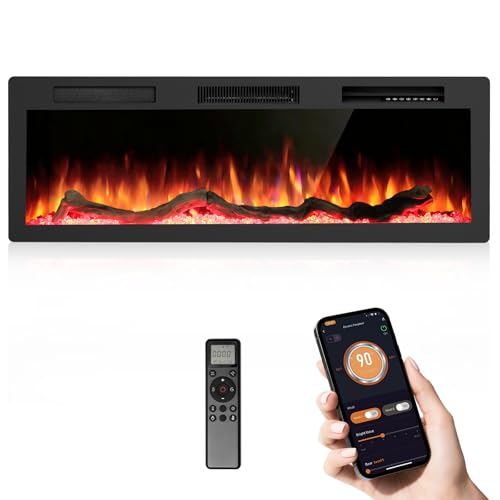
Product 2 is a recessed or wall-mounted electric fireplace with 750W and 1500W heat modes, temperature adjustment from 59-95°F, and supplemental heating for up to 400 square feet. Remote, touch, smartphone, and Alexa controls add convenience, but none of that replaces a bathroom exhaust fan.
Why it made the cut
750W and 1500W heating modes
Temperature setting from 59-95°F
Recessed or wall-mounted installation
Low-noise operation and multiple controls
Good to know
No bathroom exhaust airflow
50-inch fireplace format is unsuitable for most bathroom ceilings
The product data does not state a bathroom-specific rating
Skip it if Skip it for a bathroom unless you specifically need a decorative fireplace and have separate ventilation.
Choose airflow and heat together; heater wattage alone won’t keep a bathroom comfortable or clear steam. A bathroom exhaust fan with heater should move damp air, warm the room, and fit the ceiling opening without creating a wiring headache.
CFM means cubic feet per minute—the amount of air the fan moves. Enough airflow pulls steam away from the mirror and ceiling, which helps reduce fog and the damp conditions mildew likes. A bathroom wall heater can add warmth, but a plain wall heater won’t solve moisture unless it also exhausts air.
For the safest bathroom heaters, choose a unit specifically designed and listed for bathroom use, installed according to its instructions. The heater you can use in a bathroom isn’t a portable space heater sitting beside the sink; a ceiling exhaust fan with an integrated heater is the sensible format for most homes.
Spec
What to look for
Why it matters
Airflow
A useful CFM rating for the room
Clears steam and limits mirror fog
Heat
About 1,300W to 1,800W
Warms the room quickly without treating wattage as the whole decision
Noise
A low sone rating
A small bathroom makes fan noise sound larger than it is
Fit
Opening, depth, duct and framing details
A good motor is useless if the housing won’t fit
Read the installation dimensions before comparing feature lists.
12.5 A
Approximate draw of a 1,500W heater at 120V
That load uses most of a standard 15A, 120V circuit, so the circuit and other connected loads must be able to handle it.
Sones measure perceived fan noise, and lower is quieter. Product 4’s 1.5-sone rating is the kind of detail worth checking in a small bathroom, where a loud fan can make a short shower sound like a shop vac. Heat output from 1,300W to 1,800W is a useful band; a 1,500W unit draws about 12.5A at 120V.
Measure Before Buying
Ceiling opening length and width
Available housing depth and whether the framing is 2×6 or another size
Existing duct diameter and the path to the exterior
Circuit rating and what else shares that circuit
Fan CFM, heater wattage and sone rating
A small but costly mismatch
A unit can have the right CFM and wattage yet still fail the job if its housing is too deep, its duct is a different size, or the ceiling opening needs major alteration. Check the installation sheet before ordering; the product card rarely tells the whole fit story.
If you want a second pass through airflow, heat and noise ratings, compare this guide with our best bathroom fan heater guide before choosing a model.
Best Picks By Bathroom Size And Noise
For the best wall mounted bathroom heaters, first separate a true bath fan heater from a portable wall heater: the Keoslpy Bathroom Exhaust Fan with Light & Heater is the best bathroom fan heater here for a typical small bathroom because its 110 CFM airflow, 1300W heater and 1.5 sone sound level keep the fit balanced. A small bathroom wall heater can warm the room, but a ceiling exhaust unit also removes humid air.
The Plutoslove 4 In 1 Bathroom Exhaust Fan with Bluetooth, Light suits larger or busier bathrooms better. Its 1800W heater and 180 CFM airflow are the strongest figures in this group, while Bluetooth and RGB lighting add features for readers who want the bathroom to do a little more than dry the mirror. Product 3 also makes sense when several people use the room back-to-back: it combines 1800W heat, 140 CFM airflow, a remote and an integrated light in one ceiling unit.
Product
Heat
Airflow
Noise or controls
Best fit
R.W.FLAME Small Space Heaters for Indoor Use
Portable heater
—
—
Temporary off-to-the-side warmth
R.W.FLAME Smart Electric Fireplace 50 Inch,Recessed & Wall…
Electric fireplace
—
Smart controls
Living spaces, not a listed bath-fan match
xugossio All-in-One Bathroom Heater Fan with Light
1800W
140 CFM
Remote; integrated light
Busy bathrooms needing controls
Keoslpy Bathroom Exhaust Fan with Light & Heater, 110 CFM,…
1300W
110 CFM
1.5 sone; light
Typical small bathroom; lower noise
Plutoslove 4 In 1 Bathroom Exhaust Fan with Bluetooth, Ligh…
1800W
180 CFM
Bluetooth; RGB light
Larger or frequently used bathrooms
The listed figures make Product 4 the balanced pick, while Products 3 and 5 trade more heat and airflow for a busier feature set.
The best wall heater for a bathroom depends on what you mean by wall heater. Product 1 is a portable indoor space heater, so it can provide temporary warmth outside the splash zone, but it doesn’t exhaust steam and cannot replace a ceiling bath fan. Product 2 is a recessed and wall-mounted electric fireplace, yet the available product data doesn’t establish bathroom or damp-location approval; don’t treat its wall mounting as permission to install it near a tub or shower.
In short
Choose Product 4 for a typical small bathroom where 1.5 sone noise, 110 CFM airflow and 1300W heat are enough. Choose Product 3 or Product 5 for back-to-back use, with Product 5 bringing the highest airflow and Product 3 adding remote control.
Good for
Product 4: balanced heat, airflow and noise for a small bathroom
Product 5: strongest 1800W heat and 180 CFM airflow
Product 3: remote, light and 1800W heat in one ceiling unit
Not for
Product 4 has less airflow and heat than Products 3 and 5
Product 5 may add features you won’t use
Product 1 is temporary warmth only and doesn’t remove steam
How Much Power A Bath Fan Heater Uses
Electric bathroom heaters usually add only pennies per short shower, but the wattage still matters because a 1,300W or 1,500W heater is a serious electrical load. The best setting for a bathroom heater is the lowest heat that removes the chill, with a timer or separate switch so it isn’t running after you leave.
Use this formula: watts ÷ 1,000 × hours × your electricity rate. At 17 cents per kWh, a 1,300W heater running for 15 minutes is 1.3 × 0.25 × $0.17; an 1,800W heater uses the same quarter-hour with 1.8 in place of 1.3. Both are short-run costs measured in pennies per use, not hours of full-load heating.
Heater
Watts
Per hour
Per day (0.25 h)
Per month (1 days)
1,300W heater for 15 minutes
1,300 W
22¢
5.5¢
5.5¢
1,800W heater for 15 minutes
1,800 W
31¢
7.7¢
7.7¢
Calculated at 17¢ per kWh. One use at 17 cents per kWh; the pipeline calculates each exact cost.
12.5 A
What a 1,500W heater draws at 120V
That load leaves little room for other appliances on the same circuit, which is why a hardwired bathroom heater needs properly sized wiring and breaker protection.
Bathroom wall heaters electric models are often rated around the same load as a plug-in space heater, even when the unit is built into the ceiling or wall. A 1,500W plug-in heater draws about 12.5A at 120V; never run one from an extension cord or power strip, especially in a bathroom.
Use the controls
A timer or separate heater switch keeps the fan and heat from running longer than needed. Airflow clears steam; heat supplies comfort, so a lower-wattage setting with a sensible run time can cost less than leaving a high setting on.
Bathroom Heater Safety And Installation Rules
A bathroom fan heater is a hardwired electrical appliance, not an extension-cord gadget. Choose a model listed for bathroom use, follow its installation manual and local electrical code, and hire a licensed electrician when new wiring, a breaker or circuit changes are involved.
For most homes, the safest wallmounted bathroom heaters are listed electric fan-heater units installed in the permitted damp location. An electrician should confirm required GFCI protection, wiring size, breaker details and the required disconnect for the specific model; those details vary by product and local code.
Keep combustion out of the bathroom
A bathroom natural gas heater installation needs approved equipment, proper venting, combustion-air provisions and local-code approval. A licensed gas professional should handle it. Never bring a patio heater, construction heater or other outdoor fuel-burning heater indoors, and don’t use a fuel heater in a bathroom without the ventilation and safety systems its listing requires.
The fan must discharge outdoors through a suitable duct, not into the attic, wall cavity or another room. Blocked ducting leaves moisture behind, while a missing or damaged backdraft damper can let cold air and odors return through the grille.
Myth
More wattage always means a better bathroom heater.
Fact
More wattage can add heat, but it also adds electrical load. Steam still needs outdoor exhaust, and a 1,800W heater won’t fix a blocked duct or poor airflow.
Installation details matter
Avoid placing the housing where shower spray can reach it or where the grille, wiring compartment or motor cannot be serviced. Undersized wiring, loose connections and a covered grille can overheat the unit; stop using it if the breaker trips, the housing smells hot or the fan changes sound.
What Most Bathroom Heater Guides Leave Out
Maintenance decides how well a bathroom fan heater performs after installation: dust the grille, clear lint from the intake, and inspect the duct path so restricted airflow doesn’t turn a quiet fan into a weak one.
For a Broan bathroom ceiling fan heater element replacement, check the exact model number first; heating elements, thermal cutoffs, and mounting parts are model-specific. Plan on replacement only when the manufacturer clearly sells the part—otherwise replacing the unit may make more sense than chasing an obsolete element.
If you’re wondering how to descale your bathroom heater, don’t pour descaler into the housing. An electric bath fan heater has no water circuit; switch off the breaker, follow the manual for removing the grille, and wipe mineral residue from accessible parts with a damp cloth before drying everything fully.
Ratings for bathroom wall heaters matter only when they match the installation: choose a model listed for bathroom use, with the required damp-location rating and a heat output suited to the room. A bathroom heater for wall mounting must also fit the available space and duct or vent route; a portable room heater isn’t a substitute.
Extras aren’t heat
LEDs, remotes, Bluetooth, and RGB lighting affect convenience, not heating performance. Pay for them only if you’ll use them; a 1,300W heater doesn’t warm faster because its light changes color.
Check above the ceiling
Before buying, measure the joist depth and look through the access panel or existing opening. Confirm there is room for the housing, wiring, and duct connection without a joist blocking the route.
Skip these buys
Pass on oversized units in tiny bathrooms, features you’ll never touch, and any housing that won’t fit the joist depth or duct path. Fit and airflow beat a longer feature list.
More Questions, Answered
What size bathroom exhaust fan with heater do I need?
Choose the fan by room size and the heater by the comfort you want. For a bathroom up to 100 square feet, start with at least 50 CFM, then check the manufacturer’s duct-length and ceiling-height guidance before choosing a larger unit.
How many CFM do I need for a small bathroom?
A small bathroom generally needs at least 50 CFM, with about 1 CFM per square foot up to 100 square feet as a useful sizing rule. A long duct run, several elbows, or a high ceiling can make the rated airflow less useful, so follow the fan’s installation instructions.
Is a 1,300W bathroom heater enough?
A 1,300W heater is enough for many small, reasonably insulated bathrooms, especially with the door closed before and during a shower. At 120 volts it draws about 10.8 amps, so the fan, light, and circuit capacity still matter.
How loud is 1.5 sones in a bathroom fan?
A 1.5-sone fan is generally quiet enough for normal bathroom use, though the duct design and mounting can make the finished noise louder. Sones describe perceived loudness rather than electrical power, and a rattling grille can ruin a quiet motor’s good manners.
Can I install a bathroom fan heater myself?
Only take it on yourself if you are qualified to run and connect hardwired electrical equipment and can meet the local code. A bathroom fan heater combines line-voltage wiring, a ceiling opening, ductwork, and wet-location requirements, so many installations belong with a licensed electrician.
Do bathroom fan heaters need a separate circuit?
Not every model requires a separate circuit, but you must follow the unit’s wiring instructions and local code rather than guessing from the plug-free appearance. A 1,300W heater already uses about 10.8 amps at 120 volts, leaving limited capacity for a light, fan, or other bathroom load on a shared circuit.
Should I choose a fan heater with a light, remote, or Bluetooth?
Choose the light when you need to replace a weak ceiling fixture, and choose a remote when separate control of heat, fan, and light solves a real installation problem. Bluetooth is a convenience feature; it won’t improve ventilation, heating capacity, or moisture removal, so skip it if the core specifications are weaker.