Best Aquarium Heater For 100 Gallon Tank Without Hot Spots
On this page 8 sections
- How These Products Compare For A 100 Gallon Tank
- Best Aquarium Heaters For A 100 Gallon Tank
- Best Aquarium Heater For 100 Gallon Tank
- Choose Wattage That Matches Your Room
- Check Accuracy And Safety Before You Buy
- Install And Maintain It So The Fish Stay Calm
- Run The Numbers Before You Order
- More Questions, Answered
How These Products Compare For A 100 Gallon Tank
| Rank | Model | Best for | Wattage | Temp control | Safety | Price |
|---|---|---|---|---|---|---|
| 1 | R.W.FLAME Mini Ceramic HeaterClosest Safety Match | A room heater near the aquarium, not heating aquarium water | 1500W | 41–95°F thermostat | Overheat protection and 45° tip-over shutoff | Check price |
| 2 | DREO 1500W Ceramic Space HeaterQuiet Room Warmer | Quiet supplemental heat in the room housing your aquarium | 1500W | 41–95°F thermostat | Tilt-detection sensor | Check price |
| 3 | Amazon Basics Ceramic Space HeaterSimple Room Option | Portable room heat away from humid areas | 1500W or 900W | — | Tip-over and overheat protection | Check price |
| 4 | R.W.FLAME 50-Inch Electric FireplaceDecorative Zone Heat | Supplemental room heat where a wall-mounted fireplace fits | 750W or 1500W | 59–95°F | — | Check price |
| 5 | Kozi Auger Cycle Timer BlockReplacement Part Only | Replacing a timer block in compatible Kozi heating equipment | — | — | — | Check price |
The common mistake is buying by wattage alone. A 100 gallon tank can still heat unevenly if the tank has weak circulation, a sloppy thermostat or a heater placed in the wrong corner, and that is how you end up paying for a warm top layer and stressed fish below.
A better buy is the heater that can hold within about 1°F, shuts down out of water, and matches your tank type, because stability matters more than brute force once the water is already close to target.
Best Aquarium Heaters For A 100 Gallon Tank

R.W.FLAME Mini Ceramic Heater

DREO 1500W Ceramic Space Heater

Amazon Basics Ceramic Space Heater
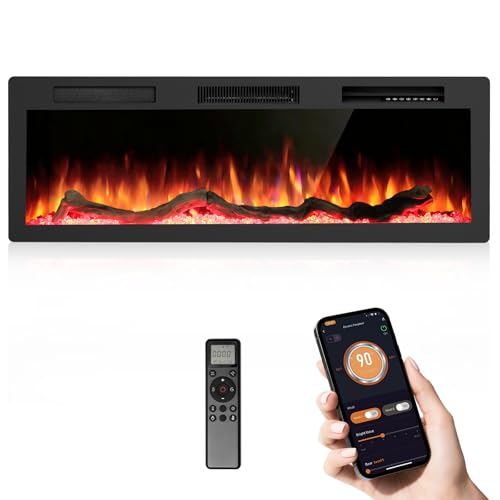
R.W.FLAME 50-Inch Electric Fireplace

Kozi Auger Cycle Timer Block
Best Aquarium Heater For 100 Gallon Tank

The best aquarium heater for 100 gallon tank is a new 500W submersible heater with an external temperature controller, over-temperature protection and automatic shutoff. That combination gives you a sensible starting point for a large tank while keeping the thermostat outside the wet heating element, where you can read and adjust it more easily.
The best aquarium heater large tanks can use isn’t automatically the heater with the biggest number on the box. A 500W model is often easier to control steadily, while an 800W unit may restore temperature faster after a water change. Faster recovery helps only when the temperature probe reads accurately and the filter or circulation pump mixes warm and cool water throughout the aquarium.
| Choice | Where it makes sense | What to watch |
|---|---|---|
| 500W submersible | Most 100-gallon setups with ordinary room temperatures | Recovery depends on circulation and the room’s coldest temperature |
| 800W submersible | A tank that needs quicker recovery after maintenance | A powerful element can overshoot if the thermostat or probe is inaccurate |
| External controller | Any setup where stable temperature matters | Place the probe where it measures representative tank water, not a warm stream beside the heater |
For a large aquarium, reliability beats a bargain and control beats raw wattage. If your setup runs unusually cold or loses heat quickly, the next section’s wattage comparison will show when stepping above 500W makes sense.
Choose Wattage That Matches Your Room
For a 100-gallon aquarium, choose wattage based on room temperature and heat loss, not the biggest number on the box. A well-designed 500W heater can control temperature better than a poorly made 800W heater if its element, sensor and water circulation work together.
How fast does each heater warm a 100-gallon tank? In an ideal calculation, 500W adds about 2°F per hour to 100 gallons, while 800W adds about 3.3°F per hour. Real tanks warm more slowly because the glass, open top, stand and room pull heat away, and the thermostat turns the element off near the set temperature.
Cold rooms, open stands and uninsulated fish rooms push you toward more wattage or two heaters because the tank loses heat continuously. A small, warm room lets a lower-wattage heater cycle less often instead of fighting a cold draft. Water movement matters too; a heater hidden in a stagnant corner can leave the probe reading warmer water than the fish are actually swimming through.
Two smaller heaters are the better choice when you want redundancy and smaller temperature swings, especially in a long tank. Splitting the load between two 250W heaters, for example, lets one maintain some heat if the other fails, while each element cycles with less force. Use separate outlets or controllers only if your equipment and circuit can support them, and keep both heaters fully submerged as their manuals require.
The common question about a 100 gallon electric water heater usually means a household hot-water tank, not an aquarium heater. That appliance stores domestic hot water and belongs in a plumbing plan; it isn’t a safe substitute for a submersible aquarium heater. A 100 gallon tankless water heater is a different appliance again: it heats water as it flows for a house, so its flow rate and installation requirements have nothing to do with warming aquarium water.
| Heater | Watts | Per hour | Per day (8 h) | Per month (1 days) |
|---|---|---|---|---|
| 500W aquarium heater | 500 W | 8.5¢ | 68¢ | 68¢ |
Check Accuracy And Safety Before You Buy
A good aquarium heater should hold a steady setpoint because its digital thermostat, temperature probe, and external controller can correct small changes before your fish feel them. In real use, temperature accuracy depends on probe placement, water circulation, calibration, and the thermometer you use to check it; a display alone isn’t proof of accuracy.
| Feature | What it does | What to check |
|---|---|---|
| Digital thermostat | Turns heat on and off around your chosen temperature. | The setting is adjustable and easy to read. |
| Temperature probe | Measures water temperature away from the heating tube. | The probe stays submerged and can be positioned where water circulates. |
| Temperature memory function | Restores or retains your preferred setting after a power interruption. | The heater doesn’t reset to an unsafe default. |
| Over-temperature protection | Stops heating if the water rises beyond the safe control limit. | Look for a listed limit, alarm, or fault indicator. |
| Automatic shutoff | Stops the element when the heater is out of water or detects a fault. | Prefer a model with out-of-water protection and a visible alarm. |
An external temperature controller improves stability by separating the measuring and switching job from the heating tube. The controller reads the temperature probe, cuts power when the setpoint is reached, and can trigger an alarm or automatic shutoff if the water gets too hot. That gives you a second control point instead of trusting one small thermostat sealed beside the element.
For a useful accuracy check, compare the heater display with a trusted aquarium thermometer after the tank has circulated and settled. A difference that keeps growing is a fault sign; a small, steady difference may be a calibration or probe-placement issue. SEAOURA lists ±0.1°F accuracy on its heater, but that figure describes the product specification, not a guarantee that every installed tank will measure that closely.
Quartz heating tubes and nickel-chromium heating wire are worthwhile construction details because quartz tolerates heat and transfers it evenly, while nickel-chromium wire is commonly used for durable resistance heating. A protective cover also keeps fish from contacting the hot tube; the HITOP PTC Heater pairs that cover with a digital controller. No element survives being run dry forever, so out-of-water shutoff still matters.
Saltwater tanks need the same control quality as freshwater tanks, but corrosion resistance and build quality matter more because salt reaches weak seals, exposed metal, and poor connections quickly. Choose a submersible aquarium heater made for continuous immersion, inspect the cable and seals, and keep salt creep away from the electrical connection. A heater marketed for freshwater alone shouldn’t get a free pass in a reef tank.
Install And Maintain It So The Fish Stay Calm
An external temperature controller improves stability by measuring the water with a separate probe and cutting power before the heater overshoots its setpoint. Put the submersible aquarium heater near strong flow, usually close to the filter return, so warmed water spreads through the tank instead of forming a hot pocket around the element.
Check the heater’s display with a separate thermometer. A tidy digital readout can still be optimistic, while an external controller gives you another temperature reading and a second cutoff. Frequent swings stress fish more than a slow, steady setpoint, so stable control matters more than bright LEDs or a temperature memory function.
Buying a used aquarium heater is a gamble I’d skip for a 100-gallon tank. Wear can leave the thermostat inaccurate or the heating element unreliable, and you usually lose the protection of a new-product warranty; a replacement after a failure costs less than explaining a sudden temperature crash to your fish.
A heater affects electricity use according to its wattage and how long it actually runs. A 500W model draws 0.5 kWh for each hour it heats continuously, so eight uninterrupted hours would use 4 kWh; the thermostat usually cycles off, and insulation, room temperature, tank cover and water movement determine how close your real use gets to that maximum.
Run The Numbers Before You Order
There isn’t a dependable average lifespan for aquarium heaters; heat cycles, saltwater exposure, glass damage and thermostat wear vary too much, so a new heater with a stated warranty beats a used one with an unknown history. Used units can look fine while the temperature control is already drifting.
Two smaller heaters can replace one large heater and reduce a single-point failure. For example, two 250W heaters provide 500W of possible output; if one stops working, the other can still slow heat loss until you replace it. Use an external temperature controller and check the tank against a separate thermometer, since backup hardware doesn’t help if both controls read incorrectly.
| Model | Warranty term to verify | What matters before ordering |
|---|---|---|
| HiTauing Aquarium Heater | Not stated in the available product data | Confirm the seller’s written coverage and replacement process. |
| SEAOURA Aquarium Heater | Not stated in the available product data | Check coverage length, exclusions and temperature-control support. |
| hygger Aquarium Heater | Not stated in the available product data | Verify the exact model’s warranty rather than assuming every version matches. |
| HITOP Aquarium PTC Heater | Not stated in the available product data | Confirm warranty coverage and how quickly a failed unit can be replaced. |
A warranty matters less than getting a replacement quickly and being able to check the controller against a separate thermometer. Keep the receipt, record the model number, and don’t wait for fish behavior to reveal a temperature problem.
Electricity use scales with wattage and runtime, but a heater only draws full power until the tank reaches its set temperature; after that, the thermostat cycles power as the water loses heat. The cost block below shows a deliberately simple full-power comparison at $0.17 per kWh, 8 hours per day, and 30 days.
| Heater | Watts | Per hour | Per day (8 h) | Per month (30 days) |
|---|---|---|---|---|
| One 500W heater | 500 W | 8.5¢ | 68¢ | $20.40 |
| One 800W heater | 800 W | 14¢ | $1.09 | $32.64 |
| Two 250W heaters | 500 W | 8.5¢ | 68¢ | $20.40 |