Buy Product 1 for quiet, adjustable supplemental heat in a bedroom, office, or small indoor room. Its thermostat, 34dB claim, timer, and safety shutoffs are useful, but they don’t make it suitable for damp rooms, extension cords, whole-house heating, or unattended overnight use.
Buy it if
Buy it if you want controlled spot heat and can supervise where it runs.
Skip it if
Skip it if you need garage or bathroom heat, whole-house output, or a heater you can safely leave running while asleep.
Best for Quiet Control
DREO 1500W PTC Space Heater
Best for Bedrooms, offices, and small indoor rooms needing supplemental heat
Product 1 combines 1500W PTC ceramic heat with a thermostat adjustable from 41–95°F in 1°F steps. Its 34dB noise claim, remote, 12-hour timer, and fan-only mode suit short, controlled runs in a bedroom or office. Tip-over and overheat protection add useful safeguards, but this is still supplemental heat—not a whole-house heater.
Power 1500WThermostat range 41–95°F, in 1°F incrementsClaimed noise level 34dBTimer 12 hoursHeating system PTC ceramicModes 5
Why it made the cut
41–95°F thermostat with 1°F adjustments
34dB claimed noise level
12-hour timer and remote control
Tip-over and overheat protection
Good to know
Not for wet or high-moisture areas
1500W output suits supplemental heat, not whole-house heating
Shouldn’t be left running unattended overnight
Skip it if Skip it if you need whole-house heat, wet-area use, or overnight unattended operation.
Half of the belief here is true: a small heater can feel expensive to run if you try to heat the whole house with it. The other half is wrong, because a 1,500W unit can still be a sensible way to warm one room for a few hours at a time.
That is the frame for this DREO. It is a plug-in indoor heater with a wide thermostat range, remote control, fan-only mode, and safety features aimed at bedrooms and offices, not damp rooms or all-night, leave-the-house heating.
The Specs
Power
1500W
Thermostat range
41–95°F, in 1°F increments
Claimed noise level
34dB
Timer
12 hours
Heating system
PTC ceramic
Modes
5
Aquarium Heater 5 Gallon
An aquarium heater 5 gallon search leads to the wrong product here: this is a DREO room space heater, not a heater for a fish tank. Don’t put it in or beside aquarium water. If you meant a digital aquarium heater, you need a device designed to control water temperature; the DREO thermostat measures and adjusts room air instead.
For this DREO, think small, dry indoor room—not tank size. It belongs on a wall outlet, with 3 feet of clearance around it, and it must stay out of wet areas. A digital thermostat can help hold a chosen temperature, but it can’t keep aquarium water stable when it’s controlling the air in your room.
Keep It Out Of The Tank
This is an electric room heater, not a submersible aquarium device. Keep it away from water and use it only as the manufacturer directs; never try to adapt it for tank heating.
Space Heater Checks
UL, ETL or CSA listing
Tip-over shutoff
Overheat shutoff
Plug directly into a wall outlet
No extension cord or power strip
If You Meant A Tank Heater
Choose aquarium equipment sized and listed for your tank and its water volume. For a 5-gallon tank, see affordable aquarium heaters that keep water stable; for digital controls, compare digital aquarium heaters. A search for the best aquarium heater for large tanks calls for a different size and product category altogether.
What The DREO Does Well
The DREO’s appeal is controlled supplemental heat: a 1,500W PTC ceramic heater, a thermostat adjustable from 41–95°F in 1°F steps, and convenience features aimed at a bedroom or office. Those settings let you make small adjustments instead of choosing between a room that feels too cool and one that gets too warm.
Its heat funnel design is meant to direct warmth outward. DREO claims warmer air reaches farther than with a traditional heater; treat that as a manufacturer claim, not a guarantee that one portable unit will heat every corner of a room evenly.
1,500 W
About 12.5 A at 120 V
That’s near the practical limit for a plug-in heater on a standard 15 A, 120 V circuit. Avoid running other high-draw appliances on the same circuit while the heater is operating.
DREO claims a 34dB operating level and uses a brushless DC motor. The 12-hour timer, remote and five modes give you ways to adjust or schedule a run without walking over to the heater—useful in a bedroom or office, though the noise figure is a product claim rather than a promise of silence.
A digital aquarium heater also uses a thermostat, but it controls water temperature; this DREO controls room air. Searches for compact aquarium heater life time need aquarium-specific product information, not a lifespan estimate for this space heater.
Feature
What it offers
Thermostat
41–95°F range in 1°F steps
Motor and noise
Brushless DC motor; 34dB claim
Controls
Remote and five modes
Timer
Up to 12 hours
Heating
1,500W PTC ceramic element and heat funnel design
Specifications and claims describe this model; room results depend on the space and conditions.
Limits And Trade-Offs
The DREO is a supplemental heater for a small indoor room, not a fix for a large open room, garage, or whole house. And despite the search wording, it isn’t an aquarium heater: aquarium heater life span depends on the tank equipment and use, and the best aquarium heater for a large tank must be sized for that tank—not chosen from this room-heater review.
For a fish tank, start with a purpose-built aquarium model and match its capacity to the tank; a room heater must never go in or near aquarium water. You can compare options in our guides to the best aquarium heater and the best heater for an aquarium.
ECO, fan-only, and low-noise settings don’t change the electrical ceiling. At 1,500 W, the heater draws about 12.5 A on a 120 V circuit, close to the practical top for a portable heater on a standard 15 A circuit. Don’t run another high-wattage appliance on that same circuit at the same time; if the breaker trips, reduce the load rather than repeatedly resetting it.
Myth
A quiet heater must put out less heat.
Fact
Noise and heat output are separate things. The DREO’s 34 dB claim describes sound, not a lower maximum output: at full power, it can still draw 1,500 W. A quiet fan doesn’t make a room heat faster or extend the heater’s electrical limit.
Like other fan heaters, it warms the area the airflow reaches. Some fan noise remains, and furniture or curtains can block the path in front of the unit. A thermostat can reduce cycling once the air near the heater reaches its setpoint, but it can’t spread heat evenly through a large, open space.
Good for
Supplemental heat in a small indoor room
A clear floor spot where its airflow can reach you
Not for
Whole-house heating or large open spaces
Use where a fan sound or localized warmth is a poor fit
Keep The Room In Mind
A 1,500 W plug-in heater is near the practical limit for a 15 A, 120 V circuit. Use a wall outlet, not an extension cord or power strip, and leave the required clearance around the unit; the safety section covers placement and protections.
What It Costs To Run
A digital aquarium heater is a different product from the DREO, and the best aquarium heater for a large tank depends on tank size and the heater’s rating. For this room heater, the useful cost figure is its electrical draw: at full power, 1,500 W costs about $2.04 for eight hours at 17 cents per kWh.
The arithmetic is straightforward: 1,500 W is 1.5 kW; 1.5 × 8 = 12 kWh per day; at 17 cents per kWh, that’s about $2.04 a day, or $61.20 a month if it ran that long at full power. The monthly estimate assumes 30 days and eight hours of continuous full-power use each day.
Heater
Watts
Per hour
Per day (8 h)
Per month (30 days)
DREO Space Heater at full power
1,500 W
26¢
$2.04
$61.20
Calculated at 17¢ per kWh. Estimate assumes eight hours daily at full power and electricity at $0.17 per kWh.
Full Power Is A Ceiling
The thermostat cycles the heating element off when the room reaches its setpoint, so real use often costs less than the full-load estimate. Actual savings depend on the room and how long the heater runs; the thermostat doesn’t guarantee a particular bill.
A tighter room, a lower setpoint, or fewer hours of operation cuts consumption more directly than choosing a fancy mode. If you want to lower the bill, reduce run time or heat only the room you’re using; ECO mode can manage operation, but it can’t make 1,500 W of active heating draw less than 1,500 W.
Safety Features That Matter
The DREO’s useful safety features are tilt detection, overheat protection, and V-0 flame-retardant materials, but they don’t replace careful placement. If you searched “free sea aquarium heater E1 code” or “free sea aquarium heater E1 code YouTube,” you’re looking at a different product family: E1 usually points to a sensor or control fault on an aquarium heater. That code isn’t relevant to this DREO room-heater review; use the DREO manual for any code its display shows.
Tilt detection can shut the heater down if it gets knocked over, while overheat protection cuts power when internal temperatures rise too far. V-0 flame-retardant material helps resist ignition around the heater’s housing. Those are backup layers, not permission to cover the grille, place the unit on bedding, or leave it running while nobody is home.
Before You Turn It On
Set the heater on a level, hard surface where it cannot be tipped.
Keep at least 3 feet of open space around the heater, including curtains, bedding, paper and furniture.
Plug it directly into a wall outlet; check that the plug and outlet are clean and undamaged.
Confirm the air intake and outlet are clear before selecting a heat setting.
Keep the heater dry and away from sinks, tubs and other wet areas.
Skip The Extension Cord
Never run the DREO through an extension cord, power strip or surge protector. A 1,500W heater draws about 12.5 amps on a 120V circuit, enough to heat a weak connection or overload a cord. Use a properly grounded wall outlet, and stop if the plug, outlet or cord becomes hot.
A Safety Feature Has Limits
The tip-over switch and overheat protection can reduce one failure risk, but they can’t detect every unsafe condition. Don’t use the heater if it has been dropped, the cord is damaged, the outlet is loose, or the unit behaves strangely. Follow the manual’s timer and unattended-use instructions; unless it explicitly allows unattended operation, turn the heater off before leaving the room or going to sleep.
How It Stacks Up Against The Others
For the best aquarium heater for large tanks, compare aquarium-rated heaters by tank size and wattage; none of these three room heaters is suitable for a fish tank. The query “three letter word 1st class aquarium heaters heater universal” doesn’t identify a usable heater spec. If you meant an adjustable aquarium model, start with this best adjustable aquarium heater guide.
For room heat, the DREO is the better fit for a quiet bedroom or office, the Amazon Basics model keeps things basic, and the Dr. Infrared is built more like a larger-room portable heater. Their differences are mostly about controls, portability, and heater design—not a promise that one will heat every room better.
Heater
What stands out
Best fit
DREO Space Heater
41–95°F thermostat, 12-hour timer, remote control, and a 34dB quiet-operation claim
Quieter bedroom or office heat
Amazon Basics Ceramic Space Heater
High, Low, and Fan Only settings
A basic compact heater
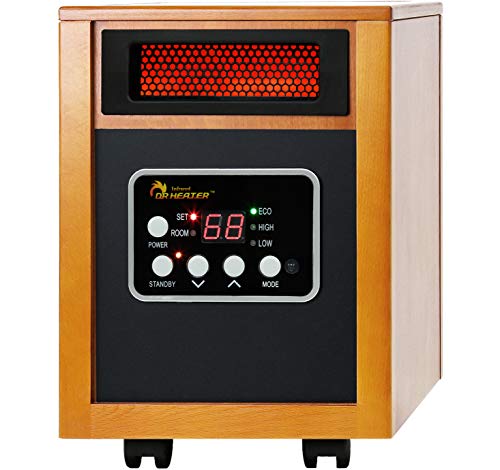
Dr Infrared Heater DR-968
Dual heating system, caster wheels, lifetime filter, and 50–85°F thermostat
A larger-feeling portable heater with a dual system
Compare the listed controls and design features; don’t treat the noise claim as a guarantee for every room or setting.
The DREO offers more control than the Amazon Basics heater: its thermostat covers a wider temperature range, and it adds a timer and remote. Amazon Basics is simpler, with three straightforward modes. Choose it if you want a compact heater without the extra controls; choose DREO if quieter operation and timed runs matter more.
The Dr. Infrared takes a different approach, pairing two heating systems with caster wheels and a lifetime filter. Its thermostat runs from 50–85°F, compared with the DREO’s 41–95°F range. The Dr. Infrared is heavier and feels more suited to moving around a larger room; skip it if you want a lighter bedroom heater with remote control and a longer timer.
Choose By Use
DREO: quiet bedroom or office use with more thermostat control.
Amazon Basics: simple High, Low, and Fan Only operation.
Dr. Infrared: caster wheels and a dual system for a larger-feeling portable heater.
Look Elsewhere If
DREO’s quiet-operation figure is a claim, not a guarantee of silence.
Amazon Basics has fewer controls than DREO.
Dr. Infrared is heavier and its thermostat range is narrower than DREO’s.
DREO Heater Alternatives
Simple Budget Alternative
Amazon Basics 1500W Ceramic Heater
Best for Small home or office spaces where compact size matters
Product 2 keeps the controls straightforward with High, Low, and Fan Only settings in a compact 3 lb body. Tip-over and overheat protection cover the basics, while its 43dB noise level is close to Product 1’s claim. The maker specifically says to avoid bathrooms, laundry rooms, and other high-moisture areas.
Why it made the cut
Compact 3 lb design
High, Low, and Fan Only settings
Good to know
Not for humid environments
Skip it if Skip it if you need a wider thermostat range, a remote, or a timer.
Best for Large rooms where infrared and PTC heating are useful
Product 3 pairs an infrared quartz tube with PTC heating and is rated around 5200 BTU, making it the stronger large-room alternative on this list. Caster wheels, a remote, and a 12-hour shut-off timer help with placement and control, though the 19 lb body is less convenient to carry.
Why it made the cut
Dual infrared quartz and PTC heating
Caster wheels, remote, and 12-hour shut-off timer
Good to know
Heavier at 19 lb
Skip it if Skip it if you want the lightest heater for carrying between rooms.
Can I use the heater in a bathroom or laundry room?
No—keep this heater out of bathrooms, laundry rooms, and other damp areas unless the manual for your exact unit specifically permits that use. Moisture and a portable electric heater make a poor combination, even when the heater has overheat protection.
How much does a 1,500W space heater cost to run for 8 hours?
At 17 cents per kWh, 1,500 W × 8 hours equals 12 kWh, or about $2.04 for one night. Running it 30 nights would be about $61.20, assuming it draws 1,500 W continuously.
Will the heater work on a standard 15-amp outlet?
Yes, a 1,500W heater draws about 12.5 amps from a 120V outlet, so a standard 15-amp circuit can supply it. Plug it directly into the wall and avoid running other high-wattage appliances on the same circuit.
Is a 34dB heater really quiet enough for a bedroom?
The claimed 34dB output is quiet enough for many bedrooms, though the fan will still be audible in a very quiet room. Use the thermostat or ECO mode to reduce runtime; low noise doesn’t make overnight operation safe unless the manual specifically allows it.
What does tip-over protection do on a portable heater?
Tip-over protection cuts power when the heater is knocked out of its upright position. It helps with an accidental bump, but you still need a stable floor, three feet of clearance, and a direct wall connection.
Which is better for a small room: Product 1, Product 2, or Product 3?
Product 1 is the strongest fit if you want the quietest claimed operation, finer 41–95°F temperature adjustment, and a remote. Product 2 is smaller and lighter but is explicitly unsuitable for humid rooms, while Product 3 offers a dual heating system and wheels but is heavier and claims 39dB operation.