For most people wanting an Alexa space heater, Product 1 (DREO Smart Wall Heater) gives the best mix of 1500 W wall-mounted heat, accurate thermostat control and built‑in Alexa voice commands, so your comfort zone space heater follows your routines instead of running flat out all night.
What to remember
Pick a heater with true thermostat and ECO mode, not just Alexa on/off, if you care about comfort and running cost.
Wall-mounted smart heaters suit bedrooms and home offices; portable towers are the best comfort portable heater style for flexible spot heat.
A 1,500 W electric heater draws about 12.5 A and suits roughly 150 sq ft of average space as supplemental heat.
Always plug space heaters directly into a wall outlet and look for UL/ETL listings, tip-over protection and overheat shutoff.
Use Alexa routines to preheat rooms for set times instead of leaving a heater running for hours in an empty space.
The big mistake with Alexa heaters is buying one that only turns fully on or off, so the room swings from chilly to stuffy while your bill quietly climbs.
You want a heater that actually holds a set temperature, fits the room, and still responds when you say, “Alexa, I’m cold,” and that’s how the picks and advice here are laid out.
The 5 Best Alexa-Friendly Space Heaters
#1Best overall pick
DREO Smart Wall Heater 1500W
Best for Wall-mounted Alexa control in bedrooms and comfort rooms
Product 1 is the sweet spot if you want a wall-mounted heater that actually ties into your Alexa routines instead of just running on high. You get 1500W PTC ceramic heat with 120° oscillation, so a small bedroom or office warms evenly instead of with one hot corner. The app, Alexa and Google Home support let you schedule and tweak temps remotely, and the thermostat adjusts in 1°F steps from 41 to 95°F for tight control. Auto-dimming and lower-noise operation make it especially friendly for night use in a bedroom or nursery corridor.
Type Wall-mounted PTC ceramic space heaterMax power 1500WOscillation 120° wide oscillationTemperature range 41–95°F with 1°F accuracyControl DREO app, remote, Alexa and Google Home
Why it made the cut
1500W PTC ceramic heater with fast, steady heating
Built-in Alexa and Google Home control plus DREO app and remote
120° wide oscillation for more even room coverage than fixed wall heaters
Thermostat adjustable from 41–95°F in 1°F increments for precise comfort
Wall-mount kit and drilling guide included for easier installation
Good to know
Wall mounting needed before you can use it in a room
Fixed location means you can’t roll it between rooms like a portable tower
Skip it if Skip Product 1 if you prefer a freestanding heater you can move between rooms without mounting it to a wall.
Best for IP24 wall heater with Alexa for up to 150 sq ft primary heat
Product 2 fits if you want Alexa control in a wall heater that can live in slightly tougher spots like a bathroom or busy office. Its PTC system and optimized airflow push warm air at 11.5 ft/s while staying around 28 dB, so you feel the heat without a roar. IP24 construction, flame-retardant materials and overheat protection give a sturdier, more sealed package, and ECO mode plus temperature calibration help you dial in real room temperature instead of guessing. It’s rated as a primary heat source for about 150 sq ft, or as a supplementary heater in spaces up to 750 sq ft.
Type Wall-mounted PTC heaterMax power —Airflow 11.5 ft/sNoise level 28 dB operationCoverage Primary 150 sq ft; supplemental up to 750 sq ftControl Alexa, DREO app and remote
Why it made the cut
PTC heating with 11.5 ft/s airflow for strong wall-mounted output
Works with Alexa, DREO app and remote for flexible smart control
IP24 rating and 5 VA flame-retardant materials for damp-prone areas
Quiet operation around 28 dB for bedrooms or offices
Coverage guidance: primary heat for 150 sq ft, supplemental up to 750 sq ft
Good to know
30° manual oscillation is limited compared to wider-sweeping towers
Wall mounting and fixed 70.8 inch power cord limit placement options
Skip it if Skip Product 2 if you want a portable heater you can move between several rooms instead of a fixed wall unit.
Best for Portable, very quiet heat with ECO mode in larger spaces
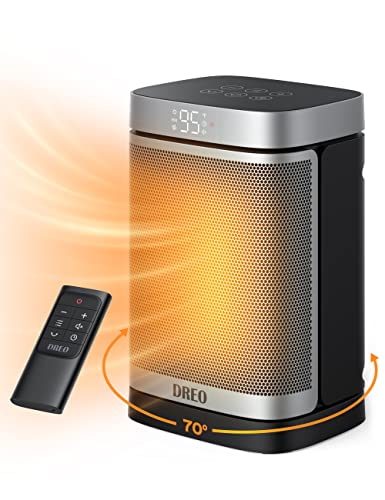
Product 3 is the workhorse if you care more about quiet, even heat than direct Alexa support. Its 1500W PTC ceramic core heats quickly, and the 70° oscillation with a trackball system is built for smooth motion and wide coverage in large rooms. Noise down around 34 dB keeps bedrooms, living rooms or home offices calmer, while ECO mode uses a precise temperature sensor to shift between 1000W and 1500W as needed. It’s also loaded with safety features, including V0 flame-retardant materials, tip-over and overheat protection and a 24-hour automatic power-off with no interaction.
Type Portable PTC ceramic space heaterMax power 1500WOscillation 70° wide-angle oscillationNoise level 34 dBSafety ETL-certified, tip-over and overheat protection, 24-hour aut
Why it made the cut
1500W PTC ceramic element for fast warm-up in bigger spaces
70° wide-angle oscillation with trackball system for uniform heating
Quiet operation around 34 dB, suitable for sleep and focused work
Smart ECO mode adjusts between 1000W and 1500W to hold set temperature
ETL-certified safety with tip-over and overheat protection
Good to know
No built-in Alexa or Wi-Fi control
Freestanding design takes floor space compared with a wall unit
Skip it if Skip Product 3 if direct Alexa voice control is a must-have instead of a nice-to-have.
Best for Fast personal heat in bedrooms, offices and small work areas
Product 4 makes sense if you want a small, quick-heating tower you can carry room to room. Its 1500W “Hyperamics” PTC element is tuned for fast warm-up, and 70° oscillation helps spread that heat around a bedroom, office, garage corner or basement nook. ECO mode with a digital thermostat from 41–95°F in 1°F steps lets you cap the temperature instead of blasting full power all day. The Shield360° safety system adds tip-over and overheat protection, an enhanced safety plug and UL94 V-0 flame-retardant materials, which is reassuring on a busy floor with pets or kids.
Type Portable PTC ceramic tower heaterMax power 1500WOscillation 70° wide-angle oscillationTemperature range 41–95°F thermostatNoise level As quiet as 37.5 dBSafety Shield360° with tip-over and overheat protection, UL94 V-0 m
Why it made the cut
Compact 1500W PTC heater with rapid heat-up
ECO mode and digital thermostat from 41–95°F in 1°F increments
70° oscillation for wider coverage than a fixed personal heater
Shield360° safety with tip-over, overheat protection and enhanced plug
Brushless DC motor and 9-blade fan for quieter airflow (~37.5 dB)
Good to know
No native Alexa, app or Wi-Fi control
Smaller tower footprint limits how much area it can realistically warm
Skip it if Skip Product 4 if you specifically want an Alexa-connected heater you can tie into voice commands and schedules without a smart plug.
Best for Quiet, furniture-style infrared heat in large living areas
Product 5 is the big-room option if you’re less worried about Alexa and more about heating a lot of space in a box that looks like furniture. Its 1500W dual heating system (infrared quartz plus PTC) is rated to heat up to 1000 sq ft and claims up to 5,200 BTU output, helped by a high-velocity low-noise blower. The cabinet stays cool to the touch, and safety is handled with tip-over and overheat protection, automatic shutoff and a UL-certified, PTFE-free design. You set 50–85°F on the electronic thermostat and adjust it from across the room with the infrared remote, then use the 12-hour timer to match your day.
Type Portable infrared + PTC space heaterMax power 1500WHeating output Up to 5,200 BTUCoverage Heats spaces up to 1000 sq ftNoise level 39 dB blowerThermostat range 50–85°F, electronic control
Why it made the cut
Dual infrared quartz + PTC heating for stronger, sun-like warmth
Rated to heat spaces up to 1000 sq ft with up to 5,200 BTU output
Quiet 39 dB blower suitable for living rooms and bedrooms
Electronic thermostat adjustable from 50–85°F with remote control
Tip-over and overheat protection, automatic shutoff and UL certified
Good to know
No Alexa or app connectivity; remote only
Box-style cabinet takes more floor space than a slim tower or wall unit
Skip it if Skip Product 5 if you need built-in Alexa control and tight smart-home integration instead of a standalone large-room heater.
Top Alexa Space Heaters: How to Choose the Right One
The right Alexa space heater is the one that quietly keeps your favorite spot at a steady temperature, not just a box you can shout “on” at.
When people say comfort zone space heater, they usually mean a heater that keeps the area around your bed, desk or sofa at a stable, comfortable temperature while the rest of the house runs cooler. For that, the best comfort portable heater is one you can park a few feet away, set to a specific temperature, and forget about while it quietly maintains that little bubble of warmth.
There are two kinds of “Alexa” heaters. Models like the DREO Smart Wall Heater have built‑in WiFi and Alexa support, so you can set the exact temperature, mode and schedule from an app or by voice. Simpler heaters only have a manual knob or buttons; you can plug them into a smart plug, but that plug can only turn power on and off and has no idea what the heater itself is doing.
Myth
Any space heater plus a smart plug is the same as a real Alexa heater.
Fact
A generic smart plug can only cut and restore power, and many heaters won’t even restart when power comes back. A true Alexa-enabled heater has WiFi, its own app, a thermostat and built‑in safety logic, so when you say “set to 68” it adjusts output, fan speed and ECO mode instead of simply blasting high until you remember to shut it off. Section 4 goes deeper into why most smart plugs are a poor match for 1,500 W heaters.
For comfort and bills, a good thermostat matters more than voice control. Look for digital controls that let you set the room in 1°F (or 1°C) steps, say 67, 68, 69°F, instead of a vague dial between “low” and “high”. An ECO mode watches the room temperature and automatically drops to a lower wattage or cycles the heater off once you’re close to your setpoint, then bumps heat back up only as needed. That keeps a bedroom around 68°F instead of swinging between chilly and sauna every 20 minutes.
Alexa is the helper, the thermostat is the boss
Pick the thermostat and ECO features you’re happy to live with first, then decide if you want Alexa and app control on top. Voice on/off without accurate temperature control just makes it easier to waste power.
Most specs pages look busy, but a few lines tell you almost everything. A plug‑in space heater on a standard 120 V outlet realistically tops out at 1,500 W, which is about 12.5 A and roughly 5,100 BTU/hour of heat output. That’s enough for a typical bedroom or small living room with decent insulation, but it won’t rescue a drafty garage. Oscillation matters too: a tower heater that sweeps 60–90° spreads that 1,500 W around the room so you don’t get a hot face and cold feet.
Type
Best Use
Pros
Trade‑offs
Wall-mounted smart heater (like the DREO Smart Wall Heater models)
Fixed comfort zones in bedrooms, offices and nurseries
Off the floor, out of the way; clean look; great for kids and pets; usually better thermostats and app control
Takes a permanent spot on the wall; not great if you like to rearrange; you’ll heat that same area every time
Portable tower or cabinet heater (like DREO towers or the Dr Infrared Heater DR-968)
Flexible comfort zones in rentals, home offices and living rooms
Easy to move between rooms; no installation; good if you only need heat where you are
Takes floor space and needs 3 ft clearance; easier to bump; comfort depends more on where you park it
Wall-mounted smart heaters suit fixed comfort zones; portable heaters suit people who move around.
Wall-mounted smart heaters such as the DREO Smart Wall Heater units make sense if you know exactly where you get cold: the bed in a small bedroom, the desk in a home office, the reading chair in a nursery. They screw to the wall, stay out of leg traffic and keep cords away from pets and kids, while Alexa and the app handle schedules and temperature changes. Once they’re up, that spot is your dedicated warm zone every day.
Portable towers and cabinet heaters, including models like the DREO Space Heater towers and the Dr Infrared Heater DR-968, are better if your “cold spot” moves around. You can roll or carry one from office to living room, keep it three feet from anything that can burn, and plug it straight into a wall outlet—no power strips or extension cords. A wide, heavy base or solid cabinet helps keep it upright if someone brushes past in a dark room.
For a smart home, the best comfort portable heater has a stable base, a quiet DC motor or low‑noise fan, wide oscillation and a physical remote. The quiet motor keeps it from sounding like a hair dryer at 2 a.m., wide oscillation evens out the room, and the remote covers the moments you don’t want to talk to Alexa or reach for your phone. Some heaters in this list add full app and Alexa control; others stay deliberately simple for people who want solid temperature control without another WiFi device broadcasting from the bedroom.
Quick checks before you pick
Decide your comfort zone: one fixed spot (wall-mounted) or a heater you’ll move around (portable).
Check the wattage: 1,500 W max on a standard 120 V outlet, with a lower setting around 750 W for milder days.
Look for a digital thermostat with 1°F increments and an ECO mode, not just “High/Low” buttons.
Choose control style: built-in Alexa/app control, or a simpler manual/remote model if you’re avoiding more WiFi gear.
Make sure the heater oscillates if it’s serving more than one person or a wider area in the room.
Confirm safety basics: tip‑over shutoff on portables, cool-touch housing where kids or pets roam, and direct plug into a wall outlet.
From HeaterGuides · our own guidePage 6: heat only the rooms you use. Page 10 covers space-heater safety.Winter Heating Bill CutterSee what every heater in your home really costs, heat the rooms you use, and cut the waste in 30 days.Cost-per-hour tables for every heaterThermostat schedule and draft-proofing planRunning-cost and bill calculator (Excel)$14.99$9.99Get it for $9.99See what's inside and watch the 2-minute video →14-page printable PDF + Excel calculator · instant download · 30-day refund
Electric Heater for Comfort Rooms: Size and Placement
An electric heater for comfort rooms needs to be matched to the room size first, then set where its heat can spread without blocking airflow or creating hazards.
Most plug-in space heaters are 1,500 W. On a standard 120 V outlet that’s about 1,500 ÷ 120 ≈ 12.5 A, already close to the 15 A rating of a typical household circuit. Because continuous loads are usually kept to about 80% of a circuit (around 12 A on a 15 A breaker), one 1,500 W heater can be the only big draw on that branch without tripping breakers or warming outlets.
Sizing is easier if you start with a simple rule of thumb—about 10 W of heater power per square foot for reasonably insulated rooms, then adjust up a bit for drafts, big windows or very high ceilings.
Worked example
Take a 12 × 12 ft bedroom. The area is 12 × 12 = 144 sq ft. Using 10 W per sq ft, you get 144 × 10 = 1,440 W. That lines up almost perfectly with a single 1,500 W heater such as the DREO Smart Wall Heater, so one unit can comfortably top up the main heat without overloading the circuit.
Room12 × 12 ft bedroom
Area144 sq ft
Rule-of-thumb watts≈1,440 W
HeaterOne 1,500 W unit
Now compare that to a 15 × 20 ft living room. The area is 15 × 20 = 300 sq ft. At 10 W per sq ft, you’d want about 3,000 W of electric heat for full coverage. That usually means two 1,500 W heaters on separate circuits, or one heater like the Dr Infrared Heater DR-968 as a comfort boost while the furnace does the heavy lifting. If a breaker trips or a plug feels hot, you’re asking too much of that circuit and should stop using that outlet for the heater.
Room Type
Size (ft)
Area (sq ft)
Rule-of-Thumb Watts
Typical Heater Setup
Small office
10 × 10
100
≈1,000 W
One 1,000–1,500 W heater
Bedroom
12 × 12
144
≈1,440 W
One 1,500 W heater
Living room
15 × 20
300
≈3,000 W
Two 1,500 W heaters on separate circuits, plus main heat
Use 10 W per sq ft as a starting point, then adjust for drafts and ceiling height.
Wall-mounted heaters make the most sense in smaller, defined comfort rooms like bedrooms and home offices. A unit such as the DREO Smart Wall Heater or DREO Smart Electric Wall Heater on an interior wall keeps the floor clear, can’t be kicked over, and throws heat steadily across the occupied area. Portable towers like the DREO Space Heaters for Indoor Use with Thermostat, 1500W are better for larger living rooms where you might want to roll the heat toward the sofa one evening and the dining table the next. Once you know your wattage target, the alexa-enabled space heaters guide helps match the style to your room layout.
Placement matters almost as much as size. Keep at least 3 ft of clear space in front of the heater, avoid tight corners that trap hot air, and don’t park it under a desk where your legs and a tangle of cables block the airflow. Aim it across the room, not straight into bedding, curtains or furniture; fabric close to the grille can overheat even on a modern unit.
Cords deserve planning too. Plug the heater directly into a wall outlet (no extension cords or power strips), then run the cord along a wall instead of across a walkway. Use low-profile cord clips on the baseboard or the back of a nightstand to take up slack so nobody can snag it and yank the heater over. Avoid burying the plug or cord under thick rugs, which can hide damage and trap heat around the connection.
Watch the circuit, not just the room
If you decide a big living room needs two 1,500 W heaters, they can’t usually share one 15 A circuit. Spreading them across different outlets that land on different breakers, or combining one space heater with your main heating system, is safer and far less likely to trip power in the middle of a cold night.
Running Costs of Alexa Space Heaters
Running an Alexa space heater costs the same as any other 1,500 W electric heater; the savings come from how many hours the thermostat and your routines let it stay off.
The basic math looks like this: cost = (watts ÷ 1,000) × hours × electricity rate. For a 1,500 W heater used 8 hours a night at $0.17 per kWh, that’s 1,500 ÷ 1,000 = 1.5 kW; 1.5 × 8 = 12 kWh per night. At 17 cents per kWh, 12 × $0.17 is about $2 for an evening, and over 30 nights that’s roughly 360 kWh and a bit over $60 on the bill if it ran full power the whole time.
Heater
Watts
Per hour
Per day (8 h)
Per month (30 days)
1,500 W space heater
1,500 W
26¢
$2.04
$61.20
Heated blanket
100 W
1.7¢
14¢
$4.08
Calculated at 17¢ per kWh. What the numbers mean for the reader.
The cost block shows how a 1,500 W heater compares with a 100 W heated blanket if both run 8 hours a day for a month at the same power price. The heater warms the whole room, but it draws about fifteen times more power than the blanket. For long evenings parked on the sofa or in bed, a low-wattage option can keep you comfortable for a fraction of the cost of heating the entire space.
Smart thermostats and ECO modes in heaters like the DREO units help by cycling power. Instead of blasting 1,500 W nonstop, they turn on to reach your set temperature, then coast for a while before firing again. If the average duty cycle over an 8‑hour night is 50%, you effectively used 1.5 kW × 4 = 6 kWh instead of 12, cutting that part of the bill roughly in half while the room still feels steady.
Alexa routines trim waste even further. You can tell an Alexa-enabled heater to preheat a home office 30–60 minutes before you start work, then drop back or shut off automatically at lunchtime and again in the evening. That’s very different from flipping a manual heater on at 7 a.m. and noticing at 3 p.m. that it has run full power all day.
Mounting style doesn’t change electricity use. A wall-mounted DREO Smart Wall Heater at 1,500 W and a 1,500 W portable tower like the DREO Space Heater, Portable Electric Heaters for Indoor Use cost the same to operate at the same settings; what matters is how warm the room’s insulation allows them to get and how many hours they spend at full draw versus idling.
It’s also worth comparing spot heating to nudging the whole-house thermostat. If you’re alone in a small office or bedroom, turning the central heat down a few degrees and using a space heater there often wins. If the whole family is spread across the house, raising the furnace thermostat slightly may cost less than running several plug-in heaters. Looking at a recent bill and your actual room-by-room habits will tell you which side of that line you’re on.
Smart or dumb, watts are watts
Electric resistance heat costs the same per kWh regardless of the brand or smart features. Alexa control makes it easier to avoid running a heater when you don’t need it, but a 1,500 W model without WiFi from a space heater buying guide will have essentially the same running cost as a 1,500 W Alexa heater if both are left on for the same hours.
Safety, Certifications and Smart Plug Myths
Smart-controlled space heaters stay safe only if you treat them like any other high-draw appliance and respect their limits, no matter how clever the app looks.
Wall outlet only
Plug any 1,500 W space heater directly into a wall outlet, never into a basic extension cord, power strip or cheap smart plug. A 1,500 W heater on a 120 V circuit draws about 1,500 ÷ 120 ≈ 12.5 A; many cords, strips and smart plugs are not designed for that much continuous current and can overheat or fail.
Certification marks are your first safety filter. Look for UL, ETL or CSA on the heater and in the manual; those logos mean the unit was independently tested for electrical safety, insulation, tip-over and overheat behavior, instead of just being self-declared “safe” by the maker.
Modern heaters usually add layers of protection: a tip-over switch that cuts power if the unit is knocked over, an overheat sensor that shuts it down if internal parts get too hot, flame-retardant housing materials and, on better designs, cool-touch exteriors so a brief bump doesn’t burn skin. Those features matter most in bedrooms, kids’ rooms and anywhere a groggy person might reach out in the dark.
Before trusting smart control
Confirm the heater has UL, ETL or CSA marking on the label or in the manual.
Verify the heater’s wattage (often 1,500 W) is within the rating printed on the outlet’s circuit and avoid using other big loads on the same circuit.
Test the tip-over shutoff by gently tipping a portable unit on a clear floor while you’re standing by.
Let the heater run for 15–20 minutes, then feel the plug and outlet; they should be warm at most, never hot.
Mount wall heaters like the DREO Smart Wall Heater exactly as the template shows, into solid structure, with the cord and grille clear of curtains and furniture.
Keep at least 3 feet of space in front of the heater and away from bedding, toys and laundry piles.
Myth
Any comfort zone space heater can be made “smart” just by plugging it into a random WiFi smart plug.
Fact
Generic smart plugs are often rated for lighter loads and short duty cycles, not for a 1,500 W heater running for hours. Pushing 12.5 A through a plug that was tested for, say, 10 A can make the plug, outlet or wiring run hot. A heater that already has built-in WiFi and Alexa, or a manufacturer-approved control module, is designed around that load; a bargain smart plug usually is not.
Alexa routines don’t override the manual’s safety rules. If the instructions say “do not leave the heater running unattended” or warn against overnight use, treat that as a hard line and adjust your routines so the heater shuts off before you leave or go to sleep, instead of trying to outsmart the warnings.
Wall-mounted designs add a safety edge by taking the heater off the floor: there’s no tipping hazard, the cord runs high on the wall where kids and pets are less likely to tug it, and the unit is less likely to end up buried in laundry. Many wall units, including models like the DREO Smart Electric Wall Heater for Indoor Use, Works with…, also use enclosed housings that are better suited to splash-prone spots such as bathrooms or laundry areas, but only install them there if the manual explicitly allows it and keep them outside direct splash zones.
One Thing Most Buyers Forget About Smart Heaters
Comfort with a smart heater depends as much on noise, lights and backup controls as it does on WiFi and Alexa tricks.
Network-controlled heat is great until the router reboots or the app has a bad day, so the heater still needs clear onboard controls you can work half-asleep. Look for simple buttons or a dial for temperature and mode so you can walk up to a unit like the tower-style DREO Space Heaters for Indoor Use with Thermostat, 1500W El… and set it without hunting for your phone or a QR code.
Test every way to control it
On day one, have each person in the home try changing the temperature and turning the heater on and off using voice, the app, the remote (if it has one) and the front panel. That quick test flushes out any pairing glitches and makes sure nobody has to shout across the room at Alexa at midnight just to knock the heat down a notch.
Light and sound matter most in bedrooms. A bright blue display or status LED can light up a dark room, and a fan-driven unit like the Dr Infrared Heater DR-968 Portable Space Heater will always have some airflow noise, which some people find soothing and others find distracting; in a living room that hum disappears into background noise, but in a quiet bedroom you may prefer the lowest fan setting or a different room for the heater.
2.4 GHz
WiFi band most smart heaters use
Most smart plugs and heaters connect only on 2.4 GHz, which travels farther through walls than 5 GHz but still weakens with distance and obstructions.
Signal strength at the heater’s spot decides how reliable your Alexa routines feel. Before you mount a wall unit at the far end of the house, stand there with your phone on the same WiFi network and check the bars or run a quick speed test; if the signal is flaky, moving the router a few feet or adding a basic extender often helps more than fighting disconnects all winter.
Smart routines earn their keep when they match how you actually use the room: for example, a “Workday Office” routine that warms the home office from 7–9 a.m. and 1–3 p.m., then turns the heater off, or a “Goodnight” scene that drops the bedroom by a couple of degrees once you’re under the covers so it isn’t wasting power on an empty room.
If you’d like more choices in smaller formats or for secondary rooms, compare other alexa-enabled space heaters once you’re clear on how WiFi reliability, controls, noise and light will feel in daily use; the specs sheet rarely mentions those, but your comfort will.
Questions People Ask
Can I use an Alexa smart plug with a non‑WiFi space heater?
Using an Alexa smart plug with a basic space heater is only acceptable if the heater’s manual does not forbid timers or remote switches and the plug is properly rated. The smart plug must be rated for at least 15 A and 1,800 W on a resistive load, and the heater needs a simple mechanical on/off knob that stays “on” when power comes back. Digital heaters that forget their settings after a power cut or say “do not use with extension cords, power strips or timers” should never be put on a smart plug. Even in the allowed cases, plug straight into a wall outlet and treat the combo as something you only run while you are nearby and awake.
Are Alexa space heaters safe to run overnight in a bedroom?
Most Alexa space heaters are only safe for overnight bedroom use if the manufacturer explicitly says they are designed for unattended operation. For that job you want a UL, ETL or CSA listing, a real thermostat, overheat protection and, if it is portable, a tip‑over switch, plus three feet of clear space around the heater. Plug it directly into a wall outlet, never a power strip or extension cord, and avoid stacking clothes or bedding nearby. Many people set an Alexa routine to drop the setpoint or turn the heater off an hour before wake‑up so the room does not get too warm while they sleep.
How many square feet can a 1,500 W Alexa space heater comfortably warm?
A 1,500 W space heater usually covers about 150 square feet as a primary heat source in a reasonably insulated room, or a larger room as a supplement to central heat. The rough rule is about 10 watts per square foot, so 1,500 ÷ 10 = 150. In a drafty older room or a space with high ceilings, expect that same heater to feel comfortable in closer to 100–120 square feet instead. In a tight, well‑insulated room, it can take the edge off 200 square feet, but it will be working hard in colder weather.
Does using Alexa voice control or routines actually lower heating bills?
Alexa voice control only saves money if it leads to the heater running fewer hours at full power. The real gain comes from routines that shut the heater off when you leave, lower the setpoint at night or only pre‑heat a room shortly before you use it. Say a 1,500 W heater would otherwise run four extra hours a day; that is 1.5 kW × 4 = 6 kWh you do not use, and you can multiply that by your electric rate to see the impact over a month. Badly set routines that keep a heater on longer than you would by hand can just as easily raise your bill.
Is a wall mounted Alexa space heater better than a portable tower heater for comfort rooms?
A wall‑mounted Alexa heater usually gives steadier, safer heat in a single comfort room because it cannot be tipped over and often sits on its own dedicated circuit or outlet. The trade‑off is that installation is more involved and you are committed to that location, so it suits a bedroom, nursery or office you heat the same way every day. A portable tower heater is easier to aim, move between rooms and stash in a closet off‑season, but it can be knocked over and is more likely to get parked too close to furniture. For a long‑term daily spot like a small den, wall‑mounted tends to win; for mixed uses, a good tower heater is more practical.
What should I look for in a quiet Alexa compatible heater for a home office?
For a home office, start with an Alexa‑compatible heater that is either fanless (like an oil‑filled radiator or panel convector) or has a clearly labeled quiet/low fan mode. A digital thermostat with a narrow temperature swing keeps it from blasting on and off, which is often more distracting than the steady noise itself. Features like the ability to dim or turn off the display, mute beeps and schedule pre‑heat before calls matter a lot in an office. Placing the heater across the room instead of right under the desk also helps the sound blend into background noise.
Can one Alexa space heater replace my home’s central heating system?
No single 1,500 W Alexa space heater can take the place of central heat in a typical house. A 1,500 W unit puts out roughly 5,000 BTU per hour, while even a modest furnace or boiler is usually in the 30,000–60,000 BTU per hour range. An Alexa heater works best for zone‑heating the room you are in so you can turn the main thermostat down a few degrees. Trying to run multiple space heaters as whole‑house heat can overload circuits, create safety problems and may not meet local code for primary heating.
Before you go · a welcome giftGet the Winter Heating Bill Cutter for $4.99See what every heater in your home really costs, heat the rooms you use, and cut the waste in 30 days. Normally $14.99; your welcome price saves $10.00. We'll email your link right now.or buy it now for $9.99 without the gift →One email with your link now. We never share your address.




 Winter Heating Bill CutterSee what every heater in your home really costs, heat the rooms you use, and cut the waste in 30 days.Cost-per-hour tables for every heaterThermostat schedule and draft-proofing planRunning-cost and bill calculator (Excel)

