For a 30×40 garage, size a propane heater to the building’s heat loss; 60,000 BTU alone doesn’t establish that a model is safe indoors. None of these four picks is documented for indoor garage use at that output. The 9,000-BTU Mr. Heater Buddy suits a smaller indoor-rated area only when you follow its ventilation instructions and use a working carbon monoxide alarm.
These picks don’t include a 60,000-BTU indoor space heater. The available options range from a small indoor/outdoor radiant heater to outdoor-only tank-top models, so the right choice depends first on where you’ll use it.
A tank-top heater can warm people outdoors without electricity, but that doesn’t make it suitable for a garage, tent, or vehicle. Check the product’s approved use before comparing output.
Propane Heater Picks by Use
#1Small indoor area
Mr. Heater Buddy Radiant
Best for Small indoor-rated areas up to 225 sq. ft., where indoor use is approved
The 4,000- or 9,000-BTU settings and radiant tiles let you direct warmth where you need it without electricity. It’s the only pick here whose data documents indoor use, though use isn’t approved in Canada or Massachusetts; it won’t heat a 30×40 garage.
Heat output 4,000 or 9,000 BTURated area Up to 225 sq. ft.Runtime on 1 lb. tank Up to 5.4 hoursRuntime on 20 lb. cylinder Up to 108 hours with optional Buddy hose and fuel filter
Why it made the cut
Indoor and outdoor use approved except in Canada and Massachusetts
Two heat settings: 4,000 or 9,000 BTU
Up to 5.4 hours on a 1 lb. tank
Good to know
Rated for spaces up to 225 sq. ft.
A 20 lb. cylinder requires an optional Buddy hose and fuel filter
Skip it if Skip it if you need heat across the full 1,200-square-foot garage or indoor use isn’t approved where you live.
Best for Outdoor areas where adjustable, directional heat is useful
The double burner offers three heat settings, and its heads swivel up to 45 degrees so you can aim warmth toward people or a work area. A tip switch and automatic safety control valve shut off the heater if it tips or the flame goes out.
Heat output 30,000 BTUBurners Double burnerFuel PropaneRuntime on 20 lb. tank Up to 18 hours
Why it made the cut
Three heat settings: low, medium, and high
Burner heads swivel up to 45 degrees
Tip switch and flame-out shutoff
Good to know
Outdoor use only
Match-light ignition; no electricity-free push-button ignition is specified
Skip it if Skip it for indoor garage use; its listed use is outdoors.
Best for Outdoor use when you want three heat settings and a portable tank-top design
Three output settings—11,000, 13,000, and 15,000 BTU—let you adjust the heat for the space and conditions. It lights with a match and has a tip-over switch, but the listing identifies it as an outdoor heater, not an indoor garage option.
Heat output 11,000, 13,000, or 15,000 BTURated area Up to 200 sq. ft.Ignition Match-litFuel Propane; cylinder not included
Why it made the cut
Three heat settings from 11,000 to 15,000 BTU
Tip-over switch shuts off gas flow
Match-lit; no electricity needed
Good to know
Outdoor use only
Propane cylinder is not included
Skip it if Skip it if you need a documented indoor heater or a stated runtime on a tank.
Best for Outdoor use where you want a tank-top heater with adjustable output
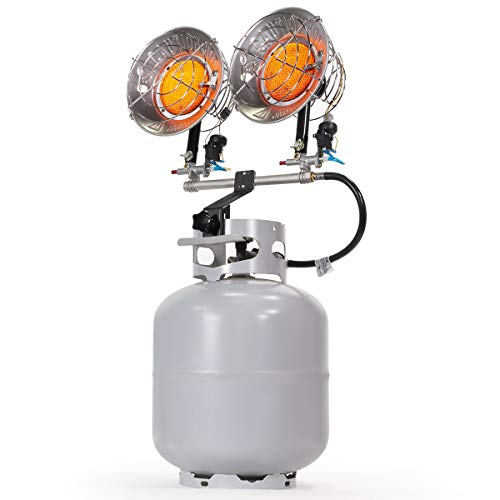
The dual-burner infrared design directs warmth toward nearby people and objects instead of relying only on warming the air. It mounts directly to a 20 lb. propane cylinder and includes a safety shut-off valve and tip-over switch.
Heat output Up to 15,000 / 30,000 BTUBurners Dual burnerFuel connection Mounts to a 20 lb. propane cylinderSafety features Safety shut-off valve and tip-over switch
Why it made the cut
Dual-burner infrared radiant heat
Three heat settings
Safety shut-off valve and tip-over switch
Good to know
Outdoor use only
The 20 lb. propane cylinder is not included
Skip it if Skip it for indoor use or if you need a stated runtime or rated heating area.
A 30×40 garage needs a heat-loss calculation, not an automatic 60,000-BTU answer. The floor area is 1,200 square feet, but insulation, air leakage, ceiling height, your local winter design temperature, and the indoor temperature you want all change the required output.
30×40 Garage
A 30×40 garage has 1,200 square feet of floor area. That number describes the space, not the heater size. A drafty garage with a tall ceiling can need far more heat than a tight, insulated garage with the same footprint.
Floor area1,200 sq ft
Automatic heater sizeCannot be established from area alone
Give the Sizing Calculation
Wall, ceiling and door insulation
Ceiling height
Air leaks around doors and windows
Local winter design temperature
Indoor temperature you want
None of the four listed products is documented as a 60,000-BTU indoor garage heater. The Mr. Heater 9,000 BTU Portable Buddy Midnight Series Radiant is rated for spaces up to 225 square feet; the Buyplus 15,000BTU, Avenger FBDTP30 and XtremepowerUS tank-top models are outdoor products.
Use a Real Load
Have a qualified HVAC professional perform a heat-loss calculation, then choose a heater listed for indoor garage use and sized to that calculated load. For other garage-heater options, see garage heaters.
Choose by Where You’ll Use the Heater
For propane heat with no electricity, the Mr. Heater 9,000 BTU Portable Buddy is the relevant pick here, while the other three listed heaters are outdoor-use models. No-electricity operation helps during an outage, but it doesn’t change a heater’s approved use or ventilation requirements.
Radiant heat warms people and nearby surfaces directly, so it can suit a small occupied area. Forced-air heat warms and moves air with a fan; none of these four products is presented in the supplied data as a forced-air heater.
Product
Output
Stated use
Electricity
Mr. Heater Portable Buddy
4,000 or 9,000 BTU
Indoor and outdoor use, except Canada and Massachusetts; up to 225 sq ft
No electricity needed
Buyplus Propane Heater
11,000, 13,000 or 15,000 BTU
Outdoor use
Not stated
Avenger FBDTP30
30,000 BTU; double burner
Outdoor use
Not stated
XtremepowerUS Tank Top Heater
Up to 15,000 or 30,000 BTU
Outdoor use
Not stated
Use the listed application, not the BTU number, to decide where a model belongs.
Myth
A match-lit or no-electricity propane heater is safe indoors because it works during a power outage.
Fact
Ignition method doesn’t grant indoor approval. Use only a model listed for indoor use, follow its ventilation instructions, and keep a working carbon monoxide alarm nearby.
Check Fuel Use Before You Buy
A higher BTU setting generally burns propane faster, while turning an adjustable heater down can stretch a tank when you don’t need full output. Actual use depends on the heater’s design and operating conditions, so don’t treat a theoretical conversion as a product-specific burn rate.
Estimate a 60,000-BTU Input
Propane contains about 91,500 BTU per gallon. At a theoretical 60,000 BTU per hour, the calculation is 60,000 ÷ 91,500 = about 0.66 gallon per hour at full input. That’s an estimate based on fuel input, not a guaranteed consumption figure; appliance efficiency and operating conditions affect real use.
Propane energyAbout 91,500 BTU per gallon
Theoretical useAbout 0.66 gallon per hour at 60,000 BTU
To estimate fuel cost, multiply gallons per hour × hours used × your propane price per gallon. For example, if the manual gives a burn rate, use that figure rather than estimating from the heater’s BTU rating.
Check the Manual’s Fuel Rate
Look for propane consumption in gallons per hour or pounds per hour, and check which setting the rate applies to. Product 1 states up to 5.4 hours on a 1 lb tank and up to 108 hours on a 20 lb cylinder with an optional hose and fuel filter; product 3 claims up to 18 hours. Those claims use different products and setups, so they aren’t a direct runtime comparison.
Verify Indoor Safety and Ignition
Use a propane heater indoors only if its manual identifies it for indoor use, and follow the manual’s ventilation requirements with a working carbon monoxide alarm in the space. Never bring an outdoor-only heater into a garage, tent, or vehicle cabin; an open door or window doesn’t change its rating.
The Mr. Heater 9,000 BTU Portable Buddy Midnight Series Radiant is listed for indoor use with stated geographic exceptions. Check its manual and local rules before using it where you live; don’t assume approval applies everywhere.
Before You Light It
Confirm the heater is rated for the location; outdoor models stay outdoors.
For indoor use, follow the manual’s ventilation instructions and confirm a carbon monoxide alarm works.
Set the heater on a stable surface and keep combustibles clear by the distance specified in its manual.
For outdoor models, identify the supplied shutoff features: Buyplus has a tip-over shutoff and match-light ignition; Avenger has a flame-out safety control and tip switch; XtremepowerUS has a safety shutoff and tip-over switch.
Stop If Operation Looks Wrong
Turn the heater off if the flame behaves abnormally or you suspect a gas leak or faulty connection. Don’t keep trying to light it or troubleshoot a connection while gas may be escaping; follow the manual’s shutdown instructions and get qualified service.
Take These Steps Before Ordering
Decide where the heater will run before comparing output: remove outdoor-only models from consideration for any enclosed space. A tank-top heater made for outdoor use isn’t a garage heater, even if its BTU rating looks right.
1
For a 30×40 garage
Get a heat-loss estimate, then choose a heater listed for indoor use and matched to that result. Don’t treat the supplied 30,000-BTU outdoor model as a garage solution; floor area alone can’t establish the required output.
2
For a small indoor area
Compare the Mr. Heater Buddy’s 4,000- and 9,000-BTU settings with the room and the manual. Its stated coverage is 225 square feet, but that figure doesn’t replace the manual’s indoor-use and ventilation instructions.
3
For outdoor spot heat
Compare the Buyplus, Avenger and XtremepowerUS models by their adjustable settings and listed safety shutoffs. Confirm that your propane tank is compatible with the model, then follow its operating instructions.
Before You Order
Room use: enclosed indoor space or outdoors
Garage: heat-loss result and indoor listing
Fuel: compatible tank and available propane
Manual: use, ventilation and operating instructions
If the manual doesn’t clearly approve the intended location, choose a different heater. For indoor propane use, follow the manual’s ventilation requirements and keep a working carbon monoxide alarm in the space.
More Questions, Answered
Can a propane heater run without electricity?
Yes, many portable propane heaters use a piezo igniter and need no household power, though some models use batteries or electricity for ignition or a fan. Check the manual for your exact model; a heater that runs without power still needs the ventilation and carbon monoxide precautions its manual specifies.
How many square feet does a 9,000-BTU propane heater cover?
There isn’t one dependable square-foot figure: insulation, ceiling height, air leaks and the temperature you want all change the heater’s workload. Use the heater’s stated coverage only as a starting point, and don’t treat a 9,000-BTU rating as evidence it can heat a 1,200-square-foot garage.
Can I use an outdoor propane heater in a garage?
No. Outdoor heaters aren’t designed for enclosed spaces, where combustion gases can build up; opening a garage door doesn’t make an outdoor-only heater suitable for indoor use. Choose a model whose manual specifically permits indoor use, follow its ventilation instructions and keep a working carbon monoxide alarm in the space.
How long can the Buddy heater run on a 20-pound propane tank?
A 20-pound tank’s runtime depends on the Buddy model, heat setting and the burn rate listed in its manual. Estimate it by dividing the propane available by the heater’s hourly fuel use; don’t assume a small disposable-cylinder runtime applies to a larger tank.
Can a tank-top propane heater be used in a tent?
No. Don’t use a tank-top heater in a tent; it’s an enclosed space where carbon monoxide can accumulate, and the heater can ignite fabric or gear. Use only equipment specifically designed for the setting and follow its manual’s safety instructions.