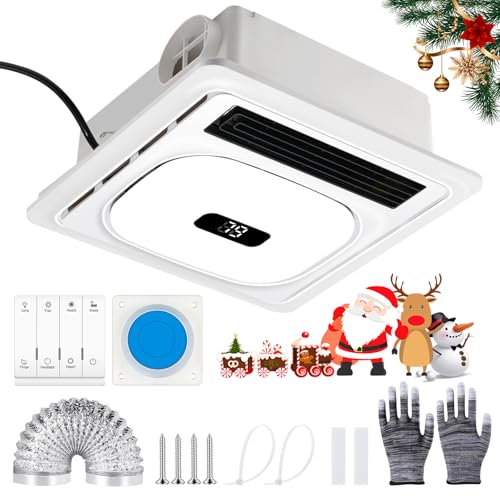
The best 3 in 1 bathroom heater for most readers is a ceiling-mounted exhaust fan with heater and light, because it warms the room, clears moisture, and saves ceiling space in one hardwired unit. For a true 3-in-1, look for enough heat for your room, enough exhaust for steam, and a fan loudness you can live with.
Pick the wrong bathroom heater and you usually pay twice: once for the unit, and again for a foggy mirror, a chilly shower, or a noisy fan you stop using. A weak heater wastes electricity trying to catch up, while a poor vent leaves moisture where mold likes it.
Bathroom heaters also sit in a damp room with real electrical risk, so the right choice needs the right installation, the right clearance, and the right safety listing. A pretty grille is nice. Dry walls are better.
Best 3 In 1 Bathroom Heater Picks
#1Best for most
xugossio Ceiling Heater Fan with Light
Best for Standard bathrooms needing heat, ventilation, and light in one hardwired unit
This one delivers 1800 W of heat, 140 CFM of exhaust, and an 18 W LED light in a single 11.7 by 11.7 inch ceiling unit that fits standard openings. The remote lets you control temperature, light, and fan speed without getting up, and the ultra-quiet operation won’t wake the house during early showers. Built-in thermal protection keeps it safe in a damp room.
Best for Cold mornings when you want the room warm in three minutes
The 1800 W PTC ceramic heater brings a cold bathroom to comfortable in three minutes, and the fan kicks on automatically in heating mode to spread warmth evenly. Three color temperatures and RGB ambient light let you match the mood, and the digital display shows room temperature in real time. Full copper motor and flame-retardant casing add durability and safety.
Heat output 1800 WHeating element PTC ceramicWarm-up time 3 minutesLighting 3 color temps + RGBMotor Full copper
Why it made the cut
Heats to comfortable in three minutes
Fan activates automatically in heating mode
Three color temperatures plus RGB lighting
Digital temperature display on panel
Good to know
No airflow or noise rating provided
Requires hardwired installation
Skip it if If you need precise exhaust specs for code compliance, the CFM isn’t listed.
Best for Bathrooms where you want powerful ventilation without the roar
A full copper core motor and custom turbine housing pull 180 CFM of air at just 1.0 sone, quieter than most ceiling fans. The 1800 W ceramic PTC heater has dual heat levels, and LED lighting with adjustable color temperature handles morning and night. Fits a 24 by 12.2 inch ceiling structure and installs between joists with a 5.11 inch duct.
Best for Renters or quick warmth without rewiring the ceiling
Plug it in, set the thermostat to the degree, and ceramic PTC delivers heat in two seconds across 200 square feet. At 35 dB it’s quieter than turning a page, the 24-hour timer shuts it off after your shower, and the handle lets you carry it room to room. Four safety features include tip-over shutoff and overheat protection, plus a child lock.
A true 3-in-1 bathroom heater is a ceiling-mounted unit that combines an exhaust fan, a heating element, and a light in one hardwired fixture. It does three jobs: warms the room before and during a shower, vents steam and moisture outside so the mirror stays clear and the walls stay dry, and lights the space. Wall-mounted or portable heaters can warm the air, but they won’t pull humidity out of the bathroom—that’s the exhaust fan’s job, and it’s why these combo units exist.
Among the ceiling units here, the xugossio delivers 1,800 W of heat and moves 140 CFM of air. The Bonoutil steps up to 180 CFM at the same 1,800 W, and the Hawkrown pushes 1,900 W with 180 CFM. More watts mean faster heating in a cold bathroom; more CFM means the fan clears steam more quickly. A 140 CFM fan handles most bathrooms under 100 square feet if you run it during and after the shower. Larger bathrooms or those with poor natural ventilation do better with 180 CFM.
Check before you buy
Heating wattage: 1,800 W or more for bathrooms over 50 sq ft
Exhaust airflow: at least 1 CFM per square foot of bathroom
Noise rating: under 3 sones if the fan will run while you’re in the room
Bathroom rating: look for damp or wet location listing, especially near the shower
Remote control and LED lighting make daily use more pleasant—no reaching for a wall switch with wet hands, and LEDs stay cool and last longer than incandescent bulbs. But ventilation comes first. If the fan can’t move enough air, you’ll still wipe down the mirror, and the ceiling will still collect moisture. Heat output comes second: a 1,500 W unit takes longer to warm a cold bathroom than an 1,800 W or 1,900 W model, and that matters most on winter mornings.
Not the same as a portable heater
Portable and wall-mounted bathroom heaters warm the air but do nothing for steam or condensation. They’re faster to install because they plug in or mount to drywall, but you still need a separate exhaust fan to meet building code and keep the bathroom dry. A ceiling combo handles both in one fixture.
Loudness matters more than you think
Exhaust fans are rated in sones: 1 sone is about as loud as a refrigerator hum, 3 sones is noticeable, and 4 sones is the point where most people turn it off early. Check the spec sheet. If the unit doesn’t list sones, expect it to be louder than you’d like at full speed.
Choose Heat, Airflow, And Noise First
Heat output determines whether you’ll feel warm in the time it takes to towel off. Most bathroom fan heaters produce between 1,000 W and 1,800 W. A 1,300 W unit puts out about 4,400 BTU per hour, enough to take the edge off a small bathroom but not enough to heat a larger space quickly on a January morning. An 1,800 W heater delivers around 6,100 BTU per hour and warms noticeably faster—the difference you’ll feel stepping out of the shower.
Airflow, measured in cubic feet per minute (CFM), clears steam and moisture before it fogs the mirror or soaks into drywall. A fan rated at 140 CFM moves enough air for a bathroom up to about 140 square feet, assuming an 8-foot ceiling. Larger bathrooms or layouts with a separate shower enclosure do better with 180 CFM or more. The xugossio and Bonoutil models both offer 180 CFM, which handles steam faster than entry-level units rated at 80 or 110 CFM.
Noise is rated in sones: lower numbers mean quieter operation. One sone is roughly the sound of a refrigerator humming in a quiet kitchen. Most ceiling-mounted bathroom exhaust fans with heater run between 1.5 and 3 sones. Below 2 sones, you’ll barely notice the fan over the sound of running water. Above 3 sones, it’s loud enough to be annoying if you run it for fifteen minutes while you brush your teeth.
Spec
Low End
Mid Range
High End
Heat output
1,000 W
1,300–1,500 W
1,800 W
Airflow (CFM)
80–110
140
180+
Noise (sones)
3+
2–3
1.5 or less
Typical ranges for ceiling-mounted 3-in-1 units sold in 2026.
Smart controls—app timers, voice commands, remote switches—add convenience but don’t make up for weak ventilation or low heat. The Hawkrown offers Bluetooth and app control, which is useful if you want the fan to start before you step into the bathroom. It won’t help if the unit only moves 110 CFM and your bathroom needs 180.
Running Cost Example
An 1,800 W heater running one hour a day costs about 31 cents at the US average of 17 cents per kWh. That’s 1.8 kW × 1 hour × $0.17, or roughly $9 a month if you heat the bathroom every morning in winter.
Power1,800 W
Daily use1 hour
Rate17¢/kWh
Daily cost≈31¢
180 CFM
Airflow that clears a 12 × 12 ft bathroom in minutes
Higher CFM ratings move steam out faster, which matters in bathrooms with poor natural ventilation or no window.
Match The Heater To Your Bathroom Size And Layout
Small bathrooms—around 50 square feet or less—do fine with 1,000 to 1,300 W of heat and 80 to 110 CFM of airflow. Standard bathrooms in the 60 to 100 square foot range need closer to 1,500 W and at least 140 CFM. Large bathrooms, especially those over 120 square feet or with a separate shower and tub, call for 1,800 W and 180 CFM or more to keep up with steam and cold air.
Bathroom Size
Heat Output
Airflow (CFM)
Example Use
Small (≤50 sq ft)
1,000–1,300 W
80–110
Powder room, half bath
Standard (60–100 sq ft)
1,300–1,500 W
140
Full bath, single shower
Large (120+ sq ft)
1,800 W
180+
Master bath, dual vanities
Sizing a 3-in-1 unit to the space it has to heat and ventilate.
Ceiling-mounted units suit new construction and remodels better because they need ductwork that vents to the outside, not into the attic. The duct typically runs 4 or 6 inches in diameter and exits through the roof or a gable vent. If you’re retrofitting an older bathroom with no existing duct, running new ductwork means opening the ceiling—a job that adds cost and time but solves the moisture problem permanently.
Wall-mounted bathroom heaters are usually hardwired units that sit in a recessed box between studs. They work in bathrooms where ceiling access is difficult, but most wall heaters don’t include exhaust fans. The best wall mounted bathroom heaters for new construction small bathrooms are typically standalone electric resistance heaters rated for damp locations, not true 3-in-1 combos. If moisture control matters, a ceiling unit with a duct does more than a wall heater alone.
A portable bathroom heater only makes sense for temporary use—a rental, a bathroom waiting for a remodel, or a guest bath used twice a year. Portable heaters warm the air but do nothing to clear steam or prevent mold. They also need a clear 3-foot radius and a GFCI outlet, which many older bathrooms lack.
Venting Matters More Than Placement
Whether the unit mounts in the ceiling or the wall, the important question is whether it vents moisture outside. A heater that recirculates air won’t stop condensation or mildew.
Check Safety, Wiring, And Bathroom Ratings
Ceiling and wall-mounted bathroom heaters need hardwired 120 V or 240 V connections installed by a licensed electrician in most jurisdictions, and that’s not a corner to cut. Portable bathroom heaters plug into a standard outlet but must stay at least three feet from the tub, shower, and sink—closer than that and water spray or a dropped hair dryer turns into a shock hazard. Extension cords and power strips can’t handle the 12.5 A a 1,500 W heater draws; plug straight into the wall outlet every time.
Look for a UL, ETL or CSA listing that covers damp locations, and check the manual’s clearance requirements before you mount anything. Many bathroom heaters claim to be bathroom-safe, but that label alone doesn’t guarantee compliance with code or proper moisture handling—the listing and correct installation do. Overheat shutoff is standard on most modern units; confirm it’s present. Exhaust fans should vent directly outdoors, never into an attic or crawl space, so moisture leaves the house instead of causing structural damage.
Bathroom-safe is not a rating
Marketing copy that calls a heater bathroom-safe doesn’t replace a UL or ETL damp-location listing, proper clearances from water, and correct installation. Check the label on the unit and the specs in the manual.
Installation safety checklist
UL, ETL or CSA listing for damp locations
Hardwired installation by a licensed electrician for ceiling and wall units
At least 3 feet of clearance from tub, shower, and sink for portable heaters
Overheat shutoff protection built into the unit
Exhaust fan ducted to the outdoors, not the attic
No extension cords or power strips—wall outlet only for plug-in models
GFCI protection
Bathroom outlets are required to have ground-fault circuit interrupter protection under current electrical code. If you’re plugging in a portable heater and the outlet doesn’t have a reset button, have an electrician inspect it.
What To Buy For A Quick Fix Or A Remodel
Remodeling or building new? A hardwired ceiling or upgrade your space with a combination fan, heater, and light—it clears steam, warms the room, and frees up outlet and floor space in one fixture. Renting or dealing with a single cold bathroom in an otherwise comfortable house? A portable heater gives you a temporary warmth boost without touching the wiring, though it won’t replace a vented exhaust fan and you’ll need to unplug it and move it away from water after every use.
Radiant heaters feel gentler than forced-air models—no fan noise, no blown dust—and bathroom-safe radiant units exist, but the same three-foot water clearance applies and you should never leave one running when you leave the room. Small bathrooms around 50 square feet do fine with 1,000 to 1,300 W; larger family baths above 100 square feet often need 1,500 W or a second heat source on the coldest mornings.
Two bathrooms, two approaches
A 50 square foot powder room with no shower can stay warm with a 1,000 W portable heater moved in before guests arrive, then unplugged and stored. A 120 square foot family bath used every morning needs a hardwired 1,500 W ceiling unit with at least 110 CFM of airflow to handle the steam and keep the mirror clear.
Powder room50 sq ft, 1,000 W portable
Family bath120 sq ft, 1,500 W hardwired ceiling uni
Before you buy
Measure the bathroom in square feet (length × width)
Confirm whether you have ceiling access and ductwork, or need a plug-in unit
Choose 1,000 to 1,300 W for rooms under 70 sq ft, 1,500 W for larger spaces
Decide between hardwired installation for a permanent fix or a portable unit for flexibility
Check that the exhaust CFM matches or exceeds your room’s square footage
In short
Hardwired combination units suit remodels and permanent installations; portable heaters work for renters and temporary warmth. Match the heat output and airflow to your room size, then confirm the install method fits your situation.
Questions People Ask
What heater can I use in a bathroom?
Hardwired ceiling or wall heaters rated for damp or wet locations are the safest choice, since they’re designed for moisture and installed by an electrician on a dedicated circuit. Portable plug-in heaters work if they carry a bathroom or damp-location rating, stay three feet from water, and plug straight into a GFCI-protected outlet—never an extension cord. Oil-filled radiators and ceramic tower heaters with tip-over shutoffs are the least risky portable types, but unplug them before you shower.
What is the best electric toe kick heater for a bathroom?
A toe kick heater mounts low under a vanity cabinet and blows warm air at floor level, which suits tight spaces where ceiling and wall real estate is gone. Look for a model rated at least 1,000 W for a small bathroom, hardwired to a 120 V or 240 V circuit, with a built-in thermostat and a louver that directs air away from plumbing. Cadet and Dimplex both make UL-listed units that fit standard cabinet toe kicks.
Is a portable heater for bathroom use safe?
Portable heaters are safe in a bathroom only if they’re kept dry, at least three feet from the tub, shower and sink, plugged into a GFCI outlet, and rated for damp locations by the manufacturer. Never leave one running while you’re in the shower or tub, and never drape towels or clothes over the grille. A hardwired ceiling unit is always the safer long-term answer.
Do bathroom exhaust fans with heaters need outside venting?
Yes, the exhaust fan portion must vent to the outside—through the roof, soffit or an exterior wall—to actually remove moisture and prevent mold. Venting into an attic or crawl space just moves the humidity problem somewhere you can’t see it. The heater and light work without a duct, but you lose the whole point of the fan if it’s not exhausting outside.
Can I replace the heating element in a Broan bathroom ceiling fan?
Some Broan models use plug-in or screw-terminal heating elements you can swap out yourself once the power is off at the breaker, but many units have the heater wired directly to the housing and aren’t designed for field replacement. Check the model number on Broan’s support site or in the installation manual; if the element isn’t listed as a replaceable part, you’re looking at a whole-unit swap.