For most buyers, the Senville LETO is the best 24,000 BTU mini split heat pump here: it provides 24,000 BTU of heating and cooling, works down to 5°F, and includes a 16-foot line set. It still requires professional installation, so it isn’t a weekend DIY swap for a window unit.
What to remember
Choose the LETO if you need a stated heating range down to 5°F and Alexa control.
The COSTWAY lists 23,000 BTU heating, 10 HSPF2 and Energy Star certification.
Treat advertised square footage as a starting point; insulation, climate and layout change the required capacity.
These systems need professional installation; a precharged line set does not make refrigerant work a DIY job.
Say your open living area is 1,200 square feet and the overnight low is 8°F. A 24,000 BTU label alone can’t tell you if a mini split will keep up; its low-temperature capacity and your home’s heat loss matter too.
The picks below separate the useful differences: rated heating output, efficiency figures, stated operating temperature, smart controls and installation details. Compare those before you let a room-size estimate make the decision for you.
Five 24,000 BTU Mini Split Heat Pump Picks
#1Best Overall
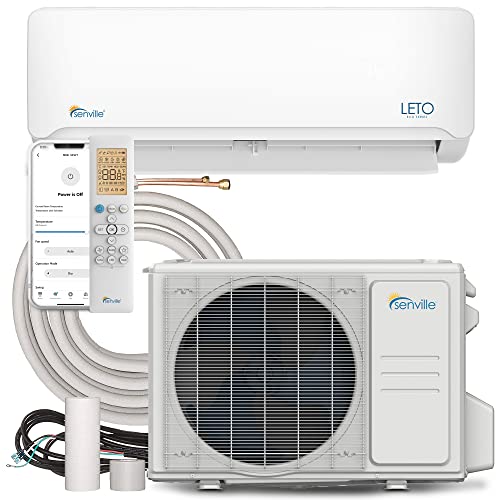
Senville LETO 24,000 BTU Heat Pump
Best for Buyers who need stated heating down to 5°F
The LETO provides 24,000 BTU of heating and cooling and is rated to work as a heat pump down to 5°F. Its included 16-foot line set and Alexa control suit buyers who want a capable year-round system, but professional installation is required.
Heating and cooling 24,000 BTULow-temperature rating 5°FLine set 16 feetVoltage 208/230V
Why it made the cut
24,000 BTU heating and cooling
Heat pump operation down to 5°F
Includes a 16-foot line set and communication wire
Good to know
Professional installation required
Preloaded refrigerant covers line sets up to 25 feet
Skip it if Skip it if you need a DIY installation or a longer preloaded line-set run.
Best for Buyers prioritizing Energy Star certification
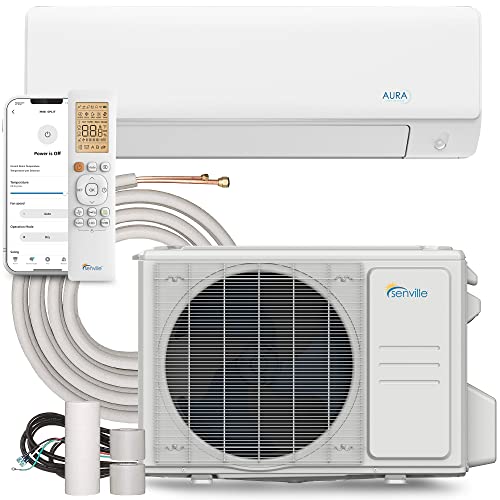
The AURA pairs an Energy Star certification with a 208–230V DC inverter, making it the efficiency-focused Senville pick in this group. It also includes a 16-foot line set and supports Alexa and app control; the supplied details don’t give a specific minimum operating temperature.
Capacity 24,000 BTUEfficiency feature DC inverterCertification Energy Star certifiedVoltage 208–230VLine set 16 feet
Why it made the cut
Energy Star certified
UL listed and AHRI certified
Includes a 16-foot line set and communication wire
Good to know
No exact low-temperature operating rating provided
Professional installation required
Skip it if Skip it if you need a confirmed minimum heating temperature before choosing.
Best for Buyers comparing published efficiency figures
COSTWAY lists a 21 SEER2 rating and 10 HSPF2, giving you both cooling and heating efficiency figures to compare. Its heating capacity is 23,000 BTU, and Alexa and Google Home compatibility add convenient control; no minimum heating temperature is stated in the supplied details.
Heating capacity 23,000 BTUCooling capacity 22,000 BTUEfficiency 21 SEER2; 10 HSPF2Controls Alexa and Google Home compatible
Why it made the cut
21 SEER2 and 10 HSPF2 ratings
23,000 BTU heating capacity
Compatible with Alexa and Google Home
Good to know
Heating capacity is 23,000 BTU, not 24,000 BTU
No exact low-temperature rating provided
Skip it if Skip it if a stated cold-weather operating limit is essential to your decision.
Best for Bedrooms and home offices where indoor noise matters
Temprium lists indoor operation as low as 30 dB, a useful detail for bedrooms, nurseries and home offices. The 19 SEER2 inverter system also offers Wi-Fi and voice control, though its supplied details don’t state a minimum heating temperature.
Capacity 24,000 BTUEfficiency 19 SEER2Noise level As low as 30 dBListed coverage Up to 1,500 sq. ft.Refrigerant R32
Why it made the cut
Listed as low as 30 dB
19 SEER2 inverter system
Wi-Fi and voice control
Good to know
No exact low-temperature rating provided
The listed coverage is up to 1,500 square feet; room fit still depends on the building
Skip it if Skip it if you need a verified cold-weather heating rating for your climate.
Best for Buyers who want Wi-Fi control and a longer airflow reach
Garvee combines built-in Wi-Fi and voice-assistant compatibility with 4D airflow listed to reach up to 50 feet. Its 19 SEER2 inverter system suits buyers who value remote scheduling and broad air distribution, but the supplied details don’t give a low-temperature rating.
Output 24,000 BTUEfficiency 19 SEER2Line set 13 feetAirflow reach Up to 50 feetVoltage 208–230V
Why it made the cut
Built-in Wi-Fi and voice-assistant compatibility
19 SEER2 inverter system
4D airflow listed up to 50 feet
Good to know
No exact low-temperature rating provided
Includes a 13-foot line set
Skip it if Skip it if you need a stated minimum outdoor temperature for heating.
DIY Mini Split Heat Pumps: What You Can Install Yourself
DIY mini split heat pumps are a separate product category; the parts included with these five 24,000 BTU models don’t establish that they’re DIY systems. You can plan the job yourself, but refrigerant work, electrical connections and commissioning should be handled by a qualified professional.
Myth
A line set or installation kit means the unit is DIY-ready.
Fact
The Senville LETO includes a 16-foot line set and communication wire, and comes preloaded with refrigerant for up to 25 feet. It still requires professional installation. The AURA product data explicitly says it isn’t a DIY mini split; don’t assume the COSTWAY, Temprium or Garvee is DIY-ready based on included parts.
Before buying, you can choose a wall location, check what electrical service is available and plan a route for the line set. Leave refrigerant handling, the electrical hookup and startup checks to the installer. Incorrect installation can create safety problems and may affect warranty coverage.
Check Before You Order
Ask your local building department whether permits are required.
Read the manufacturer’s warranty conditions for installation requirements.
Confirm the installer’s qualifications and experience with the specific system.
Ask who will handle electrical work, refrigerant lines and commissioning.
If you want a model specifically designed for homeowner installation, compare it with DIY-friendly mini-split heat pumps for budget installs—but confirm its installation and warranty requirements before choosing. A kit is a box of parts, not permission to skip the installer.
From HeaterGuides · our own guideHeat pump or not? Page 6 is the decision guide; the Excel sheet works out the payback.Heating System Upgrade PlannerChoose between a heat pump, a furnace, a boiler or a hybrid with your own numbers, and hire the right installer.Every system compared side by side25 questions for contractors, red flagsRunning-cost, payback and quote calculator (Excel)$14.99$9.99Get it for $9.99See what's inside and watch the 2-minute video →16-page printable PDF + Excel calculator · instant download · 30-day refund
Compare Heating Output, Efficiency and Cold-Weather Ratings
For a 24,000 BTU heating job, compare the stated heating output and cold-weather claim first; efficiency ratings answer different questions. Of these five models, only the LETO states a low-temperature heating limit.
Model
Heating and efficiency data provided
Room-size or cold-weather claim
Senville LETO
24,000 BTU heating and cooling
Heating operation down to 5°F (-15°C); 16-foot line set
COSTWAY
23,000 BTU heating; 21 SEER2; 10 HSPF2
Up to 1,500 sq ft
Temprium
19 SEER2
Up to 1,500 sq ft
Garvee
19 SEER2
Up to 1,500 sq ft
Senville AURA
No numerical heating output provided
No numerical low-temperature claim provided
Only specifications stated in the product data are shown; missing figures aren’t estimates.
SEER2 measures seasonal cooling efficiency, while HSPF2 measures seasonal heating efficiency. Neither rating tells you how much heat a unit delivers at a particular outdoor temperature. The LETO’s 5°F claim means it can operate at that temperature; it doesn’t establish that it still delivers its full rated capacity there.
Myth
A 1,500-square-foot room-size claim proves the system will heat your home.
Fact
COSTWAY, Temprium and Garvee cite coverage up to 1,500 square feet, but that’s not a heat-load calculation. Insulation, air leakage, ceiling height and winter weather affect how much heat your space needs.
For the stated strengths, the lineup ranks this way: LETO, Best Overall, for its stated 24,000 BTU heating and cooling and 5°F operating claim; COSTWAY, Best for Large Rooms, for its stated 1,500-square-foot coverage and 23,000 BTU heating output; Temprium, Quietest; Garvee, Best Budget, as a budget-category pick rather than a verified price advantage; and AURA, Best Smart Controls. The supplied specifications don’t include numerical noise or smart-control details, so check those features in the product listing before buying.
24,000 BTU/h
Nominal heat-pump capacity
Use this rating as a starting point for sizing; the capacity a home needs depends on its room area, insulation, climate and heat loss.
Size the Heat Pump for Your Room and Winter
A 24,000 BTU rating is nominal capacity, not a promise that the heat pump will keep every 1,500-square-foot space comfortable. The heating load depends on your climate, insulation, air leakage, ceiling height, windows, room layout and whether interior doors stay open.
Ask a qualified installer for a room-by-room heat-loss calculation, especially if your home is older or leaky, or the heat pump will be your main heat in a cold climate. In colder regions, ask for the unit’s heating capacity at your local design temperature—the outdoor temperature used for sizing—not only its minimum operating temperature. A unit may keep running below that point while delivering less heat.
Same Rating, Different Heating Load
Say two homes each have 1,500 square feet and are considering a nominal 24,000 BTU unit. These invented loads show why floor area alone can mislead: the actual result requires a heat-loss calculation.
Well-insulated open planHypothetical heat loss: 18,000 BTU/h
In the first example, the nominal capacity exceeds the assumed heat loss at the calculation condition. In the second, it falls short—and one indoor head may also struggle to move heat through closed doors. Those example figures are not sizing rules; your installer should calculate your home’s load and check the model’s output at winter temperatures.
Ask for the Cold-Weather Output
Have the installer show the model’s heating capacity at your local design temperature and explain how the indoor unit will serve rooms with closed doors.
Estimate Running Cost Before You Replace the Furnace
Estimate a mini split’s electricity cost from its average electrical draw, not its 24,000 BTU capacity. BTU capacity describes heat delivered; it isn’t a continuous wattage rating, and actual power draw changes with outdoor temperature, your setpoint, insulation and inverter speed.
Use this formula: average kW × hours of operation × your electricity rate per kWh. Get the average draw from an energy monitor or, where available, utility data for the system; a short reading during mild weather may not represent a cold spell. Don’t convert BTU capacity directly into a promised bill.
Hypothetical Cost Calculation
For illustration only—not an estimate for any product—assume an average draw of 2 kW, 8 hours of operation per day and an electricity rate of 17 cents per kWh. The arithmetic is 2 × 8 × $0.17 = $2.72 per day. Replace both assumptions with measured usage and your local rate.
Assumed average draw2 kW
Assumed operating time8 hours per day
Assumed electricity rate$0.17 per kWh
Illustrative daily costCalculated operating cost
A heat pump moves heat from outdoors instead of making all its heat directly from electricity, which can reduce electricity use compared with resistance heating. That doesn’t guarantee savings over your furnace: the comparison depends on the furnace’s fuel and efficiency, your local electricity and fuel rates, and how much heat the house needs.
Use Your Own Rate
Check your electric bill for the price per kWh, then compare usage over similar weather periods if you have past heating data.
Check Electrical Service, Certification and Installer Details
A 24,000 BTU mini split is a 208/230V system, not a heater you plug into a household outlet. Before buying, have a qualified HVAC professional check the exact model’s manual and local code for the circuit, disconnect, wiring and installation requirements.
Certification claims differ by model, so check the product data rather than assuming every unit carries the same approvals. The listed warranty terms also don’t tell you who pays for labor.
Model
Listed certifications
Listed warranty
Senville LETO
UL-listed DC inverter; AHRI certified
5 years for parts and compressor; labor isn’t specified in the warranty data
COSTWAY
Energy Star; AHRI certified
5 years for parts; 8 years for compressor
Senville AURA
Energy Star; UL; AHRI
Not specified here
Temprium and Garvee
No certifications listed here
Not specified here
These are the claims and terms provided for these models; confirm current documentation for the exact unit you plan to buy.
Check the full installation route before ordering: line-set length, communication wire, condensate drainage and a suitable outdoor-unit location can all affect the job. The LETO kit includes a 16-foot line set, and its refrigerant is stated to be preloaded for line sets up to 25 feet; ask the installer what additional parts or labor the quote includes.
Don’t treat the voltage as a DIY detail
Have the installer verify the electrical service and required circuit against the exact manual. Permits and electrical work must follow local code; don’t guess at breaker size or wiring from another model’s specifications.
Before You Place the Order
Get a room-by-room load calculation and confirm expected heating capacity in your winter temperatures.
Verify the unit’s voltage and electrical requirements with your installer.
Confirm who will install it, whether permits are required, and what the quote includes.
Read the parts, compressor and labor warranty terms.
Measure the line-set route and confirm drainage and outdoor-unit placement.
Questions People Ask
Can I install a 24,000 BTU mini split heat pump myself?
Usually, no. These systems need a dedicated 208/230V circuit, and refrigerant connections and commissioning must follow the manufacturer’s instructions; hire a qualified installer unless the exact model is designed for homeowner installation and you meet its requirements.
Will a 24,000 BTU mini split heat a 1,500-square-foot home?
It might, but square footage alone can’t establish the right capacity. Insulation, air leakage, ceiling height, window area, layout and winter design temperature all affect heat loss, so use a room-by-room load calculation rather than assuming 24,000 BTU will cover the whole home.
What does 21 SEER2 mean on a mini split heat pump?
SEER2 measures seasonal cooling efficiency under updated test conditions; 21 is the rating, not a percentage of electricity saved or a heating-efficiency score. Compare SEER2 among systems with similar capacity, and check HSPF2 separately for heating.
What does HSPF2 tell me about winter heating efficiency?
HSPF2 rates seasonal heating efficiency across a standard test season, so a higher rating generally means less electricity for the same amount of heat under those test conditions. It doesn’t tell you how much capacity remains on your coldest day; check the low-temperature output data too.
How cold can the Senville LETO heat?
The Senville LETO is rated to operate in heating mode down to 5°F. That’s an operating limit, not a guarantee of full 24,000 BTU output at 5°F; check the model’s capacity data and compare the limit with your local winter design temperature.
Does a precharged mini split line set mean no professional installer is needed?
No. A precharged line set can simplify refrigerant handling for compatible systems, but it doesn’t remove the need to mount and connect the equipment, provide the correct electrical circuit, seal the wall opening or follow the maker’s commissioning instructions. Confirm what the specific system permits before planning a DIY install.
What electrical service does a 208/230V mini split need?
It needs a correctly sized 208/230V circuit, not a standard household outlet. The breaker size, wire gauge and disconnect depend on the unit’s nameplate and installation manual; have a licensed electrician verify the existing service and make electrical connections where required.
Before you go · a welcome giftGet the Heating System Upgrade Planner for $4.99Choose between a heat pump, a furnace, a boiler or a hybrid with your own numbers, and hire the right installer. Normally $14.99; your welcome price saves $10.00. We'll email your link right now.or buy it now for $9.99 without the gift →One email with your link now. We never share your address.


 Heating System Upgrade PlannerChoose between a heat pump, a furnace, a boiler or a hybrid with your own numbers, and hire the right installer.Every system compared side by side25 questions for contractors, red flagsRunning-cost, payback and quote calculator (Excel)