The best pick for most readers is the Rheem RTEX-13 because it asks for the least electrical service of the group while still giving on-demand hot water for small homes and single-bathroom use. A 240V tankless unit is only as good as the panel behind it; buy the wrong size and you get lukewarm water, nuisance breaker trips, or a unit that never reaches full output.
A 240V electric tankless heater can save space and trim standby losses, but the wrong choice costs comfort first and money second. Pick by wiring, flow rate and winter inlet-water temperature, not by the biggest kilowatt number on the box.
For the search term with “20 amp” in it, the hard truth is that the products here draw far more than 20 amps. If your panel and branch circuit can only spare 20 amps, you are shopping in the wrong aisle and should keep looking before a permit inspector has to explain it for you.
Top 5 240 Volt Tankless Water Heaters
#1Best for One Bathroom
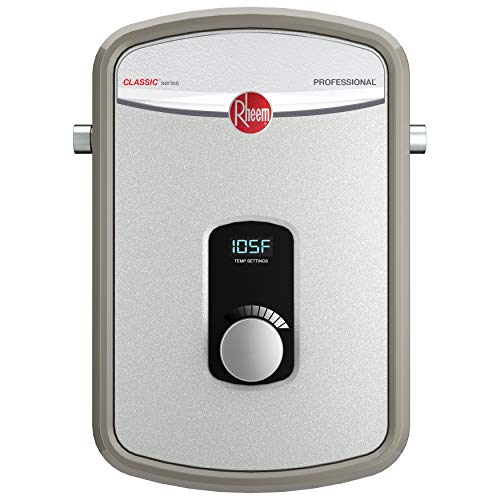
Rheem RTEX-13 Tankless Water Heater
Best for Small homes or one-bathroom use with modest simultaneous hot-water demand
The RTEX-13 supplies up to 3.17 GPM and has self-modulating power control, which adjusts output to hot-water demand. Its digital control changes the set temperature in 1-degree increments, and the listed 54 A draw makes panel capacity a key check before you buy.
Power 13 kWFlow rate Up to 3.17 GPMElectrical draw 54 ATemperature control Digital, 1-degree incrementsWater connections Side 1/2 inch compression connections
Why it made the cut
Up to 3.17 GPM flow rate
Self-modulating power control
Digital temperature adjustment in 1-degree increments
Good to know
54 A draw needs careful electrical planning
The listed flow rate may not cover several fixtures running together
Skip it if Skip it if you need several high-flow fixtures at once; compare the higher-output models and their electrical requirements.
Best for A small household with limited simultaneous hot-water use
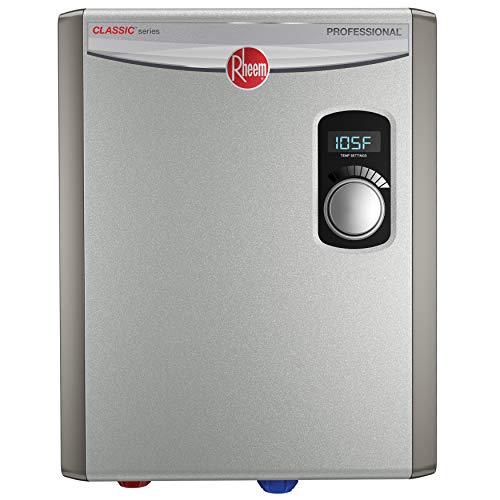
At up to 2.68 GPM, this model fits a narrower demand than the higher-output picks. Its listed electrical requirements are specific: one 50-amp double-pole breaker, #8 AWG copper conductors with ground, and a recommended minimum 100-amp household service panel.
Power 11 kWFlow rate Up to 2.68 GPMBreaker One 50-amp double-pole breakerWiring One set of #8 AWG copper conductors with groundRecommended minimum service pa 100 A
Why it made the cut
Up to 2.68 GPM flow rate
Digital temperature control in 1-degree increments
Electrical requirements are listed
Good to know
Lower flow rate limits simultaneous fixture use
Requires a 50-amp double-pole breaker
Skip it if Skip it if showers and other hot-water fixtures commonly run at the same time.
Best for Households needing more flow than the 11kW model provides
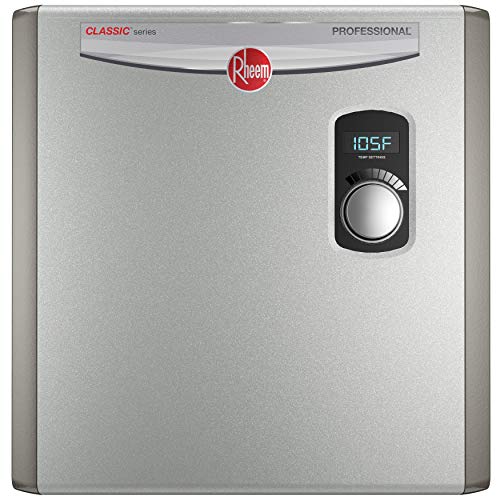
The listed flow rate reaches up to 4.4 GPM, and self-modulation adjusts power to match hot-water demand. An external digital control with an LED display gives you a clear temperature readout, though the supplied details don’t specify this model’s breaker or panel requirements.
Power 18 kWFlow rate Up to 4.4 GPMTemperature control External digital control with LED displayTemperature accuracy ±1 degreeWater connections Bottom 3/4 inch NPT connections
Why it made the cut
Up to 4.4 GPM flow rate
Self-modulating power control
External digital thermostat with LED display
Good to know
Breaker and service-panel requirements aren’t specified in the supplied product details
Skip it if Skip it until an electrician confirms its circuit and service requirements for your home.
Best for Homes with multiple fixtures that need a higher flow rate
This 24kW model is listed for up to 5.9 GPM and has digital temperature controls adjustable in 1-degree increments. The electrical demand is substantial: it calls for three 40-amp double-pole breakers and a recommended minimum 200-amp household service panel.
Power 24 kWFlow rate Up to 5.9 GPMBreakers Three 40-amp double-pole breakersWiring Three sets of #8 AWG copper conductors with groundRecommended minimum service pa 200 A
Why it made the cut
Up to 5.9 GPM flow rate
Temperature control adjusts in 1-degree increments
Electrical requirements are clearly listed
Good to know
Requires three 40-amp double-pole breakers
Recommended minimum 200-amp household service panel
Skip it if Skip it if your panel can’t support the listed service requirements or your household doesn’t need its higher flow.
Best for Supplemental room heat, not domestic hot water
This is a portable ceramic space heater, not a tankless water heater, so it can’t supply a shower or sink. Its 1,500W output, thermostat and tip-over shutoff may suit a small room, but it doesn’t belong in a comparison of water-heating capacity.
Power 1,500 WCoverage Up to 200 sq.ftTimer 24HCertification ETL-certified
Why it made the cut
1,500W ceramic heat
Thermostat and 24-hour timer
ETL-certified with overheat and tip-over protection
Good to know
Does not heat domestic water
Not a 240V tankless water heater
Skip it if Skip it if you need hot water; choose one of the Rheem water heaters instead.
For the best 240V tankless water heater, compare heating capacity, usable flow and the electrical service it needs—not the headline wattage alone. The best tankless water heaters for 2025, the best tankless water heater, top rated tankless water heaters and electric tankless water heaters 240V all come down to the same practical test: can the unit heat enough water for your use, and can your panel supply it? For this group, the Rheem RTEX-13 is the most modest electrical load; larger models need substantially more service.
Kilowatts set how much heat the unit can add, while flow rate tells you how much hot water you can use at once. Those numbers work together: as more water passes through the heater, each gallon gets less time to warm. Colder incoming water in winter means the unit must add more heat to reach the same outlet temperature, so usable flow falls. A model that seems ample on a mild day can feel smaller in January.
Heater rating
Current at 240 V
What it means
13 kW
About 54 A
Lower electrical demand in this group
18 kW
75 A
Needs more capacity than a 20 A circuit
24 kW
100 A
Highest listed demand in this group
Approximate running current, calculated as watts ÷ volts; the 13 kW result is rounded.
Check the electrical load
Current is power divided by voltage. For example, an 18 kW heater uses 18,000 W ÷ 240 V = 75 A; a 24 kW unit uses 24,000 W ÷ 240 V = 100 A. A 13 kW unit uses 13,000 W ÷ 240 V, or about 54 A. These figures show why the search for a 20 amp tankless water heater hits a wall: 20 amps is far too little for every product in this list. A 20 kW tankless water heater uses 20,000 watts and draws about 83 A at 240 V.
Before you compare models
Check the panel’s available capacity, not only its main-breaker rating.
Count the breaker spaces the installation requires; larger units may need multiple breaker poles.
Use the exact model’s installation manual to confirm its circuit and wiring requirements.
Panel capacity and breaker count are the real gatekeepers. If either rules out a model, its advertised flow rate won’t help you. The next step is sizing the heater around your fixtures and winter inlet-water temperature; a lower-kW unit may fit your service but supply less hot water at once.
From HeaterGuides · our own guideTankless? Page 8 is the descaling routine, page 15 checks the size.Water Heater Owner's ToolkitFix the common faults yourself, keep it running for years, and know when a repair is money wasted.No-hot-water flowcharts, gas and electricFlush, anode, relief valve and descaling stepsRepair-or-replace calculator (Excel)$14.99$9.99Get it for $9.99See what's inside and watch the 2-minute video →18-page printable PDF + Excel calculator · instant download · 30-day refund
Match Size To Your Hot Water Demand
A tankless water heater heats water only when a tap opens, so you size it for the fixtures running at the same time—not the total number of people in the house. In plain terms, what is a tankless water heater? It’s an electric unit that heats flowing water through internal elements instead of storing hot water in a tank. It turns on as water moves through it, then stops when the tap closes.
The useful question is how much water you need during the coldest season. One shower is a lighter job; one shower plus a sink needs more capacity; two fixtures running together may push a small unit past its useful limit. Staggered use is easier because the heater gets a short break between demands, even if the household schedule does not.
Unit
Comparison flow
Best fit
Rheem 11kW
Up to 2.68 GPM
One light-use fixture
Rheem RTEX-13
Up to 3.17 GPM
One shower or a small home
Rheem 18kW
Up to 4.4 GPM
One shower plus a sink
Rheem RTEX-24
Up to 5.9 GPM
Heavier simultaneous demand
These flow figures are comparison points, not a promise of the same output in winter.
Those numbers explain why the biggest unit isn’t automatically the right one. The 11 kW and 13 kW models suit lighter demand, while the 18 kW and 24 kW models can handle more simultaneous use if your electrical service supports them. A larger heater also won’t create unlimited hot water from a very cold supply.
Worked example
Say one shower and a bathroom sink run together. A 13 kW unit may work when the shower flow is modest and the inlet water is fairly warm, but the same setup can turn lukewarm during a cold snap. An 18 kW model gives more heating capacity, provided the panel and wiring can support it.
One showerLight simultaneous demand
Shower plus sinkMore capacity required
Cold inlet waterLess usable flow at the same setpoint
Choose Smaller
Lower electrical demand
Fits one-fixture homes and staggered use
Choose Larger
Less margin when inlet water is cold
May struggle with two fixtures together
In short
Match the heater to simultaneous flow and winter inlet temperature. The advertised GPM depends on the temperature rise and setpoint, so 5.9 GPM on paper doesn’t mean 5.9 GPM of equally hot water on the coldest morning.
Check Wiring And Panel Capacity First
The best 240V tankless water heater is the largest unit your panel and wiring can safely support; tankless water heater amps required equals watts ÷ 240. A 20kW tankless water heater uses 20,000 watts and draws about 83.3 amps at 240V before the electrician sizes the branch circuit.
That number explains why the panel usually decides the winner, not the heater body. An 11kW unit draws about 45.8 amps, an 18kW unit about 75 amps, a 24kW unit 100 amps, and a 13kW unit about 54.2 amps. Those are operating-current calculations, not permission to install matching-size breakers.
Model or capacity
Listed electrical requirement
Rheem RTEX-11
One 50-amp double-pole breaker; minimum 100-amp household service panel
Rheem RTEX-24
Three 40-amp double-pole breakers; recommended minimum 200-amp household service panel
Rheem 18kW 240V
Verify the product nameplate and installation instructions before purchase
Rheem RTEX-13
Verify the product nameplate and installation instructions before purchase
Breaker and service requirements must come from the specific model’s listing and installation instructions.
The RTEX-11 needs one 50-amp double-pole breaker and at least a 100-amp household service panel. The RTEX-24 needs three 40-amp double-pole breakers and a recommended minimum 200-amp service. A crowded 100-amp panel may have no practical room for either upgrade, even if the arithmetic looks tidy on paper.
Check Before You Buy
Spare breaker spaces for the required double-pole breakers
Your home’s service size, such as 100, 150 or 200 amps
The conductor path, including the route and access from panel to heater
A heater location close enough to the panel to avoid long, awkward wire runs
The nameplate and installation instructions for the exact model
Worked Example
Say a 20kW unit is connected to a 240V supply: 20,000 ÷ 240 = 83.3 amps. That large continuous load can compete with the range, dryer, heat pump and other branch circuits, so an electrician must check the service calculation rather than simply adding an 83-amp breaker.
Stop Before Ordering
Branch-circuit sizing, conductor gauge, breaker count and service-load calculations are electrical work for a licensed electrician in most places. If your panel is already crowded or your home has less than 100-amp service, stop and verify the upgrade path before choosing a larger unit.
One More Nameplate Check
The R.W.FLAME Small Space Heaters for Indoor Use is a separate plug-in heating product, not a substitute for a 240V tankless water heater circuit. Don’t use its electrical details to size a water-heater installation.
Compare The Five Picks By Fit And Features
For the 5 best tankless water heaters here, pick by electrical service first: the RTEX-13 fits the lightest demand, the RTEX-11 suits modest demand, the 18 kW model handles a midrange home, and the RTEX-24 serves the highest demand. That also answers “what’s the best tankless water heater?” for most small homes: the RTEX-13, provided its flow suits your fixtures.
Model
Output
Max flow
Electrical requirement
Temperature control
Rheem RTEX-13
13 kW
Up to 4 GPM
240 V; 54 A; 60 A breaker
External digital thermostatic control; self-modulation
Rheem 11 kW Multi Fixture
11 kW
Up to 2.68 GPM
240 V; 46 A; 60 A breaker
External digital thermostatic control; self-modulation
Rheem 18kW 240V
18 kW
Up to 4.4 GPM
240 V; 75 A; two 40 A breakers
External digital thermostatic control; self-modulation
Rheem RTEX-24
24 kW
Up to 5.9 GPM
240 V; 100 A; three 40 A breakers
External digital thermostatic control; self-modulation
R.W.FLAME Small Space Heater
Not applicable
Not applicable
Plug-in space heater; not a water-heater service
Room-heater controls
Flow depends on incoming-water temperature and the temperature rise you need; the electrical figures still need to match the unit nameplate and installation instructions.
1. Rheem RTEX-13: Small Homes With The Lightest Ask
Good for
Lowest electrical demand among the Rheem tankless models listed here
External digital thermostatic control
Self-modulation and field-serviceable heating elements
Skip it if
Its 13 kW output has less cold-weather capacity than the 18 kW and 24 kW units
Choose the Rheem RTEX-13 for a small home or one bathroom running at a time when a larger service panel would be a problem. Skip it if two showers or several high-flow fixtures must run together in winter.
2. Rheem 11 kW: Modest Single-Fixture Demand
Good for
Lowest listed output for a tankless model
External digital thermostatic control
Self-modulation and field-serviceable heating elements
Skip it if
The 2.68 GPM maximum flow leaves less room for simultaneous fixtures
The Rheem 11kW Multi Fixture Tankless Electric Water Heater fits a modest-demand home, apartment, or single fixture where the 46-amp load is easier to accommodate. Skip it if your shower and sink commonly run together or your incoming water is very cold.
3. Rheem 18 kW: Midrange Household Use
Good for
More output and flow than the 11 kW and 13 kW models
External digital thermostatic control
Self-modulation and field-serviceable heating elements
Skip it if
Its 75-amp load needs two 40-amp breakers and more panel capacity
Pick the Rheem 18kW 240V Tankless Electric Water Heater for a midrange home with more than one regular hot-water demand. Skip it if your panel cannot support two 40-amp circuits; a good flow rating doesn’t make an undersized service entrance grow another set of teeth.
4. Rheem RTEX-24: Highest Demand
Good for
Highest output and listed flow in this group
External digital thermostatic control
Self-modulation and field-serviceable heating elements
Skip it if
Its 100-amp load requires three 40-amp breakers and a larger service panel
The Rheem RTEX-24 is the choice for the highest demand among these models, with up to 5.9 GPM under suitable temperature-rise conditions. Skip it if your electrical service is already crowded or you only need one shower at a time.
5. R.W.FLAME: Remove It From This Comparison
The R.W.FLAME Small Space Heater is an electric room heater, not a 240-volt tankless water heater, so it has no kW, GPM, breaker, or water-temperature specification to compare here. Skip it for domestic hot water; it cannot heat water through a plumbing line.
Make The Shortlist
Choose RTEX-13 for the lightest electrical ask and the easiest small-home fit.
Choose RTEX-11 for modest, mostly single-fixture demand.
Choose 18 kW for a midrange home that can support two 40-amp breakers.
Choose RTEX-24 only when the demand justifies a 100-amp load.
Confirm the panel, breakers, wiring, flow and cold-weather temperature rise before ordering.
For a second pass focused on operating efficiency among Rheem units, see the most efficient Rheem 240V tankless water heaters; the deciding detail remains the same: the model must match both your hot-water demand and the service feeding it.
Know The Safety Rules Before Installation
A tankless water heater heats water as it flows through electric elements instead of storing hot water in a tank. How much is a tankless water heater? The total depends on the unit, electrical work, plumbing changes, permits and inspections, so the product price alone won’t tell you what the installation costs.
What These Models Avoid
Gas venting isn’t part of these electric 240V models, but plumbing connections, electrical wiring, mounting and service access still need proper installation. In most places, a licensed plumber handles water connections and a licensed electrician handles the 240V circuit.
Check the installation manual against local code before buying or mounting the heater. Confirm the required breaker, wire size, pipe connections, clearances, mounting orientation and access space; the product listing doesn’t replace those instructions.
Check
Why it matters
Electrical wiring and lugs
Undersized wire or loose terminals can overheat and damage insulation.
Plumbing connections
Leaks or incorrect flow direction can damage the unit and limit hot water.
Service clearance
A technician needs room to reach terminals, filters and heating components.
Temperature setting
Water above 120°F at the tap raises scald risk.
The manual and local code control the installation details.
Don’t Treat Installation As An Afterthought
A powerful water heater can’t excuse a poor connection. Undersized wire, loose lugs and a crowded service area are how nuisance breaker trips and the unmistakable smell of melted conductor insulation begin.
1
Confirm the circuit
Have the electrician verify the panel, breaker, conductors and terminals match the model’s manual.
2
Confirm the water path
Check inlet and outlet connections, shutoff access and the flow requirements before opening the water supply.
3
Set a safe temperature
Use a temperature setting that meets your needs without sending water above 120°F at the tap.
4
Handle the paperwork
Pull required permits and arrange inspection before covering wiring or closing access panels. A short delay beats troubleshooting a preventable trip in January.
Frequently Asked Questions
What is a 240 volt tankless water heater?
It’s an electric water heater designed to run on a 240V supply, the voltage commonly used by large household appliances. Its heating elements warm water as it flows through, so the unit needs adequate circuit capacity to reach its rated output.
What does a tankless water heater do?
A tankless water heater heats water on demand instead of keeping a tankful hot. That avoids standby heat loss, but the unit can only supply hot water at the flow rate its heating capacity supports.
How does a tankless water heater work?
When water flows through the unit, a sensor signals the heating elements to turn on. The elements transfer heat to the passing water, and the control system adjusts output to help maintain the set temperature.
What wattage does a 20 kW tankless water heater use?
A 20 kW model uses 20,000 watts at its rated output. At 240V, that works out to about 83 amps (20,000 ÷ 240), before accounting for the installation requirements in the unit’s manual.
How many amps does a tankless water heater need?
The required current depends on the unit’s wattage and supply voltage: divide watts by volts. For example, a 20 kW, 240V unit draws about 83 amps at rated output; check the nameplate and installation manual for the required circuit and wiring.
Can a 240 volt 20 amp circuit run a tankless water heater?
A 240V, 20A circuit can supply up to 4,800 watts by simple multiplication, so it cannot run a 20 kW tankless heater. Use only a model whose electrical requirements match the circuit, and have a licensed electrician assess panel capacity and wiring.
How do I choose the best tankless water heater for my home?
Start with the hot-water flow you need at the same time, then check whether the unit can raise incoming water to your target temperature at that flow. Compare those requirements with the unit’s voltage, current, and circuit needs; a model that exceeds your panel capacity is the wrong fit, even if its flow rating looks attractive.
Before you go · a welcome giftGet the Water Heater Owner's Toolkit for $4.99Fix the common faults yourself, keep it running for years, and know when a repair is money wasted. Normally $14.99; your welcome price saves $10.00. We'll email your link right now.or buy it now for $9.99 without the gift →One email with your link now. We never share your address.



 Water Heater Owner's ToolkitFix the common faults yourself, keep it running for years, and know when a repair is money wasted.No-hot-water flowcharts, gas and electricFlush, anode, relief valve and descaling stepsRepair-or-replace calculator (Excel)