

Looking for an easy, affordable way to warm up a big space this winter? Baseboard heaters running on 120 volts plug into standard outlets and offer steady, quiet heat without complicated installation.
Many buyers miss that wattage and room size matter most. Choosing a heater too small wastes money and leaves you cold; too large, and you pay more than needed. This guide shows how to pick the right heater fast and avoid common mistakes.
Compare 120V Heaters
| Model | Best for | Heat Output (Watts) | Safety Features | Control Type | Coverage Area | Price |
|---|---|---|---|---|---|---|
| Cadet Portable Baseboard Heater 1500W | Best Plug-In Pick | 1500 watts | Tip-over switch; high-temperature safety shutoff | Built-in dial thermostat | Small to medium rooms | See current price |
| Cadet F Series Baseboard Heater 750W | Best Built-In Option | 750 watts | Full-length automatic overheat cut-out | Separate line-voltage thermostat | Small to medium rooms | See current price |
| KING K Series Baseboard Heater 1000W | Best 1000W Baseboard | 1000 watts | Full-length safety cutout; crushproof element | — | — | See current price |
| BREEZOME Ceramic Heater 1500W | Best Fast Fan Heat | 1500 watts | ETL-certified; tip-over protection; overheat protection | HI, LO, ECO, and Fan modes; ECO temperature range 59–95°F | — | See current price |
| SAHAUHY Wall-Mounted Space Heater | Best Floor-Saving Pick | — | — | — | Up to 400 square feet | See current price |
Best 120V Baseboard Heaters to Warm Your Space
Cadet Portable Baseboard Heater 1500W
Cadet F Series Baseboard Heater 750W
KING K Series Baseboard Heater 1000W
BREEZOME Ceramic Heater 1500W
SAHAUHY Wall-Mounted Space Heater
Easiest and Cheapest Way to Warm Up a Big Space
Baseboard heaters that run on 120 volts are a straightforward, budget-friendly way to heat large rooms. They plug into a standard outlet and provide steady, quiet warmth along the base of your walls. Their simple design means fewer parts to go wrong and easy installation without rewiring.
That 1,500 W limit comes from the ordinary 120 V household circuit: 1,500 watts ÷ 120 volts equals 12.5 amps. Two heaters can draw about 25 amps together, so don’t plug both into one circuit and hope the breaker develops a sense of humor. Check which outlets share a circuit, and have an electrician add capacity if the room needs more heat.
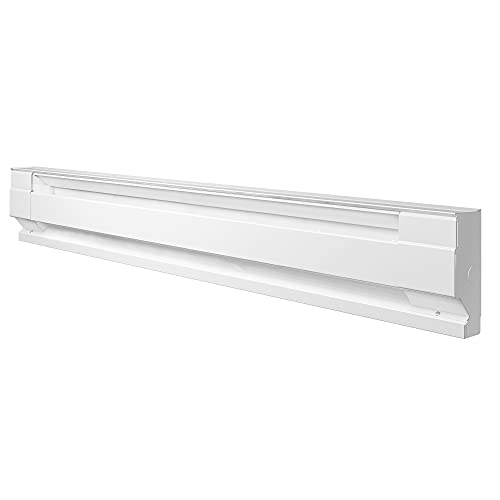
Plug-in heat is the better choice when you want to start warming the room today, move the heater later, or avoid opening a wall. Plug the Cadet Portable Electric Baseboard Heater 1500W 120V Plug In directly into a wall outlet—never an extension cord or power strip—and keep 3 feet of clearance around it. Hardwired baseboard heaters make a cleaner permanent installation and can serve a dedicated circuit, but wiring, a wall thermostat and electrical work add labor and usually require a licensed electrician.
Running cost depends on wattage, hours and your electric rate, not the heater’s name or shape. A 1,500 W heater running 8 hours a day uses 12 kWh per day; the cost block below uses an assumed rate of 17 cents per kWh so you can replace that rate with your bill’s figure.
| Heater | Watts | Per hour | Per day (8 h) | Per month (30 days) |
|---|---|---|---|---|
| 1,500 W baseboard heater | 1,500 W | 26¢ | $2.04 | $61.20 |
Cheap Ways to Warm a Small Space
The cheap way to warm a small space is to match the heater’s wattage to the room instead of buying 1,500 W by reflex. A 500 W or 750 W baseboard heater can cover a small, reasonably insulated room or a spot near a desk while using less electricity at full power.
Small spaces heat up quickly with compact, low-wattage heaters that plug into standard outlets. These units use between 500 and 1,500 watts, enough to warm rooms up to about 150 square feet. They’re portable and affordable, but expect higher electricity costs if you run them for long periods.
Portability matters for spot heating: a plug-in unit can follow you from a bedroom to a home office, while a fixed baseboard heater makes more sense when one small room needs regular heat. Choose a model with a thermostat so it shuts off at the set temperature rather than heating continuously; the thermostat saves energy by cycling the heating element, not by creating free heat.
Quiet convection baseboard heat is usually less distracting than a fan heater because warm air rises naturally instead of being pushed through a motor and grille. Fan heaters can warm the air near you faster, but their noise and airflow bother some sleepers and desk workers. If portability is your priority, compare best rated space heaters; if silence matters more, a small baseboard heater is the calmer option.
A budget heater still needs tip-over protection, overheat protection and a UL, ETL or CSA listing. Plug it straight into a wall outlet, keep 3 feet of clearance, and don’t run it while sleeping or away from home unless the manufacturer specifically says the model is designed for that use.
Using Space Heaters to Warm Plumbing Pipes Safely
Using a space heater near plumbing pipes can prevent freezing, but it requires caution. Keep the heater at least three feet away from pipes and never leave it unattended. Choose electric models with tip-over and overheat protection, and avoid fuel-burning heaters indoors unless they’re specifically rated for indoor use with proper ventilation.
Keep the heater on a solid, level surface with at least 3 feet of clearance from curtains, boxes, furniture and other combustibles. Don’t aim it into a wall, under a cabinet or at exposed pipe insulation, and don’t use an extension cord or power strip. A portable heater also shouldn’t run unattended unless its manufacturer specifically allows that use.
A 120V baseboard heater is usually the wrong tool for one vulnerable pipe. Its heating element warms air along the room’s length, so it provides even convection heat rather than the focused warmth needed at a pipe in a crawlspace, cabinet or exterior wall. Open the cabinet doors beneath a sink if the room itself is heated, then protect the pipe with properly fitted pipe insulation.
For a pipe that routinely freezes, use insulation first and investigate a listed pipe heat cable or other plumbing-approved freeze-protection method. Follow the cable’s installation instructions exactly; never overlap heat cable unless the product allows it. If a pipe is already frozen, shut off the water if you can, use gentle room heat and call a plumber when the pipe is cracked, leaking or inaccessible.
How to Warm Spaces With No Electricity
With no electricity, warm the space with a properly rated propane, kerosene or wood-burning heater; a 120V baseboard heater cannot operate without a powered outlet. Pick the fuel and appliance for the space, then plan ventilation, carbon-monoxide detection and safe exhaust before you light anything.
An indoor-rated propane heater can work during an outage when the manual permits that use and the unit has the required safety features, including an oxygen-depletion sensor where specified. Kerosene heaters must burn 1-K kerosene only—never gasoline. A wood stove needs listed clearances, a suitable chimney or vent and installation that follows local code.
Fuel combustion consumes oxygen and can produce carbon monoxide, so provide the ventilation the heater manual requires and keep a working CO alarm in the space. Never use a patio, outdoor, torpedo or construction heater indoors, in a tent or inside a vehicle cabin. Those machines belong outside; the fumes are not negotiable.
Wood stoves also need an annual chimney inspection and sweeping, and you should burn clean, dry firewood rather than trash or treated wood. Keep fuel containers, firewood and other combustibles outside the heater’s listed clearance area. A fuel heater is never a reason to skip a smoke alarm.
For a garage or workshop, a dedicated guide such as a heater to warm up your garage can help you compare fuel types, venting and installation limits. If you can provide a small battery supply for a fan and controls, a diesel air heater may be another category to research, but its exhaust must leave the occupied space; it isn’t a no-power substitute by itself.
Safety and Certification You Should Never Skip
The safest 120V baseboard heater is one with a UL, ETL, or CSA listing, working overheat protection, and installation that matches its plug-in or hardwired design. Those marks indicate the heater was evaluated against applicable electrical safety requirements; they don’t excuse damaged cords, blocked airflow, or improvised wiring.
Check the Heater Before Plugging It In
- Look for a visible UL, ETL, or CSA listing on the heater, cord, packaging, or installation label.
- Choose a model with overheat protection that shuts the heater off if its internal temperature rises too far.
- For portable units, look for a tip-over switch that cuts power when the heater is knocked over.
- Plug the heater directly into a wall outlet. Never use an extension cord, power strip, or plug adapter.
- Keep at least 3 feet between the heater and curtains, bedding, furniture, clothing, paper, and other combustibles.
A 1,500 W heater draws about 12.5 amps from a standard 120V circuit, so a power strip can be overloaded before its short cord or thin internal parts get warm enough to warn you. Check the plug and receptacle during the first hour of use; stop if either becomes hot, loose, discolored, or smells like burning plastic.
Hardwired baseboard heaters require the correct circuit, wiring, thermostat, and clearances for that model. Have a qualified electrician install or replace one, and turn off the breaker before anyone removes a cover; a plug-in heater such as the Cadet Portable Electric Baseboard Heater 1500W should stay plug-in rather than being converted to hardwired service.
Questions People Ask
Can I use a 120V baseboard heater in a bathroom?
How long does a 20 lb propane tank last compared to electric heating?
Do I need a thermostat with a plug-in baseboard heater?
Is it safe to leave a baseboard heater on overnight?
Can I use a space heater to prevent frozen pipes?
What is the difference between convection and radiant baseboard heaters?
How much electricity does a 1,500 W baseboard heater use per hour?

I am a mechanical engineer and love doing research on different home and outdoor heating options. When I am not working, I love spending time with my family and friends. I also enjoy blogging about my findings and helping others to find the best heating options for their needs.
Related guides

Best Heated Rear Window Repair Kit UK with Fast 30-Minute Fix
Compare top heated rear window repair kits in the UK for durability, conductivity, and ease of use. Find…
Best Aluminum For Heat Transfer – My Go-To Choice
Need faster cooling? Compare alloys and pick the Best Aluminum For Heat Transfer for efficient, real-world thermal performance…
Cozy Nights: Best Electric Heated Mattress Pad Ever!
Cozy up with the best electric heated mattress pad! Enjoy warmth and comfort all night long—your perfect sleep…