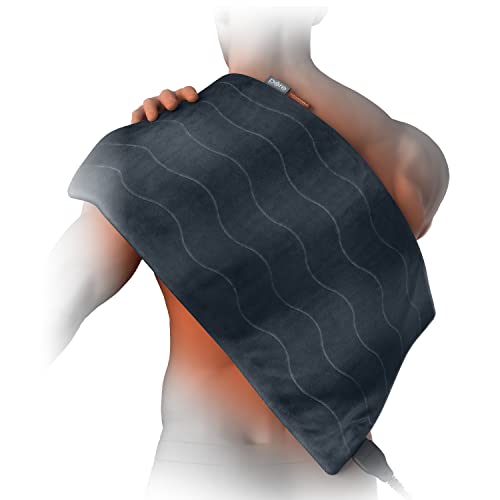
The UTK Far Infrared Heating Pad is the best pick for most people because its 23.5 × 16-inch surface covers more of your back than the 12 × 24-inch pads, and its temperature adjusts from 103°F to 159°F. Choose the oversized Pure Enrichment wrap instead if you want coverage across more of your body.
Infrared pads are electric heating pads, not room heaters. They warm the area they touch; they won’t heat a bedroom or replace a central heating system.
The five picks differ most in coverage, timer options, and how they stay in place. Stone-based designs and far-infrared labels don’t establish that a pad penetrates deeper or treats a medical condition.
Best Infrared Heating Pads By Use
#1Best Overall
UTK Infrared Heating Pad for Back
Best for Most people who want broad back coverage and precise temperature control
The 23.5 × 16-inch surface covers more area than the 12 × 24-inch pads, and its 103°F to 159°F range adjusts in 1-degree increments. The 72 jade and tourmaline stones, 4-hour auto-off and memory function suit longer relaxation sessions.
Size 23.5 × 16 inchesTemperature range 103°F to 159°FStones 52 jade and 20 tourmalineAuto shut-off 4 hoursHeating area EMF Almost zero
Why it made the cut
Broad 23.5 × 16-inch coverage
103°F to 159°F temperature adjustment
4-hour auto-off and memory function
Good to know
Heavier stone-filled design may feel less flexible
The highest setting may be too hot for some users
Skip it if Skip it if you want a lightweight wrap that hugs your body or offers moist heat.
Best for Anyone who wants coverage across the back, legs, chest, abdomen and shoulders
The 35 × 27-inch design is the clear choice for covering much more than your back at once. Four heat settings from 110°F to 140°F, a detachable LED controller and a storage bag make the oversized format easier to manage between uses.
Size 35 × 27 inchesHeat settings 4Temperature range 110°F to 140°FFabric MicrominkController Detachable LED controller
Why it made the cut
Largest 35 × 27-inch coverage
Covers the full body and multiple large areas
Detachable controller and storage bag
Good to know
Too large for focused, small-area use
The broad shape may be cumbersome in a chair
Skip it if Skip it if you mainly need a compact pad for one shoulder, knee or lower back.
Best for Back and shoulder comfort when you want a weighted pad that stays in place
The 2.4-pound weighted 12 × 24-inch pad conforms to your body, and its adjustable strap helps hold it around the shoulders, back or waist. Six heat settings from 100°F to 150°F, dry or moist heat and 30-, 60- or 90-minute shut-off options give you a flexible routine.
Size 12 × 24 inchesWeight 2.4 poundsTemperature range 100°F to 150°FPower 85WAuto shut-off 30, 60 or 90 minutes
Why it made the cut
Weighted design with adjustable strap
Dry or moist heat option
Six settings and three shut-off times
Good to know
The 2.4-pound weight may feel heavy for some users
Moist heat requires extra preparation
Skip it if Skip it if you want the lightest pad or a full-body surface.
Best for Back, neck and shoulder use when you want dry or moist heat
The 12 × 24-inch format gives you extra-long coverage without the bulk of a full-body wrap. Four settings from 110°F to 140°F, InstaHeat technology and a detachable LED controller make it a straightforward pick for targeted warmth.
Size 12 × 24 inchesHeat settings 4Temperature range 110°F to 140°FTechnology InstaHeatController Detachable LED controller
Why it made the cut
Dry or moist heat capability
Extra-long 12 × 24-inch size
Heats in seconds with four settings
Good to know
Less coverage than the oversized body wrap
The data does not specify the auto shut-off duration
Skip it if Skip it if hands-free positioning or a weighted design matters more than moist heat.
Best for Users who want six heat levels and a 20- to 90-minute timer
Six heat levels let you move from gentle to deeper warmth, while the 20- to 90-minute auto timer handles short, defined sessions. Its 65 tourmaline stones, flame-retardant layers and NTC overheating protection add useful design details for regular back use.
The best infrared heating pads for most back use are sized to cover the spot you want warm; choose a 35 × 27-inch wrap for broad body coverage or a 12 × 24-inch pad for a smaller target. Compare dimensions first, then temperature settings, timer controls and how the pad stays in place. Infrared heating technology uses electrical energy to produce heat; infrared is a form of energy transfer, not proof of a special health effect.
Pick
What the supplied specs tell you
Best for
UTK Far Infrared Heating Pad — Best Overall
23.5 × 16 inches; 103–159°F
Back coverage with a wider temperature range
Pure Enrichment PureRelief Pro Far Infrared XL — Best for Targeted Coverage
12 × 24 inches; four settings from 110–140°F
A smaller, more focused area
Pure Enrichment PureRelief Pro Far Infrared Oversized Body — Best for Broad Coverage
35 × 27 inches; four settings from 110–140°F
Warming across a broader area
Comfytemp Far Infrared Heating Pad — Best Timer Choices
Six heat levels; 20–90-minute timer
Choosing among timer lengths
BOB AND BRAD TheraHeat — Best Hands-Free
Six heat settings
A weighted pad option
Choose from the listed dimensions and controls; product data does not give wattage for most picks.
Far infrared heating means heat produced using far-infrared energy; the pad still warms electrically. Claims about deeper penetration, circulation, inflammation or pain relief aren’t established by these product specifications. Timer and auto-off details matter for controlling a session, while the way a pad stays in position matters if you need it to remain over one area. Check the individual product details for those features; don’t assume every model has the same controls.
The UTK suits you if you want its 23.5 × 16-inch surface and broader stated temperature range; skip it if you need wraparound coverage. The 12 × 24-inch Pure Enrichment XL is the targeted pick, but it covers less area than the body wrap. Choose the 35 × 27-inch Pure Enrichment wrap for broad coverage, not if a smaller pad better fits your target. Comfytemp is the timer-focused choice; skip it if you don’t need a selectable timer. BOB AND BRAD offers six settings, but the supplied specs don’t give its temperature range or timer details.
Want the practical setup steps after choosing a pad? See this guide to infrared heating.
Match The Pad Size To The Area
Infrared heating warms the area beneath the pad: its dimensions describe coverage, not room-heating capacity or how much heat reaches a person. Infrared waves can be used for heating when an electrically powered pad converts energy into heat; the size helps you judge placement, not the strength of a claimed health effect.
Compare the coverage
Say you want to warm a broad area across your body: the 35 × 27-inch Pure Enrichment wrap covers more surface than the 23.5 × 16-inch UTK or either 12 × 24-inch targeted pad. That doesn’t make one size right for every person or sore spot; match the pad to the area you want beneath it.
Broad coverage35 × 27 in
UTK surface23.5 × 16 in
Targeted pads12 × 24 in
85 W
BOB AND BRAD rated power
At an assumed electricity rate of $0.17/kWh, one hour at that rating is 85 ÷ 1,000 × 1 × $0.17 = $0.01445, or about 1.45 cents. Wattage isn’t supplied for the other listed products, so their running costs can’t be compared from this data.
Heater
Watts
Per hour
Per day (1 h)
Per month (30 days)
BOB AND BRAD TheraHeat, 85 W
85 W
1.4¢
1.4¢
43¢
Calculated at 17¢ per kWh. Assumes the pad draws its full 85 W for one hour each day, 30 days a month, at $0.17/kWh.
An eight-hour calculation would be 85 ÷ 1,000 × 8 × $0.17 = $0.1156, or about 11.6 cents, if it drew 85 W continuously. That’s only a hypothetical comparison: the Comfytemp’s selectable 30-, 60- or 90-minute shut-off isn’t designed for continuous eight-hour use.
Use Infrared Pads With Care
Infrared heating pads can be safe when used as directed, but they can also cause burns or overheating—especially with prolonged contact, a high setting, reduced skin sensation, or use during sleep. Far-infrared heating pad dangers are the same practical heat risks: don’t sleep on one or leave it running unattended, and don’t lie on it unless its manual specifically allows that use. Check your skin during use and follow the pad’s exact instructions and shut-off timer.
Ask your clinician before use if you have a pacemaker, another implanted electronic device, a metal implant near the area, reduced skin sensation, or another relevant medical concern. Implant types differ, so check both the implant instructions and the pad manual rather than assuming every metal implant is unsafe—or safe.
Before You Switch It On
Place the pad on a stable surface and use it only as its manual directs.
Keep the controller and electrical connector dry.
Plug it directly into a wall outlet, never an extension cord or power strip.
Stop using it if the pad, cord, or plug is damaged or unusually hot.
Stop If Heat Feels Wrong
Turn the pad off if your skin becomes painful, unusually red, or numb. Don’t keep increasing the setting to push through discomfort.
Certification claims vary by product: the supplied data identifies the BOB AND BRAD TheraHeat as ETL certified, but doesn’t establish that certification for the other pads in this guide. For a setup walkthrough, see infrared heating pad safety guidelines.
Far-Infrared Claims Need A Reality Check
Infrared heating pads can provide warmth, but the product descriptions here don’t establish that far-infrared wavelengths, jade, tourmaline, or ceramic beads penetrate farther or provide medical benefits beyond ordinary heat. The pads may be useful as comfort devices; that’s different from proving they cure pain, improve circulation, or treat a condition.
How does infrared heating work? Infrared is a type of radiation that transfers energy as heat when it’s absorbed by a surface. That explains a heating effect, not a special health outcome. So, are infrared heating pads effective? They can warm the area beneath the pad; the available descriptions don’t prove extra therapeutic effects.
Myth
If a pad uses far-infrared, its added medical benefits are proven.
Fact
The term describes a real type of radiation, but the label alone doesn’t demonstrate greater penetration or treatment benefits. An infrared heating pad isn’t automatically a scam, either: judge its heating function by checkable details such as dimensions, temperature range, timer, and power, not unverified claims.
Why can’t you use an infrared heating pad with metal implants? There isn’t a reliable blanket rule from the product information here. Implants vary; check the implant and pad instructions and ask your clinician, especially if the implant is near the heated area. If you’re comparing options, infrared heating pad running costs are another measurable feature to weigh.
Questions People Ask
Are infrared heating pads safe for people with heart issues or a pacemaker?
Ask your cardiologist or device clinic before using one, particularly if you have reduced skin sensation or circulation. Keep the pad and its controller away from your implanted device, and follow the device and pad manufacturers’ instructions; don’t assume a heat setting is safe for you.
Why shouldn’t you lie on an infrared heating pad?
Your body weight can compress the pad, trap heat against your skin, or strain its wiring. Use it in the position and manner the manual allows, and don’t sit or lie on it unless the manufacturer specifically says that’s safe.
Can an infrared heating pad cure a muscle knot?
No heating pad is established as a cure for a muscle knot. Warmth may temporarily ease discomfort or help you relax, but persistent, worsening, or unexplained pain deserves medical advice rather than a higher heat setting.
What does far-infrared heating mean in a heating pad?
It describes infrared radiation emitted by the pad, which warms objects and skin it reaches rather than heating the room like a space heater. The label alone doesn’t show that the heat penetrates deeper or works better than other heating pads.
How much electricity does an 85-watt heating pad use in one hour?
An 85-watt pad running for one hour uses 0.085 kWh: 85 ÷ 1,000 × 1. At 17 cents per kWh, that’s about 1.45 cents; actual use can be lower if the pad cycles off.