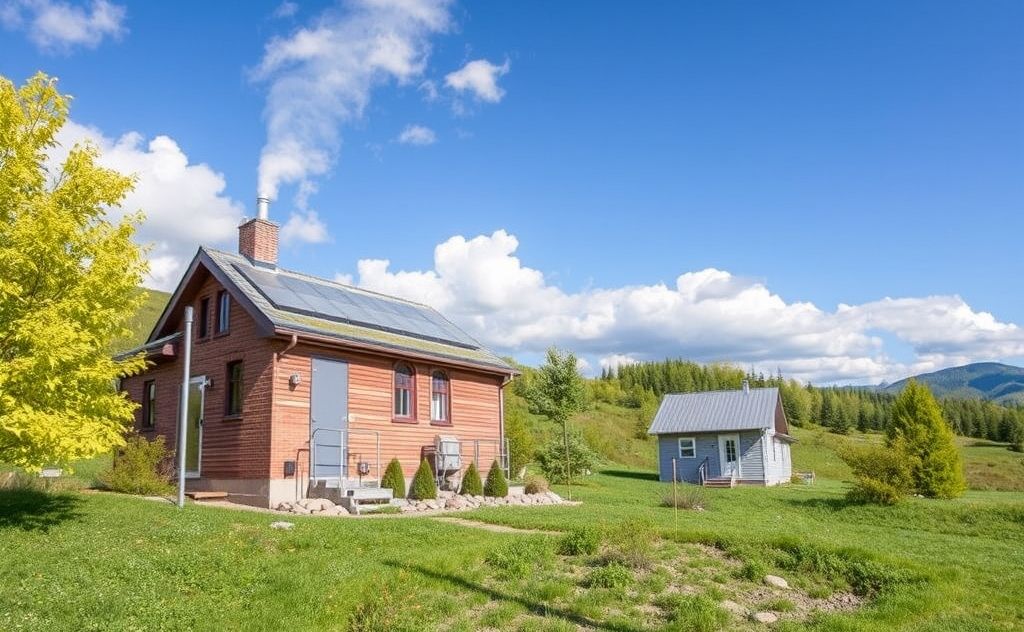
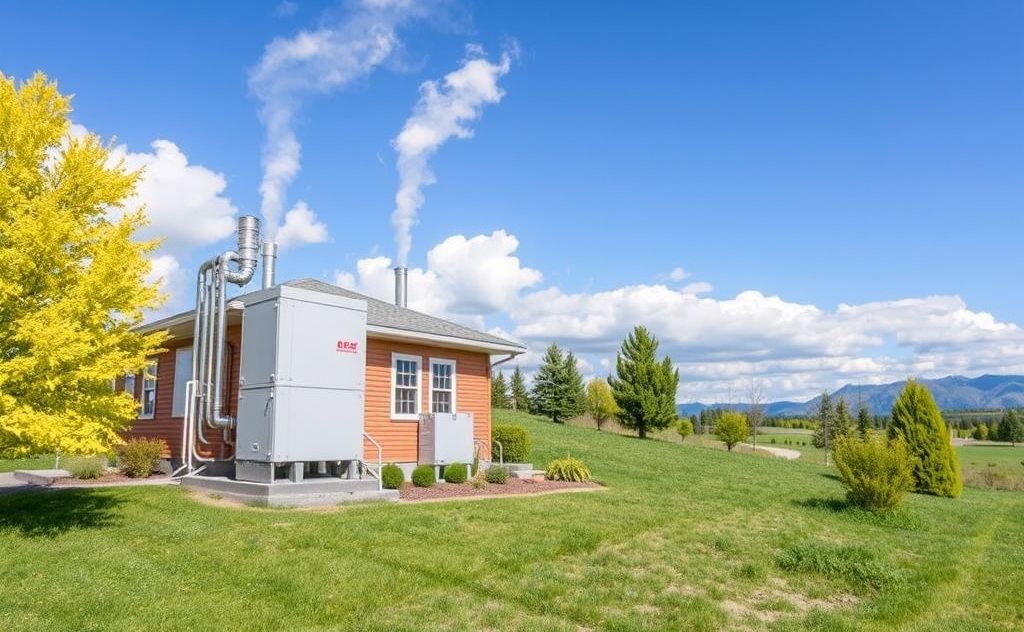
You know that feeling when you open your utility bill mid-January and just stare at the number? A lot of homeowners live with it, thinking that’s just the cost of comfort. They swap out old furnaces for high-efficiency gas units, maybe add insulation. But the bill only drops so much. Geothermal heating and cooling works differently. It pulls heat from the ground instead of burning fuel or fighting outdoor air temperatures. The result is a system that cuts your energy use by 30% to 70% compared to conventional HVAC.
By the end of this article you’ll know exactly what those savings look like as dollar figures. You’ll see how tax credits, home value increases, and low maintenance costs stack up. I’ll give you real numbers, real conditions, and the trade-offs nobody talks about. No fluff, no generic advice.
GEOCOOL
1.5 to 2 Ton Horizontal Ground Loop…
- Installation by a licensed professional required
- Kit Includes: 2 loop pipes, 1 insulted header, 1 Flow Center, 1 hose kit, 5 gallon transfer fluid
- This kit ships on two pallets
If you’re serious about making the switch, you need a reliable path from plan to installation. The GEOCOOL 1.5 to 2 Ton Horizontal Ground Loop Geothermal Installation Kit is one of the few complete kits on the market that includes everything for a horizontal loop system: two loop pipes, an insulated header, a Flow Center, hose kit, and five gallons of transfer fluid. It ships on two pallets and requires a licensed professional to install. That’s not a casual weekend project, but it gives you a single-source solution instead of piecing together components from different vendors.
Benefit 1: Drastic Operating Cost Reduction
Ground temperature stays between 45°F and 75°F year-round depending on your latitude. A geothermal heat pump shifts heat into or out of that stable reservoir. The efficiency is measured by COP (Coefficient of Performance). Modern units hit a COP of 4.0 to 5.0, meaning for every dollar of electricity you put in, you get $4 to $5 worth of heating or cooling.
Compare that to a high-efficiency gas furnace at 95% AFUE, which gives you $0.95 of heat per dollar of gas. Electric resistance heat gives you barely $1 of heat per dollar. A typical 2,000-square-foot home in the Midwest – heating and cooling – spends about $2,500 a year on conventional energy. Switch to geothermal and that drops to roughly $900 to $1,200 annually. That’s $1,300 to $1,600 saved every single year.
The exact numbers depend on your local electricity rates, ground loop design, and climate zone. In colder northern areas the savings tilt more toward heating. In hot southern climates the cooling savings dominate. I’ve seen a house in Vermont save $2,200 in its first winter alone because it replaced electric baseboard heat.
Benefit 2: The 30% Federal Tax Credit (and Then Some)
The Inflation Reduction Act extended the 30% federal tax credit for geothermal heat pumps through 2032. No cap. No phase-down until after 2032. If your installed system costs $25,000 (typical for a 4-ton system with horizontal loops), you get a $7,500 federal tax credit. That’s not a deduction – it’s a direct credit against your tax liability.
Many states add their own incentives. New York offers up to $1,200 per ton. Illinois has the Illinois Shines program that can pay $5,000 to $8,000. Massachusetts gives $8,000 through Mass Save. Some electric co-ops also offer rebates. Combine all that and your net out-of-pocket can drop by 40% to 50%.
The catch: you must install a system that meets ENERGY STAR criteria and have it done by a licensed contractor. That’s not a problem because no reputable installer would put in an undersized or non-qualifying unit. Keep your receipts and the manufacturer’s certification. File IRS Form 5695 with your taxes.
Benefit 3: Home Value Appreciation That Pays Back
Homes with geothermal systems sell faster and for more money. The Appraisal Institute has noted that appraisers often add a value increment of $10,000 to $20,000 for an installed geothermal system, depending on the local market. A 2026 study by the National Renewable Energy Laboratory found that homes with geothermal heat pumps sold for about 4% more than comparable homes without.
On a $400,000 house, that’s an extra $16,000. Combined with the tax credit, you’ve already recovered a big chunk of the upfront cost before you even turn the system on. Plus, buyers view geothermal as a premium feature – something that separates your listing from every other house with a standard HVAC system.
I’ve talked to real estate agents who say the biggest hurdle is buyer education. Most people don’t understand the numbers. If you’re selling, prepare a one-page summary of your annual energy savings and the system’s age. That simple document can close the deal faster.
Benefit 4: Stubbornly Low Maintenance Costs
A gas furnace needs annual burner inspections, heat exchanger checks, and occasional flame sensor cleaning. Air conditioners have condensers that sit outside and corrode. Geothermal systems have most mechanical parts inside your basement or utility room. The outdoor ground loop has no moving parts. Buried HDPE pipe lasts 50 years or more.
Annual maintenance for a geothermal system is straightforward: change the air filter every 1-3 months, check the fluid pressure and antifreeze concentration, clean the indoor coil every few years, and have a professional do a refrigerant check every 3-5 years. That’s about $150 to $250 a year versus $300 to $500 for a conventional system with a gas furnace and AC.
The big one: no outdoor condenser means no damage from hail, falling branches, or lawnmower rocks. No refrigerant line sets exposed to the weather. No corrosion from road salt or coastal humidity. I’ve seen 20-year-old geothermal heat pumps still running at factory efficiency because the loop kept the temperatures stable.
Cost Comparison: Geothermal vs. Other HVAC Systems
| System Type | Typical Upfront Cost (4-ton installed) | Annual Operating Cost (2,000 sq ft, Midwest) | Lifespan | Annual Maintenance | Noise Level (indoor/outdoor) |
|---|---|---|---|---|---|
| Geothermal heat pump (horizontal loop) | $20,000 – $30,000 | $900 – $1,200 | Heat pump 20-25 yrs, ground loop 50+ yrs | $150 – $250 | Very quiet (both indoor and outdoor) |
| High-efficiency gas furnace + AC | $10,000 – $15,000 | $2,200 – $2,800 | Furnace 15-20 yrs, AC 10-15 yrs | $300 – $500 | Moderate (furnace fan + outdoor compressor) |
| Air-source heat pump (cold climate) | $8,000 – $12,000 | $1,800 – $2,400 | 12-18 yrs | $250 – $400 | Quiet indoor, moderate outdoor fan noise |
| Electric resistance (baseboard or furnace) | $3,000 – $6,000 | $3,500 – $5,000 | 15-30 yrs (no compressor) | Minimal (no filters) | Silent |
The table doesn’t include tax credits or incentives, which change the picture dramatically for geothermal. Run your own numbers with local utility rates and available rebates.
Benefit 5: Protection from Fuel Price Volatility
Natural gas prices swing wildly. In 2026 they nearly doubled in some regions. Propane can spike even worse. Electricity prices are more stable because they come from a mix of sources. Geothermal uses electricity to run the heat pump and the circulating pump. A typical system draws about 1.5 to 2.5 kW while running – about as much as a hair dryer.
Because the heat pump moves heat rather than creating it, your heating cost stays low even if electricity rates rise. If rates go up 10%, your geothermal bill goes up 10% on a small base. Your neighbor with a gas furnace sees an 80% increase on a large base. That’s a massive difference over 20 years.
Some geo owners I know treat their operating costs like a fixed utility bill. They budget $100 a month for heating and cooling and rarely go over. That kind of predictability matters for retirees or anyone on a fixed income.
Benefit 6: Longer System Life Means Lower Replacement Cost Per Year
Spread the upfront cost over the system life and geothermal often comes out ahead. A $25,000 geothermal system lasting 25 years costs $1,000 per year before tax credits. A $12,000 gas furnace and AC combo lasting 12 to 15 years costs $800 to $1,000 per year – and that doesn’t include the higher operating costs or eventual replacement of the condenser and furnace.
But here’s the kicker: the ground loops last 50+ years. When the heat pump dies in year 22, you replace only the heat pump (about $6,000 to $9,000 installed). The loop stays put. The next heat pump bolts right onto the same piping. Compare that to replacing an entire outdoor AC unit plus coil every 15 years.
I’ve seen systems where the original loop was installed in the 1980s and the homeowner is on their third heat pump. The loop still works perfectly. That’s a level of durability you just don’t get from rooftop gear.
Benefit 7: No Outdoor Unit Means No Equipment Theft or Vandalism
This one is more common than you’d think. Copper refrigerant lines and compressors get stolen from backyards all the time. A stolen AC condenser can cost $4,000 to replace and leaves you without cooling for weeks. Geothermal has nothing outdoors except flush vaults or buried headers. There’s nothing to steal.
In one neighborhood near me, three AC units were stripped overnight. My friend’s geothermal system? The only visible sign is two small plastic covers flush with the lawn. The thieves walked right past them. That’s a small benefit until it saves you a headache.
Frequently Asked Questions
How long does it take for a geothermal system to pay for itself?
Typical payback periods range from 5 to 10 years after federal and state incentives. If you save $1,500 a year on energy and get $7,500 in tax credits on a $25,000 install, your net out-of-pocket is $17,500. At $1,500 annual savings you break even in under 12 years. With state rebates that can drop to 6 to 8 years. Payback is faster in regions with high electricity or fuel costs.
Will geothermal work in a cold climate like Minnesota or Maine?
Yes. Ground temperature below the frost line stays around 45°F to 50°F even in northern states. Geothermal heat pumps are designed to extract heat from that source. Modern units with variable-speed compressors and desuperheaters perform well down to outdoor temperatures that would cripple an air-source heat pump. You do need proper loop sizing and antifreeze. It works.
Can I retrofit geothermal into my existing ductwork?
Most of the time yes. Geothermal heat pumps use standard ductwork just like a forced-air furnace. The installer may need to adjust the supply air temperature and airflow, but it’s usually a straightforward connection. If your ducts are undersized or leaky, you’ll want to fix those issues first anyway – do that before the geothermal goes in.
What maintenance does a geothermal system actually require?
Change the air filter every 1 to 3 months. Check the loop pressure and antifreeze concentration once a year. Have a professional inspect the heat pump, clean the indoor coil, and test refrigerant charge every 2 to 3 years. That’s about it. The ground loop is maintenance-free. No outdoor coil to clean, no snow removal, no exposed refrigerant lines.
How much land do I need for a horizontal ground loop?
A typical 4-ton system needs roughly 400 to 600 linear feet of trench for horizontal loops. With two circuits in parallel you need two trenches about 200-300 feet each. The trenches are usually 4 to 6 feet deep and spaced 10 to 15 feet apart. You need open land without major tree roots, utilities, or bedrock. A half-acre lot is usually enough. Vertical loops (boreholes) work if you have minimal land.
What to Do With This Information
- Get three quotes from licensed geothermal installers – don’t accept the first number.
- Run a Manual J load calculation for your house to confirm the correct system size.
- Check the DSIRE database for your state and local utility rebates before you buy anything.
- Compare the 30% federal tax credit against your expected tax liability; if you can’t use it all in one year, carry it forward.
- Ask for the loop design details – should include pressure drop calculations, antifreeze type, and pipe diameter.
- Monitor your energy use for a full year before and after installation to verify the savings.
- Bookmark the geothermal energy efficiency page for a deeper look at the numbers, and don’t skip the long-term geothermal benefits article that covers system longevity in detail – both will help you make an informed decision.
Related guides
How Geothermal Heat Exchangers Work: The Complete Guide
Heat exchangers in geothermal systems transfer thermal energy between the ground and fluid, efficiently heating or cooling buildings…
6 Types Of Geothermal Heating Systems Explained
You've heard the promise: a geothermal heat pump can slash your heating bills by 30 to 60 percent.…
Geothermal System Costs: What to Expect for Installation
You opened your last electric bill and felt that familiar jolt. Maybe your gas furnace is getting old,…