A thermostat not working is usually caused by dead batteries, lost power, loose wires, or a wrong mode setting. Start with the display, the breaker, and the system switch before you pull the wall plate or call for service.
A bad thermostat can waste money fast. In heat mode, you may burn fuel or run a space heater longer than needed; in cool mode, you can sit in a house that never catches up.
Get the basic checks right first. The wrong fix can leave you with no heat, no cooling, or a service call for a problem that was only a tripped breaker.
The essentials
Check power, mode, and batteries first; those fix a lot of dead thermostats in under a minute.
If the screen is blank, look for a breaker, loose wiring, or an empty battery compartment before replacing the thermostat.
A thermostat that looks normal can still be misreading room temperature because of dirt, bad placement, or a failed sensor.
For gas, fuel-burning, or hot-water systems, shut the system down if you smell gas, see soot, or hear boiling or banging.
Replace a thermostat sooner than repairing it if the display is dead, the sensor is failed, or the unit has no clean power path.
Thermostat Not Working: What To Check First
Most thermostat problems start with a power or setting issue, and a one-minute check of the display, mode, breaker, and system switch often restores control. If the thermostat is not working, the room temperature may keep drifting because the heater or air conditioner never receives a call, or because the system receives it but fails to respond.
Stop Before Opening Anything
For a gas, propane, oil, or other fuel-burning system, a boiler, or a heater that could overheat, shut off power or fuel and stop if you smell gas, see scorch marks, or hear hissing. Don’t remove the thermostat cover or touch wiring until the system is safe; gas odors call for leaving the area and contacting the appropriate emergency or fuel service.
60-Second Checks
Set the mode to Heat or Cool, rather than Off, Fan Only, or another inactive setting.
Set the target temperature above the room temperature for heat, or below it for cooling.
Replace the thermostat batteries if the display is dim, blank, or showing a battery warning.
Check the HVAC breaker in the electrical panel and reset it once if it has tripped; don’t keep resetting it.
Confirm the furnace, air-handler, or boiler service switch is on.
Look at the filter. A packed filter can make a system stop or trip its protection.
Decide whether the display is blank, frozen, or normal but unresponsive.
A working thermostat should call for heating or cooling within a few minutes when the setpoint is on the correct side of the room temperature. The equipment should run until the room reaches that setting, then stop or enter its normal idle cycle. If your home thermostat isn’t working properly but the display looks normal, the fault may be downstream in the furnace, air handler, boiler, wiring, or safety control.
A Normal Display Doesn’t Prove Much
A thermostat can look normal while its internal relay, temperature sensor, or low-voltage power supply has failed. The display may show the room temperature and setpoint even though no signal reaches the heater, so avoid assuming the thermostat is the only problem.
In short
Check the mode, setpoint, batteries, breaker, system switch, and filter before touching wiring. If the display is normal but the room temperature keeps moving away from the setpoint, the thermostat may be fine and the heating or cooling equipment needs attention.
Blank Screen, Dead Display, Or Wrong Mode
A blank thermostat usually has lost power, while a lit thermostat that does nothing is often in the wrong mode, following a schedule, or unable to close its relay. A smart thermostat stopped working can mean the HVAC power is fine but Wi-Fi, app sync, the C-wire, or the transformer has failed.
Symptom
Likely cause
First check
No screen at all
Dead batteries or lost 24-volt power
Replace batteries; check the furnace switch and breaker
Dim screen or delayed response
Weak batteries, low control voltage, or a failing thermostat
Install fresh batteries and wait for a normal display
Screen works, no heat or cooling
Wrong mode, schedule, system switch, or relay issue
Select Heat or Cool, raise or lower the setpoint, and listen for a click
Smart AC thermostat not working in the app
Wi-Fi loss or app sync problem
Test the thermostat manually before troubleshooting the app
Outlet thermostat not working
Loose plug, tripped GFCI, or overloaded control
Reset the GFCI and check the plug and device load rating
Start with the part supplying power or the setting controlling the call.
A thermostat can be on and still not be working: the display may respond while the mode is Off, the schedule may be overriding your setting, or the relay may fail to send the heating or cooling signal. If the screen is blank, check power first; if it lights up, test manual mode before assuming the HVAC equipment is bad.
1
Check the display and batteries
Press a button and watch for a normal response. Replace removable batteries with fresh ones, then confirm the display is fully visible rather than dim or delayed.
2
Check the equipment power
Find the furnace or air-handler switch and set it on. Check the service disconnect near the equipment and the matching breaker in the electrical panel. If a breaker trips again, stop resetting it and call a qualified technician.
3
Test the setting manually
Set Heat or Cool, cancel the schedule if the thermostat allows it, and move the setpoint several degrees past the room temperature. A working relay may click after a short built-in delay.
4
Check plug-in controls
For an outlet thermostat, push the plug fully into the receptacle, reset any tripped GFCI, and confirm the heater or fan’s load is within the thermostat’s rating. The appliance can be fine even when its external control has failed.
Smart thermostat check
Wi-Fi loss affects app control, not necessarily the thermostat’s local buttons. A failed C-wire or transformer can make the screen unstable or dead, while a wrong schedule can make a healthy unit appear broken. If manual mode works but the app does not, troubleshoot the network separately.
If the unit works but its control strategy is poor—for example, a portable heater needs a better room sensor—an external thermostat for a space heater can solve that without replacing the heater. Don’t remove a wall plate or handle thermostat wires until power is off at the breaker.
Why The Room Temperature Keeps Missing The Setpoint
When thermostat temperature control isn’t working correctly, the displayed temperature can be accurate at the wall while the room still overheats or stays cold. Sunlight, a supply vent, a draft, or a thermostat behind a door can fool the control point. A home thermostat that appears alive but misses its setting may have a location problem, an airflow problem, or a sensor offset—not a dead display.
A clogged filter or weak blower airflow can leave heat trapped near the furnace, while the room takes longer to reach the target. Short cycling creates the opposite pattern: the furnace or air conditioner starts and stops before the room has mixed evenly, so the thermostat may overshoot, undershoot, or bounce around the setpoint. If your AC isn’t working while the thermostat display is normal, the thermostat may be failing to call for cooling, but a tripped outdoor-unit breaker, frozen coil, or equipment fault can produce the same symptom.
Worked example
Say the thermostat is set to 24°C, but the room climbs to 27°C after an hour. That three-degree rise suggests the heat is continuing after the call should have ended, or the thermostat is sensing cooler air than the occupied part of the room. Check the thermostat location, airflow, and relay operation before blaming the temperature setting.
Setpoint24°C
Room reading after one hour27°C
Difference3°C
1
Compare temperatures
Place a separate thermometer near the thermostat, away from sunlight and vents, and compare readings after the room has settled. A large difference points toward location or sensor trouble.
2
Remove local influences
Keep lamps and electronics away from the thermostat, open a door that blocks it, and check for a draft behind the wall plate. Don’t place furniture or curtains over the nearby return or supply openings.
3
Check airflow
Replace a visibly dirty filter, confirm supply registers are open, and listen for a weak or noisy blower. Turn power off before removing any panel; leave wiring and line-voltage parts to a qualified technician.
4
Clean and calibrate
With power handled safely, gently remove dust from the thermostat faceplate. Recalibrate only when the manual provides that option; otherwise, an offset can hide the real fault.
Sensor errors
Dust, age, or a bad calibration offset can make the thermostat report the wrong room temperature. A thermostat can therefore call for heat or cooling at the wrong time even though its screen looks normal; repeated overshoot after the location and airflow checks deserves service or replacement.
From HeaterGuides · our own guideWinter Heating Bill CutterSee what every heater in your home really costs, heat the rooms you use, and cut the waste in 30 days.Cost-per-hour tables for every heaterThermostat schedule and draft-proofing planRunning-cost and bill calculator (Excel)$14.99$9.99Get it for $9.99See what's inside and watch the 2-minute video →14-page printable PDF + Excel calculator · instant download · 30-day refund
Smart Thermostat Stopped Working On Wi-Fi
A lost internet connection usually won’t stop a properly wired smart thermostat from heating or cooling locally. You should still be able to change Heat or Cool, adjust the setpoint, and use a temporary hold at the thermostat even when the app is offline.
1
Check the network first
Confirm your router is online with another device, then check that the thermostat is connected to the correct home network and the band required by its manual. Some models need a 2.4 GHz network. Reopen the app, confirm it has local-network or notification permission, and sign in again if it shows the thermostat as offline.
2
Reboot after a power loss
A brief outage can leave the thermostat, router, or receiver stuck while the rest of the house appears normal. Reboot the thermostat only by following its manual, then restart the router if the app still can’t reconnect. Don’t remove wires as a reset method.
3
Check the schedule and clock
A smart thermostat schedule cooling not working is often a schedule or time-zone problem. Look for Sleep, Away, Eco, Vacation, or a temporary hold, then verify the thermostat’s date and time. A schedule can lower the setpoint at the wrong hour even while Wi-Fi and the equipment are fine.
4
Test local control
Raise the Heat setpoint or lower the Cool setpoint at the wall by several degrees and wait through the normal equipment delay. If the display responds but the heater or air conditioner doesn’t, the problem may be wiring or the HVAC system, not Wi-Fi.
Override The App
Yes, you can usually override a Pro or other smart thermostat when the internet isn’t working: select Heat or Cool at the thermostat, change the setpoint, and choose Hold or Override if that option appears. The hold keeps the temporary temperature until you cancel it or the model’s schedule resumes; the exact button names vary.
A wiring check comes next only when the manual matches your system and you can safely turn off power at the HVAC service switch or breaker. Check that Rc or Rh, C, Y, W, and O/B wires are fully seated in their labeled terminals; never move a wire by color alone, and don’t guess at O/B settings. A smart thermostat with no heat or cool response can have a loose connection or incompatible wiring even while its Wi-Fi icon looks healthy.
Repeated Wi-Fi dropouts after power, network, and wiring checks point toward a failing thermostat rather than a bad schedule. Replacement usually makes more sense when the display freezes after resets, the unit repeatedly loses its network, or local buttons stop responding; use the model’s manual before choosing a replacement. For a model-specific reset sequence, see how to reset a smart thermostat.
Gas Heater Thermostat Problems That Need Service
Stop for a safety fault
Carbon monoxide, failed ignition, and overheating are the real risks around gas or fuel-burning heaters. Shut the heater down if you smell gas or unusual exhaust, see poor venting, hear repeated ignition attempts, or notice the high-limit switch tripping; leave combustion, venting, and gas repairs to a licensed technician.
To see if a gas heater thermostat is the problem, raise the setpoint above the room temperature and watch what happens: the thermostat should call for heat, the control board should respond, and the burner sequence should begin. A display that works but produces no call, no control-board response, or no burner start points toward the thermostat circuit—or a separate heater fault.
1
Confirm the call for heat
Set the thermostat to Heat and raise the target several degrees. Check that the schedule, vacation setting, and system switch aren’t blocking the call.
2
Listen at the heater
Many systems make a relay click or show a call-for-heat indicator at the control board. No response with a good display suggests a thermostat, wiring, fuse, or board problem.
3
Separate ignition from control
A response from the board followed by no flame means the thermostat may be working. A dirty flame sensor, failed igniter, tripped high-limit switch, or stuck gas valve can stop the sequence after the call.
4
Stop before opening gas controls
Don’t bypass the limit switch, flame sensor, pressure switch, or other safety device. Gas-valve work, combustion testing, vent repairs, and repeated lockouts require a licensed technician.
A house thermostat that stops working usually leaves the heater without a heat call, so the burner stays off even though the fuel supply is fine. A wall thermostat not working in Heat mode can also be reporting a heater-side failure: the thermostat calls, but ignition fails or a safety lockout prevents firing.
Myth
The thermostat is bad because the gas heater won’t light.
Fact
The thermostat only requests heat; the igniter, flame sensor, limit switch, venting, and gas valve still have to complete the safety sequence. A technician can test that sequence without guessing at parts.
When To Replace The Thermostat Instead Of Repairing It
A thermostat can have a failed relay, sensor, transformer, wire connection, or display, and replacement usually beats repair once verified power reaches a dead control. For a manual thermostat not working properly, set the temperature above room temperature, check the batteries, and inspect only the low-voltage wires you can identify safely.
Symptom
Likely part
Action
Dead display after power and battery checks
Transformer, fuse, or thermostat
Have the low-voltage circuit tested; replace the thermostat if power is present at its terminals.
Clicking stops but the heater never starts
Relay
Replace the thermostat or have the control circuit tested.
Sensor error or a badly wrong reading
Temperature sensor
Replace the thermostat unless the model has a documented sensor replacement.
Loose or detached wire
Terminal connection or wire
Turn off power, verify the wire labels, and call for help if you can’t identify the circuit.
Repeated low-voltage failure
Transformer
Have the heater and transformer checked before fitting another thermostat.
The symptom points to a part, but testing confirms it.
Replace the control if the display stays dead after power is verified, the sensor is faulty, the plastic shows heat damage, or the model has no compatible parts or wiring support. A visit plus parts that approaches the cost of a basic replacement thermostat usually makes repair poor value; a thermostat that has overheated or failed twice deserves extra suspicion.
What Error 4 Means
Error 4 isn’t a universal thermostat code. Its meaning depends on the model; it may point to a sensor or communication fault on one control and something different on another. Read that model’s manual before replacing anything, and don’t bypass the fault.
1
Stop at the voltage boundary
Line-voltage thermostats, gas systems, 240 V baseboard controls, and wiring you can’t verify safely belong with a licensed technician.
2
Separate control from heater
If the thermostat calls for heat but the furnace, boiler, or heater doesn’t respond, the heater’s relay, ignition, limit, or control board may be the failed part.
3
Choose external control when needed
If the heater works but its built-in thermostat gives poor placement or control, external thermostats for space heaters can add a better sensing location without replacing the heater.
In short
A dead display with confirmed power, a bad sensor, heat damage, or unavailable parts favors replacement. Intermittent power, repeated breaker trips, and gas or line-voltage controls call for licensed diagnosis first.
Before You Buy A New Thermostat
Before buying, match the thermostat to the heating system and its electrical controls, not merely to the screw holes in the wall. A thermostat-not-working troubleshooting FAQ starts with the same check: identify what the old control is actually connected to.
Write These Down First
System type: furnace, boiler, heat pump, electric baseboard, or a portable heater
Voltage: low voltage or line voltage; never guess on a 240 V control
Wire count and the labels on each wire
Heat-only or heat-and-cool operation
Battery-powered or hardwired thermostat
Whether the old thermostat uses a C wire
A New Control Can’t Fix Every Fault
If the home thermostat powers up but the heater has a failed relay, ignition part, limit switch, or control board, a new thermostat won’t cure the problem. Call a technician if the breaker trips again, furnace lockout returns, or the thermostat powers up only intermittently.
Take a clear photo of the wiring before disconnecting anything, then compare every terminal and system requirement with the replacement instructions. If the voltage or wire purpose is uncertain, leave the old thermostat in place and book a licensed technician.
More Questions, Answered
Why is my thermostat not working but the screen is on?
A lit screen can still show the wrong mode, an active schedule, or a failed heating or cooling relay. Set the system to Heat or Cool, raise or lower the setpoint several degrees, and check for a call indicator; if the indicator appears but the equipment stays silent, the fault may be beyond the thermostat.
If the Wi-Fi is down, will my smart thermostat still heat or cool?
Usually, yes: a wired smart thermostat can control the HVAC system locally without internet access. You may lose app control, weather data, or remote scheduling, but the display and local temperature controls should continue working unless the thermostat also lost power.
How do I tell if the thermostat or the furnace is the problem?
Raise the heat setting above the room temperature and watch for a heat-call icon or relay click. A call with no furnace response points toward the furnace, wiring, or control board; no call after checking the mode and setpoint points more toward the thermostat. Gas and line-voltage checks belong to a qualified technician.
Why does the room keep overshooting the set temperature?
Poor thermostat placement can make the sensor read a colder or warmer pocket than the rest of the room. Sunlight, a nearby supply vent, a draft, or mounting on an exterior wall can cause long cycles and overshoot; a thermostat with adjustable cycle settings may also need the correct system type selected.
When should I replace a thermostat instead of repairing it?
Replacement makes sense after you verify the thermostat has the correct power and secure wires but still has a dead display, failed relay, or unreliable temperature reading. A basic thermostat is usually replaceable; matching the new model to the system voltage and heat stages matters more than reusing the old wiring layout.
What should I check first on a thermostat that has no display?
Start with the batteries if the thermostat uses them, then check the HVAC breaker and the furnace or air-handler service switch. A tripped breaker, blown low-voltage fuse, loose common wire, or equipment fault can remove power from the thermostat; turn the breaker back on only once, and call for service if it trips again.
Before you go · a welcome giftGet the Winter Heating Bill Cutter for $4.99See what every heater in your home really costs, heat the rooms you use, and cut the waste in 30 days. Normally $14.99; your welcome price saves $10.00. We'll email your link right now.One email with your link now. We never share your address.
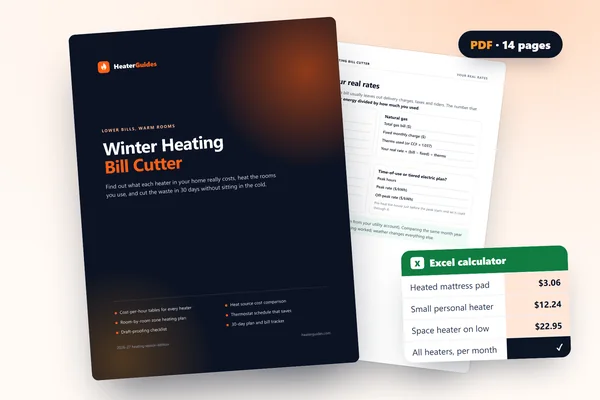 Winter Heating Bill CutterSee what every heater in your home really costs, heat the rooms you use, and cut the waste in 30 days.Cost-per-hour tables for every heaterThermostat schedule and draft-proofing planRunning-cost and bill calculator (Excel)
