The best stand-up space heater for most readers is a 1500W ceramic tower with oscillation, a thermostat, tip-over protection, and overheat shutoff, because it warms a bedroom or office fast without asking you to baby-sit it. The wrong pick wastes power, leaves cold corners, and can be a fire risk if you crowd it with furniture or run it on a weak circuit.
What to remember
Pick a 1,500 W tower with oscillation if you want fast heat spread in a bedroom or office.
Use a smaller room or a tighter budget if you only need spot heat; bigger towers do not fix bad insulation.
Look for tip-over shutoff, overheat protection, and a UL, ETL, or CSA listing before anything else.
Plug the heater straight into a wall outlet and keep 3 feet of clearance on all sides.
If you need heat for long stretches, a thermostat and timer matter more than extra fan modes.
Stand-up space heaters make sense when you want room-by-room heat instead of pushing the whole furnace harder. A 1,500 W unit can add useful warmth, but it still needs the right room size, the right outlet, and enough clearance to do its job safely.
Choose by the specs that matter in a tower heater: wattage, oscillation, thermostat control, noise, and safety listing. The fancy lights and extra modes are nice until the room is still chilly and the breaker starts grumbling.
Best for Large bedrooms and living rooms needing broad, adjustable heat
The 1,500W ceramic element, 75° oscillation, and coverage up to 280 ft2 make this the strongest fit for larger rooms in this group. A thermostat with 1°F adjustment, ECO mode, remote, and 12-hour timer gives you more control than a simple high-low heater. Tip-over and overheat protection add the safety features a stand-up heater should have.
Heat output 1,500WOscillation 75° wide oscillationCoverage Up to 280 ft2Controls 1°F thermostat adjustment, remote, 12-hour timerSafety Overheating and tip-over switch protection
Why it made the cut
Coverage up to 280 ft2
75° oscillation spreads heat across the room
1°F thermostat adjustment and 12-hour timer
Good to know
The 30-inch tower takes more vertical space
The product data does not state a third-party safety listing
Skip it if Skip it if you want a shorter, more compact heater for a small room.
Best for Medium-sized rooms, bedrooms, and home offices
This 1,500W ceramic tower uses wide oscillation to spread heat through a medium-sized room, while the remote controls heat, movement, and the 7-hour timer. ETL certification, overheat protection, a cool-touch housing, and a self-regulating ceramic element make it a sensible choice for homes with kids or pets. The carry handle also makes room-to-room moves simple.
Heat output 1,500WSize 23 inchesControls Remote control and 7-hour timerSafety ETL certified, overheat protection, cool-touch housingHeating element Self-regulating ceramic element
Why it made the cut
ETL certified
Cool-touch housing and overheat protection
Remote control and built-in carry handle
Good to know
The timer runs for up to 7 hours, shorter than some picks
The product data does not give a coverage area
Skip it if Skip it if you need a stated coverage area or a timer longer than 7 hours.
Best for Bedrooms and offices from 106 to 167 sq ft
The stated 106-167 sq ft coverage makes this a clearer match for smaller rooms than the larger PELONIS tower. You get 1,500W heat, oscillation, High, Low, and ECO modes, plus a remote and thermostat for bedroom or office use. Its 50dB working-noise specification is useful when a loud fan would get on your nerves.
Heat output 1,500WCoverage 106-167 sq ftControls Remote, thermostat, and 8-hour timerModes High, Low, and ECONoise 50dB working noise
Why it made the cut
Coverage is stated as 106-167 sq ft
Oscillation, remote, thermostat, and ECO mode
50dB working noise
Good to know
The stated coverage is smaller than Product 1’s
The timer runs for up to 8 hours
Skip it if Skip it if you need heat spread across a large living room.
Best for Smaller indoor spaces where flexible power matters
Three power settings—700W, 1,000W, and 1,500W—let you use less output when full heat isn’t needed. The thermostat, remote, 1-12 hour timer, and 24-hour automatic power-off feature suit a bedroom, desk area, or other space where simple controls matter. ETL certification, tip-over shutoff, and overheat protection strengthen its safety package.
Heat settings 700W, 1,000W, and 1,500WSize 17 inchesControls Smart thermostat, remote, and 1-12 hour timerSafety ETL certified, tip-over shutoff, and overheat protectionAutomatic shutoff 24-hour automatic power off
Why it made the cut
700W, 1,000W, and 1,500W settings
ETL certified with tip-over and overheat protection
1-12 hour timer and 24-hour automatic power off
Good to know
The product data does not state a room coverage area
The 17-inch size may provide less broad heat distribution than a taller oscillating tower
Skip it if Skip it if you want a stated coverage area or wide oscillation.
Best for Indoor rooms where quiet operation and ambient light help
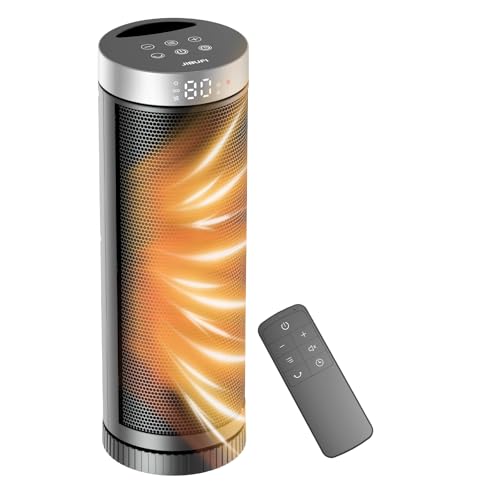
This 1,500W heater combines 70° oscillation with a thermostat range of 50°F to 95°F, so it can spread heat while maintaining a selected room temperature. Four modes, a 12-hour timer, child lock, and three adjustable light modes give it a broad control set. Its product data also calls out ultra-quiet operation for rooms where fan noise is distracting.
Heat output 1,500WOscillation 70°Thermostat range 50°F to 95°FControls Four modes and 12-hour timerSafety Tip-over protection, overheat shut-off, and child lock
Why it made the cut
70° oscillation and four modes
50°F to 95°F thermostat range
Child lock, tip-over protection, and overheat shut-off
Good to know
The product data does not state a third-party certification name
The ambient light may be unwanted in a dark bedroom
Skip it if Skip it if you prefer a heater with a named ETL listing or another stated certification.
For most bedrooms and home offices, the best electric heater is a 1,500 W ceramic tower with oscillation and a thermostat; these stand-up space heater reviews are really about matching that basic design to your room and habits. A tower heater warms the zone where you sit or sleep, so it won’t replace your home’s furnace or heat every closed room evenly.
Among the reviewed models, the PELONIS 30” Ceramic Tower Space Heater with Thermostat is the closest fit for the typical bedroom or office because the thermostat can cycle the heater instead of forcing full-time operation. The PELONIS 23” Oscillating Ceramic Tower Space Heater with Rem… and Lasko 23″ Ceramic Tower Space Heater with Remote Control make more sense when you want heat spread across a wider seating area. The shorter JIBUFI 17 Inches Space Heaters for Indoor Use and OLIXIS 23″ Space Heater for Indoor Use suit readers who care more about a compact footprint or straightforward room heating.
A Dreo space heater review should use the same checklist, even though no Dreo model is included in this group: confirm the wattage, thermostat, oscillation, timer, tip-over switch, overheat shutoff, and a UL, ETL, or CSA listing. A remote is convenient; it doesn’t make a heater stronger. For electric heater reviews for home, electric space heater reviews, and the best electric heaters reviews, those are the details that separate useful heat from a tall plastic object with a glowing display.
Myth
A higher wattage heater always makes a room warmer.
Fact
Higher wattage means more electrical heat when the heater is running, but a standard US outlet usually limits a plug-in heater to about 1,500 W, or 12.5 A at 120 V. A thermostat, good placement, and oscillation often matter more to comfort than chasing a larger number. Two 1,500 W heaters also need separate circuits; plugging both into one circuit can trip the breaker.
Model
Watts
Oscillation
Timer or control
Safety features to confirm
PELONIS 30” Ceramic Tower Space Heater with Thermostat
1,500 W class
Check product card
Thermostat
Tip-over and overheat protection; UL, ETL, or CSA listing
JIBUFI 17 Inches Space Heaters for Indoor Use
1,500 W class
Check product card
Check product card
Tip-over and overheat protection; UL, ETL, or CSA listing
PELONIS 23” Oscillating Ceramic Tower Space Heater with Rem…
1,500 W class
Oscillating
Remote; check timer
Tip-over and overheat protection; UL, ETL, or CSA listing
Lasko 23″ Ceramic Tower Space Heater with Remote Control
1,500 W class
Check product card
Remote; check timer
Tip-over and overheat protection; UL, ETL, or CSA listing
OLIXIS 23″ Space Heater for Indoor Use
1,500 W class
Check product card
Check product card
Tip-over and overheat protection; UL, ETL, or CSA listing
Verify the exact feature set on the heater’s label or manual before buying; product names don’t always tell the whole story.
In short
Choose the 1,500 W oscillating ceramic tower with a thermostat for a bedroom or office. Wider oscillation can reduce cold corners, while a quieter, less sweeping heater may be the better choice for a small room or a light sleeper.
From HeaterGuides · our own guidePage 6: heat only the rooms you use. Page 10 covers space-heater safety.Winter Heating Bill CutterSee what every heater in your home really costs, heat the rooms you use, and cut the waste in 30 days.Cost-per-hour tables for every heaterThermostat schedule and draft-proofing planRunning-cost and bill calculator (Excel)$14.99$9.99Get it for $9.99See what's inside and watch the 2-minute video →14-page printable PDF + Excel calculator · instant download · 30-day refund
How To Choose A Stand-Up Space Heater
A Dreo portable heater review or Decker space heater review should start with the same checklist: wattage, thermostat behavior, coverage, controls, and safety hardware matter more than the logo. For a plug-in US room heater, 1,500 W is the practical ceiling because a standard 120-volt, 15-amp circuit supports about 12.5 amps at that load; larger electric heaters usually need a different circuit or installation.
1,500 W
Practical plug-in ceiling
At 120 V, a 1,500 W heater draws about 12.5 A, leaving little room on a typical 15 A circuit for other heavy loads.
Ceramic heating means a PTC ceramic element warms air, while oscillation moves that air across a wider part of the room. Ceramic doesn’t make electricity cheaper at the same wattage, so compare the oscillation angle listed by each model rather than assuming a taller tower spreads heat farther. A 30-inch tower may distribute warmth more broadly, but a stable base and sensible footprint still matter beside a desk, bed, or chair.
Spec
What to compare
What it changes
Thermostat
Lowest and highest listed settings
How closely the heater can hold your target temperature
Timer
Maximum shutoff time
How long it can run before the timer ends
Noise
Published dB figure, if provided
Whether fan sound will bother sleep or concentrated work
Controls
Remote, display, and ECO mode
Convenience and reduced cycling, not extra heat output
Read the manual and product specifications; marketing names alone don’t reveal performance.
Remote control and ECO mode are convenience features, not performance features. ECO may lower output or cycle the element to avoid unnecessary heating, while a remote saves you from reaching behind the nightstand. Neither turns a 1,500 W heater into a stronger heater.
Worked example
Say a model offers a 1,500 W high setting and a 700 W lower setting. Four hours at 1,500 W uses 1.5 × 4 = 6 kWh; four hours at 700 W uses 0.7 × 4 = 2.8 kWh. The lower setting uses about 53% less electricity, provided it keeps the room warm enough.
High setting1,500 W × 4 hours = 6 kWh
Lower setting700 W × 4 hours = 2.8 kWh
Compare the useful details
For any tower in this guide, write down the thermostat range, timer length, noise information, oscillation specification, and claimed room size before comparing prices. A longer timer or remote may suit your routine, but those features don’t compensate for an undersized heater.
How Big A Room Can A Tower Heater Handle
Electric heater reviews for home are easiest to use when the claimed square footage is treated as a starting point, not a promise. Electric space heater reviews should tell you the range printed for each model, then account for insulation, drafts, ceiling height, windows, and cold floors before you choose a tower.
Claimed coverage
Best interpretation
Room fit
106–167 sq ft
More limited room-size claim
A smaller, enclosed bedroom or office with ordinary insulation
Up to 280 sq ft
Broader manufacturer claim
A larger single room when insulation and air sealing are favorable
Coverage figures come from the product data; actual comfort depends on the room and weather.
A 106–167 sq ft heater has less margin in a drafty room than a model claiming up to 280 sq ft. Smaller rooms and better insulation stretch a tower heater farther; leaky windows, exterior doors, and high ceilings shorten its reach. The larger claim still doesn’t mean one tower will heat an open floor plan evenly.
Worked example
Say your room is 12 × 14 feet: 12 × 14 = 168 sq ft. That sits just above the 106–167 sq ft range, so choose a model with a coverage claim at or above 168 sq ft, such as one claiming up to 280 sq ft, especially if the room has a draft or tall ceiling.
Know when one tower isn’t the plan
Open-plan spaces, high ceilings, and cold floors can leave warm air pooled near the heater while the far side stays chilly. Use a properly sized heating plan for that space instead of crowding one tower with furniture or expecting its coverage number to defeat the building.
How Much A Stand-Up Heater Costs To Run
A 1,500 W stand-up heater costs about $2.04 for eight hours at 17 cents per kWh, so electric heater reviews for home should show the arithmetic instead of waving at an unclear “energy saving” mode. A Dreo portable heater review belongs in the same lane: wattage and actual runtime decide the bill.
1
Convert watts to kilowatts
Divide the heater’s wattage by 1,000. A 1,500 W setting becomes 1.5 kW; a 700 W setting becomes 0.7 kW.
2
Multiply by hours
At eight hours, 1.5 kW × 8 hours equals 12 kWh. The lower setting uses 0.7 kW × 8 hours, or 5.6 kWh.
3
Multiply by your rate
Using 17 cents per kWh, 12 kWh × $0.17 equals $2.04. The 700 W setting costs 5.6 kWh × $0.17, or about $0.95.
Heater
Watts
Per hour
Per day (8 h)
Per month (30 days)
1,500 W heater
1,500 W
26¢
$2.04
$61.20
700 W setting
700 W
12¢
95¢
$28.56
Calculated at 17¢ per kWh. Example assumes eight hours per day, 30 days, and electricity at $0.17 per kWh.
A thermostat can cut that total by shutting the heating element off after the room reaches its set temperature; a timer can keep the heater from running through an empty evening. Those controls usually matter more than adding another fan mode. If a thermostat lets the 1,500 W heater run half the time, the example drops from about $2.04 to roughly $1.02 per night, though insulation, outdoor temperature, and the setpoint decide the real duty cycle.
Myth
An ECO label automatically means a heater uses less electricity.
Fact
ECO saves money only when it lowers the watt draw or shortens runtime. A 1,500 W element running continuously still uses 1.5 kWh every hour, regardless of the button’s name.
In short
Use watts ÷ 1,000 × hours × your electric rate. Pick a thermostat and timer you can use accurately; decorative modes won’t beat a heater that shuts off sooner.
Safety And Certification On Tower Heaters
A Decker space heater review or Dreo space heater review should start with the same safety floor used in electric space heater reviews: plug the tower directly into a wall outlet, keep three feet around it, and choose listed protection hardware. An extension cord or power strip adds a connection that can overheat under a 1,500 W load.
Before You Turn It On
Leave at least 3 feet between the heater and curtains, bedding, furniture, paper, and other combustible items.
Use a firm, level floor where the tower can’t be knocked over.
Look for UL, ETL, or CSA listing on the heater or its label.
Confirm that tip-over shutoff and overheat protection are present.
Choose a flame-retardant housing if the model specifically provides and identifies one.
Keep the air intake and outlet clear; don’t drape clothing over the heater.
Tip-over shutoff and overheat protection are minimum features, not luxury upgrades. The first cuts power if the tower falls; the second responds when internal temperature rises too far, often because airflow is restricted or a component is failing. Neither feature makes a crowded heater safe.
Two Mistakes Cause Trouble
Blocking the intake or outlet can trap heat inside the cabinet and trigger a shutdown—or create a fire hazard before that protection acts. Sharing a weak circuit with another heavy load, such as a microwave or hair dryer, can trip the breaker and heat an already stressed connection; use a different wall circuit instead of bypassing the breaker.
Use The Safety Hardware
Test the tip-over function only as the manual directs, and keep the heater upright during normal use. Don’t run a portable tower while you’re asleep or away from home unless the manufacturer specifically says that use is allowed.
If the plug, receptacle, or cord becomes hot, unplug the heater and stop using that outlet until a qualified electrician checks it. For replacement cords, switches, or controls, a guide to stand-up heater parts can help you identify the part, but don’t defeat a safety switch to keep the heater running.
Portable Heaters Without Electricity
Reviews of portable heaters without electricity point to a different product category: a true stand-up electric heater needs a live outlet, so a PELONIS or Lasko tower won’t heat during a power outage by itself. Battery-powered models, fuel heaters, and solid-fuel stoves solve that problem in different ways, with different limits and safety requirements.
Myth
A portable heater can run without electricity because it stores heat.
Fact
An electric tower needs power while it runs. A battery heater only moves the electricity source into a battery; a 1,500 W heater uses 1.5 kWh every hour before battery and inverter losses. Propane, kerosene, wood, pellet, and catalytic heaters create heat from fuel instead.
What you might mean
What it is
Important boundary
Propane or catalytic heater
Fuel-burning heat from a cylinder or tank
Use indoors only when the model is indoor-rated and the manual allows it
Kerosene heater
A liquid-fuel heater using 1-K kerosene
Never substitute gasoline; follow the required ventilation
Wood or pellet stove
A solid-fuel appliance connected to a listed vent or chimney
Clearances, installation, and local code control the setup
Battery heater
An electric heater powered by a battery or power station
Runtime depends on battery capacity and heater wattage
The fuel or battery changes the buying path; it doesn’t make the risks disappear.
Carbon Monoxide Boundary
Only an indoor-rated fuel heater belongs inside your home, and it still needs the ventilation specified by its manual plus a working carbon monoxide alarm. A propane model should have an oxygen depletion sensor. Never bring a patio heater, torpedo heater, or construction heater indoors, into a tent, or into a vehicle cabin; those machines are not indoor substitutes.
For normal room heating, keep comparing the electric towers already covered. For an outage, shop separately for an indoor-rated backup heater whose fuel, ventilation, clearance, and local-code requirements fit your space; don’t expect one electric tower to solve a dead circuit. A battery power station can run a small heater only for as long as its watt-hour capacity allows, and high-wattage heat drains it quickly.
Questions People Ask
What is a stand-up space heater?
A stand-up space heater is a portable electric heater designed to sit on the floor, usually in a tower or tall cabinet shape. Its height saves some floor space and can place warm air higher in the room, but it still needs open clearance around the housing.
Are stand-up space heaters energy efficient?
At the outlet, electric resistance heaters turn nearly all the electricity they use into heat, so a 1,500 W model delivers more heat than a lower-wattage model. A thermostat can reduce the cost by cycling the heating element off after the room reaches the set temperature; running time still determines the bill.
What safety features should a stand-up heater have?
Look for tip-over protection, overheat shutoff, and a UL, ETL, or CSA listing. Plug the heater directly into a wall outlet, keep at least 3 feet of clearance, and don’t run it while sleeping or away from home unless the manufacturer specifically permits that use.
How do I choose the right size stand-up heater for my room?
Start with the heater’s stated coverage, then adjust for insulation, ceiling height, drafts, and how cold the room gets. A 1,500 W tower is the practical ceiling for a standard 120 V household outlet, so a chilly large room may need better insulation or fixed heating instead of a larger plug-in heater.
Can a stand-up space heater heat an entire room?
Yes, a correctly sized tower can heat an enclosed bedroom, office, or similar room, especially with the door closed. Open doors, poor insulation, high ceilings, and exterior drafts can leave distant areas cold even while the heater’s thermostat says the nearby air is warm.
Why does a tower heater need oscillation?
Oscillation sweeps the warm airflow across a wider section of the room instead of concentrating it in one narrow column. That helps distribute heat more evenly, though it doesn’t increase the heater’s wattage or reduce the electricity needed for a given amount of heat.
Can I use a stand-up space heater with an extension cord?
No. Plug the heater straight into a wall outlet because a 1,500 W model draws about 12.5 A at 120 V, which can overheat an extension cord, power strip, or loose connection. If the outlet is too far away, move the heater or have a suitable outlet installed by an electrician.
Before you go · a welcome giftGet the Winter Heating Bill Cutter for $4.99See what every heater in your home really costs, heat the rooms you use, and cut the waste in 30 days. Normally $14.99; your welcome price saves $10.00. We'll email your link right now.or buy it now for $9.99 without the gift →One email with your link now. We never share your address.




 Winter Heating Bill CutterSee what every heater in your home really costs, heat the rooms you use, and cut the waste in 30 days.Cost-per-hour tables for every heaterThermostat schedule and draft-proofing planRunning-cost and bill calculator (Excel)