Skip to content
HeaterGuides
Space Heater

Using Smart Plugs With Space Heaters: Avoid Overload

On this page 9 sections
  1. Smart Heater Comparison
  2. Smart Heater Picks That Make More Sense Than a Plug
  3. How To Choose A Smart Heater
  4. Which Pick Fits Your Room
  5. Sizing And Running Cost
  6. Safety And Certification
  7. The Shortcut People Miss
  8. What To Check Before Buying
  9. Questions People Ask
At a glance
The safest answer for using smart plugs with space heaters is to skip the plug and buy a heater with built-in app, timer, or voice control; for most readers, Product 2 is the best fit because it combines 1500 W heat, a thermostat, tip-over protection, and a 24-hour timer. A 1,500 W heater draws about 12.5 A at 120 V, which is already close to the limit for a 15 A branch circuit before you add the plug itself.

Smart Heater Comparison

RankModelBest forHeat outputSmart controlSafetyPrice
1Bedrooms, offices, and other spaces up to 200 sq ft1500 WRemote and touch controls; 24-hour timerETL-certified; overheat protection; 45° tip-over shutoffCheck price
2
DREO Smart Wall HeaterBest for App Schedules
Bedrooms or offices where you want app, voice, and scheduled control1500 WDREO app; Alexa; Google Home—Check price
3
SereneLife Smart Space HeaterBest Portable App Pick
Home or office use when you want Wi-Fi control and portability1500 WWi-Fi app and remote; 12-hour timerOverheat protection; tip-over safety; child lockCheck price
4Bathroom or bedroom use where a wall-mounted heater and app control fit—DREO app; Alexa; remoteALCI plug; IP24 waterproof rating; overheat protectionCheck price
5
R.W.FLAME 50-Inch Smart FireplaceBest for Built-In Heat
Living rooms or apartments needing supplemental zone heat and fireplace styling750 W or 1500 WSmartphone and Alexa—Check price

Say your bedroom heater is 1,500 W and you want it to start before you wake up. A smart plug can switch the heater on and off, but it cannot make an undersized circuit safe, and it should never be used with a heater that the manual forbids on a timer or remote switch.

The smarter buy for most people is a heater with the controls built in. You get the schedule you wanted, without stacking one appliance’s wiring limits on top of another’s.

Smart Heater Picks That Make More Sense Than a Plug

#1Best Overall
R.W.FLAME Portable Ceramic Heater

R.W.FLAME Portable Ceramic Heater

Best for Bedrooms, offices, and other spaces up to 200 sq ft
For most people looking to automate a space heater, this portable model is the clearest fit: it has a thermostat, remote, and 24-hour timer, plus control at the heater itself. Its 45° tip-over shutoff and overheat protection add safety features a smart plug can’t provide.
Heat output 1500 WRoom coverage Up to 200 sq ftTimer 24 hoursControls Remote and touch controlsSafety ETL-certified; overheat protection; 45° tip-over shutoff
Why it made the cut
24-hour timer and thermostat
45° tip-over shutoff and overheat protection
ETL-certified; includes child lock
Good to know
No app or voice control listed
1500 W setting may be more heat than a small area needs
Skip it if Skip it if you need app or voice control; the product data lists a remote and touch controls instead.
#2Best for App Schedules
DREO Smart Wall Heater

DREO Smart Wall Heater

Best for Bedrooms or offices where you want app, voice, and scheduled control
This wall-mounted heater gives you app control, scheduling, and compatibility with Alexa and Google Home, so you can manage heat without an external plug. Its 24-hour timer and thermostat with 1°F accuracy suit rooms where you want more precise temperature settings.
Heat output 1500 WTemperature range 41 to 95°FTemperature accuracy 1°FOscillation 120°Controls DREO app, Alexa, Google Home, and remote
Why it made the cut
App scheduling and remote control
Works with Alexa and Google Home
120° oscillation and 24-hour timer
Good to know
Requires wall mounting
The product data does not list a safety certification or tip-over protection
Skip it if Skip it if you need a portable heater you can move between rooms.
#3Best Portable App Pick
SereneLife Smart Space Heater

SereneLife Smart Space Heater

Best for Home or office use when you want Wi-Fi control and portability
Wi-Fi app control lets you adjust the temperature, modes, and timer remotely, while the built-in handle makes it easier to move between rooms. It also has a thermostat, ECO mode, overheat protection, tip-over safety, and a child lock.
Heat output 1500 WTimer 12 hoursControls Wi-Fi app and remoteModes Power Heat, ECO, and Fan OnlySafety Overheat protection, tip-over safety, and child lock
Why it made the cut
Wi-Fi app and remote control
Overheat protection, tip-over safety, and child lock
Thermostat and ECO mode
Good to know
Timer is 12 hours, shorter than some picks here
No voice-control compatibility is listed
Skip it if Skip it if you need a timer longer than 12 hours or confirmed voice control.
#4Best for Bathrooms
DREO Smart Wall Heater With ALCI Plug
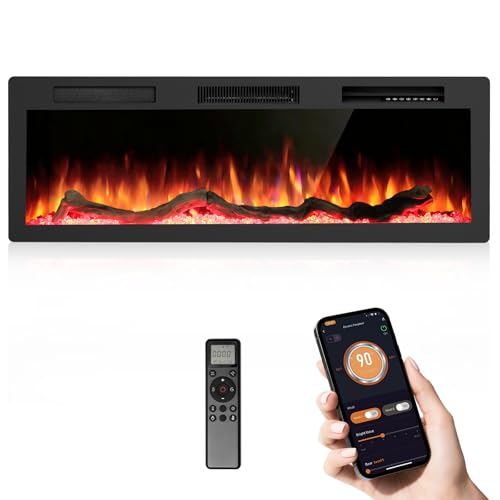
DREO Smart Wall Heater With ALCI Plug

Best for Bathroom or bedroom use where a wall-mounted heater and app control fit
App and Alexa control give you built-in remote operation, while the ALCI plug and IP24 waterproof rating are features aimed at bathroom use. The thermostat adjusts from 41°F to 95°F, and the heater can direct airflow through a 30° manual adjustment.
Controls DREO app, Alexa, touch panel, and remoteTemperature range 41°F to 95°FAirflow adjustment 30° manual adjustmentSafety ALCI plug; IP24 waterproof rating; overheat protectionPower cord 70.8 inches
Why it made the cut
ALCI plug and IP24 waterproof rating
DREO app and Alexa control
Adjustable thermostat from 41°F to 95°F
Good to know
Wall-mounted rather than portable
No heat output wattage or timer is listed in the product data
Skip it if Skip it if you need a stated wattage, timer, or heater you can carry room to room.
#5Best for Built-In Heat
R.W.FLAME 50-Inch Smart Fireplace

R.W.FLAME 50-Inch Smart Fireplace

Best for Living rooms or apartments needing supplemental zone heat and fireplace styling
The recessed or wall-mounted design combines supplemental heat with a flame display, and you can control it by smartphone or Alexa instead of adding a smart plug. Two heat settings and an adjustable temperature range give you options for bedrooms, living rooms, and apartments.
Heat settings 750 W and 1500 WSupplemental zone heating Up to 400 sq ftTemperature range 59-95°FControls Smartphone, Alexa, remote, and touch panelInstallation Wall-mounted or recessed
Why it made the cut
Smartphone and Alexa control
750 W and 1500 W heat settings
Recessed or wall-mounted installation
Good to know
Requires wall mounting or a suitable recessed opening
Larger and less portable than a space heater
Skip it if Skip it if you want a portable heater or need heat beyond supplemental zone heating.

How To Choose A Smart Heater

Using Smart Plugs With Space Heaters: How To Choose A Smart Heater

For a smart space heater, choose built-in controls unless the heater manual explicitly allows an external smart plug and the plug is rated for the heater’s load. A smart thermostat controls room temperature; a smart plug mainly switches power on or off, and it can’t make an incompatible heater safe to control remotely.

To turn on a space heater with a smart plug, first confirm the manual permits external switching and that the plug’s rating covers the heater’s wattage and current. If either check fails, skip the plug. A heater may restart unexpectedly when power returns, and a plug near its rated limit has little margin for a demanding, sustained load.

12.5 A
Current drawn by a 1,500 W heater at 120 V
The arithmetic is watts divided by volts: 1,500 ÷ 120 = 12.5 A. A 2 kW heater draws about 16.7 A, and a 3 kW heater about 25 A. A normal 15 A plug is the wrong tool for either larger load; don’t try to solve that with a higher-rated smart plug on an ordinary outlet.

A smart plug doesn’t reduce heater wattage; it only switches power. So there isn’t a smart plug that works well with a 3 kW heater on a normal 15 A outlet. A 2 kW heater also exceeds that outlet’s 15 A rating. Use the heater’s specified circuit and controls, or choose a heater with built-in app, timer, or voice control.

Myth
A smart plug makes a space heater draw less power.
Fact
It doesn’t change the heater’s wattage or current while the heater is running. It switches power on or off, so the heater still draws its full rated load when on.

Compare wattage, thermostat behavior, timer length, and the controls you’ll actually use. A thermostat cycles heat to maintain a set temperature; it doesn’t change the heater’s maximum wattage. Check whether the product offers an app, a remote, Alexa control, or some combination, and whether its timer can cover your intended schedule. Tip-over and overheat protection are important built-in safeguards, but they don’t make a damaged cord, overloaded circuit, or unsuitable smart plug safe.

Among the listed options, the R.W.FLAME Small Space Heaters for Indoor Use is a straightforward pick to compare if you want a heater with a thermostat and 24-hour timer rather than relying on an external switch. Check the exact model’s manual for its controls and safety features before buying; product names alone don’t tell you every specification.

Minimum Spec Check
Heater manual permits external switching, or the heater has the built-in controls you want.
Heater wattage and current stay within the outlet, circuit, and plug ratings.
Thermostat, timer length, and control method match how you plan to use it.
Tip-over and overheat protection are listed for the specific model.
What To Consider
For any portable heater, check the manual, the outlet and circuit, the timer behavior, and the built-in safety features before relying on remote control. Plug electric heaters directly into a wall outlet, not an extension cord or power strip, and keep 3 feet of clearance around them.

If you’re still comparing heater styles and controls, smart electric heaters may help you find a model with the control features you need built in.

From HeaterGuides · our own guidePage 6: heat only the rooms you use. Page 10 covers space-heater safety.Winter Heating Bill Cutter: the printable guide and its Excel calculatorWinter Heating Bill CutterSee what every heater in your home really costs, heat the rooms you use, and cut the waste in 30 days.Cost-per-hour tables for every heaterThermostat schedule and draft-proofing planRunning-cost and bill calculator (Excel)$14.99 $9.99Get it for $9.99See what's inside and watch the 2-minute video →14-page printable PDF + Excel calculator · instant download · 30-day refund

Which Pick Fits Your Room

The R.W.FLAME Small Space Heaters for Indoor Use is the best overall pick for a bedroom, office, or small room where you want portable heat with built-in controls. It has a thermostat, timer, tip-over shutoff, child lock, and ETL listing, so you can control the heater without adding a smart plug.

If you searched for the Govee smart space heater series, none of the five heaters in this lineup is a Govee model; the picks below are matched to room and use instead. A smart space heater on constant mode keeps heating according to that mode’s settings, but the exact behavior depends on the heater. Check its manual before relying on an app schedule or voice command.

NeedPickWhy it fits
Best overall for small roomsR.W.FLAME Small Space Heaters for Indoor UsePortable, with thermostat, timer, child lock, tip-over shutoff, and ETL listing.
Large room, no floor space to spareDREO Smart Wall Heater, 1500W Space Heater for Bedroom, WhiteWall mounting frees the floor; 120° oscillation helps move heat across a bigger room.
Quiet bathroom or bedroomDREO Smart Electric Wall Heater for Indoor Use, Bathroom, W…Rated at 28 dB, with an ALCI plug and IP24 rating for damp-room use.
Living room with a fireplace lookR.W.FLAME Smart Electric Fireplace 50 Inch, Recessed & Wall…Low-noise operation and decor-focused design for living spaces up to 400 sq ft.
Budget portable optionSereneLife Smart Space HeaterCompact body with 1500 W heat, Wi-Fi, remote control, thermostat, timer, and overheat and tip-over protection.

For smart electric heaters that are wall mounted, Product 4 is the practical choice when a larger room needs heat spread across more than one spot. Its wall-mounted design keeps floor space open, while the 120° oscillation moves warm air across a wider area. It’s a better fit for a room with an open layout than for someone who needs a heater they can carry from room to room.

Product 3 is the quietest pick for a bathroom or a quiet bedroom, at a rated 28 dB. Its ALCI plug and IP24 rating make it the right style for a damp room; a regular bedroom heater shouldn’t be moved into that setting just because it fits under the sink. Product 1 is the alternative for a living space where the heater should look like part of the room and serve as a low-noise focal point, with coverage listed for up to 400 sq ft.

Product 1 also wins on smart controls: it has app, remote, touch-panel, and voice control, plus multiple flame and heat settings for daily scheduling. Choose it when those controls and the fireplace appearance matter more than portability. Product 5 is the budget-minded option if you want Wi-Fi and remote control in a compact portable heater; its listed thermostat, timer, and safety shutoffs cover the useful basics.

When You Need More Than One Room
Smart multizone heating means controlling separate heaters or heating zones independently. These product details don’t establish a shared multizone system, so plan to set up and control each heater on its own unless the manufacturer confirms compatibility.
Best match
Product 2 suits small rooms where portable heat and built-in controls are the priority.
Product 4 suits a larger room where wall mounting and wider heat distribution help.
Product 3 has bathroom-specific protection; Product 1 adds fireplace styling and broader smart controls.
Choose another pick if
Product 2 is a portable small-room pick, not the wall-mounted choice for a larger space.
Product 3’s bathroom-friendly design doesn’t make it the best-looking choice for a living room.
Product 1 is less portable than a compact heater, and Product 5 doesn’t add the fireplace look.

Sizing And Running Cost

A 1,500 W plug-in heater is usually best for spot heat or one room, and its bill depends on how long it actually heats. On constant mode, the heater keeps running until its thermostat or timer stops it; a smart thermometer is a temperature-sensing device that reports room conditions, while a smart thermostat can use them to control heating.

Most plug-in space heaters top out at 1,500 W, so they’re better for a bedroom, office, or chilly corner than for heating an entire house. Room size alone doesn’t determine the result: insulation, drafts, ceiling height, and outdoor temperature all affect how much heat the room loses.

Bedroom Or Office Example
Say you use a 1,500 W heater in a bedroom or office for an eight-hour workday. If it ran continuously, it would use 12 kWh; at 17 cents per kWh, that’s about $2.04 for the day. A thermostat may switch the heating element off and on as the room warms and cools, reducing actual use. Treat this as a planning estimate, not a guaranteed bill.
Heater output1,500 W
Use8 hours
Continuous-use estimate12 kWh

At a 750 W setting on Product 1, the arithmetic is lower: 0.75 kW × 8 hours = 6 kWh, or about $1.02 at 17 cents per kWh. The exact setting and how often the heater cycles matter; a fan may also stop and start as the unit responds to its controls.

HeaterWattsPer hourPer day (8 h)Per month (30 days)
1,500 W heater running continuously1,500 W26¢$2.04$61.20
Product 1 at 750 W running continuously750 W13¢$1.02$30.60
Calculated at 17¢ per kWh. Continuous-use estimates at 17 cents per kWh; thermostat cycling can lower actual use.
Remote Control Isn’t Temperature Control
A remote-only smart plug can switch power on or off, but it doesn’t know when the room has reached a comfortable temperature unless it uses a compatible temperature sensor and control setup. A smart thermostat helps more because it can prevent long overrun time; check that the heater and its controls support the arrangement.

Safety And Certification

When using portable heaters, plug the heater straight into a wall outlet—never an extension cord or power strip—and keep it at least 3 feet from anything that can burn. To turn on a space heater with a smart plug, the heater’s manual must allow external switching, and the plug must be rated for the heater’s electrical load; otherwise, use the heater’s own controls.

A smart plug adds another device to the current path, which can overheat or fail if it isn’t suitable for a high-load heater. A 1,500 W heater draws about 12.5 A at 120 V, so don’t assume a plug’s smart features make it appropriate for that load. Look for tip-over and overheat protection and a UL, ETL, or CSA listing on the electric heater.

Before You Switch It On
Plug the heater directly into a wall outlet.
Keep 3 feet of clearance around the heater.
Confirm it has tip-over and overheat protection.
Check for a UL, ETL, or CSA listing.
Use an external smart plug only if the heater manual permits it and the plug rating matches the load.

For a bathroom or other damp room, Product 3, the DREO Smart Electric Wall Heater for Indoor Use, has an ALCI plug and an IP24 rating, making it the better-suited category among these picks. Keep ordinary bedroom heaters away from sinks, tubs, showers, and splash zones; Wi-Fi does not make a dry-room heater suitable for a wet location.

Don’t Leave It Running Unattended
Don’t leave an electric space heater running while you sleep or leave the house unless the manufacturer specifically designed that model for unattended use. Follow the manual’s instructions for placement and operation.
Use The Heater’s Own Timer
If you want scheduled heat, use a built-in timer or app control that the manufacturer provides instead of adding an external switching device.

The Shortcut People Miss

A smart thermostat or smart thermometer measures room temperature; it does not protect the circuit from overload. “Smart temperature” means the system can sense or adjust room conditions, not that it can make an overloaded outlet safe. A smart thermometer is simply a device that measures temperature and may report it to an app.

Choose the heater around how the room is used. Wall-mounted models save floor space and can suit a room that needs fixed, regular heat; portable heaters make more sense when you want spot heat in one room for a few hours. Product 3 is designed for wall mounting and damp-room use, while Product 2 is a portable option with built-in controls.

Match The Heater To The Room
Damp rooms, garages, and bathrooms need a heater with the right listing and protection for that location—not just Wi-Fi. Check the product manual and local requirements before installing one.

A practical rule: buy built-in controls first if you want automation, and reserve smart plugs for lamps or other light loads unless the heater’s manual explicitly allows external switching. For more options, see best plug in heaters for home.

Gas heaters without vents inside a home need special safety features and proper ventilation. Avoid using outdoor, patio, or construction heaters indoors since they lack the necessary design and certification for safe indoor use. Stick to heaters specifically made and approved for indoor spaces to prevent risks like carbon monoxide buildup.

In short
Room sensors tell you the temperature, not whether the circuit is safe. Use a heater’s built-in automation, and choose its mounting and protection for the room.

What To Check Before Buying

A 2 kW heater is too much for a typical 15 A, 120 V smart plug: it draws about 16.7 A. Don’t run it through one. A 3 kW heater draws about 25 A at 120 V, so skip any setup that depends on a normal 15 A smart plug; that load needs a properly designed fixed circuit and usually a different heater class.

Before you buy, confirm the heater’s own controls can do the job. A built-in timer and thermostat avoid relying on a smart plug to switch a heavy load, and the heater’s manual tells you what happens after a power flicker: some models resume their previous setting, while others stay off or return to standby.

Stop If Something Seems Wrong
If the heater smells hot, trips the breaker, or makes the lights flicker, stop using it and have the circuit checked by a qualified electrician. Don’t keep resetting the breaker or try a different smart plug.

Room type matters, too: choose a heater listed for the space where you’ll use it, and check its safety listing and manual before ordering. For a broader comparison of models with built-in controls, see best small space heaters.

Before You Buy Or Use It
Check the heater’s wattage and the outlet voltage; don’t assume a smart plug can handle the load.
Confirm the outlet circuit can supply the heater without other heavy loads sharing it.
Read how the timer behaves and whether the heater retains its setting after a power flicker.
Look for a UL, ETL, or CSA listing, and follow the heater’s manual.
Match the heater to the room type and intended location.
Before the first cold night, test the controls while you’re present; plug an electric heater directly into a wall outlet, never an extension cord or power strip, and keep 3 feet of clearance.

Questions People Ask

Can I use a smart plug to run a 2 kW heater?
Usually not on a standard 120 V, 15 A circuit: 2,000 W draws about 16.7 A, above the circuit’s rating. Use a heater’s built-in controls or a dedicated circuit and control device specifically approved for that heater.
Is there a smart plug that works well with a 3 kW heater?
A typical plug-in smart plug isn’t suitable: 3,000 W at 120 V draws 25 A, and a 3 kW heater may require a 240 V circuit. Use the heater’s approved built-in controls, or have an electrician confirm a compatible control for its voltage and wiring.
What should be considered when using portable heaters?
Check the heater’s manual, the outlet and circuit rating, and whether the heater has tip-over and overheat protection. Keep electric heaters at least 3 feet from anything that can burn, plug them directly into a wall outlet, and don’t leave them running unattended unless the manufacturer says the model is designed for it.
What is a smart thermometer?
A smart thermometer measures room temperature and can send readings to an app or compatible system. It doesn’t switch a heater safely or prevent a circuit overload; use it for monitoring, not as a substitute for approved heater controls.
Can I turn on a space heater with a smart plug?
Only if the heater manufacturer explicitly permits an external smart plug and the plug is rated for the heater’s load. Many heaters require their own switch to be pressed after power returns, so a smart plug may not turn them on; built-in app or timer controls are the safer choice.

Joye Editor

HeaterGuides covers home heating, water heating and HVAC: how the equipment works, what it costs to run, and how to use it safely.

More in Space Heater