

You’ve seen the photos: reefs that look like underwater graveyards, bone-white branches stretching across a pale seafloor. The term ‘coral bleaching’ gets thrown around in every climate documentary, but the actual chain of events — the precise degree of warming, the hours of exposure, the cellular breakdown — is rarely explained. Most people assume corals just ‘get too hot’ and die. The reality is far more specific, and far more interesting.
This article walks through the exact physiological and environmental sequence that turns a vibrant, colorful reef into a white skeleton. You’ll learn the temperature threshold that matters, why a single hot day does nothing but a string of them destroys everything, and why some corals shrug off heat that kills their neighbors. By the end, you’ll understand bleaching events the way a marine biologist reads a satellite map — as a predictable, measurable chain reaction.

PAIZOO
PAIZOO Aquarium Thermometer Digital, Highly Accurate Fish…
- HD LED Display: PAIZOO Aquarium Thermometer adopts LED screen to display temperature, LED can provide wide viewing angle and the c…
- Cordless & Touch Design: Stick-on Induction Thermometer senses water temperature through probe, cordless design, no messy wires in…
- High Accurate Display: Tank Thermometer Aquarium just needs to tear off the adhesive and stick it below the water level on the out…
If you keep a reef tank at home, the same principles apply on a smaller scale. A sudden heater malfunction or a summer afternoon of direct sunlight can spike your tank temperature past that same threshold. A reliable thermometer — like the PAIZOO Aquarium Thermometer Digital with its stick-on probe and 0.9°F accuracy — gives you the early warning you need to catch a drift before your corals start expelling their algae. It’s a cheap insurance policy for a system that punishes neglect.
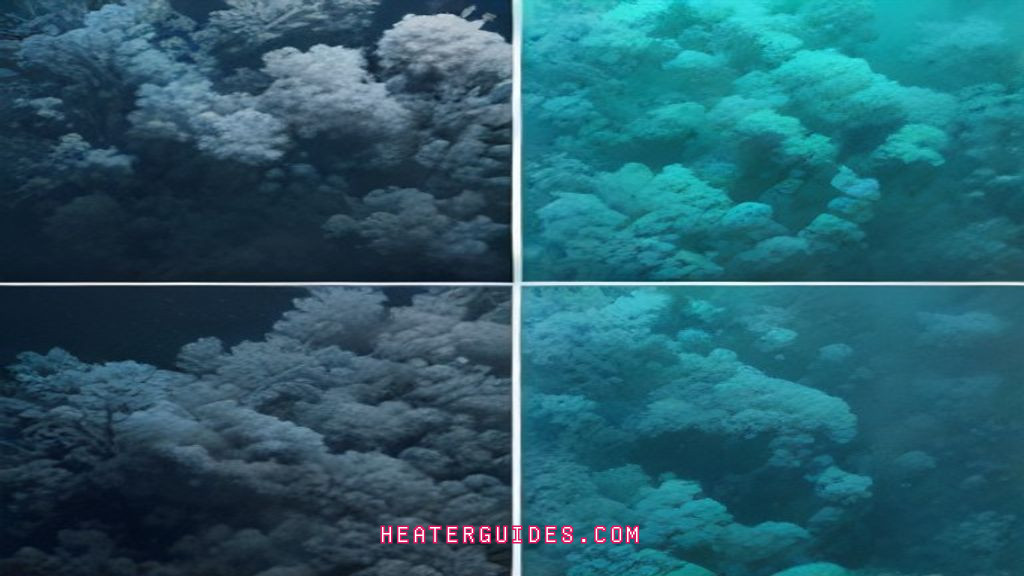
The Precise Thermal Trigger: Why +1°C Matters
Corals don’t bleach at a fixed temperature like water boiling at 100°C. The trigger is relative — it’s the temperature above the local summer maximum, sustained over time. For most reefs, that means a rise of just 1°C (1.8°F) above the warmest monthly average for that specific location. A reef in the Caribbean and a reef in the Coral Sea have different baselines, but the +1°C rule holds across both.
Duration matters as much as intensity. A single afternoon at 31°C means nothing. But hold the water at 31°C for four to six weeks, and the stress compounds. Scientists measure this using Degree Heating Weeks (DHW), a metric that adds up every degree above the bleaching threshold for every week it persists. One week at +1°C equals 1 DHW. Two weeks at +2°C equals 4 DHW. Bleaching typically begins at 4 DHW, and widespread mortality kicks in around 8 DHW.
The 2026 Great Barrier Reef event is the clearest example. Sea surface temperatures ran 1-2°C above normal for over two months, pushing DHW values past 8 in the northern sections. The result: 91% of the reef showed some bleaching, and nearly a third of the corals died. That wasn’t a random catastrophe — it was a predictable consequence of crossing a thermal threshold and staying there.
The Cellular Cascade: How Heat Kills the Coral-Algae Partnership
Bleaching is not a disease. It’s a breakdown of a symbiotic relationship. Corals host microscopic algae called zooxanthellae inside their tissues. These algae photosynthesize, producing sugars that feed the coral polyp — up to 90% of its energy budget. In return, the coral gives the algae shelter and nutrients. Heat breaks this arrangement apart in two distinct steps.
Step 1: Photosynthetic Breakdown
When water temperatures exceed the coral’s tolerance, the zooxanthellae’s photosynthetic machinery starts malfunctioning. The light-harvesting complexes in their chloroplasts — the same structures that capture sunlight — become damaged by the heat. Instead of producing oxygen and sugars, they start producing reactive oxygen species (ROS), which are essentially toxic free radicals.
Think of it like a car engine overheating. The pistons still move, but the cooling system fails, and the metal starts warping. In the algae, the equivalent of that warping is damage to the photosystem II protein complex. The algae can’t fix themselves fast enough, and the ROS begins leaking into the coral’s tissue.
Step 2: The Expulsion Event
The coral’s immune system detects this cellular chaos. Its response is drastic: it expels the zooxanthellae entirely. The coral literally spits out its food-producing partners from its tissue into the water column. This is the visible ‘bleaching’ — without the brown or green pigmentation of the algae, the coral’s transparent tissue reveals the white calcium carbonate skeleton beneath.
Here’s the brutal irony: the coral isn’t killing the algae out of malice. It’s a desperate attempt to stop the ROS damage. But by ejecting its primary food source, the coral loses its energy supply. It can survive for a few weeks by catching plankton with its tentacles, but that’s like a human trying to live on vitamins alone — possible for a short time, unsustainable long-term. If the water doesn’t cool down and the algae don’t return, the coral starves to death.
Beyond Temperature: Why Light and Water Flow Amplify the Damage
Heat alone doesn’t tell the full story. Solar radiation is a massive amplifier. Bright, calm, sunny days make bleaching far worse than overcast ones at the same water temperature. The reason is that the zooxanthellae are still trying to photosynthesize while heat-damaged. More light means more energy hitting a broken system, which means more ROS production. This is why bleaching often appears first on shallow, sun-exposed reef flats and less on shaded slopes or deeper water.
Water flow matters too. Corals in high-current areas — like reef channels with strong tidal flow — tend to bleach less than corals in stagnant lagoons. Moving water helps dissipate heat at the coral’s surface boundary layer and flushes away the ROS that leaks out. It’s the difference between standing in still air at 35°C and standing in front of a fan at 35°C. Same temperature, very different stress level.
This interaction explains why bleaching events are patchy. Two corals on the same reef, one on a wave-exposed crest and one in a sheltered backreef, can have completely different outcomes during the same heatwave. The temperature data from satellites can’t capture that local variation — it only shows the broad regional stress.
The Timeline of a Bleaching Event: From Stress to Mortality or Recovery
A bleaching event follows a predictable schedule, and knowing the timeline helps you understand what the images of white reefs actually mean.
- Week 1-2: Water temperature climbs past the local summer maximum. Corals show no visible change, but the zooxanthellae are already under photosynthetic stress.
- Week 3-4: The first visible paling appears. Corals lose some pigment as algae numbers drop. This is the last point where quick cooling can prevent serious damage.
- Week 5-6: Full bleaching. Most zooxanthellae are gone, and the coral appears stark white. The coral is now living on stored energy reserves and whatever plankton it can catch.
- Week 7-10: The critical window. If water temperatures drop to normal and stay there, corals can re-acquire zooxanthellae from the water column and recover. If heat persists, the coral’s tissue begins to slough off, and mortality follows.
- After 10 weeks: Without relief, the coral is dead. The skeleton remains, but the tissue is gone, and algae and boring organisms begin to colonize the bare calcium carbonate.
Recovery is not guaranteed even after temperatures return to normal. A bleached coral that survives the heat event is vulnerable to disease and has severely reduced growth rates for months. Some species recover within a year; others never fully regain their former size. The 2026 bleaching on the Great Barrier Reef was notable because it happened during a La Niña year, which usually brings cooler waters — a reminder that the baseline is shifting.
Why Some Corals Survive: Thermal Tolerance and Adaptive Symbionts
Not all corals are equally vulnerable. Branching corals like Acropora — the iconic staghorn and table corals — are the most sensitive. They grow fast and invest heavily in their symbionts, so they bleach first and die fastest. Massive boulder corals like Porites are far more resilient. They grow slowly, store more energy, and can shift to a more heterotrophic diet — catching zooplankton — when their algae are gone.
The algae themselves also vary. Zooxanthellae come in different strains, and some are naturally more heat-tolerant than others. Corals hosting the strain Durusdinium trenchii can withstand higher temperatures than those hosting the more common Cladocopium. After a bleaching event, surviving corals often ‘shuffle’ their symbiont communities, replacing heat-sensitive strains with heat-tolerant ones. This is a form of adaptation, but it has limits — the heat-tolerant strains are often less efficient at photosynthesis, so the coral gets less energy even when healthy.
There’s also evidence of acclimatization. Corals that have experienced a mild bleaching event in the past can sometimes handle the next one better. They’ve essentially ‘practiced’ the stress response. But this is a fragile advantage. It doesn’t help against a heatwave that pushes temperatures 3°C above normal, and it doesn’t pass reliably to offspring. The genetic adaptation of entire reef systems would take generations — time that rapidly warming oceans don’t provide.
Predicting the Next Event: How Scientists Use Degree Heating Weeks
Forecasting bleaching isn’t guesswork. NOAA’s Coral Reef Watch program uses satellite sea surface temperature data to produce real-time maps of thermal stress. The key output is the Degree Heating Week product, which I mentioned earlier. These maps are updated daily and color-coded: yellow for ‘watch’ conditions, orange for ‘warning’ (4 DHW), and red for ‘alert level 2’ (8 DHW), which signals widespread mortality risk.
These forecasts work because the physics are straightforward. If a region is already 1°C above its summer maximum in early December, and the seasonal forecast calls for continued warmth, you can predict with reasonable confidence that bleaching will occur by January. This gives reef managers time to act — though the available actions are limited. They can’t cool an entire ocean, but they can prioritize monitoring, close high-stress areas to fishing, and sometimes shade or relocate particularly valuable coral nurseries.
For aquarium keepers, the same logic applies on a smaller scale. Tracking your tank’s daily temperature — and especially its peak afternoon temperature — is the equivalent of monitoring DHW. If your tank runs consistently at 29°C during a heatwave, and your corals start paling, you’re seeing the same process that turns reefs white at scale. A tool like the daily temperature measurement guide can help you build a baseline for your own system, so you know what ‘normal’ looks like before a crisis hits.
The Future of Reefs: Can Adaptation Outpace Climate Change?
The honest answer is: probably not, at current emission trajectories. The IPCC projects that even under moderate scenarios, marine heatwaves will become four times more frequent by 2050. That means reefs will face bleaching-level stress every two years instead of every decade. Corals need several years to recover between events — a luxury they won’t have.
Some scientists are exploring interventions: breeding heat-tolerant corals, manipulating symbiont communities, even ‘seeding’ clouds to shade reefs. These are promising, but they’re band-aids on a systemic problem. The only durable fix is reducing greenhouse gas emissions and slowing the rate of ocean warming. The coral’s thermal tolerance has an upper limit, and we’re approaching it.
That said, not all reefs are doomed. Some regions, like the coral triangle in the Indo-Pacific, have shown remarkable resilience due to high species diversity and strong ocean currents. Others, like parts of the Red Sea, harbor corals that can withstand temperatures 3-4°C above the global average. These ‘refugia’ are the best hope for the future — they’re the genetic reservoirs that could repopulate degraded reefs if conditions stabilize.
For the home aquarist, the takeaway is more immediate. Your tank is a microcosm of these dynamics. A stable temperature is the single most important factor in keeping corals healthy. Monitoring tools, whether a simple stick-on thermometer or a full controller, are non-negotiable. The smart temperature response systems used in modern reef tanks can automate cooling and heating, but they still rely on accurate sensing. And if you’re curious about the seasonal swings that affect your water temperature, the seasonal temperature changes guide explains how ambient conditions translate into tank stress.
Frequently Asked Questions
Can a coral recover after it has fully bleached?
Yes, but only if the stressor is removed quickly. If water temperatures return to normal within 4-6 weeks, the coral can re-acquire zooxanthellae from the water column and regain its color. Recovery is more likely for massive, slow-growing species than for fast-growing branching corals. Once the tissue starts sloughing off — usually after 8-10 weeks of sustained heat — recovery is nearly impossible.
Why do some corals bleach while others on the same reef don’t?
Three main factors: species-specific thermal tolerance, the strain of zooxanthellae hosted, and microhabitat conditions. Corals in high-current areas or deeper water experience less thermal stress at the same ambient temperature. Corals hosting heat-tolerant symbiont strains like Durusdinium trenchii also have a built-in advantage.
Is coral bleaching always caused by rising temperatures?
No. Temperature is the primary trigger, but extreme low temperatures can also cause bleaching, as can pollution, excessive UV radiation, and changes in salinity. The mechanism is the same — stress to the zooxanthellae leads to their expulsion. However, temperature-driven events are by far the most widespread and frequent.
How quickly does a coral die from bleaching?
It depends on the species and the duration of the heat stress. A branching Acropora can die within 3-4 weeks of full bleaching if temperatures stay elevated. A massive Porites can survive for months in a bleached state. The key determinant is whether the coral has enough energy reserves to sustain itself without its primary food source.
What is the difference between coral bleaching and ocean acidification?
They are separate stressors with different mechanisms. Bleaching is a rapid response to thermal stress, affecting the coral-algae symbiosis. Ocean acidification is a chronic condition caused by increased CO2 absorption, which reduces the availability of carbonate ions needed for coral skeleton building. A reef can bleach and die in weeks, but acidification weakens the reef structure over decades.
What You Can Actually Do With This Knowledge
- If you keep corals, know your tank’s summer baseline temperature. If it climbs 1°C above that for more than a week, you’re in the danger zone.
- Invest in accurate temperature monitoring. A digital thermometer with 0.9°F accuracy is a bare minimum; a controller with a chiller is better.
- Pay attention to light intensity during heatwaves. Reducing your aquarium lighting during a temperature spike can lower ROS damage even if you can’t cool the water quickly.
- Increase water flow in a tank during a heat event. Just like on a natural reef, moving water helps dissipate the heat boundary layer around the coral.
- Don’t assume a bleached coral is dead. Give it time to recover if temperatures return to normal, but don’t expect fast-growing branches to make it.
- Use NOAA’s Coral Reef Watch DHW maps to track global events — they’re a free, real-time tool that shows exactly where thermal stress is building.
- Accept that the long-term survival of reefs depends on emissions reductions. Local interventions can save individual colonies, but not the ecosystem.

I am a mechanical engineer and love doing research on different home and outdoor heating options. When I am not working, I love spending time with my family and friends. I also enjoy blogging about my findings and helping others to find the best heating options for their needs.
Related guides

How Temperature Changes Trigger Plant Disease Outbreaks
Temperature influences plant diseases by affecting pathogen development, plant immune responses, and the severity of disease outbreaks, impacting…

How Rising Temperatures Intensify Fire Seasons Worldwide
You watch the evening news in July and see smoke plumes from a fire that started 200 miles…
How Temperature Changes Threaten Global Biodiversity
Temperature changes significantly impact biodiversity by altering habitats, affecting species distribution, and disrupting ecological interactions and food webs.…