For most shoppers searching for an indoor heater with adjustable thermostat electric control, Product 3 is the best pick: it offers 1,500 W, precise 41–95°F settings, 60° tilt, 34 dB operation, remote control and ETL-listed safety features in a portable design.
The essentials
Choose Product 3 for the best balance of precise control, quiet operation and directed heat.
Product 1 is the only pick with a stated supplemental heating area of up to 400 square feet and Wi-Fi/Alexa control.
A 1,500 W heater costs about $0.26 per hour at $0.17 per kWh when its element runs continuously.
Plug every electric heater directly into a wall outlet, keep 3 feet of clearance and use tip-over and overheat protection.
Non-electric indoor heaters need the correct fuel, ventilation and a working carbon monoxide alarm; a solar panel is not a simple indoor heater.
Compare Electric Heaters With Adjustable Thermostats
A 1,500 W plug-in heater draws about 12.5 amps on a 120 V circuit, so the outlet matters as much as the thermostat. That leaves little spare capacity for a hair dryer, kettle or other high-wattage appliance on the same circuit.
The five picks below cover a personal desk heater, a wider-room option and a recessed electric fireplace. None creates free heat; the thermostat only decides when the element runs.
Five Best Electric Heaters With Adjustable Thermostats
#1Best Overall
DREO 1500W Tilt Space Heater
Best for Precise control at a desk, bedside or small seating area
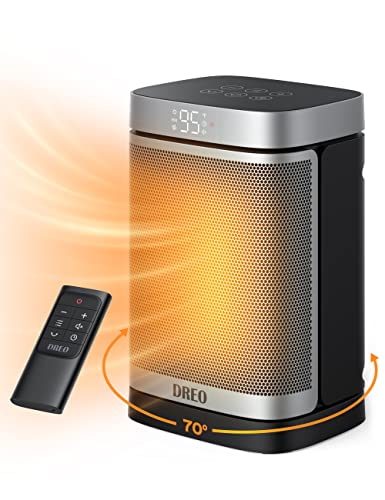
Product 3 gives you 1°F temperature adjustments from 41–95°F, a remote control and four manual tilt positions up to 60°. Its 34 dB operation, ETL-listed safety features and 1,500 W output suit readers who want quiet, directed heat with tighter control than a basic dial.
Power 1,500 WThermostat 41–95°F in 1°F incrementsTilt 0°–20°–40°–60°Noise 34 dBSafety ETL-certified; tip-over, overheat and safety plug protection
Why it made the cut
41–95°F range in 1°F increments
60° tilt and remote control
34 dB operation with ETL-listed safety features
Good to know
No stated room-coverage figure
Heat settings are described only as 3 modes
Skip it if Skip it if you need wide oscillation across a whole room instead of directed warmth.
Best for Bedrooms, offices and rooms where heat needs to spread
Product 4 combines a 41–95°F digital thermostat with ECO mode and 70° oscillation, so it can spread warmth instead of staying pointed at one chair. The remote, 12-hour timer and five modes make it a strong fit for regular room heating, while ETL-listed tip-over and overheat protection cover the basic safety checks.
Heat settings 5 modes; up to 1,500 WThermostat 41–95°F in 1°F incrementsOscillation 70°Noise As quiet as 37.5 dBSafety ETL-listed; tip-over, overheat and enhanced safety plug prot
Why it made the cut
70° wide-angle oscillation
41–95°F thermostat with 1°F increments
ECO mode, remote and 12-hour timer
Good to know
37.5 dB is quieter than many heaters but louder than Product 3
No stated room-coverage figure
Skip it if Skip it if you want a manually tilted heater aimed at your hands or feet.
Best for Small offices and personal heating up to 130 sq ft
Product 2 keeps the controls simple with two knobs for thermostat and mode selection, plus low and high heat at 950 W and 1,500 W. Its compact 3.53-pound body, built-in handle and 6-foot cord make it easy to move, and the below-35 dB operation won’t dominate an office.
Best for Small rooms where you want three heating levels
Product 5 lets you choose 700 W, 1,000 W or 1,500 W, giving you a lower-power option when full heat is unnecessary. The built-in thermostat, remote, 12-hour timer and digital display make daily adjustments easy, while the compact design suits room-to-room use.
Heat settings 700 W, 1,000 W and 1,500 WControls Built-in thermostat, remote and digital displayTimer 12 hoursSafety ETL-certified; overheat protection and automatic tip-over sh
Why it made the cut
700 W, 1,000 W and 1,500 W settings
Remote control and 12-hour timer
ETL-certified with overheat and tip-over shutoff
Good to know
The thermostat temperature range is not stated
Noise level and room coverage are not stated
Skip it if Skip it if you need a published thermostat range or noise figure before buying.
Best for Living rooms needing supplemental heat and fireplace styling
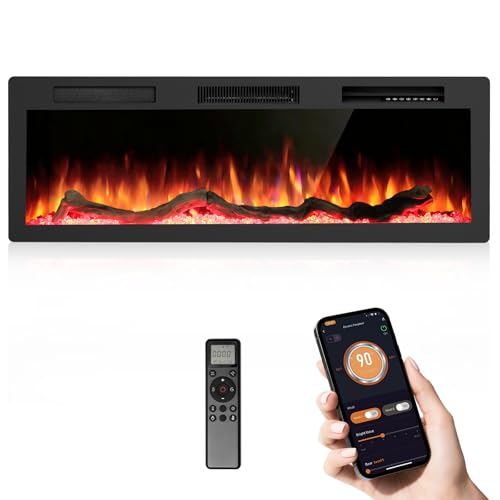
Product 1 is the choice when the heater also needs to function as a wall-mounted or recessed fireplace. It offers 750 W and 1,500 W heat modes, a 59–95°F setting range and control from the touch panel, remote, smartphone or Alexa, with supplemental heating listed for up to 400 square feet.
Heat settings 750 W and 1,500 WThermostat 59–95°FCoverage Up to 400 square feetSize 50 × 17.32 × 5.71 inchesControls Touch panel, remote, smartphone and Alexa/WiFi
Why it made the cut
Wall-mounted or recessed installation
750 W and 1,500 W heat modes
Remote, touch, smartphone and Alexa controls
Good to know
Requires installation rather than simple floor placement
The data does not list tip-over, overheat or ETL protection
Low-noise operation has no numeric dB figure
Skip it if Skip it if you need a portable heater you can move between rooms.
Choose an Indoor Heater With Adjustable Thermostat Electric
An electric heater with a real adjustable thermostat is the right choice for maintaining a room temperature; low and high heat settings only change how much heat the unit sends out. That distinction matters if you’re comparing an indoor heater with adjustable thermostat electric control, an electric heater with thermostat, or the best indoor electric space heaters.
1,500 W
Practical plug-in maximum
At 120 V, a 1,500 W heater draws about 12.5 A, so it uses nearly all of a standard 15 A circuit while heating.
Check four specifications first: maximum wattage, thermostat range and increments, safety shutoffs and certification, and the control method. Tilt, oscillation and cord length affect placement, but they don’t turn a basic heater into a temperature-controlled one.
Product
Thermostat control
Output or range
Useful distinction
R.W.FLAME 50-Inch Fireplace
Adjustable room control
Electric fireplace
Wall-mounted or recessed; Best wall-mounted option
R.W.FLAME Small Space Heater
Simple thermostat and mode knobs
1,500 W
Below 35 dB; Quietest
DREO 1500W 60° Tilt
41–95°F, 1°F increments
1,500 W
Remote, 60° tilt, 34 dB; Best overall
DREO Portable Indoor Heater
41–95°F, 1°F increments
1,500 W
70° oscillation and ECO mode; Best for large rooms
AUBKN Portable Heater
Thermostat with 700/1,000/1,500 W settings
700, 1,000 or 1,500 W
Remote control; Best budget
The useful difference is how precisely each heater controls room temperature after you set the heat.
Myth
A thermostat makes a 1,500 W heater use less electricity while it’s actively heating.
Fact
The heater still draws about 1,500 W when the heating element is on. The thermostat cycles that element off after the room reaches the set temperature, which can reduce average use.
Product 3 is the strongest fit for precise control, while Product 4 suits a larger open area because 70° oscillation spreads warm air. Product 2 is a quieter basic choice, and Product 5 gives you adjustable output without requiring digital controls. If you want a deeper comparison of temperature controls, see best indoor heater with adjustable temperatures.
Skip the fireplace if you need a carryable heater, and skip a small personal heater for an open room. A low wattage indoor heater can be sensible beside a desk or bed, but it won’t automatically heat a whole drafty space. Digital controls are useful for exact settings; skip them if simple knobs are easier for you to read and operate.
From HeaterGuides · our own guidePage 7 is a thermostat schedule that saves without leaving you cold.Winter Heating Bill CutterSee what every heater in your home really costs, heat the rooms you use, and cut the waste in 30 days.Cost-per-hour tables for every heaterThermostat schedule and draft-proofing planRunning-cost and bill calculator (Excel)$14.99$9.99Get it for $9.99See what's inside and watch the 2-minute video →14-page printable PDF + Excel calculator · instant download · 30-day refund
Measure the Room Before Choosing 1,500 W
A 1,500 W heater is about the practical upper end for a standard 120 V plug-in space heater, but wattage alone doesn’t promise whole-room heat. Insulation, drafts, ceiling height, outdoor temperature and an open floor plan can all make the same heater feel strong in one room and underpowered in another.
Worked example
Say your room is 12 by 14 feet. That is 168 square feet, which is larger than Product 2’s stated 108–130 square-foot heating area. A 1,500 W model with directed tilt or oscillation may work better as supplemental heat, but dependable whole-room heating still depends on drafts, insulation and the outdoor temperature.
Room12 × 14 ft
Floor area168 sq ft
Product 2 rating108–130 sq ft
Product 1 is rated for supplemental zone heating up to 400 square feet, so it can suit a larger living area when you need extra warmth rather than a replacement for the home’s main system. Products 3, 4 and 5 don’t have a stated square-foot coverage rating here, so don’t assign one from their wattage alone.
Place a small portable indoor heater so its airflow reaches the occupied area, on a stable hard floor unless the manual permits another position. Keep furniture, curtains and bedding away from the airflow; they aren’t heat shields, and heaters are poor judges of interior decorating.
Personal Heater
Warms the area beside a desk or chair quickly
Portable when the room or seating changes
Wall-Mounted Fireplace
May leave the far side of the room chilly
Coverage depends heavily on placement and drafts
Wall-Mounted Fireplace
Product 1 provides supplemental zone heating up to 400 square feet
Stays in one planned location
Personal Heater
Not a carryable heater
Best for zone heat rather than every room in the home
Personal comfort and whole-room heating are different jobs: a heater beside your desk can feel effective while the far side remains cold. Searches for portable heaters for indoor use non electric, non electric space heaters for indoors and non electric heaters indoor require a separate safety decision; use only an indoor-rated fuel heater with the ventilation its manual requires and a working carbon monoxide alarm. Never bring a patio, outdoor or construction heater inside.
For an oscillating model comparison, top oscillating fan heaters can help you judge whether wider air movement suits your room better than a fixed stream.
Calculate the Running Cost Before You Leave It On
Electric heaters cost watts ÷ 1,000 × hours × your rate, so a 1,500 W indoor heater with adjustable thermostat electric control costs about $2.04 for eight hours at $0.17 per kWh. That full-power figure is the ceiling for a typical night; the thermostat can shorten runtime after the room reaches its setting.
For indoor electrical heaters at Walmart or anywhere else, check your own utility rate rather than trusting a generic estimate. The arithmetic is 1.5 kW × 8 hours = 12 kWh; 12 × $0.17 = $2.04 for one night, or about $61.20 over 30 nights if the element runs continuously.
Heater
Watts
Per hour
Per day (8 h)
Per month (30 days)
1,500 W heater
1,500 W
26¢
$2.04
$61.20
750 W mode on Product 1
750 W
13¢
$1.02
$30.60
700 W setting on Product 5
700 W
12¢
95¢
$28.56
Calculated at 17¢ per kWh. Assumes eight hours per day and $0.17 per kWh; actual thermostat cycling changes the 1,500 W result.
A thermostat reduces the bill by switching the heating element off once the room is warm enough; it cannot reduce the element’s draw while that 1,500 W element is energized. ECO mode may lower output or cycle the heater, but it doesn’t repeal the electric meter. Product 5’s 700 W setting uses 0.7 kW × 8 hours × $0.17, or about $0.95 when it runs continuously, without promising a fixed monthly saving.
Check the rate
Product 1 also offers a 750 W mode, which cuts the full-power arithmetic in half before cycling is considered. Your utility bill is the useful source for the rate, not a store listing or a national average.
Keep Electric Heat on the Safe Side of the Outlet
The safe setup for an electric heater with thermostat control is a direct wall outlet, three feet of clearance, and nothing covering the cabinet. Never use an extension cord or power strip, and don’t leave the heater running while you sleep or leave home unless the manufacturer specifically says that model is designed for it.
12.5 A
Approximate draw of a 1,500 W heater
At 120 V, 1,500 W ÷ 120 V is about 12.5 A, leaving little capacity on a standard 15 A circuit for another high-wattage appliance.
A hair dryer, microwave or toaster on the same circuit can push the breaker past its limit and cause a trip. Treat that trip as a reason to investigate what shares the circuit, never as an invitation to install a larger fuse or breaker.
Before switching it on
Look for a UL, ETL or CSA listing.
Confirm tip-over and overheat protection.
Keep the intake and outlet clear of dust, curtains, bedding and clothing.
Stop using the heater if the cord is damaged, the plug gets hot or the breaker trips repeatedly.
Products 2, 3, 4 and 5 state ETL certification and include the safety features shoppers should look for. Product 1’s supplied information doesn’t state a certification, so verify its label and manual before buying; a thermostat is a comfort control, not a fire-prevention device.
Clearance still applies
A quiet rating doesn’t change the operating rules. Products 2 and 3 may be quiet enough for a bedroom, but keep three feet around the heater and follow the manufacturer’s instructions about overnight use. A safe indoor heater without electricity is a different fuel-burning question; never assume an outdoor or unvented device belongs in a room.
Use Non-Electric Heat Only When the Room Allows It
Indoor non-electric heaters can be safe only when the specific model is rated for indoor use and installed and ventilated exactly as its manual and local code require. That rule covers portable heaters for indoor use non electric, non electric heaters safe for indoor use, and the search for the best indoor heater without electricity: an outdoor, patio, torpedo or construction heater doesn’t become safe because it’s inside a building.
Carbon Monoxide Has No Warning Smell
Propane, kerosene, diesel and natural-gas heaters can produce carbon monoxide if combustion or venting goes wrong. Use only 1-K kerosene in a kerosene heater—never gasoline. Diesel heaters must exhaust outside the cabin. Indoor-rated propane models need the ventilation required by their manuals and an oxygen depletion sensor, and every fuel-burning heater needs a working CO alarm.
Myth
A cracked window does not make an outdoor heater safe indoors; use only a model listed for indoor use.
Fact
It doesn’t. A cracked window can’t correct the heater’s missing safety controls, combustion design or required venting. Outdoor, patio, torpedo and construction heaters stay outdoors.
Vented natural-gas units need a correctly installed flue, and gas connections and mounting belong to a licensed gas professional where required. Vent-free gas heaters are banned or restricted in some states and cities, so check local code before buying one. A manual’s ventilation instruction is a minimum, not a suggestion to negotiate with.
Choose the Outage Heat Source Carefully
1
No fuel-burning appliance
A battery fan or solar panel may run controls, lights or a small appliance, but solar-powered indoor heating is generally impractical for room heat unless a complete system is specifically designed and sized for that load.
2
Fuel heater
Choose only an indoor-rated model, follow its ventilation instructions, keep the CO alarm working and use the specified fuel. Never use an outdoor heater in a home, tent or vehicle cabin.
3
Generator
For an indoor heater for a power outage, a generator must follow its instructions and remain outside, with exhaust and carbon monoxide kept out of the living space.
The electric products on this page cannot heat during a blackout. A solar panel can provide electricity only when the full system supplies enough sustained power; a small panel or battery-powered fan won’t replace a 1,500 W room heater.
Run the Pre-Buy Checklist Before You Order
A safe indoor non-electric heater starts with the room, fuel and installation—not the product card alone. For indoor heaters without electricity, confirm the model’s indoor rating and manual before you spend money; for electric models, confirm the outlet and thermostat fit first.
Before Buying, Lighting or Calling a Technician
Measure the room and note the outlet location, wattage and thermostat temperature range.
Confirm UL, ETL or CSA listing, tip-over protection and overheat protection for an electric model.
Keep the required clearance around the heater and identify the fuel type before filling or connecting anything.
For fuel-burning heat, confirm ventilation, an oxygen depletion sensor where required, a working CO alarm and local code approval.
Check the manual for placement, mounting, flue and operating instructions.
Call the Right Professional
Call a licensed electrician for damaged wiring, repeated breaker trips or an outlet that becomes hot. Call a licensed gas professional for gas connections, venting or mounting questions. The product card can confirm features; the installation manual and local code control safe placement and fuel-burning installation.
More Questions, Answered
What kind of heater can I use indoors if there’s no power?
Use an indoor-rated propane or kerosene heater only if its manual permits the space and specifies the required ventilation. Keep a working carbon monoxide alarm nearby; use 1-K kerosene only, never gasoline. A patio, torpedo or construction heater doesn’t become safe indoors during an outage.
Are non-electric heaters safe for indoor use?
They can be, but only when the exact model is indoor-rated and installed or ventilated as directed. Propane models should have an oxygen depletion sensor, and vent-free gas heaters may be banned or restricted locally. Check your code before buying.
Can I use a solar heater indoors?
A solar panel doesn’t directly heat a room; it makes electricity that can run an electric heater through suitable equipment. Without battery storage and an inverter sized for the load, a solar setup won’t reliably run a 1,500 W heater after sunset or during an outage.
What are the best indoor natural gas heaters?
Choose a listed indoor model sized for the room, with the venting, shutoffs and clearances your local code requires. Vented heaters send combustion gases outdoors, while vent-free models need extra code checks and a working carbon monoxide alarm. Gas-line and venting work belongs to a licensed professional.
How do you mount an indoor gas heater?
Mount it exactly where the installation manual allows, using its supplied brackets and the listed clearances from walls, curtains and furniture. A licensed installer should handle the gas connection, leak check and venting; never improvise a flue or block a combustion-air opening.
Before you go · a welcome giftGet the Winter Heating Bill Cutter for $4.99See what every heater in your home really costs, heat the rooms you use, and cut the waste in 30 days. Normally $14.99; your welcome price saves $10.00. We'll email your link right now.or buy it now for $9.99 without the gift →One email with your link now. We never share your address.




 Winter Heating Bill CutterSee what every heater in your home really costs, heat the rooms you use, and cut the waste in 30 days.Cost-per-hour tables for every heaterThermostat schedule and draft-proofing planRunning-cost and bill calculator (Excel)