DeLonghi Silent System 24 Tower Heater: Expert Review & Analysis
On this page 9 sections
- The Specs
- DeLonghi Silent System 24 Tower Heater: What It Offers
- Account for Fan Noise and the Tower’s Limits
- Estimate the Running Cost and Room Fit
- Check the Shutoffs Before You Run It
- Choose Between the Tower, Panel and Radiator
- Run This Checklist Before Buying
- DeLonghi Tower Heater And Alternatives
- Questions People Ask

De’Longhi 24-Inch Tower Heater
The current product data identifies a 24-inch De’Longhi ceramic tower heater, model TCH8093ERSB. The older page’s TCH7915ER model number and its precise noise, timer, thermostat and heating-speed claims aren’t supported by that data, so this review sticks to verifiable features.
The Specs
| Power | 1,500W |
|---|---|
| Heating element | Ceramic |
| Height | 24 in |
| Modes | Fan only |
| Safety | Two-stage overheat protection, thermal fuse and internal tip |
DeLonghi Silent System 24 Tower Heater: What It Offers
The DeLonghi Silent System 24 tower heater is a 1,500W ceramic heater with motorized oscillation, ECO operation, fan-only mode, a remote and a thermostat. The supplied product data identifies it as model TCH8093ERSB; an older page named TCH7915ER, and those model numbers should not be treated as interchangeable. If you’re comparing DeLonghi heaters and oil-filled radiators, or looking through DeLonghi ceramic tower heater reviews, start with the model label rather than a familiar product name.
A ceramic element supplies the heat, and oscillation turns the outlet across a wider area than a fixed outlet can reach. That helps spread warmth around a small space, though it doesn’t make the heater a whole-room or whole-home system. The listing describes ECO as automatically adjusting heat and power settings; it doesn’t establish a particular energy-saving percentage or temperature accuracy.
The remote and thermostat are listed features, but the supplied information doesn’t specify timer settings or a temperature range. That distinction matters in a DeLonghi tower heater review: features you can verify are useful; features inferred from another model are guesswork. The same caution applies if you’re searching for a DeLonghi slim style heater.
Account for Fan Noise and the Tower’s Limits

A fan-assisted ceramic tower heater isn’t 100% silent: its fan moves air and makes operating noise. The supplied listing gives no measured decibel level for this model, so figures or noise-reduction claims from the older page can’t be verified here.
The fan and oscillation help distribute warmth across a wider area, but they bring moving air and sound. If you’re especially sensitive to noise, a fanless oil-filled radiator or radiant panel is a better fit; see these DeLonghi oil-filled radiators for a quieter heating style. A DeLonghi convector heater review, convection heater review or panel heater review should also be judged by the particular model’s listed design, not by claims carried over from this tower.
| Heater type | Air movement | Sound expectation | Best fit |
|---|---|---|---|
| Ceramic tower | Fan moves air; oscillation sweeps the outlet | Fan operating noise | Small spaces and personal comfort |
| Oil-filled radiator | No fan-driven airflow | No fan noise; the heater can still make operating sounds | People who prefer steady heat without a fan |
| Panel heater | Generally radiant or natural convection, depending on model | Usually no fan noise if fanless | People who want a wall or panel-style heater |
The listing describes this tower as best for small spaces and personal comfort, not as a verified medium-to-large-room heater. The older page’s fast heat-up and exact room-heating times, filter performance, anti-freeze operation, programmable timer and two-year warranty aren’t confirmed in the supplied product data, so don’t count on them.
Ceramic electric heat doesn’t prevent dry air: electric resistance heat adds no moisture to the room. If you need a fanless radiant option, compare the DeLonghi mica panel heater rather than expecting this tower’s ceramic element to change indoor humidity.
 Winter Heating Bill CutterSee what every heater in your home really costs, heat the rooms you use, and cut the waste in 30 days.Cost-per-hour tables for every heaterThermostat schedule and draft-proofing planRunning-cost and bill calculator (Excel)
Estimate the Running Cost and Room Fit
The product data gives no tested square-foot coverage, so there’s no reliable number for how many squares this DeLonghi heater can heat. Room fit depends on insulation, ceiling height, drafts, outdoor temperature and the temperature you want; use it for supplemental warmth in the room you occupy, not as a replacement for central heating.
At its 1,500W maximum, the heater draws about 12.5 amps on a standard 120V, 15A circuit—close to that circuit’s practical limit. Don’t share the circuit with another high-wattage appliance; the breaker may trip, and you won’t get more heat by asking it to do two jobs.
Actual cost can be lower if the thermostat cycles the heater or ECO operation reduces power, but the product data doesn’t establish a specific savings amount. Check the electricity rate on a recent bill, then multiply 1.5 kW × hours used × your price per kWh for a full-power estimate.
Check the Shutoffs Before You Run It
The listed protections are two-stage overheat protection—a thermal shutoff and thermal fuse—and an internal tip-over switch. They can reduce risks from overheating or a fall, but they don’t make the heater safe to cover, leave unattended or place near combustibles.
Set it on a stable, level surface. Stop using it if the plug, cord or outlet becomes hot or damaged; don’t keep running a heater through a suspect connection.
Choose Between the Tower, Panel and Radiator
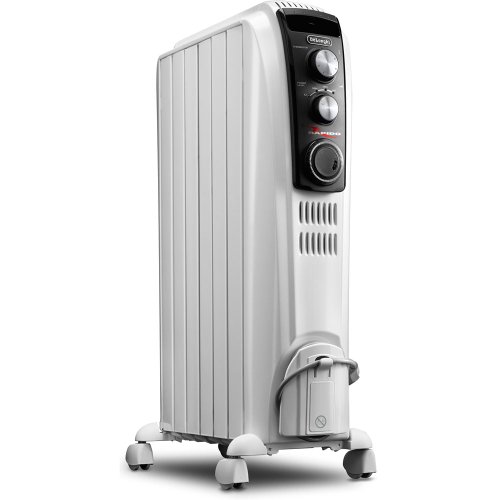
For delonghi slim style heater reviews, the tower fits if you want a fan to move heat around; for delonghi oil radiator heater reviews and delonghi dragon heater reviews, the Dragon is the fanless option. The right choice depends on whether you value air movement, mounting flexibility or less fan noise.
| Model | How it heats | Best fit |
|---|---|---|
| DeLonghi Silent System 24 tower | Ceramic element, oscillation and fan-only mode | Redirecting warm airflow around a small room or personal space |
| DeLonghi Convection Panel Heater | Convection panel with dual lateral fans; floor or wall mounting | A 1,500W panel format if you want the option to mount the heater |
| DeLonghi Dragon oil-filled radiator | Oil-filled, fanless radiant-and-convection heat | Avoiding fan airflow; the oil-filled body retains heat after power cycles |
Pick the tower if moving air and redirecting warmth matter more than fan noise. Choose the panel if you want a floor-or-wall format, and check the manual for the exact model before assuming a feature. The Dragon avoids fan-driven airflow, but its larger oil-filled body takes a different kind of floor space and keeps releasing heat after power cycles.
For more models and trade-offs, see this guide to DeLonghi radiant heaters or compare DeLonghi oil-filled radiators.
Run This Checklist Before Buying
Check the exact model and the spot where it will run before you order; similar DeLonghi names don’t guarantee identical controls or protections.
DeLonghi Tower Heater And Alternatives

De’Longhi Convection Panel Heater