

Many people think enclosing a tankless water heater is straightforward, but the truth depends on strict clearance and ventilation rules. The half truth is that while physical enclosure is possible, ignoring these requirements risks safety and code violations.
This article explains why enclosure rules exist, when the answer changes, and how to enclose your heater safely without compromising performance or safety.
Can You Enclose a Tankless Water Heater?
Yes, you can enclose a tankless water heater, but the enclosure must preserve the manufacturer’s clearances, combustion-air supply, venting, and service access. A tankless water heater can be enclosed in a closet or cabinet only when the specific model is listed for that location and local code permits the installation.
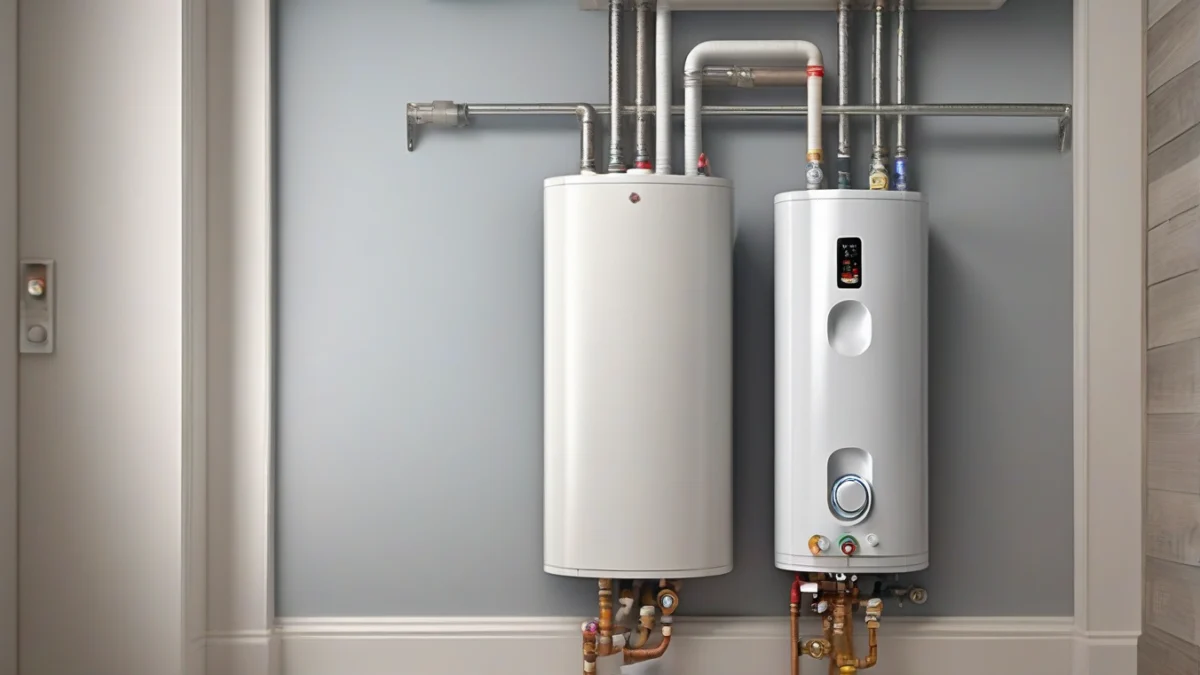
The cabinet isn’t decoration; it becomes part of the heater’s installation. Gas models need the right air for combustion and a safe path for exhaust, while electric models still need room to shed heat and for a technician to reach wiring, controls, filters, and water connections. How tankless water heaters work explains why the burner or heating elements need that airflow and access.
Why Clearance Matters
Clearance keeps hot surfaces and vent components away from wood, drywall, insulation, stored belongings, and the enclosure itself. It also prevents the cabinet from choking airflow around the heat exchanger or trapping heat near the controls. A cramped installation can cause nuisance shutdowns, damaged materials, harder servicing, and unsafe exhaust conditions on a gas unit.
Manufacturers commonly specify roughly 1/2 inch at the sides, about 12 inches above and below, and 24 inches in front, but those are only typical patterns—not a universal rule. Your installation manual and the unit’s label control, and the vent manufacturer’s instructions may require additional space around the vent termination and fittings.
| Clearance area | What to verify |
|---|---|
| Sides | The minimum gap listed for the exact model and vent system |
| Top and bottom | Space for heat, venting, water lines, gas piping, and service access |
| Front | Enough room to remove the cover and reach controls and internal parts |
| Vent termination | Required distance from windows, doors, soffits, and other openings |
| Combustibles | The listed separation from wood, shelving, insulation, and cabinet panels |
A gas enclosure also needs the combustion air and venting method specified for that heater. A sealed-combustion indoor unit may draw air through a dedicated pipe, while another installation may require openings sized by the manual or code. Blocking those openings can starve the burner, spill combustion products, or trigger a vent or flame-failure shutdown.
Factors That Affect Whether You Can Enclose a Tankless Water Heater
The answer changes with the heater’s fuel, rating, vent design, and installation location. If you’re asking, “Can I enclose my Rinnai gas tankless water heater in a closet?” the answer is yes only if that exact Rinnai model is an indoor-rated unit approved for closet installation, with its listed clearances, combustion air, venting, gas supply, and service access intact.

For a tankless water heater already installed indoors, you must build or modify the enclosure around the existing installation—not squeeze the heater into a smaller box. Confirm the model instructions, measure every required clearance, preserve the approved vent and air path, keep the gas shutoff and water isolation valves reachable, and have the work checked under local code before closing the walls.
| Condition | How enclosure rules change |
|---|---|
| Gas, indoor-rated | Needs approved venting and combustion air or the listed sealed-combustion arrangement; keep CO protection in place. |
| Gas, outdoor-rated | Don’t move it into a closet unless the manufacturer specifically lists that use; outdoor units aren’t automatically indoor-safe. |
| Electric | No combustion exhaust, but the cabinet still needs heat dissipation, electrical clearance, dry conditions, and service access. |
| Closet or cabinet | Follow the exact top, side, bottom, front, vent, and opening requirements; local code can be stricter. |
| Unit with sensors | Overheat, flame, vent, or air sensors can shut the heater down, but they don’t make an undersized enclosure safe. |
Tip-over protection is mainly associated with portable heaters, so don’t assume a tankless unit has it or needs it. Tankless models may have overheat, flame-failure, blocked-vent, or combustion-air safeguards; those controls stop operation after a problem is detected, rather than providing permission to create the problem.
An oxygen depletion sensor, or ODS, is required on some vent-free gas appliances and may apply where local rules call for that type of protection. A typical direct-vent tankless water heater isn’t made safe by adding an ODS after the fact. Check the appliance listing and local code, especially because vent-free gas rules vary by state and city.
How to Enclose a Tankless Water Heater Safely and What to Avoid
A cabinet-enclosed tankless water heater needs the exact front and side clearances listed on its installation label or manual; there is no safe universal number. Keep the entire service area open to that model’s specification, including the space needed to remove the cover, inspect connections, and replace parts. A cabinet that fits the heater but traps the technician is a very expensive cupboard.
You can put a tankless water heater in an outdoor enclosure only if the heater is rated for outdoor installation and the enclosure follows the manufacturer’s weather, venting, clearance, and freeze-protection instructions. An indoor-rated unit cannot be made suitable for outdoors with a roof and optimistic thinking.
More Questions, Answered
Can I put my Rinnai tankless water heater inside a closet?
What are the minimum side and front clearances for enclosed tankless water heaters?
Is ventilation always required if I enclose a tankless water heater?
Can outdoor tankless water heaters be enclosed without ventilation?
What happens if a tankless water heater is enclosed without proper clearance?

I am a mechanical engineer and love doing research on different home and outdoor heating options. When I am not working, I love spending time with my family and friends. I also enjoy blogging about my findings and helping others to find the best heating options for their needs.
Related guides

Best Locations to Install a Tankless Water Heater
Discover where to install your tankless water heater for best performance, safety, and maintenance access indoors or outdoors.
Superior Pump 91014 review
Ready to boost your water removal game? Check out our Superior Pump 91014 review for insights on performance,…
Which Electric Tankless Heater Handles 3 Bathrooms at Once?
What truly powers a 3-bathroom home? Find the best electric tankless water heater with expert guidance for endless…
