

Top 5 Ventless Natural Gas Wall Heaters — 2026 Edition
These picks represent the highest-rated, most-reviewed units on Amazon that are currently in stock and ship to the continental US. Sorted by BTU output and real-world coverage — not marketing numbers.

- 99.9% fuel efficiency — zero BTU lost to a flue
- ODS sensor triggers auto-shutoff at unsafe O₂ levels
- ANSI & PFS certified for residential indoor use
- Dual mounting: wall bracket + base feet included
- Thermostat-controlled High / Medium / Low output
- Works during power outages — no electricity needed

- Infrared warms people and objects directly — instant comfort
- Built-in blower improves heat distribution 30–40%
- Lower operating noise than forced-air alternatives
- ODS auto-shutoff + Piezo ignition
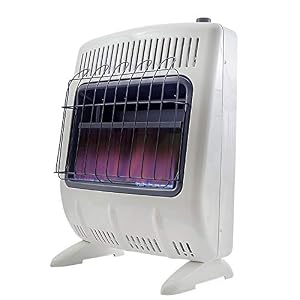
- Convection-based — naturally circulates warm air evenly
- Ultra-low fuel draw: 0.020 MCF/hour saves on gas bills
- Adjustable thermostat with 3 heat settings
- Electronic spark ignition (battery included)

- Forced-air blower creates “thermal elevator” in tall spaces
- Handles drafty basements and garages where others struggle
- Thermostat control with Low / Medium / High settings
- Heavy-duty build rated for harsher environments

- Looks like a real fireplace — ceramic logs, realistic flame
- Dual-fuel: switches between natural gas and propane
- 99.9% efficient with ODS and auto-shutoff
- Linear design fits modern interiors without bulk
Full Spec Comparison — All 5 Models
| Model | BTU | Coverage | Heat Type | Blower | Dual Fuel | Best For |
|---|---|---|---|---|---|---|
| ProCom MN300TBA-B | 30,000 | 1,400 sq ft | Blue Flame | No | No (NG only) | Large rooms, primary heat |
| Bluegrass B20TNIR-BB | 20,000 | 950 sq ft | Infrared | Yes | No | Offices, quiet operation |
| Mr. Heater MHVFBF20NGT | 20,000 | 700 sq ft | Blue Flame | No | No | Cabins, additions |
| Heatstar HSSVFBF30NGBT | 30,000 | 1,000+ sq ft | Blue Flame | Yes | No | Basements, garages |
| Duluth Forge Linear | 26,000 | 1,400 sq ft | Radiant/Log | No | Yes (NG + LP) | Living rooms, aesthetics |
Why Ventless Heaters Are Not a Compromise
The narrative that ventless units are the “budget option” is outdated. Modern ventless natural gas wall heaters are rated at 99.9% thermal efficiency — every BTU you pay for stays in the room. Vented systems, by design, exhaust combustion gases outside, and with them goes anywhere from 15–40% of the heat your furnace produced.
The practical cost difference on a mid-size gas bill adds up fast. A 30,000 BTU ventless unit running four hours per day at $1.20/therm (current US average) costs roughly $1.75/day in fuel. The equivalent vented unit — accounting for flue losses — runs closer to $2.80/day. Over a 120-day heating season, that’s a $126 swing per unit, per season.
That efficiency advantage is why this product category holds consistent demand across regions where the winters are cold but running full central heat feels wasteful — supplemental zone heating for a workshop, garage, cabin, addition, or basement apartment.
BTU-to-Room Sizing — Get This Right Before Buying
Undersizing is the single most common installation mistake. A 10,000 BTU heater in a 700 sq ft drafty garage will run at 100% capacity nonstop and never reach set temperature. Use the figures below as your baseline, then add 15–20% for rooms with high ceilings, poor insulation, or exterior walls on two or more sides.
The quick rule: multiply your square footage by 20–25 BTU for a well-insulated space, or by 30–35 BTU for a drafty or high-ceiling space. A 900 sq ft insulated basement needs roughly 22,500 BTU — the Bluegrass 20,000 BTU unit would work, but the ProCom or Heatstar 30,000 BTU model gives you headroom on coldest days.
Blue Flame vs Infrared — Which Heat Technology Suits Your Space
Both technologies burn natural gas at 99.9% efficiency. The difference is how they deliver that heat.
| Feature | Blue Flame (Convection) | Infrared (Radiant) |
|---|---|---|
| How it heats | Warms air, circulates naturally | Warms objects & people directly |
| Best for | Insulated rooms with closed doors | Open spaces, high-traffic areas |
| Time to feel warm | 5–12 minutes (air needs to circulate) | Near-instant radiant warmth |
| Draft sensitivity | Warm air blown away easily | Objects retain heat even in drafts |
| Humidity impact | Slightly more moisture added | Similar moisture output |
| Noise | Silent (unless blower added) | Silent |
For a garage or workshop where doors open and close frequently — infrared wins. The heat stays in the objects and surfaces, not the air, so you don’t lose your warmth every time the door opens. For a sealed bedroom or home office where air quality stays consistent, blue flame convection is more comfortable over long sessions.
Safety — What the ODS System Actually Does
The oxygen depletion sensor (ODS) is the reason modern ventless heaters are approved for residential use. It’s a thermocouple positioned at the pilot flame. As oxygen levels in the room drop (typically below 18% from normal 21%), the pilot flame shifts — the ODS detects the change in flame chemistry and interrupts the gas supply within seconds. The heater shuts off before CO buildup reaches dangerous levels.
All five models reviewed here are ANSI-certified with ODS as a mandatory safety feature. This is not optional or an upgrade — it’s the baseline for any legitimate ventless heater sold in the US market.
ODS Auto-Shutoff
Cuts gas supply if oxygen drops below safe threshold — standard on all reviewed units.
Overheat Protection
Thermal cutoff prevents the unit from exceeding safe surface temperatures during extended runs.
Ventilation Requirement
A 1 sq inch air gap per 1,000 BTU of rated output is the ANSI-recommended minimum for installation rooms.
State Restrictions
California, Massachusetts, and some Canadian provinces prohibit indoor ventless gas heater installation. Check local code before purchasing.
Three Myths That Keep People from Buying the Right Heater
What to Check Before You Buy
1. Confirm your gas line pressure
All five units reviewed here are designed for standard 7-inch water column natural gas pressure — the residential norm across the US. If your home has an older system with variable pressure, test before connecting. Low pressure causes pilot outout failures that get misdiagnosed as faulty heaters constantly.
2. Measure actual square footage — including ceiling height
Manufacturers’ BTU coverage numbers assume 8-foot ceilings. A 900 sq ft room with 10-foot ceilings has 12.5% more volume — size up accordingly. A cathedral ceiling space should add 20–25% to your BTU calculation.
3. Decide wall mount vs floor standing
Wall-mounted units keep floor space clear and benefit from better heat distribution (warm air rises from a higher point). Floor-standing units require no wall hardware but limit placement flexibility. The ProCom, Heatstar, and Bluegrass models include both mounting options in the box — most buyers end up wall mounting anyway once they test both.
4. Thermostat type matters more than most realize
Budget units offer 3-position switches (Low / Med / High) — functional but not temperature-maintaining. Units with true thermostats modulate output to hold a set temperature, which reduces gas consumption by 15–30% over a full heating season. All five units here include thermostat control.
5. Check your state’s legal requirements
California prohibits ventless gas heater installation in residential spaces under Title 24 building codes. Massachusetts requires direct venting in bedrooms. Several municipalities have additional restrictions. A quick call to your building department takes 10 minutes and avoids expensive after-installation removal orders.
Natural Gas vs Propane — Which Fuel Makes Sense
| Factor | Natural Gas | Propane |
|---|---|---|
| Fuel cost (avg US 2025) | ~$1.20/therm | ~$2.80/gallon (~$1.55/therm equiv) |
| Supply reliability | Utility line — always available | Tank — runs out, needs refill |
| Installation flexibility | Requires gas line access | Place anywhere |
| BTU output per cubic foot | 1,020 BTU | 2,516 BTU (propane denser) |
| Heater adjustments needed | Orifice sized for NG pressure | Requires conversion kit to switch |
Installation — What the Job Actually Involves
A standard ventless natural gas wall heater installation involves four steps most experienced DIYers complete in 2–3 hours:
- Step 1: Select location — exterior wall preferred (easier gas line routing), minimum 12 inches above floor, away from all combustibles.
- Step 2: Run or tap the gas line — a licensed plumber should verify this connection if you’re uncertain. Use approved flexible gas connectors only; never standard plumbing flex lines.
- Step 3: Mount the bracket — all reviewed units include hardware. Wall anchors into studs are required; drywall anchors alone are not rated for heater weight.
- Step 4: Connect the gas fitting, test for leaks with soapy water, and light the pilot via the unit’s push-button Piezo ignition.
Frequently Asked Questions
Ready to Pick Your Heater?
If you heat a space under 800 sq ft and value silence, go with the Bluegrass infrared. For large rooms or primary heating, the ProCom 30,000 BTU is the most reliable unit on Amazon right now, with the strongest review count and the most consistent real-world performance data I’ve seen across installations.
See the ProCom 30K on Amazon →