Best Small Room Heaters: Expert Picks for Cozy Warmth
Joye
Updated September 30, 2026 14 min read
Quick answer
The DREO Space Heater is our top pick for most people looking for a small room heater because it delivers fast, quiet, and energy-smart heat with advanced safety features.
The essentials
A 1,500-watt heater is ideal for most small rooms around 150 to 200 square feet.
Fan-forced heaters like the DREO spread heat quickly and quietly, good for bedrooms and offices.
Oil-filled radiators provide steady, silent heat but take longer to warm up and are less portable.
Look for tip-over and overheat protection, plus a thermostat with 1°F increments for precise control.
Running costs depend on wattage, hours used, and your electricity rate; 1,500 W for 8 hours at 17¢/kWh costs about $2.04 per day.
Imagine you want to warm a 12-by-14-foot bedroom quickly and quietly without blowing your electricity budget. A 1,500-watt heater is the right power level for that size, but not all heaters deliver heat the same way or cost the same to run. Choosing the right model means balancing heat output, noise, safety, and controls to fit your space and habits.
This guide walks you through the best small room heaters that fit those needs, explains how to size and run them efficiently, and highlights safety points that matter in a bedroom or office.
Best Small Room Heaters for Quick, Safe, and Quiet Warmth
#1Best Overall
DREO Space Heater with Thermostat
Best for Quiet bedrooms and offices where precise temperature control matters
The 1,500W PTC system, heat funnel design, and brushless DC motor give this heater fast warmth with noise as low as 34dB. Its thermostat adjusts from 41-95°F in 1°F increments, while the tilt-detection sensor and V0 flame-retardant materials add useful safety protection. Pick it if you want the most control and the quietest operation in this group.
Wattage 1,500WThermostat range 41-95°FNoise level 34dBModes Power heat, ECO, Fan OnlySafety Tilt-detection sensor and V0 flame-retardant materials
Why it made the cut
34dB noise level
41-95°F thermostat range with 1°F increments
Tilt-detection sensor and V0 flame-retardant materials
Good to know
The 1,500W output can draw much of a standard 120V circuit’s capacity
Advanced controls may be more than you need for occasional use
Skip it if Skip it if you want a fireplace-style flame effect or a heater with documented oscillation.
Best for Small rooms where 70° oscillation helps spread warmth beyond one chair
WINHL combines rapid PTC ceramic heating with 70° automatic oscillation, so warm air moves across more of the room instead of staying in one narrow path. A remote controls temperature, fan speed, heating modes, and timer settings from your seat. ETL certification, tip-over shutoff, and overheat protection make it a practical choice for shared spaces.
Heating system PTC ceramicOscillation 70° automatic oscillationRemote Requires 2 AAA batteriesSafety Tip-over shutoff and overheat protectionCertification ETL-certified
Why it made the cut
70° automatic oscillation
Remote control adjusts heat, fan speed, modes, and timer
ETL-certified with tip-over and overheat protection
Good to know
Noise level isn’t specified
The remote requires 2 AAA batteries
Skip it if Skip it if a precisely stated low-noise rating matters more to you than oscillation.
Best for Desks, tabletops, and small rooms where flame ambience matters
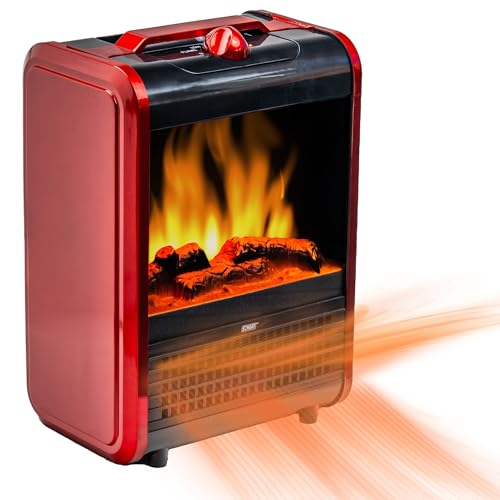
The EZ-HEAT adds a 3D flame effect and realistic ember bed to a compact 1,200W heater. Two heat settings, fan-forced heat distribution, a cool-to-the-touch body, and a molded carry handle suit tabletop use. Choose it when the fireplace look is part of the reason you’re buying a heater.
Wattage 1,200WHeat settings TwoFlame effect 3D flame with realistic ember bedSafety Overheat sensor and safety tip-over switchHousing Cool-to-the-touch body
Why it made the cut
3D flame effect and ember bed
Cool-to-the-touch body
Tip-over switch and overheat sensor
Good to know
1,200W output is lower than the 1,500W models
Oscillation and noise level aren’t specified
Skip it if Skip it if you need the widest heat movement or precise thermostat control.
Best for Bedrooms and living spaces where oscillation, lighting, and a timer help
OLIXIS pairs 1,500W heating with 70° oscillation, a thermostat from 50-95°F, and a 12-hour timer. Three adjustable light modes and ultra-quiet operation make it a sensible fit when a heater also needs to blend into an evening room. Child lock, tip-over protection, and overheat shut-off cover the basic safety needs.
Wattage 1,500WOscillation 70°Thermostat range 50-95°FTimer 12 hoursSafety Tip-over protection, overheat shut-off, and child lock
Why it made the cut
70° oscillation spreads heat evenly
50-95°F thermostat and 12-hour timer
Child lock, tip-over protection, and overheat shut-off
Good to know
Its 23-inch tower shape needs more floor space than a mini heater
A precise noise rating isn’t specified
Skip it if Skip it if you need a compact tabletop heater or a smaller footprint.
Best for Medium-sized rooms where wide oscillation and remote control are useful
Lasko uses 1,500W quiet ceramic heat with wide oscillation to move warmth across more of a room. The remote handles heat settings, oscillation, and the 7-hour timer, while the self-regulating ceramic element, overheat protection, cool-touch housing, and ETL listing add practical safeguards. It suits a family room or home office better than a tiny tabletop setup.
Pick a small room heater by matching its wattage and heat style to the room, then check the thermostat, timer, and safety shutoffs before you worry about looks. For most plug-in heaters, wattage tells you the heat ceiling; controls determine how comfortably and efficiently you reach it.
A fan-forced ceramic heater moves warm air quickly, so it’s useful when you want fast heat at a desk or in a small bedroom. An oil-filled radiator warms more gradually and continues giving off heat after the element cycles off. Micathermic heaters use a thin heating panel to provide radiant warmth and natural convection, which can feel quicker than an oil-filled unit without relying on a strong fan.
Spec or feature
Why it matters in a small room
Wattage
More watts provide more heat, but a standard plug-in heater usually tops out at 1,500 W.
Heat type
Fan-forced heats air quickly; oil-filled heat lingers; micathermic panels combine radiant and convective heat.
Oscillation
Sweeps warm air across more of the room instead of concentrating it in one narrow stream.
Thermostat
Cycles the heater near your chosen temperature instead of running continuously.
Timer
Turns the heater off after a set period, useful before sleep or when leaving the room.
Tip-over and overheat protection
Cuts power if the heater falls or its internal temperature rises too far.
Specs that matter more than a decorative front panel.
Oscillation helps when the heater sits in a corner or serves more than one person, while a fixed fan may be better aimed at a chair or desk. Look for a thermostat with clear temperature settings rather than only low, medium, and high; finer control reduces the hot-cold swing that makes a small room uncomfortable.
Power and placement
Plug an electric heater directly into a wall outlet, never an extension cord or power strip. Keep about 3 feet of clearance around it, and choose a model with a UL, ETL, or CSA listing plus tip-over and overheat protection. The DREO Space Heater is the leading pick in this guide for readers who want a compact electric model with more control features.
If you want a broader comparison before choosing among compact electric models, see our best electric room heater guide.
Sizing and Running Costs for Small Room Heaters
For a small room, start with about 10 watts per square foot; a 12-by-14-foot room is 168 square feet, so the estimate is about 1,680 W and a 1,500 W heater is the sensible plug-in choice. That estimate assumes ordinary insulation and a normal ceiling, so drafts, high ceilings, windows, and very cold outdoor temperatures can make the room feel cooler.
A standard 1,500 W heater draws about 12.5 amps on a 120 V circuit, which is close to the practical limit of a typical 15 A household circuit. Don’t run another high-wattage appliance from the same circuit if the breaker trips or the outlet feels warm; a larger heater won’t solve an electrical limit.
To estimate running cost, multiply watts divided by 1,000 by operating hours and your electricity rate. At the typical assumed rate of 17 cents per kWh, the calculation for a 1,500 W heater running 8 hours is 1.5 × 8 × $0.17; the cost block shows the resulting nightly figure.
Heater
Watts
Per hour
Per day (8 h)
Per month (1 days)
1,500 W space heater
1,500 W
26¢
$2.04
$2.04
Calculated at 17¢ per kWh. Assumes 8 hours of operation at 17¢ per kWh; the heater may use less over time if its thermostat cycles off.
A thermostat changes the real bill because the heating element doesn’t have to run for all 8 hours. For example, a heater set to maintain a room may cycle off after reaching temperature, while a cold, drafty room can keep it running near full power. Compare electric models by wattage and expected run time, not by a claim that one turns electricity into more heat than another.
Size before you shop
Measure the room, multiply its square footage by about 10 W, then select the nearest practical heater size. A 1500 W plug-in model fits the 12-by-14-foot example; larger or poorly insulated spaces may need a second properly placed heater or a different heating system.
If your room is larger than the small-space range, our guide to large room heaters is the better next comparison.
Safety and Certification You Should Never Skip
Yes, small room heaters can be safe when you use a listed model correctly and give it room to breathe. The safety features to look for are a tip-over switch, overheat protection, and a UL, ETL, or CSA listing.
A tip-over switch shuts the heater off if it falls onto its side, while overheat protection cuts power when internal parts get too hot. Those controls reduce fire risk, but they don’t make careless placement safe. Keep at least 3 feet between the heater and curtains, bedding, clothing, furniture, or paper.
Safety features to verify
Tip-over shutoff is listed in the product specifications.
Overheat protection is included.
UL, ETL, or CSA marking appears on the heater or its documentation.
The heater can stand on a level, solid surface.
A working smoke alarm and carbon monoxide alarm are in place where appropriate.
UL, ETL, and CSA marks indicate that the heater was evaluated against applicable electrical safety requirements. Check the actual unit or manual rather than trusting a marketplace title; a vague claim that a product is safe isn’t the same as a recognized listing.
Use the wall outlet
Plug a small electric heater directly into a wall outlet. Never use an extension cord, power strip, or adapter, because the heater’s sustained load can overheat those connections. A typical 1,500-watt heater draws about 12.5 amps at 120 volts, leaving little spare capacity on a standard 15-amp circuit.
Keep the heater where nobody can trip over its cord, and turn it off before sleeping or leaving home unless the manufacturer specifically says the model is designed for that use. A tip-over switch is a backup, not a bedtime babysitter.
Why Noise Level Matters More Than You Think
A quiet small room heater is usually the better choice for a bedroom or office, and space heaters can range from nearly silent to plainly audible. Noise is measured in decibels, or dB; below 35 dB is commonly described as whisper quiet.
Fan-forced heaters move air across a heating element, so the motor and fan determine much of what you hear. Brushless DC motors and winglet-style fans can reduce motor and airflow noise, but the product’s measured rating matters more than a feature name alone.
Heater
Reported noise level
What that means
DREO Space Heater
34 dB
Whisper-quiet range for sleeping or focused work
Lasko 23-inch Ceramic Tower Space Heater with Remote Control
52 dB
Noticeably louder fan sound in a quiet room
The figures are useful for comparison, though room acoustics and fan speed still affect what reaches your ears.
Oil-filled radiators are silent because they don’t use a fan, but they heat a room more slowly than a fan-forced ceramic heater. Pick one when silence matters most; choose a fan heater when you want warm air to reach you quickly.
For overnight use, listen for the heater’s lowest setting and check whether its thermostat cycles the fan on and off. In an office, a steady low hum may fade into the background, while a louder fan can interrupt calls or concentration.
Checklist Before You Buy and Use Your Small Room Heater
A small room heater buying checklist should confirm the room size, electrical setup, controls, and safety shutoffs before you buy; learning how to safely use a space heater starts with the same checks.
Before You Buy
Measure the room and compare its square footage with the heater’s wattage. A 1,500-watt plug-in heater is near the practical limit for a standard 120-volt outlet, so don’t expect a small unit to heat a large, drafty space.
Look for clearly stated tip-over protection and overheat protection. Those shutoffs should be listed in the product specifications or manual.
Choose an adjustable thermostat so the heater can cycle off after the room reaches your setting, and check for a timer if you want scheduled operation.
Confirm the heater is listed by UL, ETL, or CSA and is intended for indoor use.
1
Choose the outlet first
Plan to plug the heater straight into a wall outlet. Don’t use an extension cord, power strip, or outlet shared with another high-wattage appliance.
2
Mark the safe spot
Leave at least 3 feet between the heater and bedding, curtains, furniture, paper, clothing, and other combustibles. Keep it on a stable, level surface where children and pets can’t knock it over.
3
Run a supervised test
Before the first cold night, test the thermostat, heat settings, timer, display, remote, and tip-over shutoff. Make sure the plug and outlet stay cool during operation.
Use It Awake and Nearby
Don’t run a small room heater while you’re asleep or away from home unless the manufacturer specifically says that model is designed for it. Stop using the heater if the plug, outlet, cord, or housing becomes unusually hot, or if you smell burning plastic.
One Last Check
Keep the manual nearby for the first week. The exact button sequence for the timer and the reset procedure vary by model, and guessing at either is a poor winter tradition.
More Questions, Answered
What size heater do I need for a 150-square-foot room?
A 1,500-watt heater is the usual plug-in choice for a 150-square-foot room, using the rough estimate of 10 watts per square foot. Drafty windows, high ceilings, and cold climates can make that heater run longer, while good insulation may let the thermostat cycle off sooner.
Are oil-filled heaters better for bedrooms?
Oil-filled heaters are often better for bedrooms when quiet operation matters because they heat without a fan. They warm up more slowly than ceramic or infrared models and stay hot after the thermostat clicks off, so keep bedding, clothing, and curtains well away from the radiator.
Can I leave a small room heater on overnight?
In general, don’t leave a small room heater running overnight unless the manufacturer specifically says that model is designed for unattended or sleep use. Plug it directly into a wall outlet, keep at least 3 feet of clearance, and use tip-over and overheat protection; a timer is safer than hoping you’ll wake up when the room gets warm.
How much does it cost to run a 1,500-watt heater for 8 hours?
At 17 cents per kWh, a 1,500-watt heater uses 1.5 × 8 = 12 kWh, costing about $2.04 for one night. Running it that way for 30 nights would be about $61.20, although the thermostat may reduce the actual cost by cycling the heater off.
Related guides
best room heaterCompares room-heater picks for broader heating needs and comfort.
best space heatersCovers space-heater choices by heating style, controls, and room use.
I am a mechanical engineer and love doing research on different home and outdoor heating options. When I am not working, I love spending time with my family and friends. I also enjoy blogging about my findings and helping others to find the best heating options for their needs.