For most readers comparing room-heater brands, DREO Space Heaters for Indoor Use with Thermostat is the best pick: it’s a 1500W electric heater with ETL-listed safety, 70° oscillation, ECO mode, and a 12-hour timer, so it suits a typical bedroom or living room without fuss.
Key takeaways
A 1,500W portable heater draws about 12.5 amps on a 120V circuit, so keep it on a wall outlet, not a power strip.
Choose oil-filled heat if you want steady, quiet warmth; choose ceramic or fan heat if you want faster warm-up.
For bedrooms, look for tip-over shutoff, overheat protection, a timer, and a UL, ETL, or CSA listing.
A heater rated for 100 to 200 square feet usually fits a bedroom or office; bigger rooms need oscillation or a wall-mounted unit.
If the room is drafty, size up one step or expect the heater to run longer and cost more each night.
The common mistake is buying by brand name, flame effect, or the biggest watt number, then discovering the heater is either too noisy, too small, or too hot for the breaker and the room. That mistake usually costs you comfort first and a second heater later.
If you came here searching for an oil-filled space heater for winter, the rule is simple: oil-filled radiators are best for steady, quiet heat, while ceramic and fan heaters warm the room faster. Pick by room size, noise tolerance, and safety features, not just the badge on the box.
Ranked Picks for the Best Room Heater Brand
#1Most should pick this
DREO 1500W Space Heater with Thermostat
Best for Bedrooms and living rooms up to 270 sq ft where you want reliable heat without fuss
ETL-certified with tip-over and overheat protection, plus a 24-hour automatic shutoff if you forget about it. The 70° oscillation spreads heat across a room, and ECO mode cycles between 1000W and 1500W to hold your set temperature without waste. At 34dB it won’t interrupt sleep or work calls, and the 12-hour timer lets you warm the room before you get home.
Best for Large rooms and open areas up to 270 sq ft where speed matters
The 25-inch tower pushes air at 11.5 ft/s, the fastest in the DREO lineup, so you feel warmth within seconds of switching it on. Noise drops to 25dB, quieter than the standard model, and the extended impeller doubles the reach compared to shorter heaters. Four heating modes and a dedicated ECO setting let you match output to the room, and the child lock keeps settings from being changed accidentally.
Power 1500 WAirflow speed 11.5 ft/sNoise level 25dBOscillation 70°Coverage 100-270 sq ft
Why it made the cut
11.5 ft/s airflow heats faster than standard models
25dB operation, quieter than a whisper
V0 flame-retardant materials throughout
Four heating modes plus ECO
Good to know
Taller footprint takes more floor space
No smart controls or app
Costs more than the standard DREO model
Skip it if Skip it if your room is under 150 sq ft or you don’t need the extra speed and height.
Best for Bedrooms and offices where floor space is tight and you want remote scheduling
Mounts to the wall so it’s out of the way, and the DREO app lets you set a heating schedule or adjust temperature from another room. The 120° oscillation is the widest in the lineup, spreading warmth top to bottom, and the LED panel dims automatically at night so it won’t wake you. Works with Alexa and Google Home, and the temperature range runs from 41°F to 95°F in 1° steps.
Power 1500WOscillation 120°Temperature range 41-95°F, 1° stepsControls App, remote, Alexa, Google HomeHeating tech PTC ceramic
Why it made the cut
Wall-mount frees up floor space
120° oscillation, wider than tower models
App control and voice compatibility
Auto-dimming display for bedrooms
Good to know
Requires wall installation with drilling
No coverage area stated in the data
Can’t be moved from room to room easily
Skip it if Skip it if you rent or need a heater you can carry between rooms.
Best for Offices, desks, and rooms up to 200 sq ft where portability matters
Heats in two seconds with ceramic PTC and weighs little enough to carry by the handle from bedroom to bathroom to garage. The thermostat holds temperature within 1°F, and ECO mode cuts energy use by 20% compared to running at full power. At 35dB it’s quieter than turning a page, and the 24-hour timer lets you set it to shut off after eight hours overnight.
Best for Living rooms and bedrooms up to 400 sq ft where decor matters as much as heat
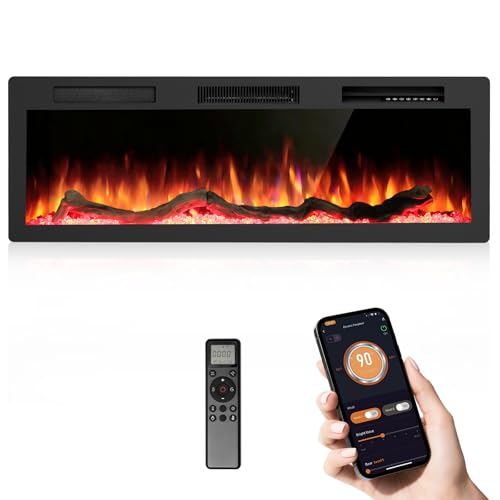
Mounts to the wall or recesses into a built-in opening, and the flame display offers 12 colors and five speeds for 144 combinations. Two heating modes, 750W and 1500W, let you match output to the room, and six sound effects—crackling firewood, ocean waves, rainfall—add atmosphere. Control it with the remote, touch panel, smartphone app, or Alexa voice commands.
An oil-filled radiator heats more slowly than a ceramic fan model, but it keeps radiating warmth for twenty minutes or more after the element switches off because the mineral oil and steel shell hold the heat. That makes it the better pick for a bedroom where you’ll run it all night, or a home office where you need steady background warmth without the fan noise. Ceramic and fan heaters push heated air faster and reach your set temperature in five to ten minutes, which matters if you only heat a room for an hour or two at a time.
Pick oil-filled for quiet bedrooms and long runtimes; pick ceramic for quick heat in occupied rooms. The choice turns on how long you’ll stay in the space and whether you need silence. An oil-filled unit won’t dry out the air and won’t blow dust, so it suits people with allergies. A ceramic heater with oscillation warms the whole room faster, so it suits a living room or den where you want comfort within minutes of sitting down.
Myth
Higher wattage always means better heat
Fact
A 1,500 W ceramic heater and a 1,500 W oil-filled radiator deliver the same total heat—about 5,120 BTU per hour—but the ceramic model moves it into the room faster with a fan, while the oil-filled unit radiates it more slowly and quietly.
Worked example
Say your bedroom is 10 by 12 feet with standard eight-foot ceilings and decent insulation. That’s 120 square feet. A 1,500 W portable heater will bring the room from 55°F to 68°F in about thirty minutes if it’s oil-filled, or fifteen to twenty minutes if it’s ceramic with a fan. Once it’s warm, either one cycles on and off to hold temperature.
Room10 × 12 ft, 120 sq ft
Heater1,500 W
Time to warm15–30 min
Drafty rooms
A room with single-pane windows, an exterior door that leaks air, or no insulation will need more output or more time to stay comfortable. Seal the obvious gaps first, then size the heater.
How The Top Brands Split By Room Size
The best space heater brands separate by mounting style and the square footage they cover. Wall-mounted models save floor space and suit finished rooms where you won’t move the heater; portable units suit renters, room swapping, and anywhere you need heat one week and not the next. Most plug-in electric heaters top out at 1,500 W because that’s the safe limit for a standard 15 A household circuit, so the difference comes down to oscillation, timers, thermostats, and the safety shutoffs built in.
The DREO Space Heaters for Indoor Use with Thermostat is the best overall pick for most rooms: it delivers 1,500 W, oscillates 70 degrees to spread the heat, includes ECO mode to cut runtime when the room holds temperature, and carries an ETL safety listing with tip-over and overheat protection. The 12-hour timer and digital thermostat let you set it and leave it running while you’re home and awake. It suits bedrooms, living rooms, and home offices from about 100 to 200 square feet.
For large rooms, the DREO 25 Inch Electric Space Heater for Indoor Use covers 100 to 270 square feet with the same 1,500 W output, 70-degree oscillation, and very quiet operation—under 45 dB, quieter than a refrigerator. The larger footprint and taller profile move more air without raising the wattage. It’s the pick for a family room, a finished basement, or an open-plan kitchen where you need even heat across twenty feet.
The R.W.FLAME Smart Electric Fireplace 50 Inch is the smart wall-mount pick for anyone who wants a fireplace look plus supplemental heat. It mounts recessed or hangs on the wall, heats up to 400 square feet, and includes app and voice control. A wall heater suits rooms where floor space is tight—a narrow hallway bathroom, a corner bedroom, a finished attic—and it stays out of the path of kids, pets, and the vacuum. A portable heater suits renters who can’t install anything permanent, or anyone who moves the heat from the bedroom at night to the office during the day.
Model
Best for
Coverage
Mount
DREO with Thermostat
Most rooms
100–200 sq ft
Portable
DREO 25 Inch
Large rooms
100–270 sq ft
Portable
R.W.FLAME 50 Inch
Wall mount, fireplace look
Up to 400 sq ft
Wall
Pick by room size and whether you need a portable or wall-mounted unit.
Running Cost Starts With Watts
Wattage determines how much a heater costs to run, and the number shows up fast on your bill. Most plug-in space heaters pull 1,500 W at full power because that’s what a standard 120 V outlet can supply without tripping a 15 A breaker. Run one for 8 hours and you’ll burn 12 kWh; at 17 cents per kWh that’s about $2.04 a night, or roughly $61 a month if you use it every evening.
Heater
Watts
Per hour
Per day (8 h)
Per month (30 days)
1,500 W space heater
1,500 W
26¢
$2.04
$61.20
300 W personal heater
300 W
5.1¢
41¢
$12.24
Calculated at 17¢ per kWh. Eight hours a night at seventeen cents per kWh, typical for a bedroom or office through winter.
A 300 W heater uses far less power—about $12 a month at the same rate—but it usually can’t heat a normal room when it’s cold outside. Models in that range work for spot warmth at a desk or beside a chair, not for raising the air temperature in a 150-square-foot bedroom. You’ll save on the electric bill, but you won’t be warm.
ECO modes and thermostats cut costs by cycling the element instead of running at full power all night. DREO Space Heaters for Indoor Use with Thermostat and the DREO Smart Wall Heater both include thermostats that switch off once the room reaches your target, then fire back up when the temperature drops. Over eight hours that can cut runtime in half, depending on insulation and how cold it is outside.
Undersized costs more
A heater that’s too small for the room can cost more in practice because it runs longer trying to catch up and still leaves the space cold. Better to size it right and let the thermostat do the work.
Worked example
Say your bedroom is 12 by 14 feet with standard 8-foot ceilings—that’s 168 square feet. A 1,500 W heater will bring it up to temperature in fifteen to twenty minutes if the room isn’t freezing to start. Set the thermostat to 68°F and the heater cycles on for maybe four hours out of eight overnight, burning 6 kWh instead of twelve. At seventeen cents per kWh that drops the nightly cost to about $1.02, or around $30 a month.
Room12 × 14 ft, 168 sq ft
Heater1,500 W with thermostat
Runtime4 hours actual per 8-hour night
CostAbout $1.02 per night, $30/month
Safety Beats Feature Lists
Portable electric heaters cause more than 1,000 house fires every winter in the US, almost always because someone skipped the basic rules. Plug straight into a wall outlet, keep three feet of clearance on all sides, and never use an extension cord or power strip. Extension cords and power strips aren’t rated for the sustained 12.5 A draw a 1,500 W heater pulls, and the connection point heats up over hours until insulation melts or a contact arcs.
Tip-over shutoff, overheat protection, and a safety listing—UL, ETL or CSA—matter more than app control or a decorative flame effect. Tip-over switches cut power the moment the heater tilts past about thirty degrees; overheat sensors shut it down if the internal temperature climbs above the safe threshold, usually because something blocked the intake or the fan failed. Every heater in the product list above carries at least one of those marks and both shutoff features.
Common fire mistakes
Blocked intake vents, soft bedding within two feet of the outlet, and daisy-chained power strips. Check the intake grille every few days if you have pets; dog hair clogs a fan heater faster than you’d think and forces the element to overheat.
High-speed fan heaters move warm air quickly, but the outlet needs clear space or nearby curtains become a problem. Models like the DREO 25 Inch Electric Space Heater for Indoor Use push air across the room with a blower, and that air is hot—often above 150°F at the grille. Fabric, paper, or anything flammable closer than three feet can ignite if the airflow holds it against the outlet long enough.
Don’t sleep or leave the house with a portable heater running unless the manufacturer specifically says the model is designed for unattended use. Most aren’t. Oil-filled radiators with a tip-over switch and a thermostat come closer to safe overnight operation because they have no fan to fail and the surface temperature stays below 180°F, but you still need working smoke alarms and the three-foot rule in place.
Before you plug it in
Wall outlet only, no extension cord or power strip
Three feet of clearance on every side
Tip-over and overheat shutoff both present
UL, ETL or CSA mark on the label
Intake grille clear of dust, pet hair, and carpet fringe
Smoke alarm working in the same room
Quiet Controls Matter At Night
Remote control, thermostat, and timer are useful only if you’ll actually use them at bedtime or on a work desk. Most portable electric heaters let you set a temperature and a shutoff time so you don’t wake up sweating at 3 a.m., but the remote matters most when the heater sits across the room and you’d rather not get up. Smart app or voice control is convenience, not heating performance, so it should not outrank safety or room size when you’re choosing between models.
Noise matters more in bedrooms than in garages. Ceramic fan heaters typically run at 45 to 50 dB, about the volume of a quiet conversation, while oil-filled radiators stay silent because they have no fan. If you’re using a heater next to a work desk or in a bedroom, check the listed noise level and favor models with ECO mode, which cycles the fan on and off to hold temperature instead of running full blast all night.
Bedroom at Night
You set a ceramic fan heater to 68°F with a six-hour timer before bed. It runs for twenty minutes, clicks off, then cycles back on for five minutes every hour to hold temperature. Total draw is about 3 kWh instead of 9 kWh if it ran continuously, and the bedroom stays comfortable without the constant hum.
Heater1,500 W ceramic fan
Timer6 hours
Runtime~3 kWh
Wall mount with app control
DREO Smart Wall Heater, 1500W Space Heater for Bedroom, White, Standa…
DREO Smart Wall Heater mounts out of the way and offers app control, 120° oscillation, and a thermostat that holds temperature quietly overnight.
Confirm the real room size, the outlet location, and whether the heater needs wall mounting or floor space before you buy. Measure the square footage and check that a floor model won’t block a doorway or sit where someone will trip over the cord. Wall-mounted heaters save floor space but need a stud or toggle anchor rated for the weight, and the outlet has to be within cord reach unless you’re hiring an electrician to add a new one.
Before You Buy
Room square footage and ceiling height
ETL, UL, or CSA safety listing on the label
Tip-over shutoff and overheat protection
Thermostat range that covers your target temperature
Timer long enough for overnight or all-day use
Cord length that reaches the outlet without an extension cord
Clearance: 3 feet in front, sides, and above the heater
Electric heaters plug straight into a wall outlet, never an extension cord or power strip, because 1,500 W pulls 12.5 A and most extension cords overheat at that load. Check that the outlet is on its own 15 A circuit or shares the circuit with only low-draw devices like a lamp or a clock radio.
Fuel-burning heaters
If you’re moving to propane, kerosene, or natural gas instead of electric, buy only indoor-rated models with an oxygen depletion sensor for propane, burn 1-K kerosene only, and install a working CO alarm. Vent-free gas heaters are banned or restricted in some states and cities, so check local code before ordering.
Buy once by matching the heater to the room it will actually heat, not the largest room in the house. A 1,500 W portable electric heater covers about 150 square feet with standard insulation and an 8-foot ceiling, and no plug-in model heats more than that because the circuit won’t allow it. Bigger rooms need a 240 V baseboard, a ductless mini-split, or a second heater on a different circuit.
Frequently Asked Questions
What is the best room heater brand?
DREO, De’Longhi, and Lasko consistently deliver reliable heaters with proper safety certifications and realistic heating claims. DREO’s indoor models pair thermostat control with wide oscillation for even warmth, De’Longhi’s oil-filled radiators hold heat longest after cycling off, and Lasko’s tower fans fit tight spaces. Pick the brand whose format matches your room and outlet placement.
What features should I look for in a room heater?
Tip-over shutoff and overheat protection are non-negotiable; look for a UL, ETL or CSA mark on the label. A thermostat saves more money than any efficiency claim because it cycles the element instead of running full-bore. Remote control and a timer matter only if you’ll adjust settings from across the room or want the heater to shut off while you sleep.
Are oil-filled heaters better than ceramic heaters?
Oil-filled radiators stay warm twenty to thirty minutes after the thermostat clicks off, so they feel steadier and run the element less often once the room reaches temperature. Ceramic fan heaters warm the air faster but stop heating the moment they cycle off. Choose oil-filled for overnight comfort in a bedroom, ceramic for quick bursts in a bathroom or home office.
How energy-efficient are modern room heaters?
All plug-in electric heaters convert watts to heat at roughly the same efficiency—close to 100 percent—so a 1,500 W ceramic model costs the same to run as a 1,500 W oil-filled radiator. The thermostat and the insulation of your room determine the bill, not the heater’s technology. Fuel-burning models measure efficiency differently: a 99-percent-efficient propane heater wastes only one BTU per hundred as exhaust heat.
Can I use a room heater overnight?
Only if the manual explicitly permits unattended operation and the heater carries tip-over and overheat protection with a thermostat that cycles automatically. Plug straight into a wall outlet, keep three feet of clearance on all sides, and never drape anything over the unit. Oil-filled radiators with no exposed element and fuel heaters with an oxygen depletion sensor are the safer overnight choices, but local fire codes and manufacturer guidance take precedence.