For most Florida pools, the best pool heater is a heat pump because it stretches the swim season without the eye-watering electric bill of straight resistance heat. If your pool gets strong sun and you want the lowest running cost, solar can make sense, but a heat pump is the safer default for most buyers.
Key takeaways
Choose a heat pump if you want the most dependable Florida option across spring, summer and shoulder months.
Choose solar only if the pool has strong sun exposure for most of the day.
Use a pool cover if you want to cut nighttime heat loss, especially on breezy lots.
Have a licensed electrician handle any 220/240 V heater installation.
Do the running-cost math before you buy; a low purchase price can still mean expensive water.
The common mistake is buying for headline BTU alone and ignoring sun, wind and nightly heat loss. That usually leaves you with a heater that runs longer than you expected and costs more to use.
Florida changes the math. Warm air helps heat pumps, sunlight helps solar, and a pool cover often saves more money than a bigger unit. The right choice depends on shade, pool size and how warm you want the water after sunset.
Best Pool Heaters for Florida
#1Best Overall
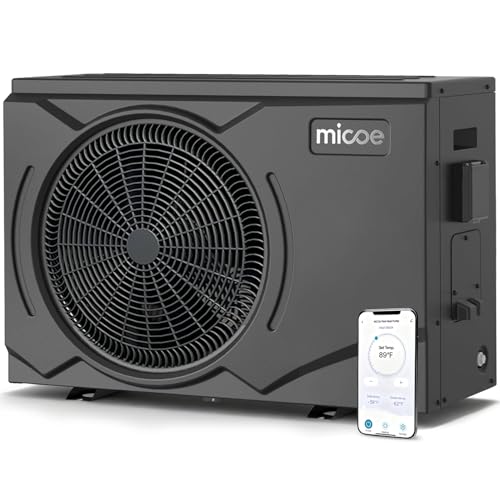
MICOE 75,000 BTU Pool Heat Pump
Best for Inground or above-ground pools up to 21,000 gallons
Product 5 is the strongest fit for most Florida pool owners because its air-source heat pump moves heat from outdoor air instead of generating it directly. The 75,000 BTU output, titanium heat exchanger, app control and auto-defrost suit larger pools that need steadier heating across spring, summer and fall. It also operates outdoors from 32°F to 109°F.
Heat output 75,000 BTUPool capacity Up to 21,000 gallonsHeating range 46°F–104°FOperating outdoor temperature 32°F to 109°FNoise level Approximately 53 dB
Why it made the cut
Fits pools up to 21,000 gallons
App and onboard digital controls
Titanium heat exchanger and auto-defrost
Heating and cooling modes
Good to know
Runs at approximately 53 dB
A pool insulation cover is recommended for cooler seasons
Skip it if Skip it if your pool is small and you want a simpler, compact heater.
Product 3 is a practical compact heat-pump choice for the above-ground pool size listed in its product data. Its 5.5 COP, 38 dB operation, auto-defrost and included 1.25-inch hose adapters and 1.5-inch conversion kits keep the setup focused and relatively quiet. Heating from 41°F to 104°F and cooling from 41°F to 83°F adds flexibility for changing conditions.
Pool size 12′ × 14′ × 48″Heating range 41–104°FCooling range 41–83°FEfficiency 5.5 COPNoise level 38 dB
Why it made the cut
5.5 COP
38 dB operating sound
Auto-defrost system
Includes hose adapters and conversion kits
Good to know
Designed for above-ground pools
The listed pool size is specific rather than broadly stated
Skip it if Skip it if you have an inground pool or need capacity for more than the listed pool size.
Best for Pools up to about 1,000 gallons with an electrician available
Product 4 is a direct electric-heating option for smaller pools, with 11KW output and a thermostat that cycles the heater around the preset temperature. The digital touch display makes control straightforward, while the 304 stainless steel heating tube is designed to resist corrosion and UV damage. It requires electrician installation and includes no cables, plug or circulation pump.
Heat output 11KWVoltage 220V/240VPool capacity Up to about 1,000 gallonsHeating tube 304 stainless steelControls Digital touch display and thermostat
Why it made the cut
11KW heating output
Digital touch display
Automatic thermostat cycling
304 stainless steel heating tube
Good to know
Requires electrician installation
No cables, plug or circulation pump included
Limited to about 1,000 gallons
Skip it if Skip it if you want a heat pump’s air-source efficiency or your pool is larger than about 1,000 gallons.
Best for Small 10- to 50-gallon containers and inflatable pools
Product 2 is a portable immersion heater for very small water volumes, not a substitute for a Florida pool heat pump. Its real-time thermostat, 2,000W element, GFCI protection and full-submersion design fit small inflatable pools, tubs and containers where portability matters. The 118-inch cord gives you reach, but the unit still needs careful placement and proper electrical safety.
Heat output 2,000WWater capacity 10 to 50 gallonsCord length 118 inchesElement material Food-grade 304 stainless steelSafety feature Built-in GFCI
Why it made the cut
Portable 2,000W heating
Real-time thermostat
Built-in GFCI protection
304 stainless steel element
Good to know
Designed for 10 to 50 gallons
Not sized for a standard swimming pool
Requires full submersion
Skip it if Skip it for any full-size pool; the stated 10- to 50-gallon capacity is the deciding limit.
Best for Indoor rooms up to 200 square feet, not pool water
Product 1 is an indoor ceramic space heater, so it doesn’t belong in a pool-heater installation. Its 1,500W output, thermostat, remote and 45° tip-over shutoff are useful for warming a room, but the product data gives no pool-water capacity or pool-heating design. Keep it in the room where it belongs.
Heat output 1,500WRoom coverage Up to 200 sq. ft.Noise level 35 dBTimer 24 hoursSafety feature 45° tip-over shutoff
Why it made the cut
1,500W ceramic heat
Thermostat and remote control
45° tip-over shutoff
ETL-certified
Good to know
Indoor room heater, not a pool heater
No pool capacity or water-heating specification
Coverage is stated for up to 200 square feet
Skip it if Skip it for pool heating; choose a heater designed to circulate and heat pool water.
The best pool heater for Florida is usually a heat pump sized to your pool, because Florida buyers need efficient shoulder-season heating more than maximum July output. Solar fits a sunny pool with flexible swim times, while electric resistance fits smaller pools or occasional use where installation simplicity matters more than operating cost.
Spec
What to check
Why it matters in Florida
Pool capacity
Gallons covered by the heater
A claim for 21,000 gallons means more than vague language such as “large pool.”
Heat source
Heat pump, solar or resistance
Heat pumps suit regular use; solar needs sun and patience; resistance heats quickly but uses more electricity.
Air-temperature range
Minimum and maximum operating temperature
Shoulder-season limits matter more than performance in July.
Noise
Sound rating and installation location
A loud pad near a lanai, patio or bedroom window gets old quickly.
Electrical service
Voltage, amperage and dedicated installation requirements
A 220/240 V heater needs the right circuit and proper installation.
Read the operating conditions, not only the headline BTU number.
For what type of pool heater is best for Florida, start with a heat pump if you want a predictable swimming season and moderate running cost. Solar can be the lowest-cost choice after installation when the pool has strong sun, enough roof or ground area and a cover; cloudy spells and cool nights slow it down. Electric resistance heat works when you need fast, dependable heat for a smaller pool, but its power draw deserves close attention.
Capacity beats brand language
Pool size in gallons is the first filter, not the last word. A heater rated for your pool may still struggle with an uncovered pool, cold nights or a large exposed surface. Ask for the stated pool volume, output, operating temperature range and required electrical service.
For what size pool heater do I need for Florida, match the heater’s published gallon capacity to your pool, then favor extra capacity if you want warmer water during spring and fall or won’t use a cover. A 21,000-gallon rating, for example, gives the MICOE 75,000 BTU heat pump a clear use case; it doesn’t promise the same heating speed in every weather condition.
Check the pad before you buy
A 120 V plug-in appliance is not a practical pool heater. The 11KW direct-electric Product 4 calls for 220 V, and 220/240 V pool equipment needs the correct circuit, disconnect and installation. Have an electrician confirm the service before the heater arrives.
From HeaterGuides · our own guidePage 6 is the decision guide: heat pump, furnace, boiler or hybrid, with your own numbers.Heating System Upgrade PlannerChoose between a heat pump, a furnace, a boiler or a hybrid with your own numbers, and hire the right installer.Every system compared side by side25 questions for contractors, red flagsRunning-cost, payback and quote calculator (Excel)$14.99$9.99Get it for $9.99See what's inside and watch the 2-minute video →16-page printable PDF + Excel calculator · instant download · 30-day refund
Best Heat Pump Choices For Most Florida Pools
The best heat pump pool heater for Florida is the MICOE 75,000 BTU Pool Heat Pump for buyers who want steady water temperature, broad shoulder-season use and less operating cost than direct electric heat.
Best overall: MICOE 75,000 BTU Pool Heat
Rated for pools up to 21,000 gallons
Heating and cooling functions suit Florida’s long warm season
App control, auto-defrost and outdoor operation from 32°F to 109°F
Skip it if
Its larger capacity may be more heater than a small above-ground pool needs
It still needs suitable electrical service and outdoor space
The MICOE is the practical main pick because its inverter heat-pump design can maintain water temperature without relying on direct resistance heat every time the pool loses warmth. Heating and cooling are useful in Florida, while auto-defrost helps the unit operate during cooler shoulder-season conditions. The 32°F to 109°F outdoor range is a specification to compare against your actual winter nights, not a promise that heating speed stays constant across that range.
Useful for steady temperature
MICOE 75,000 BTU Pool Heat Pump
Choose the MICOE when your pool is near its 21,000-gallon limit or you want app control, cooling and wider-season operation in one outdoor unit.
The runner-up is the Swimming Pool Heater for Above Ground and Inground Pool 12’… for buyers who want a quieter, lower-capacity heat pump and specifically need stated compatibility with an above-ground pool. Its listed 5.5 COP means it can deliver about 5.5 units of heat for each unit of electricity under its rated test conditions; actual results change with water temperature, air temperature and installation.
Runner-up: Above-Ground and Inground Poo
Quieter operation suits a pool near living space
5.5 COP supports efficient heat-pump operation under rated conditions
Stated compatibility covers above-ground pools as well as inground pools
Choose another unit if
Lower capacity makes it a weaker fit for larger pools or faster recovery
The product data gives less operating detail than the MICOE
In short
Pick the MICOE for a larger pool and broader control; pick Product 3 for a quieter, lower-capacity setup, especially above ground. Either choice works better when a cover limits evaporation, because a heat pump replaces lost heat but doesn’t stop water from leaving the pool.
Solar Pool Heating In Sunny Florida
Solar pool heaters are effective in Florida when the pool gets long, unobstructed sun and the panels have a good roof or ground location; the best solar pool heater for Florida is a properly sized panel system, not a small electric heater labeled for pool use.
Solar heat is usually the cheapest pool heat to run because sunlight supplies the energy after installation. The tradeoff is recovery time: clouds, shade, wind and short winter days reduce output quickly, so solar may struggle after a cold front or a long, windy night.
A Sunny Florida Setup
Say a pool has a south- or southwest-facing roof area with little shade from trees or screen enclosures. Solar panels can add useful heat during sunny hours, but the pool may still lose temperature overnight and need time to recover after several cloudy days.
Best siteLong, unobstructed sun
Main weaknessClouds, shade and wind
Best fitOwners who can accept slower recovery
Read The Product Type
The Swimming Pool Heater for Above Ground and Inground Pool 12’… and the MICOE 75,000 BTU Pool Heat Pump are heat pumps, not solar heaters. They use electricity to move heat into the water and are better choices when you need predictable heating after cloudy weather.
If your roof is shaded or the pool sits under trees for part of the day, compare a solar panel system with a heat pump before buying. solar pool heater panels can make sense for a sunny site, while a heat pump gives you more control when the forecast turns gray.
Protect The Heat
Run solar circulation during the sunniest part of the day and use a pool cover whenever the pool isn’t in use. Evaporation can erase much of the heat that the panels worked to add.
Florida Running Cost And Sizing Math
Florida pool-heater cost depends on the heater’s power, run time, electricity rate and heat loss; sizing also depends on the temperature rise you want, wind, shade and how often the cover stays on, not pool volume alone.
For a direct-electric heater, multiply watts ÷ 1,000 by operating hours and your electricity rate. Product 4, the Pool Heater 11KW 220V Upgrade, uses 11 kW, so six hours is 11 × 6 = 66 kWh; at 17 cents per kWh, that heating run costs about $11.22.
Heater
Watts
Per hour
Per day (6 h)
Per month (1 days)
Pool Heater 11KW 220V Upgrade
11,000 W
$1.87
$11.22
$11.22
Calculated at 17¢ per kWh. Assumes six hours at $0.17 per kWh; actual runtime depends on water loss, weather and the cover.
A Monthly Estimate
Say a heater runs six hours on 12 days in a month. The 11 kW unit uses 11 × 6 × 12 = 792 kWh, before cycling, thermostat control and heat retained by a cover. Multiply that energy by your utility’s actual rate rather than borrowing a neighbor’s number.
Heat-pump cost works differently because the compressor draws electricity while the unit moves available heat into the water. Its COP affects how much heat you get for each unit of electricity, so a heat pump will usually cost much less than straight resistance heat for maintaining the same water temperature.
11 kW
Product 4’s stated heater power
At six hours, that rating becomes 66 kWh before the thermostat cycles the heater off.
A pool cover can cut runtime enough to change the bill materially, and it is often the cheapest way to improve any heater’s economics. For sizing, start with pool volume, then account for the desired temperature rise, exposed surface, wind, shade, local weather and the hours the cover is actually used.
In short
Choose output for the heat loss your pool experiences, not just its gallons. Compare the heater’s electrical draw with its expected runtime, then reduce that runtime with a cover before deciding the unit is too small.
Installation And Safety For Pool Heaters
You generally can’t install a pool heater yourself, and 220/240 V models aren’t plug-in appliances. Do pool heaters need an electrician? Usually, yes: a licensed electrician must size the circuit, install the disconnect and wiring, and handle bonding, grounding and permits required by local Florida code.
A high-powered resistance heater can draw enough current to make installation a serious electrical job, while its running cost can climb quickly. An 11,000 W heater uses 11 kWh every hour it runs; at 17 cents per kWh, that is about $1.87 per hour before heat loss. The weekend project belongs in the garage, not beside the pool panel.
Pool Heater Safety In Florida
Leak-proof connections and overheat protection are useful safeguards, but they don’t replace code-compliant wiring, bonding, grounding or clearances. Keep electrical equipment away from splash zones, and have a qualified professional inspect any damaged cable, conduit or connection.
Before Installation Day
Read the heater manual for circuit, disconnect, bonding and clearance requirements.
Confirm whether your city or county requires an electrical or building permit.
Leave the service panel and heater access clear for testing and repairs.
Use the manual’s outdoor mounting and weather-exposure instructions.
One Easy Miss
Outdoor electric heaters still need room for service access and airflow. Squeezing one behind equipment or under an overhang may make a neat-looking installation that the technician can’t safely work on.
The Part Florida Buyers Leave Out
A pool cover is the first add-on to buy if your water loses warmth after sunset, including with a heat pump. Evaporation is usually the biggest heat thief: wind and dry air pull warm water from the surface, especially on an exposed lot overnight.
The practical answer to how to keep a pool warm in Florida is to cover it as soon as swimming ends, then uncover it before using the pool. A heater replaces lost heat; a cover reduces the loss, so upsizing the heater may accomplish less than stopping the nightly escape.
Cover It After Use
Cover the pool right after swimming on cooler or breezy evenings. Check that the cover fits the pool and follow its use instructions; a basic cover isn’t automatically a safety cover.
Myth
A heat pump makes a pool cover unnecessary.
Fact
A heat pump still works harder when evaporation keeps removing heat. Patios, screen enclosures and nearby trees change the result by blocking wind or casting shade, so two similar pools can need different run times on the same night.
Frequently Asked Questions
What is the best type of pool heater for Florida?
A heat pump is the best default for most Florida pools because it uses outdoor heat efficiently and maintains temperature steadily. Solar can cost less to run when you have strong, unobstructed sun, while gas suits buyers who want faster heating and accept higher fuel and installation costs.
Are solar pool heaters effective in Florida?
Solar pool heaters work well when the panels receive several hours of unobstructed sun and have enough area for the pool. They add little heat after sunset or during cloudy stretches, so a cover or backup heater may still be useful.
How much does it cost to run a pool heater in Florida?
Your cost depends on the heater’s electrical input or fuel burn rate, daily runtime, local energy price and heat loss from the water. A pool cover can reduce the hours the heater runs, while an uncovered pool loses substantial heat through evaporation overnight.
Can I use a gas heater for my pool in Florida?
Yes, a properly sized gas heater can heat a Florida pool quickly, making it useful for occasional swimming or rapid temperature changes. Gas-line sizing, venting and combustion work should be handled by a qualified professional, and you should compare fuel availability with the heater’s operating requirements before buying.
What size pool heater do I need for a 10,000-gallon pool?
Gallons alone don’t determine heater size because pool surface area, desired temperature rise, wind, shade and cover use all affect heat loss. Give those details to the manufacturer or installer; a 10,000-gallon pool with a large exposed surface may need more capacity than a deeper pool holding the same volume.
Do I need a pool cover with a heat pump?
A cover isn’t mandatory, but it can greatly reduce overnight evaporation and the heat pump’s runtime. Use one when the pool sits unused, especially in windy conditions; the heater then spends less energy replacing heat that escaped from the water’s surface.
Before you go · a welcome giftGet the Heating System Upgrade Planner for $4.99Choose between a heat pump, a furnace, a boiler or a hybrid with your own numbers, and hire the right installer. Normally $14.99; your welcome price saves $10.00. We'll email your link right now.or buy it now for $9.99 without the gift →One email with your link now. We never share your address.


 Heating System Upgrade PlannerChoose between a heat pump, a furnace, a boiler or a hybrid with your own numbers, and hire the right installer.Every system compared side by side25 questions for contractors, red flagsRunning-cost, payback and quote calculator (Excel)